4260 results for "World History"

Soviet politics in the 1980s

Sonnenfeldt, Helmut
The Soviet Union, in the aftermath of the Brezhnev era, may well stand at a crossroads in its history. According to the authors of this volume, the Chernenko administration and the new generation of political leaders now on the threshold of power must steer through a difficult period in the USSR's international relations, especially where the U.S. is concerned, continuing to assert what they regard as the legitimate Soviet role as a world superpower while coping with an inflexible and aging political system, a stagnant economy, and growing social problems. The contributors provide a careful consideration of the choices confronting the USSR as this new era begins and analyze the paths its leaders may take as they grapple with the challenges of the 1980s.
Taylor & Francis Group 2019-09-13 247 pages

New directions in European historiography

Iggers, Georg G.
Impressive analytical essays on the transformation of historical studies in Europe. In four impressively researched essays Georg Iggers recounts the transformation of historical studies in Europe during the twentieth century, with particular emphasis on the historiography of the past fifteen years. Although the book does survey a broad area of contemporary historical thought, it is primarily a careful analytical examination of the methodological and theoretical reorientation of certain influential European historians. The first essay discusses the emergence at German Universities during the eighteenth and nineteenth centuries of the concept of history as a scientific discipline, distinct from the classical tradition of literary history, and the later broad acceptance of this mode of Enquiry in the Western world. Against this background Mr. Iggers then considers the challenge to this mode of the political, social, and intellectual upheavals of the twentieth century, especially after World War II. The three essays following examine important attempts to develop alternate paradigms for historical study: the French historians of the Annales tradition; the German political historians of the 1960s; the various Marxist historians of France, Poland, East Germany, and Great Britain. In despite of the frequent insistence by philosophers and theorists of history that history is not a science in contemporary terms, historians themselves have striven in recent years to strengthen the quantitative aspects of historical study, moving away from traditional patterns of writing and adopting methods and concepts from the systematic social sciences. Mr. Iggers' book is an excellent introduction to these contemporary changes in historiography, and in its comparative analyses itself makes a contribution to historical studies.
Wesleyan University Press 1984-07 267 pages

From tolerance to tyranny: a cautionary tale from fifteenth century Spain

Paris, Erna
Before the Inquisition, Spain was a tolerant and peaceful society. How, precisely, does a culture that prizes autonomy and harmony within the population descend so quickly into one of the most oppressive nations to have ever existed? Focusing on the humanity of the major historical players, Erna Paris traces the obscure origins of what was to become a brutal and enduring campaign of religious and ethnic conformity through terror and segregation. The conclusions she draws from the annals of Spanish history are enduring lessons on basic human nature, as applicable to the modern world as they are to the medieval.
Cormorant Books 2015 316 pages

Full Circle A Memoir

Edith Kurzweil
This is a personal history of the twentieth century as seen through the eyes of Edith Kurzweil, author, teacher, editor of Partisan Review, and a recent recipient of the National Medal of Humanities. The book opens with Kurzweil early adolescence in Vienna during the Nazi takeover. It ends with the author finding herself in the new century. In between, she kept moving on and interrogating the world around her. The reader follows Kurzweil on her perilous journey, at the age of fourteen, to Belgium, through France, Spain, and Portugal, alone with her younger brother. Her fantasies of reunion with her parents in New York kept her going but came to naught: she had not expected to fall from a wealthy childhood into the life of the working-class poor, as a millinery apprentice or a diamond cutter. Instead of entering college life, she eventually became a conventional American housewife. Unhappy and anxious, she anticipated the social changes in America, and returned to Europe with her second husband and her two children. She arrived at the beginning of the Italian miracle--its post-war revitalization. In Milan she met many Americans as an active member of its community and of the British-American club. After personal tragedy she returned to New York, and only then pursued her early intellectual ambitions. The author eventually became a professor of sociology and quickly climbed up the academic ladder. Just as she had been as a little girl, she still "wanted to know everything," beginning with her study of Italian entrepreneurs and going on to European history and French thought, to psychoanalysis and anti-Semitism. Her early writings prompted William Phillips, co-founder and editor of Partisan Review, to invite her into the elite circle of New York intellectuals. She worked alongside him, first as a reader, then as executive editor, and took over the editorship of the legendary journal during its final period. Kurzweil's journey was one of courage, and of emotional and intellectual growth. Full Circle will be of interest to intellectual and cultural historians, literary and Holocaust scholars, and American studies specialists.
Taylor & Francis Group 2017-10-06 310 pages

Mohammedanism

D. S. MARGOLIOUTH
“Mohammedanism†by D.S. Margoliouth offers a detailed exploration of the origins, development, and core tenets of Islam. Examining the life of the Prophet Muhammad and the historical context in which Islam emerged, Margoliouth delves into the religious, political, and social forces that shaped the early Islamic world. This comprehensive study provides insights into the key doctrines of Islam, including the Quran, the Hadith, and the Sharia, as well as the major theological and philosophical debates that have characterized Islamic thought throughout history. A valuable resource for students, scholars, and anyone interested in gaining a deeper understanding of one of the world's major religions, “Mohammedanism†remains a significant contribution to the field of Islamic studies. This work has been selected by scholars as being culturally important, and is part of the knowledge base of civilization as we know it. This work was reproduced from the original artifact, and remains as true to the original work as possible. Therefore, you will see the original copyright references, library stamps (as most of these works have been housed in our most important libraries around the world), and other notations in the work. This work is in the public domain in the United States of America, and possibly other nations. Within the United States, you may freely copy and distribute this work, as no entity (individual or corporate) has a copyright on the body of the work. As a reproduction of a historical artifact, this work may contain missing or blurred pages, poor pictures, errant marks, etc. Scholars believe, and we concur, that this work is important enough to be preserved, reproduced, and made generally available to the public. We appreciate your support of the preservation process, and thank you for being an important part of keeping this knowledge alive and relevant.
Creative Media Partners, LLC 2025-05-22 262 pages

Gay essentials: facts for your queer brain

Bianco, David
TABLE OF CONTENTS: Who was Sappho? How gay was the Renaissance? When were the first sodomy laws passed in America? Were there any gay heroes in the American Revolution? Were "passing" women lesbians? Who was Walt Whitman? Who was Karl Heinrich Ulrichs? How did San Francisco become so gay? Was Susan B. Anthony a lesbian? Who were the "berdaches"? Who was Katharine Lee Bates? What was the Scientific-Humanitarian Committee? What were Oscar Wilde's trials about? What is the history of gay bathhouses? When did American gays, lesbians, and others first start calling themselves "queer"? Who was E.M. Forster? Who were Havelock Ellis and Edith Lees Ellis? How gay was the Harlem Renaissance? Who were Gertrude Stein and Alice B. Toklas? Who was Willa Cather? What was the Leopold and Loeb case? Who was Natalie Barney? What was the first gay rights organization in America? Who was Janet Flanner? What was the "Padlock" Bill? What was The Well of Loneliness? Who was Babe Didrikson Zaharias? Was Eleanor Roosevelt a lesbian? What was The Children's Hour? What happened to gays and lesbians during the Holocaust? Who were some of the lesbians in Hollywood's golden age? What is the origin of the phrase "a friend of Dorothy's"? Who were Ruth Benedict and Margaret Mead? What were the army drag shows during World War II? What were "blue discharges"? When did the American gay and lesbian press begin? How gay were Tennessee Williams's plays? What was the Kinsey Report? What were the lesbian pulp novels of the 1950s? What were physique magazines? Who was Christine Jorgensen? What was the Mattachine Society? How did McCarthyism affect gays and lesbians? Who were the Daughters of Bilitis? Who was Rudi Gernreich? Who was James Baldwin? What was the Boise Sex Scandal? What was Evelyn Hooker's research about? What was the Wolfenden Report? Who was Lorraine Hansberry? What was the Supreme Court's first pro-gay ruling? What have gays and lesbians experienced in revolutionary Cuba? Who was Bayard Rustin? What was NACHO? What is the origin of the annual gay and les
Alyson Books 1999 327 pages

A commentary on Herodotus books I-IV

Asheri, David
Herodotus, one of the earliest and greatest of Western prose authors, set out in the late fifth century BC to describe the world as he knew it - its peoples and their achievements, together with the causes and course of the great wars that brought the Greek cities into conflict with the empires of the Near East. Each subsequent generation of historians has sought to use his text and to measure their knowledge of these cultures against his words. This commentary by leading scholars, originally published in Italian, has been fully revised by the original authors and has now been edited for English-speaking readers by O. Murray and A. Moreno. It is designed for use alongside the Oxford Classical Text of Herodotus, and will replace the century-old historical commentary of How and Wells (1912) as the most authoritative account of modern scholarship on Herodotus. Books I-IV cover the history and cultures of Lydia, Egypt, Persia, and the nomads of Scythia and North Africa, in their contacts with the Greeks from mythical times to the start of the fifth century BC; these themes, with many digressions, are woven into an account of the expansion of the Persian Empire and its relations with the Greeks.
Oxford University Press 2011-10-27 721 pages

The Americanist

Aaron, Daniel
“I have read all of Daniel Aaron’s books, and admired them, but in The Americanist I believe he has composed an intellectual and social memoir for which he will be remembered. His self-portrait is marked by personal tact and admirable restraint: he is and is not its subject. The Americanist is a vision of otherness: literary and academic friends and acquaintances, here and abroad. Eloquently phrased and free of nostalgia, it catches a lost world that yet engendered much of our own.” —Harold Bloom “ The Americanist is the absorbing intellectual autobiography of Daniel Aaron, who is the leading proponent and practitioner of American Studies. Written with grace and wit, it skillfully blends Daniel Aaron’s personal story with the history of the field he has done so much to create. This is a first-rate book by a first-rate scholar.” —David Herbert Donald, Professor Emeritus, Harvard University The Americanist is author and critic Daniel Aaron’s anthem to nearly a century of public and private life in America and abroad. Aaron, who is widely regarded as one of the founders of American Studies, graduated from the University of Michigan, received his Ph.D. from Harvard, and taught for over three decades each at Smith College and Harvard. Aaron writes with unsentimental nostalgia about his childhood in Los Angeles and Chicago and his later academic career, which took him around the globe, often in the role of America’s accidental yet impartial critic. When Walt Whitman, whom Aaron frequently cites as a touchstone, wrote, “I am large, I contain multitudes,” he could have been describing Daniel Aaron—the consummate erudite and Renaissance individual whose allegiance to the truth always outweighs mere partisan loyalty. Not only should Aaron’s book stand as a resplendent and summative work from one of the finest thinkers of the last hundred years, it also succeeds on its own as a first-rate piece of literature, on a par with the writings of any of its subjects. The Americanist is a veritable Who’s Who of twentieth-century writers Aaron interviewed, interacted with, or otherwise encountered throughout his life: Ralph Ellison, Robert Frost, Lillian Hellman, Richard Hofstadter, Alfred Kazin, Sinclair Lewis, Malcolm Muggeridge, John Crowe Ransom, Upton Sinclair, Edmund Wilson, Leonard Woolf, and W. B. Yeats, to name only a few. Aaron’s frank and personal observations of these literary lights make for lively reading. As well, scattered throughout The Americanist are illuminating portraits of American presidents living and passed—miniature masterworks of astute political observation that offer dazzlingly fresh approaches to well-trod subjects.
University of Michigan Press 2007-02-26 199 pages

The Home Life of the Ancient Greeks

Hugo Blümner,Alice Zimmern
Step back in time and explore the fascinating world of ancient Greece through "The Home Life of the Ancient Greeks" by H. Blümner. This detailed study offers a captivating glimpse into the daily routines, social structures, and customs that shaped the lives of people in ancient Greece up to 146 B.C. Delve into the nuances of domestic life, uncovering the traditions and practices that governed households. From social interactions to the intricacies of daily existence, this book provides a comprehensive overview of a bygone era. Discover the unique aspects of ancient Greek culture, meticulously researched and presented. A valuable resource for anyone interested in ancient history, social customs, and the rich tapestry of life in ancient Greece. This work has been selected by scholars as being culturally important, and is part of the knowledge base of civilization as we know it. This work is in the public domain in the United States of America, and possibly other nations. Within the United States, you may freely copy and distribute this work, as no entity (individual or corporate) has a copyright on the body of the work. Scholars believe, and we concur, that this work is important enough to be preserved, reproduced, and made generally available to the public. We appreciate your support of the preservation process, and thank you for being an important part of keeping this knowledge alive and relevant.
Creative Media Partners, LLC 2025-03-29 376 pages

Trial and Error: The Autobiography of Chaim Weizmann

Chaim Weizmann
Chaim Weizmann’s autobiography is a highly personal account of his life in the Zionist movement. Book One, completed in 1941, covers the years 1874-1917 and Book Two covers the years 1918-1948.Weizmann describes the Russian shtetl where he was born in 1874, his schooling in Pinsk and his university studies in Berlin, Geneva and Freiburg (Switzerland) where he received his PhD in chemistry in 1899 before moving to Manchester in 1904. He portrays many leading Zionists such as Theodor Herzl, Achad Ha-am, Max Nordau, Shmarya Levin, Ussishkin, Jabotinsky, Ruppin. He describes the opposition by assimilationist Jews (like Edwin Montagu) to Zionism, and internal debates within the Zionist movement, such as the defeat of Herzl’s Uganda plan — bitterly opposed by Weizmann — at the 6th Zionist Congress (1903) and his frictions with the American Zionists led by Brandeis. Weizmann describes how, during World War I, his work on acetone brought him into contact with British political leaders such as Lloyd George, Arthur Balfour and Winston Churchill and facilitated the Balfour Declaration which, in 1917, paved the way for “the establishment in Palestine of a national home for the Jewish people”.Weizmann recounts his role in the creation of what would become Israel’s leading scientific institutions, the Hebrew University, the Weizmann Institute of Science and the Technion, including his fundraising efforts in Europe and in the United States on their behalf and for other Zionist initiatives. He became the first President of Israel, and died in office in 1952.“... one of the important historical documents of our time.” — Orville Prescott, The New York Times (January 19, 1949)“[Trial and Error] is likely to be read for many years to come as an authoritative exposition of the Zionist movement ... records eye-witness accounts of so many crucial events and reflects so many deep insights that it is certain to become of permanent value to the scholar and a delight to the general reader.” — Salo Baron, The New York Times (January 23, 1949)“There are four angles from which one can approach this book. One can take it as a history of Zionism during the last seventy years... a record of personal endeavour triumphant over obstacles and dissension... a sad commentary upon human achievement, when eventual triumph comes at a date, and in circumstances, which rob it of its full savour... the self-portrait of a most remarkable man.” — Harold Nicolson, The Observer (March 27, 1949)“Notable in this intellectually candid record is the fact that [Weizmann] embraced and propagated Jewish nationalism because he regarded it as a positive good, not merely a negative escape from gentile persecution. This intensely human book, which in a sense is the story of modern Zionism, constitutes one of the indispensable sources for the history of our times.” — Robert Gale Woolbert, Foreign Affairs (July 1949)“[Weizmann’s] autobiography ... is an astonishingly objective and life-like narrative, without a trace of dramatization, exaggeration, vanity, self-pity, self-justification; it conveys his authentic, richly and evenly developed, autonomous, proud, firmly built, somewhat ironical nature, free from inner conflict, in deep, instinctive harmony with the forces of nature and society, and therefore possessed of natural wisdom, dignity and authority.” — Sir Isaiah Berlin, Chichele Professor of Social and Political Theory, Oxford University (November 19, 1957)“Ranks between Churchill’s war memoirs and those of Nehru, Masaryk and Trotzky, among the founders’ own stories ...
Schocken Books 1966-01-01

Was there an alternative? 1923-1927: Trotskyism: a look back through the years

Rogovin, V. Z.
"This book was published by Vadim Rogovin in Moscow in the fall of 1992, slightly less than one year after the Soviet Union had been dissolved. It is the first volume of what would become a seven-volume study of the struggle of the Left Opposition, both inside the Soviet Union and abroad, as it fought the Stalinist degeneration of the workers' state established after the October Revolution in 1917. This first volume raises the question: "Was There an Alternative to Stalinism?" It studies the rise of the Left Opposition led by Leon Trotsky in 1923, and ends with the expulsion of Trotsky and his supporters at the Fifteenth Party Congress in 1927. The succeeding volumes examine the history of the resistance to Stalinism up through Trotsky's assassination in August 1940 and the outbreak of World War II"--
Mehring Books 2021 558 pages

Pets

Robinson, Tony
In Sir Tony Robinson's Weird World of Wonders: Pets , Sir Tony Robinson takes you on a headlong gallop through time, pointing out all the most important, funny, strange, amazing, entertaining and smelly bits about pets. It's history, but not as we know it! Find out everything you ever needed to know about pets through time in this brilliant illustrated, action-packed, fact-filled book, including: - The fact that Egyptians worshipped cats and shaved off their eyebrows to mourn them when they died - The brilliant and extremely useful jobs that animals did and still do for us in times of war - A whole array of bizarre animals through time, including medieval squirrels! - Pet fashions and fashionable pets And lots of other facts about the amazing pets that we spend our lives with. What are you waiting for? Let's get going . . . For more funny history facts discover the whole series!
Macmillan Children's Books 2018-06-14 160 pages

The pleasure of thinking: a journey through the sideways leaps of ideas

Dalrymple, Theodore
In The Pleasure of Thinking, Theodore Dalrymple embarks on an entertaining intellectual journey. With his characteristic wit, Dalrymple navigates the quirky realms of literature, biography, philosophy, science, and history, highlighting the satisfaction that comes with reflecting on life's questions. This book is for anyone who delights in the intricacies of the human mind and seeks to understand the world in all its quirky complexity. Often through personal anecdotes from his time as a prison doctor and psychiatrist, his essays illuminate the myriad corners of the human mind seen through his inimitable, thought-provoking observations and celebrate thought and the paradox of reflection. About the author: Theodore Dalrymple spent the first part of his career as doctor in deprived parts of Africa and South America. When he returned to England he joined the Prison Service as a GP and psychiatrist in London's East End and later inner-city Birmingham. He is a regular contributor to, among others, the Daily Mail, Telegraph, Spectator, the Australian, the Critic, and he has a column in The Oldie and City Journal.
Gibson Square 2013 224 pages

How sweet it is!

Rosenbaum, Thane
Set in Miami Beach in 1972, this novel follows the Posner family--two Holocaust survivors, Sophie and Jacob, and their son, Adam--doing everything they can to avoid one another in a city with an infinite supply of colorful diversions. In '72 Miami hosted both the Republican and Democratic political conventions and experienced the rise of the counterculture, the Cold War, and the desegregation of the old South. Miami Beach was to be the Posner's salvation. Instead they discover their lives quickly turning into a Disney World of funhouse mirrors and chaotic rides that give them front row seats through a transformational year in American culture, politics, and history.
Mandel Vilar Press 2015 194 pages

Radek: a novel

Heym, Stefan
"Through this dramatic history by Stefan Heym, we become intimate with the story of the maverick and internationalist Karl Radek, known as the editor of the newspaper of record throughout the Soviet era, Isvestia. Beginning as Lenin's companion at the dawning of the October Revolution, Radek later became Stalin's favorite intellectual - only to find himself entangled in the great purges of the late 1930s and scripting his own trial. In this, his last historical novel, Heym reveals Radek as a brilliant Bolshevik journalist and politician who found himself at every turn of the wheel of fate. A central figure of the communist world, Radek was such a controversial and perennially ambiguous personality that even his historical biography seems a work of fiction. With his thick glasses and most non-Aryan appearance, marked by what some might have seen as distinctively Jewish argumentative skills and humor, Radek's enormous talent as a writer, political acumen, and continuous curiosity carried him through event after event. In the struggles of the revolutionary movement Radek changed sides several times and came into conflict with Stalin, was exiled to Siberia, capitulated and resumed his editorial duties at Isvestia -- only to get caught up in the purge trials and sentenced to prison, where he died. As Heym sculpts credible conversations with Lenin, Luxemburg, Liebknecht, Trotsky, Stalin, and many others (all seen from Radek's perspective) we come to know Radek as a man haunted by the fear that the insurgency will cease to move forward, living his life as a frenzied chase in pursuit of the continuation of the revolution, until the very end. Originally published in Munich in 1995, this first-ever English translation of Radek fashions the inner voice of a unique figure in the global revolutionary wave of the first half of the twentieth century"--
Monthly Review Press 2022 614 pages

In the days of Simon Stern: a novel

Cohen, Arthur A.
Nathan, a blind Jewish scribe, tells the story of the coming of the Messiah in the person of one Simon Stern—from his birth on the Lower East Side, through his career as a millionaire dealer in real estate, to his building of a refuge for the Jewish remnant of World War II. "A majestic work of fiction that should stand world literature's test of time, to be read and reread. A masterpiece."— Commonweal "This book ensnares one of the most extraordinarily daring ideas to inhabit an American novel in a number of years. For one thing, it is that risky devising, dreamed of only by the Thomas Manns of the world, a serious and vastly conceived fiction bled out of the theological imagination. For another, it is clearly an 'American' novel—altogether American, despite its Jewish particularity: it is not so much about the history of the Jews as it is about the idea of the New World as haven. . . . In its teeming particularity every vein of this book runs with a brilliance of Jewish insight and erudition to be found in no other novelist. Arthur Cohen is the first writer of any American generation to compose a profoundly Jewish fiction on a profoundly Western theme."—Cynthia Ozick, New York Times Book Review "This stately, ambitious amalgam of Jewish myth, history, theology, and speculations on the Jewish soul is like an enormous Judaic archeological ruin—often hard for the uninitiated to interpret, but impressive. . . . Intelligent, inventive, fascinating."— New Yorker
University of Chicago Press 1988 464 pages

The Last Secret of the Deverills

Santa Montefiore
Bestselling author Santa Montefiore’s spellbinding, historical trilogy reaches its sweeping and heartwarming conclusion in The Last Secret of the Deverills. A new generation of love and war at Castle Deverill... Ireland, 1939. Peace flourishes throughout the country, but much has changed for the Deverill family. In Dublin, Martha Wallace searches for her birth mother. Given up for adoption as a baby and raised in America, Martha returns to Ireland to connect with her Irish roots. Instead, she falls in love with the impossibly charming JP Deverill, and together they uncover the truth about her family. At Castle Deverill, the humble daughter of the castle’s former cook is now Countess di Marcantonio and mistress of the Castle. Bridie is determined to make the splendid surroundings her home, but to do so she must turn a blind eye to the failings of her husband and son. Kitty has settled into her life with Robert and their two children, but when Jack O’Leary returns to Ballinakelly with a family of his own, she realizes she never forgot her first love, even though his heart belongs elsewhere. As the Second World War hovers on the horizon, the Deverills uncover a secret that will forever change their lives. The Last Secret of the Deverills is the dramatic conclusion to a stunning saga about a family caught in the sweep of history, and the ties that keep them together.
Simon & Schuster UK 2019-01-01 480 pages

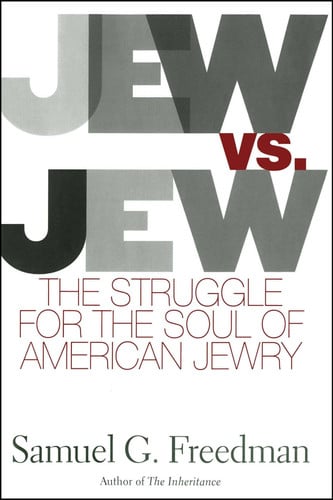
Jew Vs Jew The Struggle For The Soul Of American Jewry

Samuel G. Freedman
At a time when American Jews should feel more secure and cohesive than ever, civil war is tearing apart their community. Congregations, neighborhoods, even families are taking sides in battles about Jewish identity and Jewish authenticity. The conflict pits fundamentalist against secularist, denomination against denomination, even liberal against conservative within each branch of Jewry. Jew vs. Jew tells the story of how American Jewry has increasingly -- and perhaps terminally -- broken apart in the last forty years. Jew vs. Jew stretches in time from 1960 to 2000. It travels the country from Florida to New England, from Los Angeles to the Catskills in New York, from Cleveland to Denver, and it also crosses the ocean to Israel to show how tensions within the Jewish state inflame those among American Jews. The flash-points range from conversion standards to the role of women, from the peace process in Israel to the sexual climate on an Ivy League campus. But behind them all, as Samuel Freedman writes, lie common causes. First, far from unifying American Jews, Israel now divides them on both political and religious grounds. Second, neither America nor the larger world presents Jews with a single enemy against whom to coalesce. Third, and most important, nothing in the Jewish history of persecution, oppression, and exile prepared the Chosen People for the challenge posed by America, the challenge of being absorbed into a tolerant and diverse nation, being accepted so thoroughly that the intermarriage rate tops 50 percent. Jew vs. Jew introduces readers to memorable places and characters. Freedman describes one of the final summers at a Labor Zionist camp in the Catskills whose brand of secular Jewishness is becoming obsolete because Zionism succeeded in creating Israel. He tells the story of Orthodox and Reform Jews in a Cleveland suburb who are fighting about the construction of several synagogues -- and, on a deeper level, about whether unity or pluralism ought to be the goal of Jewish life. He portrays a Florida Jew so violently opposed to the Oslo peace accords that he planted a bomb in a synagogue where Shimon Peres was speaking. He tells about a Los Angeles congregation that spent three years debating whether or not to honor the Biblical matriarchs in its liturgy.We come to know the Long Island neighbors who cannot tolerate sharing even a property line because their versions of Jewish identity are so irreconcilably different. Jew vs. Jew is a work of vigorous reporting, lucid writing, and intellectual curiosity. And even as it chronicles an embittered and polarized community, it refuses to take sides or pass judgment. Instead, with compassion and acuity, Jew vs. Jew bears witness.
Simon & Schuster 2007-09-21 400 pages

Temptations of a superpower

Steel, Ronald
America is the last remaining superpower. Yet what does this triumph mean when the challenges we face often defy military solutions? In Temptations of a Superpower , one of our most eloquent and incisive foreign policy analysts takes a hard look at this question, with all its implications for America's role in the post-Cold War world. Ronald Steel offers a devastating critique of a high-stakes game of foreign policy played by rules that no longer apply, and then proposes a more realistic--and pragmatic--view of the world and our place in it. The Cold War imposed a certain order on the world, giving us a secure sense of our enemies and allies, our interests and our mission. Steel paints a disturbing picture of the world now deprived of its ordering principle, where ethnic conflicts and national rivalries once held in check erupt in violence, where the shifting allegiances and fevered ambitions flout familiar strategies for keeping peace, conducting trade, and protecting human rights. He explores the history of our present predicament and explains the dangers of adapting outmoded but habitual policies to a new world whose shape is fast evolving. What, for instance, is the future of America's military, deeply embedded as it is in our culture and economy? If Wilsonian idealism, with its vision of converting the world to democracy, replaces anti-communism as the guiding principle behind foreign policy, how far should it take us? What distinctions should we make between our nearest neighbors and distant nations? How are we to balance economic needs and ethical imperatives? Analyzing the turmoil sweeping the world from China to Bosnia, Haiti to the Caucasus, Steel depicts the shattering dilemmas facing American policymakers. What concern should the United States have with many world quarrels? How can national interest be reconciled with strategic considerations and morality? When should domestic needs take precedence over foreign policy? The alternatives that Steel proposes to current policies defy much of the conventional wisdom and are certain to provoke controversy. He asks not only what America should do for the world, but what it must do for itself. Reminding us that foreign and domestic policy are inseparable, Steel argues that a renewed foreign policy must address not only changes in the world order, but the pressing, unmet needs within America itself.
Harvard University Press 1995 144 pages