

58,196 results in 0.08 seconds

Hey kids! Comics!
HEY KIDS! COMICS! takes its cue from nearly a century of turbulence and triumph, despair and drama in the comics racket. Artists and writers, conmen and clowns, ganefs and gangsters, create the foundations of today’s biggest entertainment business—or at least the tail that wags the dog. Some of it really happened, and the names have been changed to protect the innocent and guilty... ...although in the end, everyone was guilty of something. Collects Hey Kids! Comics! #1-5

Ralph 124C 41+
2014 Reprint of 1950 Edition. Full facsimile of the original edition, not reproduced with Optical Recognition Software. "Ralph 124C 41+" by Hugo Gernsback is an early science fiction novel, written as a twelve-part serial in "Modern Electrics" magazine beginning in April 1911. It was compiled into novel/book form in 1925. It is considered one of the most influential science fiction stories of all time. The title itself is a play on words, ( 1 2 4 C 4 1 + ) meaning "One to foresee for one another". Some successful predictions from this novel include television (and channel surfing), remote-control power transmission, the video phone, transcontinental air service, solar energy in practical use, sound movies, synthetic milk and foods, artificial cloth, voiceprinting, tape recorders, and spaceflight. It also contains "...the first accurate description of radar, complete with diagram..." according to Arthur C. Clarke in his "non-genre" novel "Glide Path." (1963)

"Coming to writing" and other essays
This collection presents six essays by one of France's most remarkable contemporary authors. A notoriously playful stylist, here Hélène Cixous explores how the problematics of the sexes-viewed as a paradigm for all difference, which is the organizing principle behind identity and meaning-manifest themselves, write themselves, in texts. These superb translations do full justice to Cixous's prose, to its songlike flow and allusive brilliance. --

Stigmata: escaping texts
This collection of essays explores some poetico-philosophical questions that have long been circulating in the Cixousian universe: love's labours lost and found, feminine hours, autobiographies of writing, and animal-human family ties.

Underground to Palestine
This work has been selected by scholars as being culturally important and is part of the knowledge base of civilization as we know it. This work is in the public domain in the United States of America, and possibly other nations. Within the United States, you may freely copy and distribute this work, as no entity (individual or corporate) has a copyright on the body of the work. Scholars believe, and we concur, that this work is important enough to be preserved, reproduced, and made generally available to the public. To ensure a quality reading experience, this work has been proofread and republished using a format that seamlessly blends the original graphical elements with text in an easy-to-read typeface. We appreciate your support of the preservation process, and thank you for being an important part of keeping this knowledge alive and relevant.

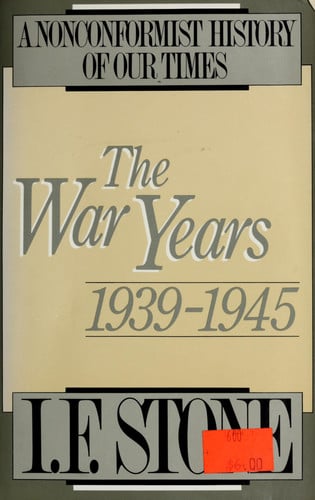
The War Years, 1939-1945
The celebrated radical journalist presents a selection of his World War II columns, celebrating the times' great men and deeds and castigating corruption, prejudice, self-interest, and stupidity
The missionary and the libertine: love and war in East and West
For centuries Westerners have projected fan-tasies of a decadent, voluptuous East in contrast to the puritanism of their own cultures. A Japanese theatrical troupe performing in his native Holland in 1971 exposed the young Ian Buruma to these temptations, and soon he was off to Tokyo, a would-be libertine. The essays collected in The Missionary and the Libertine chronicle Buruma's sobering discovery that Asians often have equally distorted visions of the West. In these humorous and enlightening essays, Buruma describes the last days of Hong Kong, the showbiz politics of the Philippines, the chauvinism of the Seoul Olympics, the sinister genius of Lee Kuan Yew, the intricacies of Japanese sexuality, and much more. His portraits of Benazir Bhutto, Imelda Marcos, Satyajit Ray, and Corazón Aquino are classics of the journalist's art. Buruma shows that the cultural gap between East and West is not as wide as either missionaries or libertines, in East or West, might think. At home in both worlds, he has provided a splendid counterblast to fashionable theories of clashing civilizations and uniquely Asian values. By stripping away our fantasies, Buruma reveals a world that is all too recognizably human.

An anatomy of thought: the origin and machinery of the mind
One of the human brains most remarkable achievements is that it is able to investigate its own working. In An Anatomy of Thought, Ian Glynn takes full advantage of this facility to explain why the nature of consciousness is now much more of a mystery to science than the nature of life. Assuming no specialized knowledge, Glynn demonstrates how it is that nerve cells in our eyes and ears, on our tongues, and on our finger tips (as well as many other places) are able to interact with our nerve cells in our brains to analyse situations, make decisions and remember past events. Drawing deeply on a dazzlingly wide array of disciplines physiology, neurology, psychology, anthropology, linguistics and philosophy he explains the nature of seeing, of language and of thought, in the process often telling us not only what is known but also how we have come to know it, and where, precisely, the gaps remain in our knowledge. In his concluding chapters, Glynn provides an account of recent attempts by philosophers to explain the relationship between mind and body, and explains why we possess free will and ethical responsibilities. In its scope and ambition, and in the extraordinary range of the sciences on which it draws, An Anatomy of Thought is indispensable for anyone seeking a truly comprehensive and state-of-the-art understanding of what is still the most complex object in the known universe.

Right-sizing the state: the politics of moving borders
Strategic decisions to reduce the size, scope, or ambitions of organizations--including states--to enhance future prospects are among the most difficult and least understood conclusions. This volume identifies the conditions in which less really is more, analyzing the possibilities for institutional redesign--including state contraction--for responding effectively to destabilizing and often violence-laden conflicts. Among the countries discussed in detail are Turkey, Pakistan, Morocco, Congo, Jordan, Indonesia, Russia, the former Soviet Union, Iraq, and India.

A hand in the darkness: the autobiography of a refusenik
A Soviet Jew describes her sixteen-year battle to leave the USSR and emigrate to Israel, detailing the frustration, imprisonment, exile, and hardships that she experienced during that struggle

Introduction to Islamic theology and law
Ignaz Goldziher (1850-1921), a Hungarian scholar, was recognized as one of the outstanding European Islamicists of his time. Presented here for the first time in a scholarly and accurate English translation are six lectures he originally had planned to deliver in America in 1906. Although the lectures were never given, they were published in the original German in 1910 and were translated into many European languages. Since then, this classic work has served as an essential guide for serious students and scholars of Islam. Based almost entirely on primary sources, the lectures are devoted to the following aspects of Muslim religion and culture: Mohammed and the Qur'an, the holy law of Islam; the principles of Muslim theology; asceticism and Sufism; Islamic sects; and developments in modern times. In an introduction Bernard Lewis discusses the lectures as a product of their time. Supplementary notes have been provided to correct or clarify the author's remarks in the light of more recent research.

Muslim studies
This is the first volume of Goldziher's Muslim Studies , which ranks highly among the classics of the scholarly literature on Islam. Indeed, the two volumes, originally published in German in 1889-1890, can justly be counted among those that laid the foundations of the modern study of Islam as a religion and a civilization. The first study deals with the reaction of Islam to the ideals of Arab tribal society, to the attitudes of early Islam to the various nationalities and more especially the Persians, and culminates in the chapter on the Shu'ubiya movement which represents the reaction of the newly converted peoples, and again more especially the Persians, to the idea of Arab superiority. The second essay is the famous study on the development of the Hadith, the "Traditions" ascribed to Muhammed, in which the Hadith is shown to reflect the various trends of early Islam: Goldziher's name is mainly associated with the critical study of the Hadith, of which this essay is the chief monument. The third essay is about the cult of saints, which, though contrary to the spirit and letter of the earliest Islam, played such an important part in its subsequent development. These essays, with the author's marvelous richness of information, profound historical sense, and sympathetic insight into the motive forces of religion and civilization, are today as fresh as at the time of their original publication and their reissue is indispensable for the growing number of students of Islam. Hamid Dabashi contributes a major eighty-five-page study of Goldziher's life and scholarship, situating both in the intellectual and political currents of his own time while evaluating his work in the context of the current debate over Orientalism. Ignaz Goldziher (1850-1921) has been described as Europe's most influential student of the Middle East. He was born in Hungary into an Orthodox Jewish family. He was honored by universities and academies in many countries for his contribution to oriental studies and was hailed as a founder of the scholarship of Islam. S.M. Stern was a Fellow of All Souls College, Oxford. Hamid Dabashi is professor of Persian Studies at Columbia University. He is the author of, among other works, the acclaimed Authority in Islam: From the Rise of Muhammad to the Establishment of the Umayyads , issued by Transaction, which won the Association of American Publishers Award for most outstanding professional and scholarly publication in religion and philosophy.

The forgotten Palestinians: a history of the Palestinians in Israel
Examines how Israeli Palestinians have fared under Jewish rule, revealing both Israel's attitude toward minorities and Palestinian's attitudes toward the Jewish state and analyzes the Israeli state's policy towards its Palestinian citizens

Lobbying for Zionism on both sides of the Atlantic
The untold history of how pro-Israel lobbying groups influence US and British policy[Bokinfo]

The FSG Book of Twentieth-Century Latin American Poetry An Anthology
A comprehensive, multi-lingual anthology of 20th-century Latin American Poetry in both Spanish and Portuguese. During a century of extraordinary change, poets became the chroniclers of deep polarizations. From Rubén Darío's quest to renew the Spanish language to César Vallejo's linking of religion and politics, from Jorge Luis Borges's cosmopolitanism to Pablo Neruda's placement of poetry as uncompromising speaker for the downtrodden, and from Alejandra Pizarnik's agonies of the self to Humberto Ak'abal's examination of all things indigenous, it is through verse that the hemisphere's cantankerous collective soul in an age of overhaul might best be understood. A brilliant, moving, and thought-provoking summation of these forking paths, The FSG Book of Twentieth-Century Latin American Poetry invites us to look at an illustrious literary tradition with fresh eyes. Ilan Stavans, one of the foremost scholars of Hispanic culture and a distinguished translator, goes beyond easy geographical and linguistic categorizations. This bilingual anthology features eighty-four authors from sixteen different countries writing in Spanish, Portuguese, Mapuche, Nahuatl, Quechua, Mazatec, Zapotec, Ladino, and Spanglish. The poems are rendered into English in inspired fashion by first-rate translators such as Elizabeth Bishop, Galway Kinnell, W. S. Merwin, Alastair Reid, Mark Strand, and Richard Wilbur. In these pages the reader will experience the power of poetry to account for a hundred years in the life of a restless continent.

Connecticut in the movies: from dream houses to dark suburbia
The book takes the reader on a cinematic road trip through Hollywood history and Connecticut geography. Illeana Douglas, an actor and film historian from Connecticut, defines how the perception of on-screen Connecticut has shifted more than that of any other New England state over the decades and provides some surprising conclusions about just what it means to be a "Connecticut movie." Filled with behind-the-scenes stories as well as her own personal snapshots of the places where these films were made

Modern thermodynamics: from heat engines to dissipative structures
Modern Thermodynamics: From Heat Engines to Dissipative Structures, Second Edition presents a comprehensive introduction to 20th century thermodynamics that can be applied to both equilibrium and non-equilibrium systems, unifying what was traditionally divided into 'thermodynamics' and 'kinetics' into one theory of irreversible processes. This comprehensive text, suitable for introductory as well as advanced courses on thermodynamics, has been widely used by chemists, physicists, engineers and geologists. Fully revised and expanded, this new edition includes the following updates and features: Includes a completely new chapter on Principles of Statistical Thermodynamics. Presents new material on solar and wind energy flows and energy flows of interest to engineering. Covers new material on self-organization in non-equilibrium systems and the thermodynamics of small systems. Highlights a wide range of applications relevant to students across physical sciences and engineering courses. Introduces students to computational methods using updated Mathematica codes. Includes problem sets to help the reader understand and apply the principles introduced throughout the text. Solutions to exercises and supplementary lecture material provided online at http://sites.google.com/site/modernthermodynamics/. Modern Thermodynamics: From Heat Engines to Dissipative Structures, Second Edition is an essential resource for undergraduate and graduate students taking a course in thermodynamics.

From the Exodus to King Akhnaton
This is the first volume of the series Ages in Chaos, in which Immanuel Velikovsky undertakes a reconstruction of the history of antiquity. With utmost precision and the exciting style of a presentation that's typical for him he shows, beyond doubt, what nobody would consider possible: in the conventional history of Egypt - and therefore also of many neighboring cultures - a span of 600 years is described, which has never happened! This assertion is as unbelievable and outrageous as the assertions in Worlds in Collision or Earth in Upheaval. But Velikovsky takes us on a detailed and highly interesting journey through the - corrected - history and makes us a witness to how many question marks disappear, doubts vanish and corresponding facts from the entire Near East furnish a picture of overall conformity and correctness. You will meet an Egyptian eyewitness of the biblical plagues and the mysterious Queen of Sheba. You will find out to where her legendary visit led her. You will, moreover, learn surprising details about the temple of Solomon and learn who was behind its sacking. In the end you do not only wonder how conventional historiography has come into existence, but why it is still taught and published. Just as Velikovsky became the father of "neo-catastrophism" by Worlds in Collision, he became the father of "new chronology" by Ages in Chaos.

Fiasco
Translated into English at last, Fiasco joins its companion volumes Fatelessness and Kaddish for an Unborn Child in telling an epic story of the author's return from the Nazi death camps, only to find his country taken over by another totalitarian government. Fiasco as Imre Kertesz himself has said, "is fiction founded on reality" — a Kafka-like account that is surprisingly funny in its unrelentingly pessimistic clarity, of the Communist takeover of his homeland. Forced into the army and assigned to escort military prisoners, the protagonist decides to feign insanity to be released from duty. But meanwhile, life under the new regime is portrayed almost as an uninterrupted continuation of life in the Nazi concentration camps-which, in turn, is depicted as a continuation of the patriarchal dictatorship of joyless childhood. It is, in short, a searing extension of Kertesz' fundamental theme: the totalitarian experience seen as trauma not only for an individual but for the whole civilization — ours — that made Auschwitz possible.
