5053 results for "Biography"

Herzl: Theodor Herzl and the foundation of the Jewish State

Avineri, Shlomo
Theodor Herzl was born in 1860 in Budapest. He developed a successful career in journalism. As the Paris correspondent for Neue Freie Presse, Herzl followed the Dreyfus Affair, a notorious anti-Semitic incident in France in which a French Jewish army captain was falsely convicted of spying for Germany. Herzl came to reject his early ideas regarding Jewish emancipation and assimilation, and to believe that the Jews must remove themselves from Europe and create their own state. In 1896, he published 'Der Judenstaat' to immediate acclaim, attracting international attention. As a result, he met Kaiser Wilhelm II on several occasions, once in Jerusalem, attempted and failed to obtain support for a Jewish homeland from Pope Pius X, secured an offer from the British government to facilitate a large Jewish settlement in East Africa, and visited St Petersburg to confront the Russian threat to the Zionist movement. Herzl died suddenly in 1904, over 40 years before the creation of a Jewish state in Israel.
Phoenix 2014 274 pages

You're welcome, Cleveland: how I helped Lebron James win a championship and save a city

Raab, Scott
"Scott Raab's big-hearted companion to his darkly comic "sports-jeremiad-slash-memoir" The Whore of Akron follows the first two years of LeBron James's return to Cleveland, where everybody just loves a good story of forgiveness--especially when you fulfill your promise and bring home an NBA Championship, the first major title for a Cleveland team since 1964. "If I had a chance to return to Cleveland, and those fans welcomed me back, that'd be a great story." --LeBron James in 2010, days after "The Decision" In 2010, when LeBron James announced to the world that he was leaving for Miami, he broke the collective heart of his native city and destroyed the hopes of an entire tortured generation. As LeBron headed south, unofficial spokesman Scott Raab sent him off with a middle-finger salute of his own--a deliciously obscene aria of sports fandom, Jewishness, and weight gain that became infamous as The Whore of Akron. Four years--and two NBA championships later--LeBron came home to the Rust Belt faithful who had vilified him mercilessly, none more so than Raab. You're Welcome, Cleveland is the story of both LeBron's and Scott's redemption as they pursue the one thing they crave more than anything in life--an NBA title for the city that made them men. LeBron is back. So is Scott Raab. It's a great story. You're Welcome, Cleveland"--
Harper 2017-02-28 253 pages

In the world of Sumer: an autobiography

Kramer, Samuel Noah
Samuel Noah Kramer is the leading authority on the interpretation and reading of civilization's oldest literature. His life and life's work are so thoroughly intertwined that his autobiography is also the story of the recovery of the language and literature of the Sumerians. From young Talmudist to the patriarch of Sumerology, Kramer recountshis long and distinguished career. Writing for the non-specialist, he paints a panoramic view of Sumerian literature and provides thumbnail sketches of the individuals with whom he collaborated.
Wayne State University Press 1988 253 pages

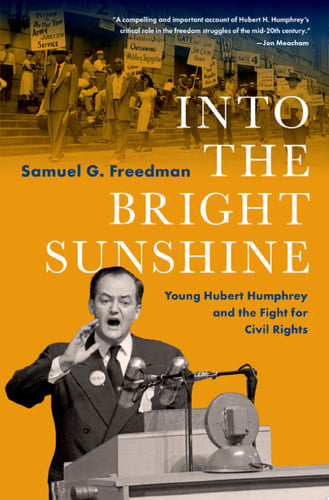
Into the bright sunshine: young Hubert Humphrey and the fight for civil rights

Freedman, Samuel G.
"Hubert Humphrey, a fallen hero and a dying man, rose on rickety legs to approach the podium of the Philadelphia Convention Hall, his pulpit for the commencement address at the University of Pennsylvania. He clutched a sheaf of paper with his speech for the occasion, typed and double-spaced by an assistant from his extemporaneous dictation, and then marked up in pencil by Humphrey himself. A note on the first page, circled to draw particular attention, read simply, "30 years ago--Here." In this place, at that time, twenty-nine years earlier to be precise, he had made history. From the dais now, Humphrey beheld five thousand impending graduates, an ebony sea of gowns and mortarboards, broken by one iconoclast in a homemade crown, two in ribboned bonnets, and another whose headgear bore the masking-tape message HI MA PA. In the horseshoe curve of the arena's double balcony loomed eight thousand parents and siblings, children, and friends. Wearing shirtsleeves and cotton shifts amid the stale heat, they looked like pale confetti from where Humphrey stood, and their flash cameras flickered away, a constellation of pinpricks"--
Oxford University Press 2023 488 pages

Familiar stranger: a life between two islands

Hall, Stuart
This is the story, in his own words, of the extraordinary life of Stuart Hall: writer, thinker and one of the leading intellectual lights of his age. Growing up in a middle-class family in 1930s Jamaica, then still a British colony, Hall found himself caught between two worlds: the stiflingly respectable middle class in Kingston, who, in their habits and ambitions, measured themselves against the white planter elite; and working-class and peasant Jamaica, neglected and grindingly poor, though rich in culture, music and history. But as colonial rule was challenged, things began to change in Jamaica and across the world. When, in 1951, a scholarship took him across the Atlantic to Oxford University, Hall encountered other Caribbean writers and thinkers, from Sam Selvon and George Lamming to V. S. Naipaul. He also forged friendships with the likes of Raymond Williams and E. P. Thompson, with whom he worked in the formidable political movement, the New Left, and developed his groundbreaking ideas on cultural theory. Familiar Stranger takes us to the heart of Hall's struggle in post-war England: that of building a home and a life in a country where, rapidly, radically, the social landscape was transforming, and urgent new questions of race, class and identity were coming to light. Told with passion and wisdom, this is a story of how the forces of history shape who we are.
Duke University Press 2017-04-12 301 pages

Ruby of Cochin

Daniel, Ruby
"Ruby of Cochin" is the first book written by a Jewish woman from Cochin. It is a rich description of Jewish life on the Southwest Coast of India, spanning many centuries. It is the story of one woman - yet it is also the story of all the Jews of Cochin, from the earliest settlements, when the Maharajah granted the Jews their land and privileged status, until today, when a transplanted Cochin community is finding new life in Israel. The book is written with a distinctive storyteller's voice and contains historical legends, ghost tales, colorful renditions of Jewish celebrations in Cochin, and translations of Jewish women's songs from Malayalam, the language of the Cochin Jews." -- Google books.
Jewish Publication Society 2001-09 211 pages

Into my own: the remarkable people and events that shaped a life

Kahn, Roger
Roger Kahn is one of America's foremost sportswriters. After successful seasons as a newspaperman and magazine writer, he burst onto the national scene in 1972 with his memorable bestseller, The Boys of Summer, a work that went beyond sports and captured the minds and hearts of millions across the country. Now in his eighth decade, Kahn has again written a book for the hearts and minds of his readers. Chronicling his own life, Into My Own is Kahn's reflection on the eight people who shaped him as a man, a father, and a writer. In this poignant self-portrait, Kahn begins with his childhood in Brooklyn, reared on the verses of Homer, Shakespeare, Housman, and Millay---a curriculum set by his mother, and one that would influence his career with words. He combined his intellectual upbringing with his inherent passion for baseball, and began his sportswriting career under the legendary Stanley Woodward at the New York Herald Tribune . This lent Kahn the opportunity to interview and develop friendships with Pee Wee Reese and Jackie Robinson--men he knew and admired for reasons far beyond their baseball abilities. Kahn's writing is by no means limited to his sports coverage, and on the political front he devotes chapters to Eugene McCarthy and Barry Goldwater, whom he interviewed for the Saturday Evening Post ---two diverse men in a turbulent era who championed their distinct versions of idealism. The Post had earlier sent Kahn to interview poet Robert Frost at his home in Vermont, a rare opportunity for any journalist, and one that resulted in the development of a marked friendship between two men of words. Perhaps most touching is his account, straightforward but abrim with love, of the life and death---at twenty-three---of his scholar-athlete son, Roger Laurence Kahn. Into My Own is the touching memoir of an unassuming man, whose great love of baseball and literature led him into extraordinary experiences, opportunities, and friendships. Even amidst great family tragedy and personal difficulty, Kahn has prevailed---amongst poets, writers, politicians, and most of all, ballplayers. Praise for Roger Kahn: "As a kid, I loved sports first and writing second, and loved everything Roger Kahn wrote. As an adult, I love writing first and sports second, and love Roger Kahn even more." ---Pulitzer Prize winner, David Maraniss "He can epitomize a player with a single swing of the pen." --- Time magazine "Roger Kahn is the best baseball writer in the business." ---Stephen Jay Gould, New York Review of Books "A work of high moral purpose and great poetic accomplishment. The finest American book on sports." ---James Michener on The Boys of Summer "Kahn has the almost unfair gift of easy, graceful writing." --- Boston Herald
Thomas Dunne Books/St. Martin's Press 2006-05-30 290 pages

The girl from Human Street: a Jewish family odyssey

Cohen, Roger
It has taken me a long time to piece all this together. Memories come not like heavy rain but the drops falling from leaves after it. There were elements missing. At last I knew I would not be whole until I found them... June Cohen was born on Human Street in 1929. Her street ran through the centre of Krugersdorp, a mining town near Johannesburg where June's father, Laurie, a doctor, and his wife of Lithuanian Jewish heritage, had decided to establish themselves thirty years on from the family's crossing to South Africa. June was named after the month she was born in. In the wake of his mother's death, New York Times columnist Roger Cohen embarks on a compassionate and sensitive portrait of the journeys made by both his maternal and paternal family, exploring the stories that have filtered through to him since childhood. Told through personal letters and collective memories, Cohen follows his family from Lithuania to South Africa, England, the United States and Israel. He illuminates the uneasy resonance of the racism his relatives witnessed living in apartheid-era South Africa and explores the pervasive sense of 'otherness' that originated from his Jewish heritage of persecution and from the repeated loss that accompanied his forebears' multiple migrations. And through this, he begins to understand better the manic depression that has permeated his family and that plagued his mother until her last moments. A sweeping family story spanning continents, families and great swathes of history, Roger Cohen's deeply personal examination of Jewish identity is a tale of displacement and remembrance, an account of suicide and resilience, a meditation on identity and belonging, a classic for our times.
Bloomsbury 2016-01-27 304 pages

Laboratory for world destruction: Germans and Jews in Central Europe

Wistrich, Robert S.
The Austro-Hungarian Empire was rife with ethnic tensions that undermined the possibilities for Jewish assimilation in Central Europe. The Jews were trapped between rising German nationalism and other nationalisms. Discusses various Jewish and non-Jewish attitudes toward the "Jewish problem", whereby Jews were often stereotyped (e.g. by Rosa Luxemburg) or were considered to need a solution separate from that of European majority peoples (e.g. Nathan Birnbaum and Max Nordau). Views Nietzsche as belonging more to the philosemites than the antisemites, for whom he had great scorn; however, his complexity and obscurity provided ammunition for antisemites, including the Nazis. Herzl believed that a Jewish state was needed to provide a home for Jews suffering from antisemitism. Freud's experience of antisemitism, combined with his negative view of human nature, left no room for illusions about Austrian and German acceptance of Jews. Karl Kraus exhibited elements of Jewish self-hatred when he identified the worst elements of contemporary journalism and capitalism with Jews. Karl Lueger used political antisemitism to become mayor of Vienna. He provided a model for Hitler, who imbibed antisemitic attitudes and stereotypes from the cauldron of nationalisms that was Austria-Hungary.
Published by University of Nebraska Press for the Vidal Sassoon International Center for the Study of Antisemitism (SICSA), the Hebrew University of Jerusalem 2007 404 pages

The real deal: the autobiography of Britain's most controversial media mogul

Desmond, Richard
From the age of five, when he helped his deaf father negotiate advertising contracts, Richard Desmond has always had an eye for business. In The Real Deal he offers a no-holds-barred account of an extraordinary career that has taken him from cloakroom attendant at a north London club to billionaire media owner. En route he tells of his early life as a rock and roll drummer, his first steps in the world of magazine publishing as a purveyor of leisure and top-shelf titles, and finally, after decades of paying his dues building smaller brands, his arrival in the big league with the launch of OK! magazine and the acquisition of Express Newspapers, his purchase and sale of Channel 5, and his £80 million investment in the Health Lottery, combining business innovation with help for good causes. Along the way, he imparts many of the secrets of his astounding success, as well as giving his forthright opinion (and he always has one) on such diverse subjects as politicians, religion, and the similarities between being a rock and roll drummer and running a business – as well as his views on a cast of characters ranging from Alan Sugar to Victoria Beckham and from Simon Cowell to Jennifer Aniston. Often controversial, frequently revelatory, always entertaining, The Real Deal is the brilliantly frank account of a life spent at the sharp end.
RH Business Books 2015 342 pages

I want to be a mathematician: an automathography

Halmos, Paul R.
This is a book of aspirations fulfilled, those of the author and his colleagues. It tells us what it is to be a mathematician and to do mathematics. It will be read with interest and enjoyment by those in mathematics and by those who might want to know what mathematicians and mathematical careers are like. Halmos, mathematician and expositor, has contributed much to ergodic theory, algebraic logic, operator theory, and the mathematical literature in general.
Springer-Verlag 1985 421 pages

Confessions of a raving, unconfined nut: misadventures in the counterculture

Krassner, Paul
Uncensored, uncontained, and thoroughly demented, the memoirs of Paul Krassner are back in an updated and expanded edition. Paul Krassner, “father of the underground press” (People magazine), founder of the Realist, political radical, Yippie, and award-winning stand-up satirist, shares his stark raving adventures with the likes of Lenny Bruce, Abbie Hoffman, Norman Mailer, Ken Kesey, Groucho Marx, and Squeaky Fromme, revealing the patriarch of counterculture’s ultimate, intimate, uproarious life on the fringes of society. Whether he’s writing about his friendship with controversial comic Lenny Bruce, introducing Groucho Marx to LSD, his investigation of Scientology, or John Kennedy’s cadaver, no subject is too sacred to be skewered by Krassner. And yet his stories are soulful and philosophical, always authentic to his iconoclastic brand of personal journalism. As Art Spiegelman said, “Krassner is one of the best minds of his generational to be destroyed by madness, starving, hysterical, naked—but mainly hysterical. His true wacky, wackily true autobiography is the definitive book on the sixties.”
Soft Skull Press 2012-09-11 389 pages