

5053 results for "Biography"

A conspiracy so immense: the world of Joe McCarthy
Describes the internal and external forces that launched Joseph McCarthy on his political career and carried him to national prominence.

Things that make white people uncomfortable
"Defensive lineman Michael Bennett adds his voice to discussions of racism and police violence, Black athletes and their relationship to powerful institutions like the NCAA and the NFL, the role of protest in history, and the responsibilities of athletes as role models to speak out against injustice. Following in the footsteps of activist-athletes from Muhammad Ali to Colin Kaepernick, Bennett demonstrates his outspoken leadership both on and off the field."--Provided by publisher.

Coreyography: a memoir
"A deeply personal and revealing memoir and Hollywood-survival story by The Lost Boys and Stand By Me star We all know Corey Feldman from such iconic movies as Stand by Me, Gremlins, The Goonies, and The Lost Boys. Growing up onscreen, he exuded tough guy edge with a heart of gold. And he lived the life that went along with his success: he palled around with Michael Jackson, dated Drew Barrymore, and was best friends with Corey Haim (aka "the other Corey"). But now that two of those close friends--Haim and Jackson--have passed away, along with others, Corey has decided that it's time to come clean about his past, a past that included physical, drug, and sexual abuse, a dysfunctional family from whom he was emancipated at age fifteen, and a stint in rehab. He will zone in on his close friendship with Haim: the two actors shared a darker story of abuse, which led to Haim's lifelong battle with various addictions and his eventual death. Through it all, Corey has overcome the worst traps that have ensnared so many others of his generation, others who have not made it to where he is today--still acting, a touring musician, and a loving father. At the same time, he still fights for his career and his health, every single day. Coreyography is a tale of survival and redemption"--

CHASING HISTORY : A KID IN THE NEWSROOM

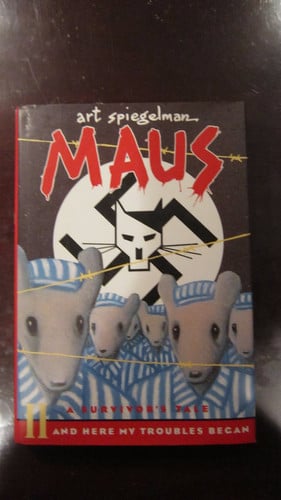
Maus II: a survivor's tale : and here my troubles began
The author-illustrator traces his father's imprisonment in a Nazi concentration camp through a series of disarming and unusual cartoons arranged to tell the story as a novel.
Taking the stand: my life in the law
#1 New York Times bestselling author Alan Dershowitz recounts his extraordinary coming of age in this legal autobiography, as well as the cases that have changed American jurisprudence over the past fifty years, most of which he has personally been involved in. “Overflowing with fascinating and funny vignettes involving his cases and clients, and probing and provocative insights into contemporary legal controversies.”— The Boston Globe Alan Dershowitz, the preeminent defense lawyer in America today, has been called the “winningest appellate criminal defense lawyer in history.” A professor at Harvard Law School since the age of twenty-five, he has led or been part of the defense team for such storied clients as Bill Clinton, Julian Assange, O. J. Simpson, Claus von Bülow, Mia Farrow, Jeffrey MacDonald, Patty Hearst, Mike Tyson, and countless others. In Taking the Stand, Dershowitz describes his evolution as a lawyer—from a C-minus student in Yeshiva High School to the youngest full professor in the history of Harvard Law School. In his #1 New York Times bestselling book Chutzpah, Alan described his Jewish life. In Taking the Stand, he looks at the people and events that have helped to shape his ideas about the law. He describes his formative years as a clerk for the United States Court of Appeals and the Supreme Court. In the course of his career, he confronts the challenges of First Amendment law, the ongoing tension between individual freedom and national security, the questionable science often employed to prosecute accused murderers, the evolution of civil rights—and why the abortion rights debate in society hasn’t moved forward since Roe v. Wade . Filled with unforgettable cases and inside legal “baseball,” Taking the Stand is a deeply personal account of one of the legendary legal minds of our time.

Edie: an American biography
When Edie was first published a decade ago, it quickly became an international bestseller. In the sixties Edie Sedgwick exploded into the public eye like a comet--aristocratic, glamorous, and Andy Warhol's superstar. Then at 28 her light fizzled and died from a drug overdose. Alternately thrilling, tragic and horrifying, this book shatters many myths about the American sixties. Photographs.

Max Perkins Editor of Genius
The National Book Award winner from Pulitzer Prize-winning author A. Scott Berg is now celebrating its 40th anniversary. The talents he nurtured were known worldwide: F. Scott Fitzgerald, Ernest Hemingway, Thomas Wolfe, and numerous others. But Maxwell Perkins remained a mystery, a backstage presence who served these authors not only as editor but also as critic, career manager, moneylender, psychoanalyst, father-confessor, and friend. This outstanding biography, a winner of the National Book Award, is the first to explore the fascinating life of this genius editor extraordinare --in both the professional and personal domains. It tells not only of Perkins's stormy marriage, endearing eccentricities, and secret twenty-five-year romance with Elizabeth Lemmon, but also of his intensely intimate relationships with the leading literary lights of the twentieth century. It is, in the words of Newsweek , "an admirable biography of a wholly admirable man." The basis for the Major Motion Picture Genius , Starring Colin Firth, Nicole Kidman, and Jude Law.

The Cage
Biography, autobiography, and memoir is among the best ways to teach students to appreciate nonfiction reading.

Rebbe The Life and Teachings of Menachem M. Schneerson, the Most Influential Rabbi in Modern History
“One of the greatest religious biographies ever written.” – Dennis Prager In this enlightening biography, Joseph Telushkin offers a captivating portrait of the late Rabbi Menachem Mendel Schneerson, a towering figure who saw beyond conventional boundaries to turn his movement, Chabad-Lubavitch, into one of the most dynamic and widespread organizations ever seen in the Jewish world. At once an incisive work of history and a compendium of Rabbi Schneerson's teachings, Rebbe is the definitive guide to understanding one of the most vital, intriguing figures of the last centuries. From his modest headquarters in Crown Heights, Brooklyn, the Rebbe advised some of the world's greatest leaders and shaped matters of state and society. Statesmen and artists as diverse as Ronald Reagan, Robert F. Kennedy, Yitzchak Rabin, Menachem Begin, Elie Wiesel, and Bob Dylan span the spectrum of those who sought his counsel. Rebbe explores Schneerson's overarching philosophies against the backdrop of treacherous history, revealing his clandestine operations to rescue and sustain Jews in the Soviet Union, and his critical role in the expansion of the food stamp program throughout the United States. More broadly, it examines how he became in effect an ambassador for Jews globally, and how he came to be viewed by many as not only a spiritual archetype but a savior. Telushkin also delves deep into the more controversial aspects of the Rebbe's leadership, analyzing his views on modern science and territorial compromise in Israel, and how in the last years of his life, many of his followers believed that he would soon be revealed as the Messiah, a source of contention until this day.

Lou Gehrig The Luckiest Man
This biography traces Gehrig's life, from childhood through his illustrious career with the Yankees to his struggle with amyotrophic lateral sclerosis and his tragic death at age thirty-seven. Expressive illustrations capture the strength, modesty, and dignity for which this remarkable man will always be remembered. "Readers will feel good after reading this biography--and maybe even inspired to start measuring themselves against Gehrig's standard."-- Kirkus Reviews

A Picture Book of John Hancock
Protestor, patriot, and signer of the declaration of Independence, John Hancock. His life revealed for picture book readers. When the British started imposing unfair taxes on the colonists, John Hancock decided to stand up to the injustice and dedicate himself to the public good. He would later serve as a delegate to the First Continental Congress, president of the Second Continental Congress, and signer of the declaration of Independence. This Founding Father is made accessible to young children through clear and concise text paired with watercolor art. "Using a warm, subdued palette, Himler's paintings bring Hancock and his times to life," says Booklist . Back matter includes a note, a timeline, source notes, a selected bibliography, and recommended websites. For almost thirty years, David Adler's Picture Book Biography series has profiled famous people who changed the world. Colorful, kid-friendly illustrations combine with Adler's "expert mixtures of facts and personality" ( Booklist ) to introduce young readers to history through compelling biographies of presidents, heroes, inventors, explorers, and adventurers. These books are ideal for first and second graders interested in history or who need reliable sources for school book reports.

Benjamin Franklin An American Life
A New York Times Bestseller A Book of the Month Club Main Selection A History Book Club Alternate Selection In this colorful and intimate narrative, Isaacson provides the full sweep of Franklin's amazing life, from his days as a runaway printer to his triumphs as a statesman, scientist, and Founding Father. He chronicles Franklin's tumultuous relationship with his illegitimate son and grandson, his practical marriage, and his flirtations with the ladies of Paris. He also shows how Franklin helped to create the American character and why he has a particular resonance in the twenty-first century.

The Memory Chalet
Selected by The New York Times Book Review as a Notable Book of the Year Final reflections on a happy life-from acclaimed historian Tony Judt. Tony Judt's The Memory Chalet is a memoir unlike any other. Each essay brings the smallest details of personal experience into the larger frame of history. Judt's youthful love of a London bus route becomes a reflection on public civility. Food and trains and smells all come alive as Judt takes us from the postwar London of his childhood through Paris, Prague, and points east to New York, where he found his home. Judt brings his moral clarity and wit to bear on everything from fast cars to radical politics and, finally, the devastating illness that took his life. This book, composed when Judt was paralyzed and unable physically to write, found its shape in the ordered rooms of a Swiss Chalet of the mind: a warm refuge in the closing darkness of his final years. Judt's book, Ill Fares the Land , republished in 2021 featuring a new preface by bestselling author of Between the World and Me and The Water Dancer , Ta-Nehisi Coates.

Blue Latitudes Boldly Going Where Captain Cook Has Gone Before
In an exhilarating tale of historic adventure, the Pulitzer Prize-winning author of Confederates in the Attic retraces the voyages of Captain James Cook, the Yorkshire farm boy who drew the map of the modern world Captain James Cook's three epic journeys in the 18th century were the last great voyages of discovery. His ships sailed 150,000 miles, from the Artic to the Antarctic, from Tasmania to Oregon, from Easter Island to Siberia. When Cook set off for the Pacific in 1768, a third of the globe remained blank. By the time he died in Hawaii in 1779, the map of the world was substantially complete. Tony Horwitz vividly recounts Cook's voyages and the exotic scenes the captain encountered: tropical orgies, taboo rituals, cannibal feasts, human sacrifice. He also relives Cook's adventures by following in the captain's wake to places such as Tahiti, Savage Island, and the Great Barrier Reef to discover Cook's embattled legacy in the present day. Signing on as a working crewman aboard a replica of Cook's vessel, Horwitz experiences the thrill and terror of sailing a tall ship. He also explores Cook the man: an impoverished farmboy who broke through the barriers of his class and time to become the greatest navigator in British history. By turns harrowing and hilarious, insightful and entertaining, BLUE LATITUDES brings to life a man whose voyages helped create the 'global village' we know today.

On Animals
NATIONAL BESTSELLER “Magnificent.” — The New York Times * “Beguiling, observant, and howlingly funny.” — San Francisco Chronicle * “Spectacular.” — Star Tribune (Minneapolis) * “Full of astonishments.” — The Boston Globe Susan Orlean—the beloved New Yorker staff writer hailed as “a national treasure” by The Washington Post and the author of the New York Times bestseller The Library Book —gathers a lifetime of musings, meditations, and in-depth profiles about animals. “How we interact with animals has preoccupied philosophers, poets, and naturalists for ages,” writes Susan Orlean. Since the age of six, when Orlean wrote and illustrated a book called Herbert the Near-Sighted Pigeon , she’s been drawn to stories about how we live with animals, and how they abide by us. Now, in On Animals , she examines animal-human relationships through the compelling tales she has written over the course of her celebrated career. These stories consider a range of creatures—the household pets we dote on, the animals we raise to end up as meat on our plates, the creatures who could eat us for dinner, the various tamed and untamed animals we share our planet with who are central to human life. In her own backyard, Orlean discovers the delights of keeping chickens. In a different backyard, in New Jersey, she meets a woman who has twenty-three pet tigers—something none of her neighbors knew about until one of the tigers escapes. In Iceland, the world’s most famous whale resists the efforts to set him free; in Morocco, the world’s hardest-working donkeys find respite at a special clinic. We meet a show dog and a lost dog and a pigeon who knows exactly how to get home. Equal parts delightful and profound, enriched by Orlean’s stylish prose and precise research, these stories celebrate the meaningful cross-species connections that grace our collective existence.

Native Sons
James Baldwin was beginning to be recognized as the most brilliant black writer of his generation when his first book of essays, Notes of a Native Son , established his reputation in 1955. No one was more pleased by the book’s reception than Baldwin’s high school friend Sol Stein. A rising New York editor, novelist, and playwright, Stein had suggested that Baldwin do the book and coaxed his old friend through the long and sometimes agonizing process of putting the volume together and seeing it into print. Now, in this fascinating new book, Sol Stein documents the story of his intense creative partnership with Baldwin through newly uncovered letters, photos, inscriptions, and an illuminating memoir of the friendship that resulted in one of the classics of American literature. Included in this book are the two works they created together–the story “Dark Runner” and the play Equal in Paris , both published here for the first time. Though a world of difference separated them–Baldwin was black and gay, living in self-imposed exile in Europe; Stein was Jewish and married, with a growing family to support–the two men shared the same fundamental passion. Nothing mattered more to either of them than telling and writing the truth, which was not always welcome. As Stein wrote Baldwin in a long, heartfelt letter, “You are the only friend with whom I feel comfortable about all three: heart, head, and writing.” In this extraordinary book, Stein unfolds how that shared passion played out in the months surrounding the creation and publication of Baldwin’s Notes of a Native Son , in which Baldwin’s main themes are illuminated. A literary event published to honor the eightieth anniversary of James Baldwin’s birth, Native Sons is a celebration of one of the most fruitful and influential friendships in American letters.

My Kitchen Year 136 Recipes That Saved My Life
In the fall of 2009, the food world was rocked when Gourmet magazine was abruptly shuttered by its parent company. No one was more stunned by this unexpected turn of events than its beloved editor in chief, Ruth Reichl, who suddenly faced an uncertain professional future. As she struggled to process what had seemed unthinkable, Reichl turned to the one place that had always provided sanctuary. “I did what I always do when I’m confused, lonely, or frightened,” she writes. “I disappeared into the kitchen.” My Kitchen Year follows the change of seasons—and Reichl’s emotions—as she slowly heals through the simple pleasures of cooking. While working 24/7, Reichl would “throw quick meals together” for her family and friends. Now she has the time to rediscover what cooking meant to her. Imagine kale, leaves dark and inviting, sautéed with chiles and garlic; summer peaches baked into a simple cobbler; fresh oysters chilling in a box of snow; plump chickens and earthy mushrooms, fricasseed with cream. Over the course of this challenging year, each dish Reichl prepares becomes a kind of stepping stone to finding joy again in ordinary things. The 136 recipes collected here represent a life’s passion for food: a blistering ma po tofu that shakes Reichl out of the blues; a decadent grilled cheese sandwich that accompanies a rare sighting in the woods around her home; a rhubarb sundae that signals the arrival of spring. Here, too, is Reichl’s enlivening dialogue with her Twitter followers, who become her culinary supporters and lively confidants. Part cookbook, part memoir, part paean to the household gods, My Kitchen Year may be Ruth Reichl’s most stirring book yet—one that reveals a refreshingly vulnerable side of the world's most famous food editor as she shares treasured recipes to be returned to again and again and again.

Camelot's Court Inside the Kennedy White House
Fifty years after John F. Kennedy’s assassination, presidential historian Robert Dallek, whom The New York Times calls “Kennedy’s leading biographer,” delivers a riveting new portrait of this president and his inner circle of advisors—their rivalries, personality clashes, and political battles. In Camelot’s Court, Dallek analyzes the brain trust whose contributions to the successes and failures of Kennedy’s administration—including the Bay of Pigs, civil rights, the Cuban Missile Crisis, and Vietnam—were indelible. Kennedy purposefully put together a dynamic team of advisors noted for their brilliance and acumen, including Attorney General Robert Kennedy, Secretary of Defense Robert McNamara, Secretary of State Dean Rusk, National Security Advisor McGeorge Bundy, and trusted aides Ted Sorensen and Arthur Schlesinger. Yet the very traits these men shared also created sharp divisions. Far from being unified, this was an uneasy band of rivals whose ambitions and clashing beliefs ignited fiery internal debates. Robert Dallek illuminates a president deeply determined to surround himself with the best and the brightest, who often found himself disappointed with their recommendations. The result, Camelot's Court: Inside the Kennedy White House, is a striking portrait of a leader whose wise resistance to pressure and adherence to principle offers a cautionary tale for our own time.
