1472 results for "Biography"

Eyes to the wind: a memoir of love and death, hope, and resistance

Barkan, Ady
In this “gripping story of resistance and the triumph of human will” (Senator Elizabeth Warren), activist and subject of the documentary Not Going Quietly Ady Barkan explores his life with ALS and how his diagnosis gave him a profound new understanding of his commitment to social justice for all. Ady Barkan loved taking afternoon runs on the California coast and holding his newborn son, Carl. But one day, he noticed a troubling weakness in his hand. At first, he brushed it off as carpal tunnel syndrome, but after a week of neurological exams and two MRIs, he learned the cause of the problem: amyotrophic lateral sclerosis, better known as ALS or Lou Gehrig’s disease. At age thirty-two, Ady was given just three to four years to live. Yet despite the devastating diagnosis, he refused to let his remaining days go to waste. Eyes to the Wind is a rousing memoir featuring intertwining storylines about determination, perseverance, and how to live a life filled with purpose and intention. The first traces Ady’s battle with ALS: how he turned the initial shock and panic from his diagnosis into a renewed commitment to social justice—not despite his disability but because of it. The second, told in flashbacks, illustrates Ady’s journey from a goofy political nerd to a prominent figure in the enduring fight for equity and justice whose “selfless activism fighting to make health care a right should be an inspiration to us all” (Senator Bernie Sanders). From one of the most vocal advocates for social justice, Eyes to the Wind ’s “primary question is existential: how to live when you are dying? Barkan’s answer is to share, open up, act, and capital-R Resist, and his memoir, clearly and candidly written, establishes a legacy” ( Booklist ).
Atria Books 2019 281 pages

Freedom for the thought that we hate: a biography of the First Amendment

Lewis, Anthony
"More than any other people on earth, Americans are free to say and write what they think. The media can air the secrets of the White House, the boardroom, or the bedroom with little fear of punishment or penalty. The reason for this extraordinary freedom is not a superior culture of tolerance, but just fourteen words in our most fundamental legal document: the free expression clauses of the First Amendment to the Constitution. In Lewis’s telling, the story of how the right of free expression evolved along with our nation makes a compelling case for the adaptability of our constitution. Although Americans have gleefully and sometimes outrageously exercised their right to free speech since before the nation’s founding, the Supreme Court did not begin to recognize this right until 1919. Freedom of speech and the press as we know it today is surprisingly recent. Anthony Lewis tells us how these rights were created, revealing a story of hard choices, heroic (and some less heroic) judges, and fascinating and eccentric defendants who forced the legal system to come face-to-face with one of America’s great founding ideas."
BasicBooks 2010-01-05 221 pages

A Picture Book of Sojourner Truth

David A. Adler
Discover the life story of one of American history's most imporant orators & freedom fighters. Sojourner Truth was born into slavery 1797, and what she would learn and do during her lifetime would change the country. She was one of the first African-American women in the United States to win a lawsuit against a white man. She traveled the country speaking out against slavery and racist injustice, and for her efforts she met and talked with two different presidents. Introduce young readers to a remarkable story of a woman who always believed there was more work to be done. For almost thirty years, David Adler's Picture Book Biography series has profiled famous people who changed the world. Colorful, kid-friendly illustrations combine with Adler's "expert mixtures of facts and personality" ( Booklist ) to introduce young readers to history through compelling biographies of presidents, heroes, inventors, explorers, and adventurers. These books are ideal for first and second graders interested in history or who need reliable sources for school book reports.
Candlewick Press 1994-01-01 32 pages

When Everybody Wore a Hat

William Steig
This is the story of when I was a boy, almost 100 years ago, when fire engines were pulled by horses, boys did not play with girls, kids went to libraries for books, there was no TV, you could see a movie for a nickel and everybody wore a hat. When Everybody Wore a Hat was one of celebrated author/artist William Steig's last gifts to the world of children's books: a portrait of the artist himself, told in Steig's signature quirky words and illustrations. Now in paperback, this funny, poignant, and revealing picture book has all the vitality and wit of a Steig classic. Ages 2+
HarperCollins 2005-04-26 40 pages

Strange Justice The Selling of Clarence Thomas

Jane Mayer,Jill Abramson
Now a New York Times Best Seller and a National Book Award finalist. Charged with racial, sexual, and political overtones, the confirmation of Clarence Thomas as a Supreme Court justice was one of the most divisive spectacles the country has ever seen. Anita Hill's accusation of sexual harassment by Thomas, and the attacks on her that were part of his high-placed supporters' rebuttal, both shocked the nation and split it into two camps. One believed Hill was lying, the other believed that the man who ultimately took his place on the Supreme Court had committed perjury. In this brilliant, often shocking book, Jane Mayer and Jill Abramson, two of the nation's top investigative journalists examine all aspects of this controversial case. They interview witnesses that the Judiciary Committee chose not to call, and present documents never before made public. They detail the personal and professional pasts of both Clarence Thomas and Anita Hill and lay bare a campaign of lobbying, public rela
Houghton Mifflin 2018 406 pages

Heroes of the Revolution

David A. Adler
Some are household names, other are all but forgotten. These twelve heroes played an important role in the American Revolution. Paul Revere, silversmith, engraver, midnight messenger to the Patriots. Lydia Darragh, nurse, mother of five, Continental army spy. Crispus Attucks, escaped slave, "the first to defy, the first to die." George Washington, father of the country. Deborah Sampson, "the female soldier." From spying on the British to rescuing fallen soldiers on the battlefield, these men and women stand as unforgettable heroes of the Revolutionary War. David A. Adler's lively anecdotes and Donald A. Smith's bold paintings present a dozen figures whose courage and determination to seek freedom were indomitable in their own times and remain a shining example in our own. Author's notes, a list of important dates, source notes, and a selected bibliography expand on the biographies of each person. This is a great gift for young history buffs interested in the Revolutionary War as well as a resource for classroom use.
Holiday House 2006-03-01 32 pages

Theodore Roosevelt for the Defense The Courtroom Battle to Save His Legacy

Dan Abrams,David Fisher
"No more dramatic courtroom scene has ever been enacted," reported the Syracuse Herald on May 22, 1915, as it covered "the greatest libel suit in history," a battle fought between former President Theodore Roosevelt and the leader of the Republican party. Roosevelt, the boisterous and mostly beloved legendary American hero, had accused his former friend and ally, now turned rival, William Barnes of political corruption. The furious Barnes responded by suing Roosevelt for an enormous sum that could have financially devastated him. The spectacle of Roosevelt defending himself in a lawsuit captured the imagination of the country, and more than fifty newspapers sent reporters to cover the trial. Accounts from inside and outside the courtroom combined with excerpts from the trial transcript give us Roosevelt in his own words and serve as the heart of this book. This was Roosevelt's final fight to defend his political legacy and perhaps regain his fading stature. He spent more than a week on the witness stand, revealing hidden secrets of the American political system, and then endured a merciless cross-examination. Witnesses, including a young Franklin D. Roosevelt and a host of well-known political leaders, were questioned by two of the most brilliant attorneys in the country. Following the case through court transcripts, news reports, and other primary sources, Dan Abrams and David Fisher present a high-definition picture of the American legal system in a nation standing on the precipice of the Great War, with its former president fighting for the ideals he held dear
Harlequin Enterprises ULC 2021-04-27 512 pages

The Civil War: Red River to Appomattox

Shelby Foote
Selected by the Modern Library as one of the 100 best nonfiction books of all time On the occasion of the 150th anniversary of the Civil War, the Modern Library publishes Shelby Foote's three-volume masterpiece in a new boxed set including three hardcovers and a new trade paperback, American Homer: Reflections on Shelby Foote and His Classic Civil War: A Narrative, edited by and with an introduction from Pulitzer Prize winner Jon Meacham and including essays by Michael Beschloss, Ken Burns, Annette Gordon-Reed, and others. Random House publisher Bennett Cerf commissioned southern novelist Shelby Foote to write a short, one-volume history of the American Civil War. Thirty years and a million and a half words later--every word having been written out longhand with nib pens dipped into ink--Foote published the third and final volume of what has become the classic narrative of that epic war. As he approached the end of the final volume, Foote recounted this scene in a letter to his friend, the novelist Walker Percy: "I killed Lincoln last week--Saturday, at noon. While I was doing it (he had his chest arched up, holding his last breath to let it out) some halfassed doctor came to the door with vols I and II under his arm, wanting me to autograph them for his son for Xmas. I was in such a state of shock, I not only let him in; I even signed the goddam books, a thing I seldom do. Then I turned back and killed him and had Stanton say, 'Now he belongs to the ages.' A strange feeling, though. I have another 70-odd pages to go, and I have a fear they'll be like Hamlet with Hamlet left out. Christ, what a man. It's been a great thing getting to know him as he was, rather than as he has come to be--a sort of TV image of himself, with a ghost alongside." When Percy read the final book, he wrote to Foote: "It's a noble work. I'm still staggered by the size of the achievement. . . . It is The Iliad ." A selection of these letters, along with essays by Jon Meacham, Michael Beschloss, Ken Burns, Annette Gordon-Reed, Michael Eric Dyson, Julia Reed, Robert Loomis, Donald Graham, John M. McCardell, Jr., and Jay Tolson, are included in American Homer, the bonus paperback book available only in the Modern Library boxed set of The Civil War. Shelby Foote's tremendous, sweeping narrative of the most fascinating conflict in our history--a war that lasted four long, bitter years, an experience more profound and meaningful than any other the American people have ever lived through--begins with Jefferson Davis's resignation from the United States Senate and Abraham Lincoln's departure from Springfield for the national capital. It is these two leaders, whose lives continually touch on the great chain of events throughout the story, who are only the first of scores of exciting personalities that in effect make The Civil War a multiple biography set against the crisis of an age. Four years later, Lincoln's second inaugural sets the seal, invoking "charity for all" on the Eve of Five Forks and the Grant-Lee race for Appomattox. Here is the dust and stench of war, a sort of Twilight of the Gods. The epilogue is Lincoln in his grave, and Davis in his postwar existence--"Lucifer in Starlight." So ends a unique achievement--already recognized as one of the finest histories ever fashioned by an American--a narrative that re-creates on a vast and brilliant canvas the events and personalities of an American epic: the Civil War.
Random House 2011 2984 pages

Great Society A New History

Amity Shlaes
The New York Times bestselling author of The Forgotten Man and Coolidge offers a stunning revision of our last great period of idealism, the 1960s, with burning relevance for our contemporary challenges. "Great Society is accurate history that reads like a novel, covering the high hopes and catastrophic missteps of our well-meaning leaders." --Alan Greenspan Today, a battle rages in our country. Many Americans are attracted to socialism and economic redistribution while opponents of those ideas argue for purer capitalism. In the 1960s, Americans sought the same goals many seek now: an end to poverty, higher standards of living for the middle class, a better environment and more access to health care and education. Then, too, we debated socialism and capitalism, public sector reform versus private sector advancement. Time and again, whether under John F. Kennedy, Lyndon Johnson, or Richard Nixon, the country chose the public sector. Yet the targets of our idealism proved elusive. What's more, Johnson's and Nixon's programs shackled millions of families in permanent government dependence. Ironically, Shlaes argues, the costs of entitlement commitments made a half century ago preclude the very reforms that Americans will need in coming decades. In Great Society, Shlaes offers a powerful companion to her legendary history of the 1930s, The Forgotten Man, and shows that in fact there was scant difference between two presidents we consider opposites: Johnson and Nixon. Just as technocratic military planning by "the Best and the Brightest" made failure in Vietnam inevitable, so planning by a team of the domestic best and brightest guaranteed fiasco at home. At once history and biography, Great Society sketches moving portraits of the characters in this transformative period, from U.S. Presidents to the visionary UAW leader Walter Reuther, the founders of Intel, and Federal Reserve chairmen William McChesney Martin and Arthur Burns. Great Society casts new light on other figures too, from Ronald Reagan, then governor of California, to the socialist Michael Harrington and the protest movement leader Tom Hayden. Drawing on her classic economic expertise and deep historical knowledge, Shlaes upends the traditional narrative of the era, providing a damning indictment of the consequences of thoughtless idealism with striking relevance for today. Great Society captures a dramatic contest with lessons both dark and bright for our own time.
HarperCollins Publishers 2020-11-24 528 pages

Roy Lichtenstein

Lichtenstein, Roy
From the funny pages to the canvas, comics recontextualized In the late 50s and 60s, American painter Roy Lichtenstein (1923-1997) became one of the most important exponents of Pop Art - that movement which transformed products of mass consumption and the entertainment industry into subjects for art. This apotheosis of banal, everyday objects simultaneously constituted a criticism of the traditional elitist understanding of art. Almost alone among artists, Lichtenstein pursued the question of how an image becomes a work of art. Wholly in keeping with the spirit of the Classical Modern, he held that it was not the "rank" of the picture's subject that lends the picture its artistic character, but rather the artist's formal treatment of it. To Lichtenstein, however, this position seemed far too broad to be seriously pursued. Developed in the early 60s, Lichtenstein's grid technique, with its allusion to the mass-production of graphic art, allowed the painter to give vent to his own artistic scepticism. In the 60s and 70s, Lichtenstein expanded his formal repertoire of techniques for creating distance and irony by means of an idiosyncratic process of abstraction and especially by his use of his numerous art quotations. About the Series: Each book in TASCHEN's Basic Art series features: a detailed chronological summary of the life and oeuvre of the artist, covering his or her cultural and historical importance a concise biography approximately 100 illustrations with explanatory captions
Taschen 2000 96 pages

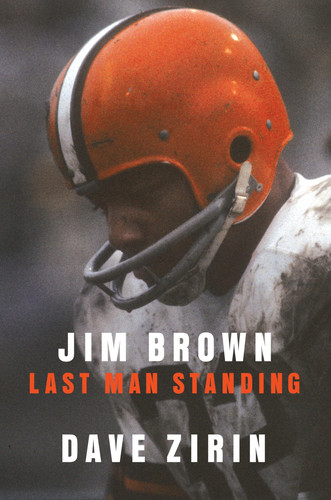
Jim Brown: last man standing

Zirin, Dave
A unique biography of Jim Brown—football legend, Hollywood star, and controversial activist—written by acclaimed sports journalist Dave Zirin. Jim Brown is recognized as perhaps the greatest football player to ever live. But his phenomenal nine-year career with the Cleveland Browns is only part of his remarkable story, the opening salvo to a much more sprawling epic. Brown parlayed his athletic fame into stardom in Hollywood, where it was thought that he could become “the black John Wayne.” He was an outspoken Black Power icon in the 1960s, and he formed Black Economic Unions to challenge racism in the business world. For this and for his decades of work as a truce negotiator with street gangs, Brown—along with such figures as Muhammad Ali, Bill Russell, and Billie Jean King—is revered as a socially conscious athlete. On the most hypermasculine cultural canvases of the United States—NFL football, the Black Power movement, Hollywood's blaxploitation films, gang intervention both inside and outside prison walls—Jim Brown has made his mark. Yet in the landscape of the most toxic expression of “what makes a man”—numerous accusations of violence against women—he has left a jagged mark as well. Dave Zirin's book redefines an American icon, and not always in a flattering light. At eighty-one years old, Brown continues to speak out and look for fights. His recent public support of Donald Trump and criticism of Colin Kaepernick are just the latest examples of someone who seems restless if he is not in conflict. Jim Brown is a raw and thrilling account of Brown's remarkable life and a must-read for sports fans and students of the black freedom struggle.
Blue Rider Press 2018-05-15 320 pages

William Howard Taft

Rosen, Jeffrey
The only man to serve as president and chief justice, who approached every decision in constitutional terms, defending the Founders’ vision against new populist threats to American democracy William Howard Taft never wanted to be president and yearned instead to serve as chief justice of the United States. But despite his ambivalence about politics, the former federal judge found success in the executive branch as governor of the Philippines and secretary of war, and he won a resounding victory in the presidential election of 1908 as Theodore Roosevelt’s handpicked successor. In this provocative assessment, Jeffrey Rosen reveals Taft’s crucial role in shaping how America balances populism against the rule of law. Taft approached each decision as president by asking whether it comported with the Constitution, seeking to put Roosevelt’s activist executive orders on firm legal grounds. But unlike Roosevelt, who thought the president could do anything the Constitution didn’t forbid, Taft insisted he could do only what the Constitution explicitly allowed. This led to a dramatic breach with Roosevelt in the historic election of 1912, which Taft viewed as a crusade to defend the Constitution against the demagogic populism of Roosevelt and Woodrow Wilson. Nine years later, Taft achieved his lifelong dream when President Warren Harding appointed him chief justice, and during his years on the Court he promoted consensus among the justices and transformed the judiciary into a modern, fully equal branch. Though he had chafed in the White House as a judicial president, he thrived as a presidential chief justice.
Times Books, Henry Holt and Company 2018-03-20 183 pages

Bob Dylan in America

Wilentz, Sean
A brilliantly written and groundbreaking book about Dylan's music - now the recipient of the Nobel Prize for Literature 2016 - and its musical, political and cultural roots in early 20th-century America Growing up in Greenwich Village in the 1960s Sean Wilentz discovered the music of Bob Dylan as a young teenager. Almost half a century later, now a distinguished professor of American history, he revisits Dylan's work with the critical skills of a scholar and the passion of a fan. Drawing partly on his work as the current historian-in-residence on Dylan's official website, Sean Wilentz provides a unique blend of biography, memoir and analysis in a book which, much like its subject, shifts gears and changes shape as the occasion demands.
Vintage 2011 390 pages

Tito Puente, Mambo King: Tito Puente, Rey del Mambo

Brown, Monica
In this vibrant bilingual picture book biography of musician Tito Puente, readers will dance along to the beat of this mambo king's life. Tito Puente loved banging pots and pans as a child, but what he really dreamed of was having his own band one day. From Spanish Harlem to the Grammy Awards—and all the beats in between—this is the true life story of a boy whose passion for music turned him into the "King of Mambo." Award-winning author-illustrator duo Monica Brown and Rafael López bring the remarkable story of this talented legend to life in this Pura Belpré Honor Book. Supports the Common Core State Standards.
HarperCollins Publishers 2013-03-05 32 pages