1265 results for "Economics"

Hopes and Prospects

Noam Chomsky
In this urgent new book, Noam Chomsky surveys the dangers and prospects of our early twenty-first century. Exploring challenges such as the growing gap between North and South, American exceptionalism (including under President Barack Obama), the fiascos of Iraq and Afghanistan, the U.S.-Israeli assault on Gaza, and the recent financial bailouts, he also sees hope for the future and a way to move forward - in the democratic wave in Latin America and in the global solidarity movements that suggest ''real progress toward freedom and justice.'' Hopes and Prospects is essential reading for anyone who is concerned about the primary challenges still facing the human race.
ReadHowYouWant.com 2010 544 pages

Boss bitch: a simple 12-step plan to take charge of your career

Lapin, Nicole
"New York Times bestselling author Nicole Lapin is back with a sassy and actionable guide empowering women to be the boss of their lives and their careers. You don't need dozens or hundreds of employees to be a boss, says financial expert and serial entrepreneur Nicole Lapin. Hell, you don't even need one. You just need to find your inner Boss Bitch -- your most confident, savvy, ambitious self -- and own it. A Boss Bitch is the she-ro of her own story. She is someone who takes charge of her future and embraces being a "boss" in all aspects of the word: whether as the boss of her own life, family and career, the literal boss at work, or, as the boss of her own company. Whichever she chooses (or all three), a Boss Bitch is someone who gets out there and makes her success happen -- and so can you. Lapin draws on raw and often hilariously real stories from her own career -- the good, the bad, and the ugly -- to show what it means to be a "boss" in twelve easy steps. In her refreshingly accessible and relatable style, she first shows how to embrace the "boss of you" mentality by seizing the power that comes from believing in yourself and expanding your skillset. Then she offers candid no-nonsense advice for how to kill it at as the "boss at work" whether you have a high-up role or not. And finally, for those who want to take the plunge as an entrepreneur, she lays out the nuts and bolts of how to be the "boss of your own business" from raising money and getting it off the ground to hiring a kickass staff and dealing office drama to turning a profit. Being a badass in your career is something that should be worn as a badge of honor, says Lapin. Here, she inspires us to rise to the occasion and celebrate our successes -- and then keep killing it like the Boss Bitches we are!"--
Crown Business 2017-03-21 382 pages

Revolt The Worldwide Uprising Against Globalization

Nadav Eyal
A well-written and thought-provoking account of the current crisis of globalization. Not everyone will agree with Eyal's interpretation, but few will remain indifferent.' --Yuval Noah Harari, author of SapiensRevolt is an eloquent and provocative challenge to the prevailing wisdom about the rise of nationalism and populism. With a vibrant and informed voice, Nadav Eyal illustrates how modern globalization is not sustainable. He contends that the collapse of the current world order is not so much about the imbalance between technological achievement and social progress or the breakdown of liberal democracy as it is about a passion to upend and destroy power structures that have become hollow, corrupt, or simply unresponsive to urgent needs. Eyal illuminates the benign and malignant forces that have so rapidly transformed our economic, political and cultural realities, shedding light not only on the economic and cultural revolution that has come to define our time but also on the counterrevolution waged by those it has marginalized and exploited.With a mixture of journalistic narrative, penetrating vignettes and original analysis, Revolt shows that the left and right have much in common. Eyal tells stories of distressed Pennsylvania coal miners, anarchist communes on the outskirts of Athens, a Japanese town with collapsing fertility rates, neo-Nazis in Germany and Syrian refugee families whom he accompanied from the shores of Greece to their destination in Germany. Into these reports from the present Eyal weaves lessons from the past, from the opium wars in China to colonialist Haiti to the Marshall Plan. With these historical ties, he shows that the revolts' roots have always been deep and strong, and that rather than seeing current uprisings as part of a passing phenomenon, we should recognize that revolt is the new status quo.
Pan Macmillan 2021 512 pages

Like No Other Store . . . The Bloomingdale's Legend and the Revolution in American Marketing

Marvin Traub
Bloomingdale's has been the most celebrated store in the world--and its style has been copied throughout the world. As Bloomingdale's chairman for nearly 20 years, Traub played an essential role in this success. Here he tells the story of how the art of selling moved into the modern world--and how Bloomingdale's became a mecca of high style. 16 pages of photos.
Crown Publishing Group 1994-12-05 430 pages

Microtrends The Small Forces Behind Tomorrow's Big Changes

Mark Penn
The adviser to Senator Hillary Clinton, Bill Gates, and President Bill Clinton proves that small is big by identifying 75 hidden-in-plain-sight trends that are moving America, revealing that the nation is no longer a melting pot but a collection of communities with many individual tastes and lifestyles. "The ideas in his book will help you see the world in a new way." --Bill Clinton "Mark Penn has a keen mind and a fascinating sense of what makes America tick, and you see it on every page of Microtrends ." --Bill Gates In 1982, readers discovered Megatrends . In 2000, The Tipping Point entered the lexicon. Now, in Microtrends , one of the most respected and sought-after analysts in the world articulates a new way of understanding how we live. Mark Penn, the man who identified "Soccer Moms" as a crucial constituency in President Clinton's 1996 reelection campaign, is known for his ability to detect relatively small patterns of behavior in our culture-microtrends that are wielding great influence on business, politics, and our personal lives. Only one percent of the public, or three million people, is enough to launch a business or social movement. Relying on some of the best data available, Penn identifies more than 70 microtrends in religion, leisure, politics, and family life that are changing the way we live. Among them: People are retiring but continuing to work. Teens are turning to knitting. Geeks are becoming the most sociable people around. Women are driving technology. Dads are older than ever and spending more time with their kids than in the past. You have to look at and interpret data to know what's going on, and that conventional wisdom is almost always wrong and outdated. The nation is no longer a melting pot. We are a collection of communities with many individual tastes and lifestyles. Those who recognize these emerging groups will prosper. Penn shows readers how to identify the microtrends that can transform a business enterprise, tip an election, spark a movement, or change your life. In today's world, small groups can have the biggest impact.
Grand Central Publishing 2007-09 448 pages

Other People's Money and How The Bankers Use It

Louis D. Brandeis
Louis D. Brandeis was a Supreme Court Justice and a patriot. He wrote "Other People's Money and How Bankers Use It" to warn the American people about the greedy bankers that control the United States and drive us into financial ruin. The book attacked the use of investment funds to promote the consolidation of various industries under the control of a small number of corporations, which Brandeis alleged were working in concert to prevent competition. Brandeis harshly criticized investment bankers who controlled large amounts of money deposited in their banks by middle-class people. The heads of these banks, Brandeis pointed out, routinely sat on the boards of railroad companies and large industrial manufacturers of various products, and routinely directed the resources of their banks to promote the interests of their own companies. These companies, in turn, sought to maintain control of their industries by crushing small businesses and stamping out innovators who developed better products to compete against them. Brandeis supported his contentions with a discussion of the actual dollar amounts--in millions of dollars--controlled by specific banks, industries, and industrialists such as J. P. Morgan, noting that these interests had recently acquired a far larger proportion of American wealth than corporate entities had ever had before. He extensively cited testimony from a Congressional investigation performed by the Pujo Committee, named after Louisiana Representative Arsène Pujo, into self-serving and monopolistic business dealing. Chapter V of the book ("What Publicity Can Do") contains in its opening section a well-known line that has frequently been cited in support of regulation through disclosure obligations: "Sunlight is said to be the best of disinfectants; electric light the most efficient policeman."
Brian Westland 1914 108 pages

Gold Standard How to Rock the World and Run an Empire

Kym Gold
The cofounder of True Religion Brand Jeans, Kym Gold uses her story to serve up a firm dose of life and career lessons that helped her build a multimillion-dollar fashion brand from the ground up. Kym Gold’s mantra, “never settle for a no; always look for a yes,” is what led her to co-create True Religion Brand Jeans, a major retail clothing company that sold for close to a billion dollars in 2013. In Gold Standard, Kym finally gives her side of the story of how the once fledgling jeans company that nobody wanted, went on to become a giant revolutionizing player in the fashion industry. As a woman in the boys’ club world of the fickle fashion business, Kym armed herself and became one of True Religion’s majority shareholders and their lead female clothing designer. On Valentine’s Day in 2007, she was served divorce papers by her then husband and had her company ripped from under her—all within an hour. Since then, she has reestablished her place in the industry and catapulted herself into the coveted 1 percent of the richest Americans. In Gold Standard , Kym’s savvy business and fashion branding experience of thirty years gives a behind-the-scenes look into the always changing fashion industry. It also mixes in her compelling personal journey, including her marriage to Mark Burnett before he became TV's biggest mega producer, a compassionate view for women of the pressures of balancing a career, finances, and family. Kym motivates readers to throw the gold gloves on and put up a fight.
Skyhorse 2021-05-18 216 pages

I Am Spartacus!

Kirk. Douglas
A "lively" memoir by the Hollywood legend about the making of Spartacus , with a foreword by George Clooney ( Los Angeles Times ). One of the world's most iconic movie stars, Kirk Douglas has distinguished himself as a producer, philanthropist, and author of ten works of fiction and memoir. Now, more than fifty years after the release of his enduring epic Spartacus , Douglas reveals the riveting drama behind the making of the legendary gladiator film. Douglas began producing the movie in the midst of the politically charged era when Hollywood's moguls refused to hire anyone accused of Communist sympathies. In a risky move, Douglas chose Dalton Trumbo, a blacklisted screenwriter, to write Spartacus . Trumbo was one of the "Unfriendly Ten," men who had gone to prison rather than testify before the House Un-American Activities Committee about their political affiliations. Douglas's source material was already a hot property, as the novel Spartacus was written by Howard Fast while he was in jail for defying HUAC. With the financial future of his young family at stake, Douglas plunged into a tumultuous production both on- and off-screen. As both producer and star of the film, he faced explosive moments with young director Stanley Kubrick, struggles with a leading lady, and negotiations with giant personalities, including Sir Laurence Olivier, Charles Laughton, Peter Ustinov, and Lew Wasserman. Writing from his heart and from his own meticulously researched archives, Kirk Douglas, at ninety-five, looks back at his audacious decisions. He made the most expensive film of its era--but more importantly, his moral courage in giving public credit to Trumbo effectively ended the notorious Hollywood blacklist. A master storyteller, Douglas paints a vivid and often humorous portrait in I Am Spartacus! The book is enhanced by newly discovered period photography of the stars and filmmakers both on and off the set.
Open Road Integrated Media, Incorporated 2014-01-21 220 pages

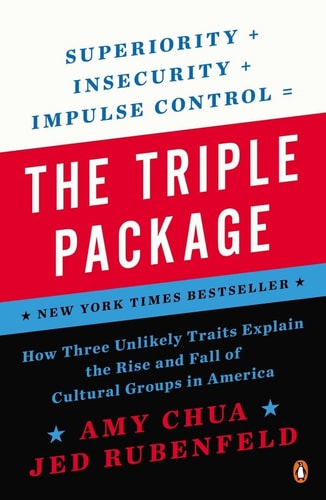
The Triple Package How Three Unlikely Traits Explain the Rise and Fall of Cultural Groups in America

Amy Chua,Jed Rubenfeld
"That certain groups do much better in America than others — as measured by income, occupational status, test scores, and so on — is difficult to talk about. In large part this is because the topic feels racially charged. The irony is that the facts actually debunk racial stereotypes. There are black and Hispanic subgroups in the United States far outperforming many white and Asian subgroups. Moreover, there’s a demonstrable arc to group success — in immigrant groups, it typically dissipates by the third generation — puncturing the notion of innate group differences and undermining the whole concept of 'model minorities.'" Mormons have recently risen to astonishing business success. Cubans in Miami climbed from poverty to prosperity in a generation. Nigerians earn doctorates at stunningly high rates. Indian and Chinese Americans have much higher incomes than other Americans; Jews may have the highest of all. Why do some groups rise? Drawing on groundbreaking original research and startling statistics, The Triple Package uncovers the secret to their success. A superiority complex, insecurity, impulse control—these are the elements of the Triple Package, the rare and potent cultural constellation that drives disproportionate group success. The Triple Package is open to anyone. America itself was once a Triple Package culture. It’s been losing that edge for a long time now. Even as headlines proclaim the death of upward mobility in America, the truth is that the old-fashioned American Dream is very much alive—but some groups have a cultural edge, which enables them to take advantage of opportunity far more than others. • Americans are taught that everyone is equal, that no group is superior to another. But remarkably, all of America’s most successful groups believe (even if they don’t say so aloud) that they’re exceptional, chosen, superior in some way. • Americans are taught that self-esteem—feeling good about yourself—is the key to a successful life. But in all of America’s most successful groups, people tend to feel insecure, inadequate, that they have to prove themselves. • America today spreads a message of immediate gratification, living for the moment. But all of America’s most successful groups cultivate heightened discipline and impulse control. But the Triple Package has a dark underside too. Each of its elements carries distinctive pathologies; when taken to an extreme, they can have truly toxic effects. Should people strive for the Triple Package? Should America? Ultimately, the authors conclude that the Triple Package is a ladder that should be climbed and then kicked away, drawing on its power but breaking free from its constraints. Provocative and profound, The Triple Package will transform the way we think about success and achievement.
Penguin 2015-01-27 352 pages

The Choose Yourself Guide To Wealth

James Altucher
This is a bold book by James Altucher because he not only gives you a new map for the new financial landscape, but he also has skin in the game. This is the first financial book in which the author REVEALS HOW HE, PERSONALLY, MAKES HIS OWN MONEY. We are living in an epic period of change, danger and opportunity. The economy is crashing and booming every few years. People are getting fired and replaced by computers and Chinese workers. The stock market crashes with regularity. Every "fix" from the government makes things worse. The Old World has been demolished... and people are desperate for answers. James Altucher's "The Choose Yourself Guide To Wealth" contains those answers. This is the field guide to the "New World" we live in. You can play by the old rules and get left behind, or you can use these new ideas and become wealthy. This is not a book for the faint of heart. Read at your own risk, because sometimes the truth is hard to take. But for those who are ready to hear, James provides an updated map of the new territory for generating wealth and freedom. This book is the eye-opener of the century, it is the guide to building, keeping, and investing your money and breaking free from the chains of rusted, old thinking.
CreateSpace Independent Publishing Platform 2015-03-16 278 pages

No Excuses Nine Ways Women Can Change How We Think About Power

Gloria Feldt
An invaluable guidebook, which contends that the most vexing problems facing women today isn't that doors of opportunity aren't open but that not enough women are walking through them Feminist icon Gloria Feldt pulls no punches in this new book, which argues that the most confounding problem facing women today isn't that doors of opportunity aren't open, but that not enough women are walking through them. From the boardroom to the bedroom, public office to personal relationships, she asserts that nobody is keeping women from parity-except themselves. Feldt puts women's power into an historical context, showing the ways in which women have made huge leaps forward in the past, only to pull back right when they were at the threshold. Feldt argues that there's no excuse-whether it's the way women are socialized, or pressure to conform, or work/life balance issues-for women today not to own their power. Women are still facing unequal pay, being passed over for promotions, entering public office at a much lesser rate than men, and oftentimes still struggling with traditional power dynamics in their interpersonal relationships. Feldt's solution to all these places where women face inequality is the same: we need to shift the way we think to achieve true parity with our male counterparts. No Excuses is divided into nine chapters that organized around how women can change the way they think, and therefore the way they act. These include: Know Your History and You Can Create the Future of Your Choice; Define the Terms-First; Embrace Controversy; Employ Every Medium; and other helpful ideas for using the tools and resources women already have to create the changes they want to see. No Excuses is a timely and invaluable book to help women equalize gender power in politics, work, and love.
Basic Books 2012-02-28 384 pages

Law and social norms

Posner, Eric A.
What is the role of law in a society in which order is maintained mostly through social norms, trust, and nonlegal sanctions? Eric Posner argues that social norms are sometimes desirable yet sometimes odious, and that the law is critical to enhancing good social norms and undermining bad ones. But he also argues that the proper regulation of social norms is a delicate and complex task, and that current understanding of social norms is inadequate for guiding judges and lawmakers. What is needed, and what this book offers, is a model of the relationship between law and social norms. The model shows that people's concern with establishing cooperative relationships leads them to engage in certain kinds of imitative behavior. The resulting behavioral patterns are called social norms. Posner applies the model to several areas of law that involve the regulation of social norms, including laws governing gift-giving and nonprofit organizations; family law; criminal law; laws governing speech, voting, and discrimination; and contract law. Among the engaging questions posed are: Would the legalization of gay marriage harm traditional married couples? Is it beneficial to shame criminals? Why should the law reward those who make charitable contributions? Would people vote more if non-voters were penalized? The author approaches these questions using the tools of game theory, but his arguments are simply stated and make no technical demands on the reader.
Harvard University Press 2002-03-08 260 pages

Isn't it obvious

Eliyahu M. Goldratt,Ilan Eshkoli,Joe Brownleer
This book does for retail what Goldratt's International best-seller did for manufacturing. A breakthrough solution is exposed when some unexpected events force Caroline and Paul, a married couple working for their family's retail business, to make a few small changes in the way things are done. A solution that propels the family's regional chain of stores into a very profitable, rapidly growing, international enterprise. If there is a hint of Jonah, from THE GOAL, reappearing in this novel, it is Henry, the soon-to-retire president and majority owner of the company who logically states that, if you do not deal directly with the core problem, don't expect significant improvement. Eli Goldratt's Theory of Constraints is woven throughout this book but answers are not handed to you. The reader, along with the characters in the book, work through the process together to discover solutions.
North River Press 2009 232 pages

Don't get too comfortable

Rakoff, David
In these essays, social satirist Rakoff journeys into the land of unchecked plenty that is contemporary America, skewering overconsumption, greed, vanity, selfishness, and vapidity. Somewhere along the line, our healthy self-regard has exploded into obliterating narcissism; our manic getting and spending have now become celebrated as moral virtues. Whether contrasting the elegance of one of the last flights of the supersonic Concorde with the good-times-and-chicken-wings populism of Hooters Air, working as a cabana boy at a South Beach hotel, or traveling to a private island off the coast of Belize to watch a soft-core video shoot--where he is provided with his very own personal manservant--Rakoff takes us on a grand tour of our culture of excess, and comes away from his explorations hilariously horrified.--From publisher description.
Doubleday 2005 222 pages

Good for the money: my fight to pay back America

Benmosche, Bob
"In 2009, at the peak of the financial crisis, AIG - the American insurance behemoth - was sinking fast. It was the peg upon which the nation hung its ire and resentment during the financial crisis: the pinnacle of Wall Street arrogance and greed. When Bob Benmosche climbed aboard as CEO, it was widely assumed that he would go down with his ship. In mere months, he turned things around, pulling AIG from the brink of financial collapse and restoring its profitability. Before three years were up, AIG had fully repaid its staggering debt to the U.S. government - with interest.Good for the Money is an unyielding leader's memoir of a career spent fixing companies through thoughtful, unconventional strategy. With his brash, no-holds-barred approach to the job, Benmosche restored AIG's employee morale and good name. His is a story of perseverance, told with refreshing irreverence in unpretentious terms.Called "an American hero" by Andrew Ross Sorkin, author of Too Big to Fail, Benmosche was a self-made man who never forgot what life is like for the nation's 99-percent; again and again, he pushed back against obstinate colleagues to salvage American jobs and industry. Good for the Money affords you a front-row seat for Benmosche's heated battles with major players from Geithner to Obama to Cuomo, and offers incomparable lessons in leadership from the legendary CEO who changed the way Wall Street does business"--
St. Martin's Press 2016-04-12 271 pages

Data Science and Digital Business

Fausto Pedro García Márquez,Benjamin Lev
This book combines the analytic principles of digital business and data science with business practice and big data. The interdisciplinary, contributed volume provides an interface between the main disciplines of engineering and technology and business administration. Written for managers, engineers and researchers who want to understand big data and develop new skills that are necessary in the digital business, it not only discusses the latest research, but also presents case studies demonstrating the successful application of data in the digital business.
Springer International Publishing 2019-01-16 316 pages

Take on the Street How to Fight for Your Financial Future

Arthur Levitt,Paula Dwyer
Arthur Levitt -- chmn. of the Securities & Exchange Comm. (SEC) for 8 years under Pres. Clinton -- provides the best kind of insider information: the kind that can help honest small investors protect themselves from the deliberately confusing ways of Wall Street. Levitt offers the benefits of his own experience, both on Wall Street & as its chief regulator. His straight talk about the ways of stockbrokers (they are salesmen, plain & simple), corporate financial statements (the truth is often hidden), mutual fund managers (remember who they really work for), & other aspects of the business will help to arm everyone with the tools they need to protect -- & enhance -- their financial future. This book is clear & informative; the analysis of investor alternatives is jargon-free.
DIANE Publishing Company 2005-08 364 pages

Memos from the Chairman

Alan C. Greenberg
“Ace Greenberg did almost everything better than I do—bridge, magic tricks, dog training, and arbitrage—all the important things in life.” —WARREN BUFFETT Alan C. Greenberg, the former chairman of Bear, Stearns, and a celebrated philanthropist, was known throughout the financial world for his biting, quirky but invaluable and wise memos. Read by everyone from Warren Buffett to Jeff Bezos to Tom Peters (“I love this book,” the coauthor of In Search of Excellence said), Greenberg’s MEMOS FROM THE CHAIRMAN comprise a unique—and uniquely simple—management philosophy. Make decisions based on common sense. Avoid the herd mentality. Control expenses with unrelenting vigil. Run your business at the highest level of morality. Free your motivated, intelligent people from the chain of command. Always return phone calls promptly and courteously. Never believe your own body odor is perfume. And stay humble, humble, humble.
Workman Publishing Company 1996-03-01 160 pages

The optimum quantity of money

Friedman, Milton
This classic set of essays by Nobel Laureate and leading monetary theorist Milton Friedman presents a coherent view of the role of money, focusing on specific topics related to the empirical analysis of monetary phenomena and policy. The early chapters cover factors determining the real quantity of money held in a community and the welfare implications of policies that affect the quantity held. The following chapters formally restate why quantity analysis has become central to the science of economics. Friedman's presidential address to the American Economic Association, included here, provides a general summary of his views on the role of monetary policy, with an emphasis on its limitations and its possibilities. This theoretical framework is used in examining a number of empirical problems: the demand for money, the explanation of price changes in wartime periods, and the role of money in business cycles. These essays summarize some of the most important results of Friedman's extensive research over the course of his lifetime. The chapters on policy that follow survey the positions of earlier economists and deal with the importance of lags and the implications of destabilizing speculation in foreign markets. Taken as a whole, The Optimum Quantity of Money provides a comprehensive view of the body of monetary theory developed in leading centers of monetary analysis. This work is essential reading for economists and graduate students in the field. The volume will be no less important for practicing business and banking personnel as well. The new statement by Michael Bordo, a student of Friedman's and an expert in the field, provides a sense of where the field now stands in the economy and academy. Milton Friedman is a senior fellow at the Hoover Institution of Stanford University. Before that, he was Distinguished Service Professor of Economics at the University of Chicago. He has also taught at Columbia University, the University of Wisconsin, the University of Minnesota, and Cambridge University. Among his many books are Essays in Positive Economics , A Program for Monetary Stability , Capitalism and Freedom , and A Monetary History of the United States . Michael D. Bordo is professor of economics at Rutgers, The State University of New Jersey, and author, with Lars Jonung, of, among other works, Demand for Money .
Aldine Transaction 2006 296 pages