541 results for "Jewish History"

This Holy Place

Steven Fine
""Steven Fine's This Holy Place is a comprehensive treatment of the synagogue as a place of sanctity in Late Antiquity. This book is essential for an understanding of how the synagogue became the central Jewish communal institution and how it served as a substitute for the destroyed Jerusalem Temple during the long period of Jewish exile from the Land of Israel. Fine's mastery of both archaeological evidence and a wide variety of literary sources makes this a major contribution to the field."" --Lawrence H. Schiffman, New York University ""Fine has mastered an unusually wide range of disciplines--rabbinical sources, archaeology, art and epigraphy. . . . His book is thoroughly researched, well written, and engagingly presented. It should be required reading for anyone interested in how this most central institution of Jewish life was perceived and presented."" --Lee I. Levine, Hebrew University of Jerusalem ""I read [This Holy Place] with the greatest profit and enjoyment. It is an important contribution to the entire nature of late antique civilization and not only to Jewish studies."" --Peter Brown, Princeton University Steven Fine is the Dean Pinkhos Churgin Professor of Jewish History at Yeshiva University.
Wipf & Stock Publishers 2016-10-17 300 pages

Paul the convert: the apostolate and apostasy of Saul the Pharisee

Segal, Alan F.
Although Paul's writings have been intensively studied by Christian theologians, they have been dismissed by Jewish scholars as the meditations of an antagonistic apostate who broke completely with his Jewish past. In this revisionist account of Paul's work, Alan Segal argues that Paul's life can be better understood by taking his Jewishness seriously, and that Jewish history can be illuminated greatly by examining Paul's writings. By reading Paul from the viewpoint of the religion he left behind, Segal sheds new light on the man who played a critical role in both Judaism and Christianity.
Yale University Press 1990-01-01 368 pages

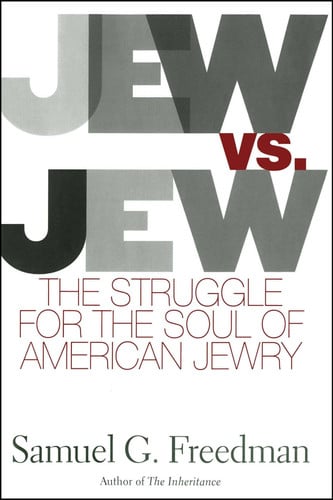
Jew Vs Jew The Struggle For The Soul Of American Jewry

Samuel G. Freedman
At a time when American Jews should feel more secure and cohesive than ever, civil war is tearing apart their community. Congregations, neighborhoods, even families are taking sides in battles about Jewish identity and Jewish authenticity. The conflict pits fundamentalist against secularist, denomination against denomination, even liberal against conservative within each branch of Jewry. Jew vs. Jew tells the story of how American Jewry has increasingly -- and perhaps terminally -- broken apart in the last forty years. Jew vs. Jew stretches in time from 1960 to 2000. It travels the country from Florida to New England, from Los Angeles to the Catskills in New York, from Cleveland to Denver, and it also crosses the ocean to Israel to show how tensions within the Jewish state inflame those among American Jews. The flash-points range from conversion standards to the role of women, from the peace process in Israel to the sexual climate on an Ivy League campus. But behind them all, as Samuel Freedman writes, lie common causes. First, far from unifying American Jews, Israel now divides them on both political and religious grounds. Second, neither America nor the larger world presents Jews with a single enemy against whom to coalesce. Third, and most important, nothing in the Jewish history of persecution, oppression, and exile prepared the Chosen People for the challenge posed by America, the challenge of being absorbed into a tolerant and diverse nation, being accepted so thoroughly that the intermarriage rate tops 50 percent. Jew vs. Jew introduces readers to memorable places and characters. Freedman describes one of the final summers at a Labor Zionist camp in the Catskills whose brand of secular Jewishness is becoming obsolete because Zionism succeeded in creating Israel. He tells the story of Orthodox and Reform Jews in a Cleveland suburb who are fighting about the construction of several synagogues -- and, on a deeper level, about whether unity or pluralism ought to be the goal of Jewish life. He portrays a Florida Jew so violently opposed to the Oslo peace accords that he planted a bomb in a synagogue where Shimon Peres was speaking. He tells about a Los Angeles congregation that spent three years debating whether or not to honor the Biblical matriarchs in its liturgy.We come to know the Long Island neighbors who cannot tolerate sharing even a property line because their versions of Jewish identity are so irreconcilably different. Jew vs. Jew is a work of vigorous reporting, lucid writing, and intellectual curiosity. And even as it chronicles an embittered and polarized community, it refuses to take sides or pass judgment. Instead, with compassion and acuity, Jew vs. Jew bears witness.
Simon & Schuster 2007-09-21 400 pages

The philosophy of Chabad

Mindel, Nissan
Few luminaries in Jewish history, particularly in modern times, have made such a lasting and profound contribution to our spiritual heritage as Rabbi Schneur Zalman of Liadi (1745-1812). His works embrace the entire spectrum of Jewish thought - mysticism, philosophy, psychology, ethics and law - and represent an expression of unparalled creative genius.This richly detailed biography traces Rabbi Schneur Zalman's life from his childhood and formative years to his trials and triumph as a leader who revolutionized Jewish life. It reveals many hitherto unknown facts, and offers the reader considerable insight into his extraordinary strength of character. Vilified by many of his contemporaries and arrested by the Czar, Rabbi Schneur Zalman emerged victorious; today his teachings continue to inspire and vitalize Jewish life all over the world.
Chabad Research Center, Kehot Publication Society 1985 255 pages

Beyond patriarchy: Jewish fathers and families

Fuchs, Lawrence H.
Is patriarchy necessary to ensure responsible fathering? Lawrence H. Fuchs, author of Family Matters, argues that the link between male dominance and fatherhood is no longer iron-clad. Analyzing the universality of patriarchy and its incentives for cultural fatherhood, Fuchs concedes that the importance of biological differences between the sexes was a possible, even plausible, basis for the evolution of patriarchy. But in this timely work he imagines a new paradigm of fatherhood for a post-patriarchal age, one inspired by the history of Jewish patriarchy. Two millennia ago the rabbis established the strategies to curb the extreme abuses of patriarchy found in all civilizations. They did so by according wives significant sexual and economic rights. In the last two centuries as Jews became more integrated into the societies in which they lived, their unique variation of patriarchy was disrupted. Fuchs argues that the Jewish story sets the precedent for fundamental change in the nature of patriarchy today, thus breaking what may have been the evolutionary connection between male dominance and incentives for fatherhood. It is Fuchs's startling conclusion that the Jewish precedent points to the next step in evolution: fathers without patriarchy.
Published by University Press of New England, Brandeis University Press 2000 216 pages

Jewish Bible translations: personalities, passions, politics, progress

Greenspoon, Leonard J.
"Jewish Bible Translations is the first book-length history and analysis of Jewish Bible translations from the third century BCE to our day. Greenspoon delves into the historical, cultural, linguistic, and religious contexts of translations in eleven languages: Arabic, Aramaic, English, French, German, Greek, Hungarian, Italian, Russian, Spanish, and Yiddish"--
The Jewish Publication Society 2020-11 298 pages

The Jew and the other

Benbassa, Esther
In the current situation of polarization in the Middle East, it is easy to lose sight of the fact that a long tradition of dialogue and openness toward the "Other" exists in many strands of Jewish thought. Himself or herself the quintessential Other in a world in which she or he has existed dispersed, in exile, as a minority, the Jew has consistently envisioned the self in relation to surrounding societies. Esther Benbassa and Jean-Christophe Attias show that alterity is a useful and morally compelling notion with which to structure Judaism's historically specific and politically charged encounters with deity, femininity, the Christian West, and the Muslim East. In Benbassa and Attias's view, the Other may be rejected, but it is also a mirror, both reminding the Jew of ethical duties and constituting a source of temptation and danger. Sometimes, the authors find, the Other is the enemy. They note that it is with the enemy that peace is made, peace with the Other and peace with the self. The Jew and the Other , which is an extended commentary on a dozen Biblical verses and which follows the five books of the Pentateuch, offers the history of that encounter as an inextricable part of the Jewish condition and is itself a meditation on this encounter.
Cornell University Press 2004 157 pages

The Pentateuch And The Haftaroth (1889)

Abraham Benisch
The Pentateuch And The Haftaroth is a book written by Abraham Benisch in 1889. The book is a comprehensive guide to the Jewish scriptures, specifically the first five books of the Hebrew Bible, known as the Pentateuch, and the related readings from the Prophets, known as the Haftaroth. The Pentateuch, which includes the books of Genesis, Exodus, Leviticus, Numbers, and Deuteronomy, is considered the foundation of Jewish law and tradition. The Haftaroth, on the other hand, are selections from the books of the Prophets that are read in synagogues on Sabbaths and holidays, and are meant to complement the themes of the Torah portion.Benisch's book provides a detailed analysis of each section of the Pentateuch and the corresponding Haftarah reading, examining the historical context, literary style, and theological themes of each passage. The book also includes translations of the Hebrew text, as well as commentary and interpretation from various Jewish scholars throughout history.Overall, The Pentateuch And The Haftaroth is a valuable resource for anyone seeking a deeper understanding of Jewish scripture and tradition.This scarce antiquarian book is a facsimile reprint of the old original and may contain some imperfections such as library marks and notations. Because we believe this work is culturally important, we have made it available as part of our commitment for protecting, preserving, and promoting the world's literature in affordable, high quality, modern editions, that are true to their original work.
Kessinger Publishing 2009-06 438 pages

Jewish Theology Systematically and Historically Considered

Kaufmann Kohler
"The most important book on Jewish learning of this season, and one of the leading works published within the past few years....The work is a pioneer of its kind, in English as well as in other languages, in so far as it is a 'systematic' study of the subject....All other attempts made hitherto by German and other Jewish scholars at a presentation of Jewish theology have been of a limited scope....Kohler, on the other hand, through writing from the standpoint of the Reformer, does not refrain from giving the viewpoint of Orthodox or Conservative Judaism, which he endeavors to present fairly, howsoever much he disagrees with it....And never does Dr. Kohler better sustain his reputation as a scholar, nor use his vast learning to greater advantage, than in this splendid compendium of Jewish theology....Kohler's work covers the entire range of Jewish theological development, thus justifying its claim that it is a 'systematic' exposition of the subject where other works of a like nature dealt only with a partial survey. A mere glance at the table of contents reveals the immensity of the task performed, while a careful study of the book itself shows that the work is not only all-inclusive and exhaustive, but that it was executed with a charm and grace seldom to be met with in a work of so 'dry' a nature....The book is a truly valuable contribution to the treasure-house of Jewish learning for which its eminent author deserves the gratitude of the Jewish community. It is a book which will be read with pleasure and profit by student and layman alike." -The American Jewish Chronicle "In truth, Dr. Kohler's extended work of Jewish theology, the first of its kind, is an epoch-making contribution not only in the field of Jewish theological study, but also in the larger field of the study of comparative religion. Judging by the many favorable and even enthusiastic criticisms with which the book was received by scholars in the non-Jewish world, we are justified in believing that this work was, and will be instrumental in no small degree in correcting the utterly vicious and false view of Jewish theology, broadcasted in Christian circles.... Father Time often rectifies the encomiastic estimates made of living men so that men who were exalted in their day sink into insignificance and sometimes into oblivion with the passing of those who knew them. In the case of Dr. Kohler, I believe, that we may say, even now, that in the light of his signal and path-finding contributions in the field of Jewish scholarship, his eminence as a scholar in Israel will not be fugitive." -Hebrew Union College Monthly "Of all branches of Jewish study theology was hitherto the most neglected one. While here and there articles were written dealing with certain theological problems, no comprehensive book covering the entire field of Jewish theology and presenting a systematic treatment of the fundamental beliefs and doctrines of Judaism has heretofore appeared. Dr. Kohler's book is the first attempt in this direction....The method of Dr. Kohler in treating the subject of Jewish theology is a very excellent one and should be take as a starting point by future writers on the subject. He divides the subject into three parts God, where all questions relating to God, his nature and relation to the world are discussed; Man, dealing with man's relation to God and the world; and Israel and the Kingdom of God, describing the Jewish Mission and the destiny of Israel in history...The great scholarship displayed in it, the warmth and enthusiasm, the beautiful and simple style...and the zeal and earnestness, as well as the store of knowledge on traditional theology contained in it, will always serve as a source of inspiration to all those who respect earnestness and scholarship no matter how much their opinions may differ from the author's." -The Jewish Forum
CreateSpace Independent Publishing Platform 2017-12-19 588 pages

Mind, body and Judaism: the interaction of Jewish law with psychology and biology

David Shatz,Joel B. Wolowelsky
Sovereignty over the Temple Mount in Jerusalem is one of the most difficult problems in the ongoing Israeli-Palestinian conflict. Although it is a present-day bone of contention, its roots go back into the distant past. Israelites, Christians, and Muslims had fought over this holy site, and built on it a succession of shrines. The book leads the reader into the intricate history, geography, and politics of this unique site. It relates the roots of its holiness, describes the succession of temples built on it, and explains how in the twentieth century its sanctity become interwined with the national aspirations of both Jews and Arabs. It explains why the Temple Mount is considered the holiest site for the Jews, and how it became holy also to the Muslims. The book also explores the role of evangelical Christians, who, alongside a segment of the Jewish population, see the Temple Mount as the center of messianic aspirations, fed by the myriad of Jewish, Christian, and Muslim legends and myths which evolved around it. The book is richly illustrated with photographs, sketches, maps, and plans.
Michael Scharf Publication Trust of Yeshiva University Press 2004 257 pages

Art and Judaism in the Greco-Roman world

Fine, Steven
Art and Judaism During the Greco-Roman Period explores the Jewish experience with art during the Greco-Roman period-from the Hellenistic period through the rise of Islam. It starts from with the premise that Jewish art in antiquity was a "minority" or "ethnic" art and surveys ways that Jews fully participated in, transformed, and at times rejected the art of their general environment. Art and Judaism focuses upon the politics of identity during the Greco-Roman period, even as it discusses ways that modern identity issues have sometimes distorted and at other times refined scholarly discussion of ancient Jewish material culture. Art and Judaism, the first historical monograph on ancient Jewish art in forty years, evaluates earlier scholarship even as it sets out in new directions. Placing literary sources in careful dialogue with archaeological discoveries, this "New Jewish Archaeology" is an important contribution to Judaic Studies, Religious Studies, Art History, and Classics. The Revised Edition includes a new introduction, additional images, and color plates.
Cambridge University Press 2009 271 pages

Reimagining the Bible: the storytelling of the rabbis

Schwartz, Howard
Reimagining the Bible collects a dozen essays by Howard Schwartz. Together the essays present a coherent theory of the way in which each successive phase of Jewish literature has drawn upon and reimagined the previous ones. The book is organized into four sections: The Ancient Models; The Folk Tradition; Mythic Echoes; Modern Jewish Literature and the Ancient Models. Within these divisions, each of the essays focuses on a specific genre, ranging from Torah and Aggadah to Kabbalah, fairy tales, and the modern Yiddish stories of S.Y. Agnon and Isaac Bashevis Singer. Arguing the important thesis that there is a continuity in Jewish literature which extends from the Biblical era to our own times, over a period of more than 3,000 years, this collection also serves as a guide to the history of that literature, and to the genres it comprises.
Oxford University Press 1998 289 pages

German Jews Beyond Judaism

George L. Mosse
Jews were emancipated at a time when high culture was becoming an integral part of German citizenship. German Jews felt a powerful urge to integrate, to find their Jewish substance in German culture and craft an identity as both Germans and Jews. In this reprint edition, based on the 1983 Efroymson Memorial Lectures given at Hebrew Union College-Jewish Institute of Religion in Cincinnati, George Mosse argues that they did this by adopting the concept of Bildung-the idea of intellectual and moral self-cultivation-and combining it with key Enlightenment ideas such as optimism about human potential, individualism and autonomy, and a connection between knowledge and morality through aesthetics. Personal friendships could be devoted to common pursuit of Bildung and become a means of overcoming differences, becoming a means for integration into German society. Mosse traces how Jewish artists, writers, and thinkers actively sought to participate in German culture and communicate these ideals through popular culture, scholarship, and political activity. From the historical biographies, novels, and short stories of Stefan Zweig and Emil Ludwig; to the psychoanalysis of Freud, which sought to subject irrationality to reason; to the revolutionary thought of Walter Benjamin-Jews sought to influence a mass political culture that was fast drifting into irrationality. As individualism was subsumed into nationalism, and eventually the German political right's racist version of nationalism, German-Jewish dialogue became more difficult. Jews remained idealistic as German society became less rational, their ideas corresponded less and less to the realities of German life, and they drifted out of the mainstream into an intellectual isolation. Yet out of this German-Jewish dialogue, what had once been part of German culture became a central Jewish heritage. The ideal of cultivating a personal identity beyond religion and nationality, the liberal outlook on society and politics, and the desire to transcend history by stressing what united rather than divided individuals and nations infiltrated Jewish life became an inspiration for many men and women searching to humanize their society and their own lives. Mosse's lectures trace the emergence of a form of Jewishness which resisted cultural ghettoization in favor of the pursuit of that which is universally human.
Hebrew Union College Press 1997 98 pages

Judaism and the challenges of modern life

Moshe Halbertal,Donniel Hartman
Much more than a particular period in world history, modernity has fundamentally transformed how we think and live, and especially how we understand and relate to religious traditions. As the 'ghetto walls' have fallen, both empirically and metaphorically, Judaism is compelled to compete in an open marketplace of ideas. Jews can no longer count on an assumedly necessary Jewish identity or commitment, nor on the rallying force of anti-Semitism to ensure an individual and collective sense of belonging. Rather Jewish moral, spiritual and historical values and ideas must be read with new eyes and challenged to address modernity's proliferating array of questions and realities. The pertinent questions modern Jewry faces are how to embrace modernity as Jews and what such an embrace means for the meaning and future of Jewish life. This collection of essays, authored by scholars of the Shalom Hartman Institute, addresses three critical challenges posed to Judaism by modernity: the challenge of ideas, the challenge of diversity, and the challenge of statehood, and provides insights and ideas for the future direction of Judaism. Providing readers with new insights into Judaism and the Jewish people in contemporary times, the collection explores a wide range of issues that includes: the significance of Israel for the future of Judaism; the Jewish people as a people; the relationship between monotheism and violence; revelation and ethics; Judaism and the feminist challenge; and Judaism and homosexuality.
Continuum 2007-12-11 192 pages

Confronting Creation How Judaism Reads Genesis

Jacob Neusner
By setting forth the book of Genesis as it is re-presented in the rabbinic statement Genesis Rabbah, Neusner demonstrates the way in which Judaism confronted creation and the Genesis story. In 'Confronting Creation', the author presents a new, analytical translation of Genesis Rabbah, a document that came to closure around 400 C.E. What made that particular time crucial in the life of Israel and the Jewish people is an event that also helped shape the entire history of Western civilization - the rise of Christianity to the status of the official religion of the Roman Empire. The Judaic sages' rereading of the Torah's accounts of the beginning of the world and of Israel took place during a time of significant change in Western civilization. That fact explains the importance of this reading of Genesis to Western civilization, because Genesis Rabbah illuminates the Judaic tradition in contemplating God's creation of the world.
Wipf and Stock Publishers 2004-06-15 400 pages

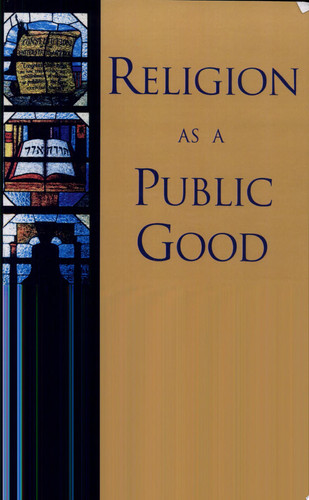
Religion as a public good: Jews and other Americans on religion in the public square

Alan Mittleman
Religion as a Public Good: Jews and Other Americans on Religion in the Public Square explores the often controversial topic of how religion ought to relate to American public life. The sixteen distinguished contributors, both Jewish and Christian, reflect on the topic out of their own disciplines-social ethics, political theory, philosophy, law, history, theology, and sociology. and take a stand based on their religious convictions and political beliefs. The volume is at once scholarly and committed, polemic and civil, reflective and activist. Written in the shadow of 9/11, it invites a new consideration of how religion enhances democratic public life with full awareness of the dangers that religion can sometimes pose. The volume is polemical, as befits the topic, but also civil, as befits a dialogue about an issue of profound significance for democratic citizenship.
Rowman & Littlefield 2003-12-09 336 pages

The rabbi's wife: the rebbetzin in American Jewish life

Schwartz, Shuly Rubin
2006 National Jewish Book Award, Modern Jewish Thought Long the object of curiosity, admiration, and gossip, rabbis' wives have rarely been viewed seriously as American Jewish religious and communal leaders. We know a great deal about the important role played by rabbis in building American Jewish life in this country, but not much about the role that their wives played. The Rabbi’s Wife redresses that imbalance by highlighting the unique contributions of rebbetzins to the development of American Jewry. Tracing the careers of rebbetzins from the beginning of the twentieth century until the present, Shuly Rubin Schwartz chronicles the evolution of the role from a few individual rabbis' wives who emerged as leaders to a cohort who worked together on behalf of American Judaism. The Rabbi’s Wife reveals the ways these women succeeded in both building crucial leadership roles for themselves and becoming an important force in shaping Jewish life in America.
New York University Press 2006-01-01 312 pages

Excommunicating the Faithful Jewish Christianity in the Early Church

Kenneth W. Howard
Excommunicating the Faithful traces the development of Jewish Christianity from among the earliest Jesus followers through its apparent disappearance in the fourth or fifth century. The author's thesis is that among Jewish Christians in the early Church, there existed at least one Jewish Christian sect whose theology stood within the acceptable boundaries of orthodoxy at that time and existed through at least the fifth century, at which point it was declared heretical by the Church Fathers and eventually died out despite the fact that it considered itself part of the greater Church. The author's thesis also suggests that the increasing antipathy of the Church toward Jewish Christianity was the result of a variety of interrelated influences operating over several centuries. Some of these influences included the changing demographics of the Church and the accompanying clash of cultures; the increasing isolation of Jewish Christianity from the predominantly Gentile Church; power struggles between competing Christian communities in Palestine, as well as Rome's interest in asserting its primacy; and theological and pastoral concerns, which were well-intentioned but resulted in increasingly narrow views of orthodoxy and orthopraxis; and lasting anti-Jewish sentiments throughout the Empire, some of which still exist today.
Global Center for Religious Research, LLC 2022-02 128 pages