492 results for "Leadership"

Jack Kemp: the bleeding-heart conservative who changed America

Kondracke, Morton,Barnes, Fred
"THE PURPOSE OF POLITICS IS NOT TO DEFEAT YOUR OPPONENT AS MUCH AS IT IS TO PROVIDE SUPERIOR LEADERSHIP AND BETTER IDEAS THAN THE OPPOSITION." --JACK KEMP The late 1970s were miserable for America. It was the post-Vietnam, post-Watergate era, a time of high unemployment, ruinous inflation, gasoline lines, Communist advances, and bottomed-out U.S. morale. In the 1980s, it all turned around: "stagflation" ended and nearly two decades of prosperity ensued. The Soviet Union retreated, then collapsed. America again believed in itself. And around the world, democratic capitalism was deemed "the end of history." Ronald Reagan's policies sparked the American renaissance, but the Gipper's leadership is only part of the story. The economic theory that underpinned America's success was pioneered by a star professional quarterback turned self-taught intellectual and "bleeding-heart conservative": Jack Kemp. Kemp's role in a pivotal period in American history is at last illuminated in this first-ever biography, which also has lessons for the politics of today. Kemp was the congressional champion of supply-side economics--the idea that lowering taxes would foster growth. Even today, almost no one advocates a return to a top income tax rate of 70 percent. Kemp didn't just challenge the Democratic establishment. He also encouraged his fellow Republicans to be growth (not austerity) minded, open their tent to minorities and blue-collar workers, battle poverty and discrimination, and once again become "the party of Lincoln." Kemp approached politics the same way he played quarterback for the Buffalo Bills: with a refusal to accept defeat. Yet he also was incapable of personal attack, arguing always on the level of ideas. He regarded opponents as adversaries, not enemies, and often cooperated with them to get things done. Despite many ups and downs, including failed presidential and vice-presidential bids, he represented a positive, idealistic, compassionate Republicanism. Drawing on never-published papers and more than one hundred Kemp Oral History Project interviews, noted journalists Morton Kondracke and Fred Barnes trace Kemp's life, from his childhood through his pro football career to his influential years as a congressman and cabinet secretary. As the American Dream seems to be waning and polarized politics stifles Washington, Kemp is a model for what politics ought to be. The Republican party and the nation are in desperate need of another Kemp.
Sentinel 2015 390 pages

Republic of denial: press, politics, and public life

Janeway, Michael
This thought-provoking book offers the most insightful critique of the relationship among the press, politics, and public life in decades. Disdain for politics today in the United States is almost universal. Condemnation of the press is rampant as well. Until we understand the modern condition of politics and journalism--and the cultural context in which they interact--says Michael Janeway, there's small hope of either recovering its standing. Drawing on years of experience at the top levels of the news business and in politics and government, Janeway provides an integrated, insider's critique of the profound changes in each of these professional worlds, showing how trends in each have contributed to deepening public alienation. From its confident post-World War Two era of world leadership, the United States entered a difficult period of turbulence and reversals in the 1960s and 1970s. With wit, clarity, and an eye for offbeat cultural indicators, Janeway examines the full complex of forces that have corroded our press, politics, and public life since then. The result, he argues, is a loss of substance and structure in public life as well as citizen connection to it, a vacuum all too easily filled by political entertainers, shallow coverage of "character," and--engulfing the nation in convulsive crisis for a year of its history--the politics of scandal. None of today's proposed remedies for the failings of our press or politcal system is adequate, Janeway argues, for none take full account of the integral relationship between the two spheres. In the absence of recognition of its buried democratic crisis, Janeway concludes, the United States has become a "republic of denial."
Yale University Press 2001 192 pages

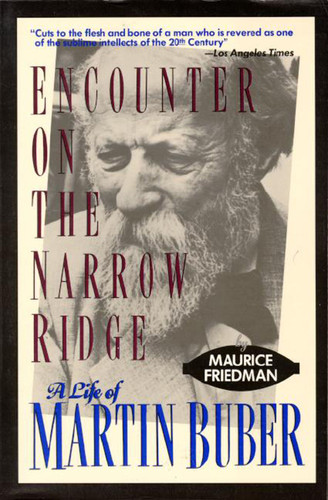
Encounter on the Narrow Ridge A Life of Martin Buber

Maurice Friedman
Martin Buber's stature as the most significant Jewish religious philosopher of the twentieth century is reinforced by his accomplishments and renown in areas as diverse as Hasidism, psychotherapy, education, folklore, and politics. His classic, I and Thou, is known and studied all over the world. In this complete and masterful biography, Maurice Friedman traces the interweaving of Buber's wholehearted engagement with world events and crises and the evolution of his unique and influential philosophy. We see the impact of World War I on the young thinker; his work in education, community, and politics between the wars; his leadership of the spiritual resistance to the Nazis in Hitler's Germany; and his more than forty years of fighting for Jewish-Arab understanding. In addition, we see Buber interact with Heidegger, Sartre, Jung, Ben Gurion, Hesse, Rosenzweig, and Hammarskjold. Through his close relationship with Buber and recent access to forty-five thousand unpublished letters, Maurice Friedman recreates Buber's vitality, his philosophy of dialogue, and his spirituality based on a personal relationship with God. Encounter on the Narrow Ridge delivers the essential spontaneity of a great man who saw in every encounter a focal point for human growth.
Paragon House 1998-06-15 496 pages

The king without a kingdom

Druon, Maurice
"'This was the original GAME OF THRONES' George R.R. Martin. Available for the first time in English, THE KING WITHOUT A KINGDOM is the seventh and final volume of The Accursed Kings series. The reign of the Capetian kings has ended and John II, 'The Good', takes the throne. Under the leadership of this vain, cruel, incompetent monarch The Hundred Years War escalates and England and France begin to tear each other apart. Warring factions plunder the land, famine threatens the people and the Black Death spreads far and wide. France is bleeding to death around the new king..."--förlagstext
Harper 2015 346 pages

The socialist challenge today: Syriza, Corbyn, Sanders

Panitch, Leo,Gindin, Sam,Maher, Stephen
Leo Panitch, Sam Gindin, and Stephen Maher provide a newly updated and expanded primer for twenty-first century democratic socialists. The Socialist Challenge Today presents an essential historical, theoretical, and critical perspective for understanding the potential as well as the limits of three important recent phenomena: the Sanders electoral insurgency in the United States; the Syriza experience in Greece; and Corbyn's leadership of the Labour Party in the United Kingdom. The renowned coauthors compellingly convey the importance of developing strategic and practical capacities to democratically transform state structures so as to render them fit for realizing collective democracy, social equality, sustainable ecology, and human solidarity.
Haymarket Books 2020-04-28 119 pages

The Heir Apparent

Joel Rosenberg
Karl Cullinane and his fellow Earth--exiles Andrea, Ahira, Walter and Lou had succeeded beyond their wildest expectations in the years since a wizard's spell hadd cast them into an alternate world where magic and dragons were real. Now Karl was Emperor and his son Jason was of an age to begin learning the realities if war and leadership. And with the aid of dwarves, elves, humans, and one sarcastic dragon, Karl and his friends had freed many from the evil specter of slavery and were pledged to fight till slavery was at an end. But their actions had made them some extremely powerful enemies, chief among whom was Ahrmin of the Slaver's Guild. And for Ahrmin the time of final reckoning had at last arrived. With or without the aid of the Guild, he would draw sword and take blood vengeance on Karl and Jason Cullinane and all they held dear.......
New American Library 1987 319 pages

The economic history of the Jewish people

Attali, Jacques
The story many have told can lead one to believe in the existence of a united Jewish people: rich, powerful, placed under centralized command and responsible for establishing a worldwide power strategy through money. Such a belief would merge with the fantasies that have spread across every century from Trajan to Constantine, from Matthew to Luther, from Marlow to Voltaire, from the Protocol of the Elders of Zion to Mein Kampf, to all that which is propagated today via the anonymity of the Internet. This is the story ripe to be challenged and retold. Herein lies the history of the relationship between the Jewish people, money and the world at large. The author is well aware of the subversive nature of this subject. It is a topic that has unleashed so many controversies and brought about so many massacres as to have become a veritable taboo, a topic that must not be evoked under any circumstance for fear of provoking some age-old catastrophe. Today, no one dares write on this topic, as if centuries of study have served no purpose other than to fuel book burning. It remains nevertheless in the best interest of modern mankind to understand how those who discovered monotheism also founded the ethics of capitalism, how some became its primary brokers and leading bankers, while others its most unrelenting enemy. In this book the author tackles the facts and the lies of the history of the relationship between the Jewish people, money and the world at large. "It seems essential that our world, and Jewish people themselves, face a part of their history that they may not care for but of which they have every reason to be proud." REVIEWS "The Economic History of the Jewish People by Jacques Attali is set to be as controversial as it is well documented and thoroughly researched by one of the foremost financial authorities of Europe, the Head of the Commission to Promote Economic Growth in France. Attali has written numerous books and knows this subject thoroughly. He has tackled it from the standpoint of history, myth, and dirty stories, proving some and dispelling others with facts. He has traced the economic experiences, leadership, and fall of the Jewish people from 2,000 years BC until present upheavals of economy worldwide. The book is fascinating for anyone interested in history, finance, or the Jewish people. It is an eye-opener in some instances and shows the influence, admitted or behind-the-scenes, which the Jewish people have had on the entire history of our world through the ages and how they have been rewarded or persecuted along the way for their use of any kind of tender (legal or illegal) around the world for 4,000 years. Really interesting and so very well written." Bonnie Neely, Amazon Top 1000 Reviewer, 2010/05/24
Eska Pub 2010 572 pages

Ambassador Morgenthau's Story A Personal Account of the Armenian Genocide

Henry Morgenthau
The evocative, first-hand accounts of American ambassador Henry Morgenthau regarding the Armenian genocide are one of the most thorough, authoritative sources on the atrocities. This book contains the full accounts of Henry Morgenthau throughout his posting in Constantinople, Turkey. At the time the Ottoman Empire was on the brink of collapse; amid the chaos and upheaval began the Armenian genocide, a ruthless campaign of targeted killing which occurred over eight years, from 1915 to 1923. In his role as ambassador, Henry Morgenthau would receive regular, commonly excruciating reports of mass murders and forced deportations; revulsed, he moved to prevent further such atrocities taking place. Despite the efforts of Henry Morgenthau to convince his superiors in Washington to intervene on humanitarian grounds, his pleas fell on deaf ears. The masses of evidence he personally reviewed and verified are related in this book, as are many of the high-level meetings Morgenthau personally held with Ottoman leaders in an attempt to stem the holocaust of the Armenian people. Stonewalled, dismissed and waved away at every turn, the frustrations Morgenthau felt at the futility are amply expressed in this emotional and sometimes harrowing chronicle. The many obstructions he encountered with the Ottoman leadership led Morgenthau to resign his post in 1916. He spent the final three decades of his life tirelessly campaigning on behalf of the oppressed and victimized Ottoman peoples. As well as publishing this book plus hundreds of newspaper and magazine articles, Henry Morgenthau Sr. raised enormous sums for the displaced Armenians reeling from the horrific genocide. Recognized and lauded for his humanitarian work, he would represent the United States at the Second Geneva Conference in 1932.
Createspace Independent Publishing Platform 2017-04-11 204 pages

The fall of the University of Cape Town: Africa's leading university in decline

Benatar, David
"Destructive forces have been eroding the University of Cape Town, Africa's leading university. This book tells the sad, true tale of what has been transpiring. It is a saga of lunacy, criminality, pandering, and identity politics. The mad and the bad - the deranged, deluded, the depraved - have been granted endless latitude in bullying and abusing others. The decline began in 2015 with the Rhodes Must Fall protest that resulted in the offending statue's removal within a month, and which spawned similar protests abroad. Emboldened by their local success, the protestors issued new and ever-increasing demands later that year and then again in 2016 and 2017. Their methods also became criminal - including intimidation, assault, and arson. The university leadership capitulated to this behaviour, and this fostered a broader and now pervasive toxic environment within the institution." --
Politicsweb Publishing 2021 481 pages

We the people. Volume 3. The Civil Rights revolution

Ackerman, Bruce A.
The Civil Rights Revolution carries Bruce Ackerman’s sweeping reinterpretation of constitutional history into the era beginning with Brown v. Board of Education . From Rosa Parks’s courageous defiance, to Martin Luther King’s resounding cadences in “I Have a Dream,” to Lyndon Johnson’s leadership of Congress, to the Supreme Court’s decisions redefining the meaning of equality, the movement to end racial discrimination decisively changed our understanding of the Constitution. “The Civil Rights Act turns 50 this year, and a wave of fine books accompanies the semicentennial. Ackerman’s is the most ambitious; it is the third volume in an ongoing series on American constitutional history called We the People . A professor of law and political science at Yale, Ackerman likens the act to a constitutional amendment in its significance to the country’s legal development.” —Michael O’Donnell, The Atlantic “Ackerman weaves political theory with historical detail, explaining how the civil rights movement evolved from revolution to mass movement and then to statutory law...This fascinating book takes a new look at a much-covered topic.” —Becky Kennedy, Library Journal
The Belknap Press of Harvard University Press 2018-07-09 432 pages

The empire and the five kings: America's abdication and the fate of the world

Lévy, Bernard-Henri
"The Empire and the Five Kings is a cri de coeur that draws upon lessons from history and the eternal touchstones of human culture to reveal the stakes facing the West as America retreats from its leadership role, a process that did not begin with Donald Trump's presidency and is not likely to end with him. The crisis is one whose roots can be found as far back as antiquity and whose resolution will require the West to find a new way forward if its principles and values are to survive."--Jacket flap.
Henry Holt and Company 2019 261 pages

The Eagle and the Rising Sun: the Japanese-American war, 1941-1943, Pearl Harbor through Guadalcanal

Schom, Alan
On Saturday, August 2, 1941, the Washington Post reported that President Franklin D. Roosevelt would depart the next day for a fishing vacation aboard his yacht, Potomac. By the morning of August 5, the Potomac was sailing toward the fishing waters off Cape Cod -- but the president was not on board. Having quietly disembarked in the middle of the night, the president, now joined by his top military advisors, was headed for Newfoundland, where the U.S. and British governments would meet in a secret summit to coordinate their military efforts, although the United States had yet to declare war on Germany. The British were appalled at the state of American preparedness, one British colonel remarking, "They have a long way to go before they can play any decisive part in the war." But ready or not, the United States would be catapulted into World War II within a matter of months. Alan Schom's superb histories and biographies have been lauded for their dramatic sweep, their focus on extraordinary personalities, and their refreshingly iconoclastic perspective. Schom begins this magisterial account of World War II in the Pacific by demonstrating an ironic paradox: on one hand, the American government and people were as inadequately prepared for war as any major power ever has been; on the other, the Japanese high command plunged headlong into the Pacific campaign despite clear evidence -- from their own analysts -- that Japan had too little oil and too feeble an economy to prevail against the United States. It was a war that should not have been fought. Schom recounts a tense saga of diplomatic maneuvering, strategic blunders, and pivotal successes played out in the halls of the White House, Downing Street, and the Imperial Palace, as well as on the seas and shores of the Pacific. Key figures in the war come vividly to life in a series of brilliant biographical sketches: Emperor Hirohito, a devotee of Western pursuits such as golf and jazz, who hungered to expand Japan's global reach; the destructively egotistical General Douglas MacArthur, whose splendid achievements in World War I stood in stark contrast to his incompetent leadership in the Philippines; Rear Admiral Kelly Turner, whose realism and tactical savvy played a crucial role in turning the tide of the war; and the cool-headed Admiral Tanaka Raizo, who repeatedly slipped through the Allied net, transporting troops and supplies to and from Guadalcanal. The Eagle and the Rising Sun embraces the broad strategic concerns of the war and the telling details and turning points of individual engagements. As Rear Admiral Thomas Marfiak, Ret., CEO and publisher of the U.S. Naval Institute, writes in the Foreword: "From time to time, we are privileged to be given extraordinary insights into the history of our age. Alan Schom has given us a tapestry, into which he has woven figures of immense proportions, yet he has not lost sight of their humanity. He writes ... in the grand tradition of Barbara Tuchman's The Guns of August." Book jacket.
W.W. Norton 2004 540 pages

The Koch Papers My Fight Against Anti-Semitism

Edward I. Koch,Ed Koch,Rafael Medoff
For more than three decades, Ed Koch has been one of America's most interesting and outspoken political figures. In this provocative new book, Koch with Rafael Medoff guides readers through the major battles in his life-long fight against anti-Semitism. Interviews, speeches, new essays, never-before published personal correspondence, and more highlight his leadership--on campuses, in the media, on the streets of New York City, and in the halls of power in Washington, DC. The book also features personal letters from Henry Louis Gates, former President George Bush, and other prominent figures. Koch will reveal startling information for the first time here, and his writings are controversial, piercing, teasing, and questioning. This book will ignite discussion for years to come
Macmillan 2009-03-17 256 pages

The genius of the beast: a radical re-vision of capitalism

Bloom, Howard K.
Is global capitalism on its last legs? Is the era of American leadership over? Has the West begun a decline into a new Dark Age? Does American civilization deserve to survive? These are the unnerving questions raised by the Great Crash of 2009. This book presents a radically new answer, insisting that global society has only begun to realize its full potential. Author HowardBloom argues that there's a hidden mandate beneath the surface of capitalism: "It's struggling to whisper and rumble its message to you and me. That hidden imperative can lift us from economic crisis, can make us a leader in the next-generation economy, and can dramatically upgrade our ability to empower our fellow human beings." Bloom sees crisis as opportunity, opportunity for the whole human race.In more than eighty short, fast chapters, insights appear suddenly, like the quick bursts of flashbulbs, taking the reader on a sweeping tour of human history, from the Stone Age to the present. Every chapter conveys a radically new way to see the astonishing mechanism we call "Western Civilization." Bloom marvels at how humans have turned toxic waste into food and fuel, trash into treasure, and garbage into gold. He shows how we've produced material miracles based on immaterial things-passion, persistence, and fantasy. He shows that what many regard as the end is just the beginning. The beginning of something you've never before imagined. The author explains why the secret to capitalism's next great leap does not lie in new financial tricks, but in tapping things right under our noses in radically new ways-that is, tapping our imagination, our desire to feel useful, our desire to help others, and our desire to be recognized for contributing to the welfare of humanity. The key to next-generation capitalism lies in a big-picture view that's utterly unlike anything you've previously perceived. A big-picture view that will startle you. A big-picture view with which you can ignite the world, get a new handle on your life, and help transform society. This brilliant, inspirational work of daring ideas and breathtaking research offers more than hope. It offers unseen levels of understanding. Understanding that can literally redefine what it means to be a human being.
Prometheus Books 2010 607 pages

Political leadership and charisma: Nehru, Ben-Gurion, and other 20th century political leaders

Brecher, Michael
This book is unique in illuminating and comparing the charismatic role of two political leaders, Jawaharlal Nehru and David Ben-Gurion, along with assessments of many other 20th century political leaders. Its aim is to enrich our knowledge of an important dimension of global politics: charismatic leadership. The central role of political leaders in shaping the behavior of states has been universally recognized since the political systems of antiquity in East Asia, the Middle East, and Europe. With the massive increase of independent states since the end of World War II, from 55 initial members of the United Nations to more than 200 today, and especially the emergence of awesome weapons of mass destruction, the centrality of political leaders in the survival of the planet has grown exponentially. Both India and Israel have experienced the crucial role of charismatic leaders, Nehru and Ben Gurion, who dominated their states and societies for a near-identical formative period in their political independence, 1947-64 and 1948-63 respectively, as charismatic leaders. Their impact, Brecher shows, extended far beyond their states to both their geographic regions and global politics.
Springer 2016-10-05 276 pages

Revolutionary constitutions: charismatic leadership and the rule of law

Ackerman, Bruce A.
Populism is a threat to the democratic world, fuel for demagogues and reactionary crowds--or so its critics would have us believe. But in his award-winning trilogy We the People, Bruce Ackerman showed that Americans have repeatedly rejected this view. Now he draws on a quarter century of scholarship in this essential and surprising inquiry into the origins, successes, and threats to revolutionary constitutionalism around the world. He takes us to India, South Africa, Italy, France, Poland, Burma, Israel, and Iran and provides a blow-by-blow account of the tribulations that confronted popular movements in their insurgent campaigns for constitutional democracy. Despite their many differences, populist leaders such as Nehru, Mandela, and de Gaulle encountered similar dilemmas at critical turning points, and each managed something overlooked but essential. Rather than deploy their charismatic leadership to retain power, they instead used it to confer legitimacy to the citizens and institutions of constitutional democracy. Ackerman returns to the United States in his last chapter to provide new insights into the Founders' acts of constitutional statesmanship as they met very similar challenges to those confronting populist leaders today. In the age of Trump, the democratic system of checks and balances will not survive unless ordinary citizens rally to its defense. Revolutionary Constitutions shows how activists can learn from their predecessors' successes and profit from their mistakes, and sets up the next volume in Ackerman's distinguished multivolume work, which will address how elites and insiders coopt and destroy the momentum of revolutionary movements.--
The Belknap Press of Harvard University Press 2019-05-13 457 pages

Don't wait for the next war: a strategy for American growth and global leadership

Clark, Wesley K.
With the end of the Cold War came not the end of history, but the end of America's sense of its strategic purpose in the world. Then, after a decade of drift, the US was violently dragged back into international conflict. Its armed forces responded magnificently but its leaders' objectives were substantially flawed. We fought the wrong war—twice—for reasons that were opaque, and few American citizens understood the cause for which their sons and daughters were fighting and dying. War is a poor substitute for strategic vision, and decisions made in the heat of imminent conflict are often limited by the emotions of the moment. In Don't Wait for the Next War , Wesley K. Clark, a retired four-star general of the US army and former Democratic candidate for president, presents a compelling argument for continued American global leadership and the basis on which it can succeed—a new American strategy. America needs both new power and deeper perspective. The platform for American leadership is to use America's energy resources to spark sustainable economic growth, building new strength to deal with pressing domestic issues like the deficit as well as the longer term challenges to US security—terrorism, cyber threats, the next financial crisis, China's rising power, and climate change. Such a strategy is not only achievable but essential, and it is urgently needed. This is the true test of American leadership for the next two decades, but it must start now, so America has the power and vision to deal with the acute crises that will inevitably come—in the Mideast, Europe, or Asia.
PublicAffairs 2016-06-14 272 pages