580 results for "World History"

Dirty blonde: the diaries of Courtney Love

Love, Courtney
A multi-textual memoir chronicling the life of one of our most potent pop iconsGroundbreaking rock musician. Award-winning actress. Perceptive songwriter and author. Mother. Wife of a rock god. Fashionista and trendsetter. Provocateur. In each and every one of these roles Courtney Love has demonstrated a wholehearted commitment to her art, and an intense drive and a lust for life that have made her a star and a celebrity icon—but have also led her into some unwise, uncharted, and even dangerous territory. Simultaneously candid and enigmatic, Love has a mordant wit and vivid intelligence matched in intensity only by the extraordinary life she has led, from a bleak early childhood through great fame and terrible heartbreak to the present day. By turns exhilarating and unsettling, this is a story told for the first time in Dirty Blonde . Composed of an astonishing and eclectic collection of deeply personal artifacts including personal letters, childhood records, poetry, diary entries, song lyrics, fanzines, show flyers, other original writings, and never-before-seen photographs, Dirty Blonde leads us through the unimaginable highs and the despairing lows of one of the most compelling and creative figures in the world of popular culture. Through these diaries we see Love’s accomplishments, her mistakes, her history, and her bright future in a whole new light. From her upbringing in Oregon through her years living in Japan, New Zealand, and London, from her career highs with Hole and as a Hollywood leading lady to her personal heartbreak and struggle, Dirty Blonde is Love laid bare—a wholly fascinating portrait of a fierce and insightful woman with an unblinking worldview and a determination to express herself no matter the cost.
Faber and Faber 2006-10-31 292 pages

Getting to the heart of the matter: my 36 years in the Senate

Levin, Carl
"Representing Michigan for thirty-six years in the U.S. Senate, Carl Levin, the longest-serving senator in Michigan history, was known for his dogged pursuit of the truth, his commitment to holding government accountable, and his basic decency. Getting to the Heart of the Matter: My 36 Years in the Senate is his story - from his early days in Detroit as the son of a respected lawyer to the capstone of his career as chair of both the Senate Armed Services Committee and the Senate Permanent Subcommittee on Investigations. Levin's career placed him at the center of some of our nation's most critical points in modern times: from the aftermath of the 1967 Detroit riots, to the Clinton impeachment, through 9/11 and the wars in Iraq and Afghanistan, and the 2008 financial crisis. He met with numerous world leaders, including Egypt's Anwar Sadat and China's Jiang Zemin. Getting to the Heart of the Matter recounts Levin's experiences, thoughts, and actions during these historic moments. Consisting of seventeen chapters, the book takes the reader through Levin's early life in Detroit of the 1940s, 50s, and 60s where he met his wife, started a family, practiced law and served as the first General Counsel for the newly created Michigan Civil Rights Commission and the chief appellate defender for Detroit's Legal Aid Office. Elected to the Detroit City Council in 1969, where Levin served for eight years including four as Council president, the book describes how his fight against the Department of Housing and Urban Development's devastating housing practices in the neighborhoods of Detroit led him to run for the U.S. Senate with a pledge to make government work more effectively. Winning election six times, Levin had an illustrious career in the Senate where he challenged leaders in government and the private sector for the greater good of the nation. Levin describes how, as a Democrat, throughout his time in the Senate, he worked with Republican senators who often held different policy positions in order to find common ground to achieve national goals, and how he and his Senate staff searched for creative solutions to trade issues, support for the auto industry and manufacturing sector, U.S. military action in Iraq and Afghanistan, and efforts to protect the Great Lakes and the environment, among many other issues. Levin's hope in writing this memoir is that by sharing his deeply held beliefs about the responsibility of elected officials, the book will serve as a resource for people beginning a career in, or contemplating running for, public office. Readers with an interest in politics, history, facts, and perseverance will find kinship in this book" -- provided by the publisher
Wayne State University Press 2021 338 pages

GI Jews: how World War II changed a generation

Moore, Deborah Dash
Whether they came from Sioux Falls or the Bronx, over half a million Jews entered the U.S. armed forces during the Second World War. Uprooted from their working- and middle-class neighborhoods, they joined every branch of the military and saw action on all fronts. Deborah Dash Moore offers an unprecedented view of the struggles these GI Jews faced, having to battle not only the enemy but also the prejudices of their fellow soldiers. Through memoirs, oral histories, and letters, Moore charts the lives of fifteen young Jewish men as they faced military service and tried to make sense of its demands. From confronting pork chops to enduring front-line combat, from the temporary solace of Jewish worship to harrowing encounters with death camp survivors, we come to understand how these soldiers wrestled with what it meant to be an American and a Jew. Moore shows how military service in World War II transformed this generation of Jews, reshaping Jewish life in America and abroad. These men challenged perceptions of Jews as simply victims of the war, and encouraged Jews throughout the diaspora to fight for what was right. At the same time, service strengthened Jews' identification with American democratic ideals, even as it confirmed the importance of their Jewish identity. GI Jews is a powerful, intimate portrayal of the costs of a conflict that was at once physical, emotional, and spiritual, as well as its profound consequences for these hitherto overlooked members of the "greatest generation."
Belknap 2006-04 368 pages

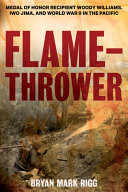
Flamethrower: Medal of Honor recipient Woody Williams, Iwo Jima, and World War II in the Pacific

Rigg, Bryan Mark
"Imagine strapping on a highly flammable 70-pound pack and entering combat as a surefire walking target-and you'd only begin to understand the job, and the horror, of Marine Corps flamethrower man. That's precisely what Hershel "Woody" Williams did in World War II, most importantly in February 1945 on Iwo Jima, one of the Pacific War's toughest battles. A few days into the battle, Marines were fighting hard for an airfield, and his captain asked Woody if he could do anything. He responded, "I'll try"-and for the next four hours, he virtually singlehandedly took on and ultimately destroyed seven enemy pillboxes and helped secure the airfield. Accomplished military historian Bryan Mark Rigg reconstructs Williams' remarkable story, from his youth in West Virginia to his experiences on Guadalcanal, Saipan, Guam, and most significantly Iwo Jima. In Rigg's telling, Williams's Medal of Honor action is not "just" a brave deed, but one of only a few strategically significant brave deeds-one that secured a strategic objective during a major campaign. Rigg tells Williams' story vividly, and objectively, and places it in the context of the broader Pacific theater of World War II."--
Stackpole Books 2020 544 pages

The Greatest Story Ever Sold: The Decline and Fall of Truth in Bush's America

Rich, Frank
Demonstrating the candor and conviction that have made him one of our most trusted and incisive public voices, The New York Times columnist Frank Rich brilliantly and meticulously illuminates the Bush administration?s disturbing love affair with ?truthiness.? Rich?s step-by-step chronicle shows how, in the wake of 9/11, a propaganda president and his advisors misled a nation into war in Iraq and how the bungled aftermath, a Washington leak, and a devastating hurricane at long last revealed the lies in a story that had been so effectively sold to the nation as God-given patriotic fact.
Penguin Books 2007-08-28 352 pages

The era: 1947-1957, when the Yankees, the Giants, and the Dodgers ruled the world

Kahn, Roger
Celebrated sports writer Roger Kahn casts his gaze on the golden age of baseball, an unforgettable time when the game thrived as America's unrivaled national sport. The Era begins in 1947 with Jackie Robinson changing major league baseball forever by taking the field for the Dodgers. Dazzling, momentous events characterize the decade that followed-Robinson's amazing accomplishments; the explosion on the national scene of such soon-to-be legends as Mickey Mantle, Willie Mays, Bobby Thomson, Duke Snider, and Yogi Berra; Casey Stengel's crafty managing; the emergence of televised games; and the stunning success of the Yankees as they play in nine out of eleven World Series. The Era concludes with the relocation of the Dodgers from Brooklyn to Los Angeles, a move that shook the sport to its very roots.
University of Nebraska Press 2002-03-01 376 pages

Slavery in White and Black: class and race in the Southern slaveholders' new world order

Fox-Genovese, Elizabeth
Southern slaveholders proudly pronounced themselves orthodox Christians, who accepted responsibility for the welfare of the people who worked for them. They proclaimed that their slaves enjoyed a better and more secure life than any laboring class in the world. Now, did it not follow that the lives of laborers of all races across the world would be immeasurably improved by their enslavement? In the Old South but in no other slave society a doctrine emerged among leading clergymen, politicians, and intellectuals -- "Slavery in the Abstract," which declared enslavement the best possible condition for all labor regardless of race. They joined the Socialists, whom they studied, in believing that the free-labor system, wracked by worsening class warfare, was collapsing. A vital question: to what extent did the people of the several social classes of the South accept so extreme a doctrine? That question lies at the heart of this book.--Publisher.
Cambridge University Press 2008 314 pages

To begin the world anew: the genius and ambiguities of the American founders

Bailyn, Bernard
Two time Pulitzer Prize-winning historian Bernard Bailyn has distilled a lifetime of study into this brilliant illumination of the ideas and world of the Founding Fathers. In five succinct essays he reveals the origins, depth, and global impact of their extraordinary creativity. The opening essay illuminates the central importance of America’s provincialism to the formation of a truly original political system. In the chapters following, he explores the ambiguities and achievements of Jefferson’s career, Benjamin Franklin’s changing image and supple diplomacy, the circumstances and impact of the Federalist Papers , and the continuing influence of American constitutional thought throughout the Atlantic world. To Begin the World Anew enlivens our appreciation of how America came to be and deepens our understanding of the men who created it.
Alfred A. Knopf 2003 183 pages

Written in stone: public monuments in changing societies

Levinson, Sanford
Twentieth Anniversary Edition with a new preface and afterword From the removal of Confederate monuments in New Orleans in the spring of 2017 to the violent aftermath of the white nationalist march on the Robert E. Lee monument in Charlottesville later that summer, debates and conflicts over the memorialization of Confederate “heroes” have stormed to the forefront of popular American political and cultural discourse. In Written in Stone Sanford Levinson considers the tangled responses to controversial monuments and commemorations while examining how those with political power configure public spaces in ways that shape public memory and politics. Paying particular attention to the American South, though drawing examples as well from elsewhere in the United States and throughout the world, Levinson shows how the social and legal arguments regarding the display, construction, modification, and destruction of public monuments mark the seemingly endless confrontation over the symbolism attached to public space. This twentieth anniversary edition of Written in Stone includes a new preface and an extensive afterword that takes account of recent events in cities, schools and universities, and public spaces throughout the United States and elsewhere. Twenty years on, Levinson's work is more timely and relevant than ever.
Duke University Press 2018-10-26 206 pages

Confidence Men

Ron Suskind
In this gripping book, Pulitzer Prize–winning journalist Ron Suskind tells the complete story of the financial meltdown in the United States and an untested new president charged with commanding Washington, taming Wall Street, rescuing an economy on the verge of collapse and restoring the confidence of a shaken nation. Suskind moves from the frenzied trading floors of lower Manhattan to the power corridors inside the Beltway and introduces a larger-than-life cast of politicians and advisors, titans of high finance, reformers, lobbyists and others who faced a crisis that threatened not only a nation, but the entire world. Based on hundreds of hours of interviews and exhaustive research, filled with piercing insight and startling disclosures, Suskind’s eye-opening book goes beyond the headlines and previous accounts, bringing into focus the unprecedented struggle between Wall Street and Washington, between hope and fear, that continues to roil the country.
HarperCollins 2012-06-19 528 pages

The fall of the house of Roosevelt: brokers of ideas and power from FDR to LBJ

Janeway, Michael
In the 1930s a band of smart and able young men, some still in their twenties, helped Franklin D. Roosevelt transform an American nation in crisis. They were the junior officers of the New Deal. Thomas G. Corcoran, Benjamin V. Cohen, William O. Douglas, Abe Fortas, and James Rowe helped FDR build the modern Democratic Party into a progressive coalition whose command over power and ideas during the next three decades seemed politically invincible. This is the first book about this group of Rooseveltians and their linkage to Lyndon Johnson's Great Society and the Vietnam War debacle. Michael Janeway grew up inside this world. His father, Eliot Janeway, business editor of Time and a star writer for Fortune and Life magazines, was part of this circle, strategizing and practicing politics as well as reporting on these men. Drawing on his intimate knowledge of events and previously unavailable private letters and other documents, Janeway crafts a riveting account of the exercise of power during the New Deal and its aftermath. He shows how these men were at the nexus of reform impulses at the electoral level with reform thinking in the social sciences and the law and explains how this potent fusion helped build the contemporary American state. Since that time efforts to reinvent government by "brains trust" have largely failed in the U.S. In the last quarter of the twentieth century American politics ceased to function as a blend of broad coalition building and reform agenda setting, rooted in a consensus of belief in the efficacy of modern government. Can a progressive coalition of ideas and power come together again? The Fall of the House of Roosevelt makes such a prospect both alluring and daunting.
Columbia University Press 2004 284 pages

Jefferson measures a moose

Rockliff, Mara
Thomas Jefferson was wild about numbers. He was constantly counting, measuring, and observing things that caught his interest. He loved sharing his discoveries and reading the discoveries of others. But when a famous Frenchman published a book about America, Jefferson was appalled: all the information in the book was wrong. The author insisted that America was a wretched, dismal place, where birds could not sing, dogs could not bark, and everything and everyone was puny and weak. Thomas Jefferson resolved to set the record straight - with numbers - and prove to the world that the new nation was worthy of investment.
Candlewick Press 2020-08-04 48 pages

America the beautiful: the stirring true story behind our nation's favorite song

Sherr, Lynn
We've all sung it a thousand times, and most of us know at least the first verse by heart. "America the Beautiful" has been called a hymn, a prayer, even the "national heartbeat set to music." Numerous proposals and half a dozen bills in Congress have tried to replace our national anthem, "The Star-Spangled Banner," with this more lyrical, less militaristic song. But who knows the story behind the song? In America the Beautiful, Lynn Sherr tells the story of Katharine Lee Bates, a poet and pioneering young English professor at the newly established Wellesley College, who penned "America the Beautiful" at age 33, as she gazed over the glorious panorama from the top of Pike's Peak, Colorado. The poem, published two years later on July 4, 1895, struck a chord. Americans embraced it and immediately set it to music, trying out at least 74 different melodies. There were even Mexican, Canadian, and Australian versions. Analyzing the lyrics of "America the Beautiful" and the story of Katharine Lee Bates's unusual life, Lynn Sherr opens a window onto the shifting world of late 19th century America. She explores the lingering impact of the Civil War and the dramatic developments in commerce and technology, which shaped the American Century and the popularity of one brilliant, stirring song.
Public Affairs 2001-10-17 125 pages