5744 results for "Literature"

No steps behind: Beate Sirota Gordon's battle for women's rights in Japan

Gottesfeld, Jeff
"Her parents moved her from Austria to Tokyo, Japan before she started school. They were all rendered stateless when Nazi Germany and Austria stripped Jews of their citizenship. She graduated high school fluent in Japanese plus four other languages and went to college in America at age 15. Cut off from her parents by the Japanese attack on Pearl Harbor, and America's entry into World War II, she went years not knowing if they were alive. She returned to post-war Japan as an interpreter, found her parents, and wrote the fateful words that make her a storied feminist hero in that nation even today. As Justice Sonia Sotomayor said about Beate Sirota Gordon, 'It is a rare life treat for a Supreme Court Justice to get to meet a framer of a Constitution. It is rarer indeed for that framer to have been a woman'"--
Creston Books 2020

In praise of antiheroes: figures and themes in modern European literature, 1830-1980

Brombert, Victor
In an age of upheaval and challenged faith, traditional heroes are hard to come by, and harder still to love, with their bloodstained hands and backs unbowed by the consequences of their actions. Through penetrating readings of key works of modern European literature, Victor Brombert shows how a new kind of hero—the antihero—has arisen to replace the toppled heroic model. Though they fail, by design, to live up to conventional expectations of mythic heroes, antiheroes are not necessarily "failures." They display different kinds of courage more in tune with our time and our needs: deficiency translated into strength, failure experienced as honesty, dignity achieved through humiliation. Brombert explores these paradoxes in the works of Büchner, Gogol, Dostoevsky, Flaubert, Svevo, Hašek, Frisch, Camus, and Levi. Coming from diverse cultural and linguistic traditions, these writers all use the figure of the antihero to question handed-down assumptions, to reexamine moral categories, and to raise issues of survival and renewal embodying the spirit of an uneasy age.
University of Chicago Press 1999-04-15 168 pages

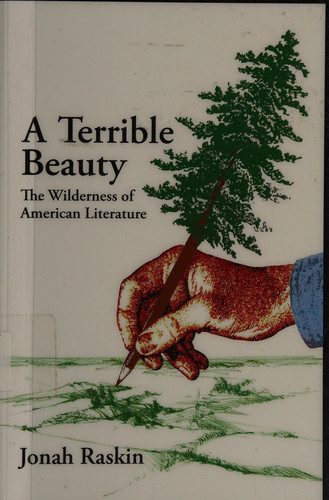
A terrible beauty: the wilderness of American literature

Raskin, Jonah
ABOUT THE BOOK Shortly before he published Walden; or Life in the Woods, Henry David Thoreau called ¿The library a wilderness of books.¿ He also noted that while Americans were ¿clearing the forest in our westward progress, we are accumulating a forest of books in our rear, as wild and unexplored as any of nature¿s primitive wildernesses.¿ In "A Terrible Beauty: the Wilderness of American Literature," Jonah Raskin takes a long close look at the forest of books that poets, novelists and essayists mapped and explored before and after Thoreau. The first work of cultural criticism to look back at writing in the United States from the perspective of the contemporary environmental crisis, Raskin offers insights for students, teachers and lovers of literature as well as for backpackers and hikers who have trekked across untrammeled forests, deserts and mountains. ABOUT THE AUTHOR Jonah Raskin, Phd, has taught American literature at Sonoma State University, the State University of New York at Stony Brook and as a Fulbright professor at the University of Antwerp and the University of Ghent in Belgium. The author of fifteen books, he earned his B.A. at Columbia College in New York, his M.A. at Columbia University and his Ph.D. at the University of Manchester, Manchester, England. He lives in northern California and has written for The San Francisco Chronicle, The L.A. Times, The Nation, The Redwood Coast Review and Catamaran.
Regent Press 2014 366 pages

From Mesopotamia to modernity: ten introductions to Jewish history and literature

Burton Visotzky,David Fishman
From Mesopotamia to Modernity is a one volume introduction to both Jewish history and literature from its earliest times up to the present. Leading experts in each field of Jewish history and literature contribute original and comprehensive essays introducing their subjects. Beginning readers will learn the rudiments for further study, and scholars will be refreshed by the balanced, yet challenging treatments found here.These introductory essays cover most major aspects of Jewish studies from the Bible and its time up to modern Judaism. The work is designed to serve undergraduate and graduate courses in Judaism as well as Church and Synagogue adult study courses. Ideal for reading groups, this work will lead readers to further study of the varied subjects considered. Each essay covers the basic field, be it in a given era of Jewish history or in a defined area of Jewish literature. Suggestions for further reading will assist the reader in moving beyond this volume to explore a given area in further detail. The introductions range from encyclopedic detail through elegiac essay and enthusiastic appreciation of the field considered. The authors hold positions in major academic institutions throughout the United States and Israel.
Westview Press 1999-07-29 274 pages

Facing Black and Jew: literature as public space in twentieth-century America

Newton, Adam Zachary
A reading of African American and Jewish American writers from Henry Roth and Ralph Ellison to Philip Roth and David Bradley. Reading the work of such writers alongside and through one another, Newton's book offers an original way of juxtaposing two major traditions in modern American literature, and rethinking the sometimes vexed relationship between two constituencies ordinarily confined to sociopolitical or media commentary alone. Newton combines Emmanuel Levinas's ethical philosophy and Walter Benjamin's theory of allegory in shaping an innovative kind of ethical-political criticism. Through artful, dialogical readings of Saul Bellow and Chester Himes, David Mamet and Anna Deavere Smith, and others, Newton seeks to represent American Blacks and Jews outside the distorting mirror of 'Black-Jewish Relations', and restrictive literary histories alike. A final chapter addresses the Black/Jewish dimension of the O. J. Simpson trial.
Cambridge University Press 1999-07-15 218 pages

Literature and the image of man

Lowenthal, Leo
This volume's predominant theme is bourgeois mentality and its historical development. The works of Lope de Vega, Calder�n, Cervantes, and Shakespeare, among others, are analyzed within the historical framework of the decline of feudalism and the rise of the absolute regimes. Those of Moli�re and Goethe are set against the background of an evolving and consolidating bourgeois society in Western Europe.
Transaction Publishers 2016 344 pages

Literature is Freedom The Friedenspreis Acceptance Speech

Susan Sontag
Cultural Writing. Susan Sontag delivered LITERATURE IS FREEDOM as her acceptance speech after receiving the highly prestigious Friedenspreis des Deutschen Buchhandels, the Peace Prize of the German Book Trade. Past recipients of the prize, awarded annually since 1950, include Martin Buber, Hermann Hesse, Octovio Paz, Vaclav Havel, Chinua Achebe and Mario Vargas Llosa. Among other things this brilliant speech touches on the historical and philosophical roots of Sontag's fervent opposition to the U.S. occupation of Iraq.
Winterhouse Editions 2003 35 pages

Love's knowledge: essays on philosophy and literature

Nussbaum, Martha Craven
This volume brings together Nussbaum's published papers on the relationship between literature and philosophy, especially moral philosophy. The papers, many of them previously inaccessible to non-specialist readers, deal with such fundamental issues as the relationship between style and content in the exploration of ethical issues; the nature of ethical attention and ethical knowledge and their relationship to written forms and styles; and the role of the emotions in deliberation and self-knowledge. Nussbaum investigates and defends a conception of ethical understanding which involves emotional as well as intellectual activity, and which gives a certain type of priority to the perception of particular people and situations rather than to abstract rules. She argues that this ethical conception cannot be completely and appropriately stated without turning to forms of writing usually considered literary rather than philosophical. It is consequently necessary to broaden our conception of moral philosophy in order to include these forms. Featuring two new essays and revised versions of several previously published essays, this collection attempts to articulate the relationship, within such a broader ethical inquiry, between literary and more abstractly theoretical elements.
Oxford University Press 1992 403 pages

The Edge of the Swamp A Study in the Literature and Society of the Old South

Louis D. Rubin, Jr.
The flowering of literary imagination known as the American Renaissance had few roots in the South. While Hawthorne, Emerson, Melville, Thoreau, and Whitman were creating a body of work that would endure, the only southern writer making a lasting contribution was Edgar Allan Poe. This failure on the part of antebellum southern writers has long been a subject of debate among students of southern history and literature. Now one of the region's most distinguished men of letters offers a cogently argued and gracefully written account of the circumstances that prevented early southern writers from creating transcendent works of art. Louis D. Rubin, Jr., brings forty years of critical integrity and imaginative involvement with the history and literature of the South to his informal inquiry into the foundations of the southern literary imagination. His exploration centers on the lives and works of three of the most important writers of the pre-Civil War South: Poe, William Gilmore Simms, and Henry Timrod. In a close and highly original reading of Poe's poetry and fiction, Rubin shows just how profoundly growing up in Richmond, Virginia, influenced that writer. The sole author of the Old South whose work has endured did not use southern settings or concern himself with his region's history or politics. Poe was, according to Rubin, in active rebellion against the middle-class community of Richmond and its materialistic values. Simms, on the other hand, aspired to the plantation society ideal of his native Charleston, South Carolina. He was not the most devoted and energetic of southern writers and one of the country's best-known and most respected literary figures before the Civil War. Rubin finds an explanation for much of the lost promise of antebellum southern literature in Simms's career. Here was a talented man who got caught up in the politically obsessed plantation community of Charleston, becoming an apologist for the system and an ardent defender of slavery. Timrod, also a Charlestonian native, was a highly gifted poet whose work attained the stature of literature when the Civil War gave him a theme. He was known as the poet laureate of the Confederacy. Only when his region was locked in a desperate military struggle for the right to exist did he suddenly find his enduring voice. Anyone interested in southern life and literature will welcome his provocative and engaging new look at southern writing from one of the region's most perceptive critics.
LSU Press 1999-03-01 248 pages

The Curious Death of the Novel Essays in American Literature

Louis D. Rubin, Jr.
One of the country’s more perceptive younger critics, Louis Rubin is well known for his commentaries on the literature of the South. These essays—selected from his critical works over a period of more than a dozen years—reflect his wider concern with the whole spectrum of American literature. In the title essay Rubin treats “tired literary critics” and the often-heard pronouncement that the novel is dead. He argues that the response of novelists to our difficult and demanding times “will doubtless be what the response of writers to difficult and demanding times always has been: namely, difficult and demanding works of literature.” Another essay, “The Experience Difference: Southerners and Jews,” is a perceptive examination of the parallels in different factors and cultural experiences which brought Southern and Jewish writers to prominence. Rubin explores the potential pitfalls for Southern writers today in an essay called “Getting Out From Under William Faulkner.” Edgar Allan Poe’s position in American literary history and H.L. Mencken’s role as a literary critic and an “artist of destruction” who cleared the way and created an audience for the major American writers of the twenties are dealt with in other essays. The collection includes imaginative studies of Henry James, Mark Twain, Edmund Wilson, and Karl Shapiro. Several Southern writers, including Faulkner, Ellen Glasgow, Robert Penn Warren, Flannery O’Connor, and James Branch Cabell, also come under Rubin’s scrutiny.
LSU Press 1999-03-01 312 pages