1322 results for "American History"

Romantic longings: love in America, 1830-1980

Seidman, Steven
In Romantic Longings Steven Seidman offers an original perspective on the origins and current meaning of the American intimate culture. Drawing on a wide range of sources--sex surveys, advice literature, autobiographies, novels--he charts a change from a Victorian spiritual ideal to efforts by current reformers to sexualize love. Stressing that contemporary notions of intimacy are grounded in twentieth-century historical developments, he observes the birth of a culture of eroticism in the post-World War II years--a culture where sexuality is conceived as both a sphere of love and intimacy and a domain of pleasure and self-expression.
Routledge 1991 247 pages

Drone Warfare: Killing by Remote Control

Medea Benjamin
The CIA chief, Leon Panetta, calls drones the ‘only game in town’. The figures bear him out. Between 2004 and 2012, the US reportedly conducted over 350 drone strikes in Pakistan, killing between 2,600 and 3,400 people. Drone strikes have killed more than 200 children alone in Pakistan and Yemen. In 2000, the Americans had fewer than fifty aerial drones; ten years later, it had a fleet of nearly 7,500, and the US Air Force now trains more drone ‘pilots’ than bomber and fighter pilots combined. Drones are already a $ 5 billion business in the US alone. American activist Medea Benjamin, a co-founder of the peace group CODEPINK and the international human rights organization Global Exchange, provides the first extensive analysis of who is producing the drones, where they are being used, who controls these unmanned places, and what are the legal and moral implications of their use. Benjamin also looks at what activists, lawyers, and scientists across the globe are doing to ground these weapons.
Daily Star Books 2013 241 pages

Republican Gomorrah: inside the movement that shattered the party

Blumenthal, Max
Over the last year, award-winning journalist and videographer Max Blumenthal has been behind some of the most sensational (and funniest) exposes of Republican machinations. Whether it was his revelation that Sarah Palin was "anointed" by a Kenyan priest famous for casting out witches, or his confronting Republican congressional leaders and John McCain's family at the GOP convention about the party's opposition to sex education (and hence, the rise in teen pregnancies like that of Palin's daughter), or his expose of the eccentric multimillionaire theocrat behind California's Prop 8 anti- gay marriage initiative, Blumenthal has become one of the most important and most constantly cited journalists on how fringe movements are becoming the Republican Party mainstream. Republican Gomorrah is a bestiary of dysfunction, scandal and sordidness from the dark heart of the forces that now have a leash on the party. It shows how those forces are the ones that establishment Republicans-like John McCain-have to bow to if they have any hope of running for President. It shows that Sarah Palin was the logical choice of a party in the control of theocrats. But more that just an expose, Republican Gomorrah shows that many of the movement's leading figures have more in common than just the power they command within conservative ranks. Their personal lives have been stained by crisis and scandal: depression, mental illness, extra-marital affairs, struggles with homosexual urges, heavy medication, addiction to pornography, serial domestic abuse, and even murder. Inspired by the work of psychologists Erich Fromm, who asserted that the fear of freedom propels anxiety-ridden people into authoritarian settings, Blumenthal explains in a compelling narrative how a culture of personal crisis has defined the radical right, transforming the nature of the Republican Party for the next generation and setting the stage for the future of American politics.
Nation Books 2009-09-01 394 pages

The Face of War

Martha Gellhorn
A collection of "first-rate frontline journalism" from the Spanish Civil War to US actions in Central America "by a woman singularly unafraid of guns" (Vanity Fair). For nearly sixty years, Martha Gellhorn's fearless war correspondence made her a leading journalistic voice of her generation. From the Spanish Civil War in 1937 through the Central American wars of the mid-eighties, Gellhorn's candid reporting reflected her deep empathy for people regardless of their political ideology. Collecting the best of Gellhorn's writing on foreign conflicts, and now with a new introduction by Lauren Elkin, The Face of War is a classic of frontline journalism by "the premier war correspondent of the twentieth century" (Ward Just, The New York Times Magazine ). Whether in Java, Finland, the Middle East, or Vietnam, she used the same vigorous approach. "I wrote very fast, as I had to," she says, "afraid that I would forget the exact sound, smell, words, gestures, which were special to this moment and this place." As Merle Rubin noted in his review of this volume for The Christian Science Monitor, "Martha Gellhorn's courageous, independent-minded reportage breaks through geopolitical abstractions and ideological propaganda to take the reader straight to the scene of the event."
Grove/Atlantic, Incorporated 2018-10-16 352 pages

Past and present: the challenges of modernity, from the Pre-Victorians to the Postmodernists

Himmelfarb, Gertrude
"Past and Present brings together almost two dozen newly collected essays by the distinguished American historian and cultural critic, Gertrude Himmelfarb. Their common theme is the intriguing, often unexpected ways in which the past illuminates the present. The novelist William Faulkner wrote that "The past is never dead. It's not even past." In these essays, Himmelfarb shows the truth of this statement. She helps us find a new perspective on contemporary issues by bringing to bear a trenchant analysis of debates and thinkers of the past. She allows the past to inform the present without distorting either past or present. The essays, unified by the common theme of present and past, are varied. The topics range from the disorders of modern democracy to the challenges of postmodernism, from the Victorian ethos to the Jewish question. The thinkers range from Edmund Burke to Leo Strauss, from Cardinal Newman to Lionel Trilling. The political figures range from Benjamin Disraeli to Winston Churchill, from the American founders to Queen Elizabeth II. The underlying premise and principle of the essays is the conviction that the pursuit of knowledge and truth, however difficult or discomforting, eminently matters, in the "practical life,"as Trilling put it,as in the "moral life."Past and Presentis a notable contribution to this endeavor-to understanding where we have been, where we are now, and where we may be-or should be-going"--
Encounter Books 2017 240 pages

The Next Decade Where We've Been ... and where We're Going

George Friedman
The author of the acclaimed New York Times bestseller The Next 100 Years now focuses his geopolitical forecasting acumen on the next decade and the imminent events and challenges that will test America and the world, specifically addressing the skills that will be required by the decade's leaders. The next ten years will be a time of massive transition. The wars in the Islamic world will be subsiding, and terrorism will become something we learn to live with. China will be encountering its crisis. We will be moving from a time when financial crises dominate the world to a time when labor shortages will begin to do so. In The Next Decade, George Friedman offers readers a pro_vocative and endlessly fascinating prognosis for the immedi_ate future. Using Machiavelli's The Prince as a model, Friedman focuses on the world's leadersÑparticularly the American presidentÑand, with his trusted geopolitical insight analyses the complex chess game they will all have to play. The book also asks how to be a good president in a decade of extraordinary challenge, and puts the world's leaders under a microscope to explain how they will arrive at the decisions they will makeÑand the consequences these actions will have for us all.
Scribe Publications 2011 243 pages

Let the People Rule Theodore Roosevelt and the Birth of the Presidential Primary

Geoffrey Cowan
"The best new discussion of the primary system." —Jill Lepore, author of These Truths In 1912, Theodore Roosevelt came out of retirement to challenge William Howard Taft for the Republican nomination. TR seized on the campaign theme “Let the People Rule”—a cry echoed in today’s elections—and through the course of his run helped create thirteen new primaries. Though he won most of the primaries, party bosses proved too powerful, and Roosevelt walked out of the convention to create his own Bull Moose Party—only to make the shocking political calculation to ban black delegates from his new coalition. In Let the People Rule , Geoffrey Cowan takes readers inside the dramatic campaign that changed American politics forever.
National Geographic Books 2017-01-17 320 pages

Down the Great Unknown John Wesley Powell's 1869 Journey of Discovery and Tragedy Through the Grand Canyon

Edward Dolnick
0n May 24, 1869, a one-armed Civil War veteran named John Wesley Powell and a ragtag band of nine mountain men embarked on the last great quest in the American West. No one had ever explored the fabled Grand Canyon; to adventurers of that era it was a region almost as mysterious as Atlantis -- and as perilous. The ten men set out down the mighty Colorado River in wooden rowboats. Six survived. Drawing on rarely examined diaries and journals, Down the Great Unknown is the first book to tell the full, true story.
HarperCollins 2002-09-17 400 pages

The Port Chicago 50 Disaster, Mutiny, and the Fight for Civil Rights (National Book Award Finalist)

Steve Sheinkin
An astonishing World War II military story of civil rights from New York Times bestselling author and Newbery Honor recipient Steve Sheinkin. A National Book Award Finalist A YALSA Award for Excellence in Nonfiction Finalist A School Library Journal Best Book of the Year On July 17, 1944, a massive explosion rocked the segregated Navy base at Port Chicago, California, killing more than 300 sailors who were at the docks, critically injuring off-duty men in their bunks, and shattering windows up to a mile away. On August 9th, 244 men refused to go back to work until unsafe and unfair conditions at the docks were addressed. When the dust settled, fifty were charged with mutiny, facing decades in jail and even execution. The Port Chicago 50 is a fascinating story of the prejudice and injustice that faced black men and women in America's armed forces during World War II, and a nuanced look at those who gave their lives in service of a country where they lacked the most basic rights. This thoroughly-researched and documented book can be worked into multiple aspects of the common core curriculum, including history and social studies. “Sheinkin delivers another meticulously researched WWII story, one he discovered while working on his Newbery Honor book, Bomb ...Archival photos appear throughout, and an extensive bibliography, source notes, and index conclude this gripping, even horrific account of a battle for civil rights predating Rosa Parks and Martin Luther King, Jr.” — Publishers Weekly (starred review) Also by Steve Sheinkin: Bomb: The Race to Build—and Steal—the World's Most Dangerous Weapon The Notorious Benedict Arnold: A True Story of Adventure, Heroism & Treachery Undefeated: Jim Thorpe and the Carlisle Indian School Football Team Most Dangerous: Daniel Ellsberg and the Secret History of the Vietnam War Which Way to the Wild West?: Everything Your Schoolbooks Didn't Tell You About Westward Expansion King George: What Was His Problem?: Everything Your Schoolbooks Didn't Tell You About the American Revolution Two Miserable Presidents: Everything Your Schoolbooks Didn't Tell You About the Civil War Born to Fly: The First Women's Air Race Across America
Square Fish 2017-01-03 208 pages

The POLITICS OF BAD FAITH The Radical Assault on America's Future

David Horowitz
In this intellectual companion piece to his acclaimed autobiography, Radical Son, David Horowitz argues that, even in this supposedly post-ideological, post-Cold War era, the historic themes of that conflict still drive our politics and animate our cultural debates. With keen political insight and a masterly grasp of history, he examines how the political Left, including those who describe themselves as liberals, has refused to learn from the past -- particularly from the checkered records of progressive movements for social justice. This important work is a cohesive and searing document for all who refuse to bury their heads in the sand while American institutions and beliefs are corrupted by the politics of bad faith masquerading under the guise of social justice.
Simon and Schuster 2000-03-03 224 pages

Truth has a power of its own: conversations about a people's history

Zinn, Howard,Suarez, Ray
"Truth Has a Power of Its Own is an engrossing collection of never-before-published conversations with Howard Zinn, conducted by the distinguished broadcast journalist Ray Suarez in 2007, that covers the course of American history from Columbus to the War on Terror from the perspective of ordinary people--including slaves, workers, immigrants, women, and Native Americans. Viewed through the lens of Zinn's own life as a soldier, historian, and activist and using his paradigm-shifting People's History of the United States as a point of departure, these conversations explore the American Revolution, the Civil War, the labor battles of the nineteenth and twentieth centuries, U.S. imperialism from the Indian Wars to the War on Terrorism, World Wars I and II, the Cold War, and the fight for equality and immigrant rights, all from an unapologetically radical standpoint. Longtime admirers and a new generation of readers alike will be fascinated to learn about Zinn's thought processes, rationale, motivations, and approach to his now-iconic historical work."--Amazon.com.
The New Press 2022 223 pages

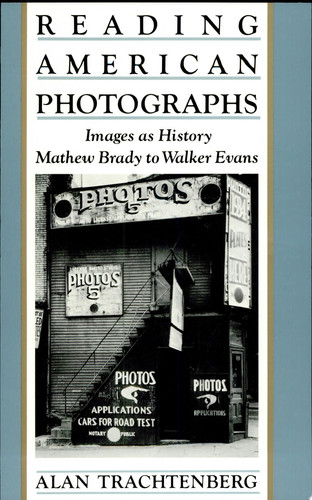
Reading American photographs: images as history, Mathew Brady to Walker Evans

Trachtenberg, Alan
Winner of the Charles C. Eldredge Prize In this book, Alan Trachtenberg reinterprets some of America's most significant photographs, presenting them not as static images but rather as rich cultural texts suffused with meaning and historical content. Reading American Photographs is lavishly illustrated with the work of such luminaries as Mathew Brady, Timothy O'Sullivan, and Walker Evans--pictures that document the American experience from 1839 to 1938. In an outstanding analysis, Trachtenberg eloquently articulates how the art of photography has both followed and shaped the course of American history, and how images captured decades ago provocatively illuminate the present.
Hill and Wang 1989 326 pages

Facing the beast: courage, faith, and resistance in a new dark age

Wolf, Naomi
"From New York Times bestselling author Naomi Wolf, Facing the Beast is a devastating, detailed account of wrongthink, deplatforming, and an unexpected political, personal, and spiritual transformation that followed during one of the most divisive times in American history. In this uncompromising investigation into today's most urgent issues, Naomi Wolf uses her own wildly politicized pilgrimage-from New York Times bestselling author and high-level Democratic consultant to a journalist cast out from the elite political and social circles she once moved through-as a stunning narrative framework that is both chilling and incisive. Wolf's sin? Doing the job that good journalists once prided themselves on: asking questions, challenging authority, and, during one of the most politically divisive moments in modern history, exposing the many failures of the public health response during the COVID-19 pandemic by chronicling the dangerous descent of our democracy into tyranny, censorship, and totalitarianism. Unable to remain silent in the shadows and unwilling to collude with the mainstream, Wolf bravely covers topics that few other writers dare to address critically for fear of being deplatformed. Facing the Beast explores reproductive rights, medical freedom, the uncurious thought-policing of the "progressive" left, the Second Amendment, the criminal relationship between the FDA and Pfizer-Wolf's clear writing repeatedly shines light in the dark corners of our fractured society. A decades-long champion of free speech, freedom of the press, and the Constitution, Wolf found herself not only in the midst of a political rebirth but a spiritual transformation as well-one in which the events of the day could only be described in terms of good, evil, and a metaphysical quest on the nature of reality. For readers of Matt Taibbi, Glenn Greenwald, and Bari Weiss, Facing the Beast is a fearless indictment of legacy media and the political class, as well as a brutal reminder that searching for and defending the truth can be dangerous. "Naomi Wolf is one of the bravest, clearest-thinking people I know. The reason you hear the forces of repression so desperately trying to dismiss her is because she is right."-Tucker Carlson"--
Chelsea Green Publishing 2023 232 pages

The Venona Secrets The Definitive Exposé of Soviet Espionage in America

Herbert Romerstein,Eric Breindel
The Venona Secrets presents one of the last great, untold stories of World War II and the Cold War. In 1995, secret Soviet cable traffic from the 1940s that the United States intercepted and eventually decrypted finally became available to American historians. Now, after spending more than five years researching all the available evidence, espionage experts Herbert Romerstein and Eric Breindel reveal the full, shocking story of the days when Soviet spies ran their fingers through America's atomic-age secrets. Included in The Venona Secrets are the details of the spying activities that reached from Harry Hopkins in Franklin Roosevelt s White House to Alger Hiss in the State Department to Harry Dexter White in the Treasury. More than that, The Venona Secrets exposes: • Information that links Albert Einstein to Soviet intelligence and conclusive evidence showing that J. Robert Oppenheimer gave Moscow our atomic secrets. • How Soviet espionage reached its height when the United States and the Soviet Union were supposedly allies in World War II. • The previously unsuspected vast network of Soviet spies in America. • How the Venona documents confirm the controversial revelations made in the 1940s by former Soviet agents Whittaker Chambers and Elizabeth Bentley. • The role of the American Communist Party in supporting and directing Soviet agents. • How Stalin s paranoia had him target Jews (code-named Rats ) and Trotskyites even after Trotsky’s death. • How the Soviets penetrated America’s own intelligence services. The Venona Secrets is a masterful compendium of spy versus spy that puts the Venona transcripts in context with secret FBI reports, congressional investigations, and documents recently uncovered in the former Soviet archives. Romerstein and Breindel cast a spotlight on one of the most shadowy episodes in recent American history - a past when by our very own government officials, whether wittingly or unwittingly, shielded treason infected Washington and Soviet agents.
Skyhorse Publishing 2014-12-08 608 pages

The Gettysburg Gospel The Lincoln Speech That Nobody Knows

Gabor Boritt
Lincoln scholar Gabor Boritt dispels a century of myths and legends to reveal the true meaning of the Gettysburg Address as Abraham Lincoln intended it in this "magisterial work [and] instant classic" (Doris Kearns Goodwin). The words Abraham Lincoln spoke at the dedication of the Soldiers' National Cemetery at Gettysburg comprise perhaps the most famous speech in history. Many books have been written about the Gettysburg Address and yet, as Lincoln scholar Gabor Boritt shows, there is much that we don't know about the speech. In The Gettysburg Gospel he tears away a century of myths, lies, and legends to give us a clear understanding of one of the greatest American's most important speeches. In the aftermath of the bloodiest battle ever fought in North America, the little town of Gettysburg was overwhelmed. This was where Lincoln had to come to explain why the horror of war must continue. Boritt shows how Lincoln responded to the politics of the time, as well as how and when he wrote the various versions of his remarks. Few people initially recognized the importance of the speech, but over the years it would grow into American scripture, acquiring new and broader meanings. Based on years of scholarship as well as a deep understanding of Lincoln and of Gettysburg itself, The Gettysburg Gospel is an indispensable book for anyone interested in the Gettysburg Address, Abraham Lincoln, the Civil War, or American history
Simon and Schuster 2008-02-05 432 pages

Freedom's Detective The Secret Service, the Ku Klux Klan and the Man Who Masterminded America's First War on Terror

Charles Lane
Chronicles the story of the Reconstruction-era Secret Service and its battle against the KKK's effort to suppress the emancipated African-American vote, sharing particular insights into the career of controversial Secret Service chief, Hiram C. Whitley. In the years following the Civil War, a new battle began. Newly freed African American men had gained their voting rights and would soon have a chance to transform Southern politics. Former Confederates and other white supremacists mobilized to stop them. Thus, the KKK was born. After the first political assassination carried out by the Klan, Washington power brokers looked for help in breaking the growing movement. They found it in Hiram C. Whitley. He became head of the Secret Service, which had previously focused on catching counterfeiters and was at the time the government's only intelligence organization. Whitley and his agents led the covert war against the nascent KKK and were the first to use undercover work in mass crime--what we now call terrorism--investigations. Like many spymasters before and since, Whitley also had a dark side. His penchant for skulduggery and dirty tricks ultimately led to his involvement in a conspiracy that would bring an end to his career and transform the Secret Service. Populated by intriguing historical characters--from President Grant to brave Southerners, both black and white, who stood up to the Klan--and told in a brisk narrative style, Freedom's Detective reveals the story of this complex hero and his central role in a long-lost chapter of American history.
Hanover Square Press 2021-03-02 352 pages

Jews and the American slave trade

Friedman, Saul S.
The Nation of Islam's Secret Relationship between Blacks and Jews has been called one of the most serious anti-Semitic manuscripts published in years. This work of so-called scholars received great celebrity from individuals like Louis Farrakhan, Leonard Jeffries, and Khalid Abdul Muhammed who used the document to claim that Jews dominated both transatlantic and antebellum South slave trades. As Saul Friedman definitively documents in Jews and the American Slave Trade, historical evidence suggests that Jews played a minimal role in the transatlantic, South American, Caribbean, and antebellum slave trades.Jews and the American Slave Trade dissects the questionable historical technique employed in Secret Relationship, offers a detailed response to Farrakhan's charges, and analyzes the impetus behind these charges. He begins with in-depth discussion of the attitudes of ancient peoples, Africans, Arabs, and Jews toward slavery and explores the Jewish role hi colonial European economic life from the Age of Discovery tp Napoleon. His state-by-state analyses describe in detail the institution of slavery in North America from colonial New England to Louisiana. Friedman elucidates the role of American Jews toward the great nineteenth-century moral debate, the positions they took, and explains what shattered the alliance between these two vulnerable minority groups in America.Rooted in incontrovertible historical evidence, provocative without being incendiary, Jews and the American Slave Trade demonstrates that the anti-slavery tradition rooted in the Old Testament translated into powerful prohibitions with respect to any involvement in the slave trade. This brilliant exploration will be of interest to scholars of modern Jewish history, African-American studies, American Jewish history, U.S. history, and minority studies.
Transaction Publishers 1998 326 pages