381 results for "Finance"

The great disorder: politics, economics, and society in the German inflation, 1914-1924

Feldman, Gerald D.
This book presents a comprehensive study of the most famous and spectacular instance of inflation in modern industrial society--that in Germany during and following World War I. A broad, probing narrative, this book studies inflation as a strategy of social pacification and economic reconstruction and as a mechanism for escaping domestic and international indebtedness. The Great Disorder is a study of German society under the tension of inflation and hyperinflation, and it explores the ways in which Germany's hyperinflation and stabilization were linked to the Great Depression and the rise of National Socialism. This wide-ranging study sets German inflation within the broader issues of maintaining economic stability, social peace, and democracy and thus contributes to the general history of the twentieth century and has important implications for existing and emerging market economies facing the temptation or reality of inflation.
Oxford University Press 1993-01 1011 pages

Mortimer of the Maghreb: stories

Shukman, Henry
In this psychologically complex and darkly humorous debut collection, awardwinning writer Henry Shukman introduces an unforgettable cast of characters, travelers whose certain paths around the world lead invariably back to the uncertain self. In “The Garden of God” an aging, ailing war reporter reflects on his adventures covering a little-known conflict in the Sahara and the precipitous and disgraced end of his career; In “Old Providence,” a dissolute artist mourns a lost love and the “bloody perfect island” where, through his own callow foolishness, he lost her. In “Darien Dogs” a man goes south to Panama, desperate for a business deal that will restore his finances and sense of mastery, only to find himself on a confounding search for a beautiful, mysterious woman and his stolen wallet. By turns full of suspense, farce and poignance, always alive with energy and atmosphere, these are the stories of a gifted and assured writer.
Vintage Contemporaries 2007-05-08 460 pages

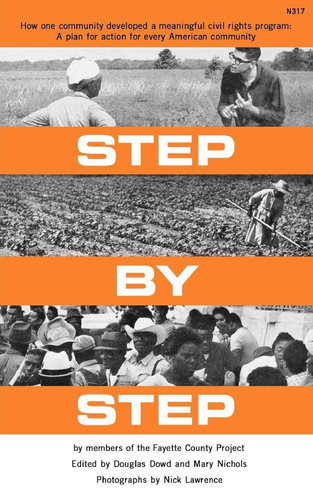
Step by Step Evolution and Operation of the Cornell Students' Civil-Rights Project in Tennessee, Summer, 1964

Douglas Dowd
The book arose out of the authors' experiences in a project which was itself unique: The Cornell-Tompkins Committee for Free and Fair Elections in Fayette County, Tennessee. The project entailed six to eight weeks of living in Fayette County by forty-five volunteers, mostly students from Cornell University, in the summer of 1964. The project was financed entirely, to an amount exceeding fifteen thousand dollars, by the contributions of students, faculty, and townspeople in and around Cornell University, and by contributions from more distant places solicited by those involved at Cornell.Of the many things learned from the Cornell project, one of the most important was how responsive a community can become when confronted with a concrete civil rights program, one with which it can identify, one small enough to be feasible and intelligible, but still compelling in terms of the needs involved.The authors believe that many thousands of Americans can find no good answer to the questions "What can I do." not because they are unwilling to do much, nor because there is little to be done, but because they lack the knowledge of what is needed where, and how and with whom one can go about responding to such needs. The book therefore undertakes, step by step, to describe and explain the development of the project at Cornell and its workings during the summer in Tennessee, and reasons that similar steps can be taken by others, with appropriate variations. It concludes with a detailed appendix listing civil rights projects and organizations desperately in need of help, whether in terms of money or volunteers or both.
W. W. Norton, Incorporated 1965-04 132 pages

Debt WSQ Volume 42, Numbers 1&2

Meena Alexander,Rosalind Petchesky
How do we make sense of debt? What does it mean to live in a world of debt, whether you are a university student crippled by student loans, a struggling farmer in India, a homeowner fighting to keep mortgage payments up, or even a country? WSQ investigates what happens when debt overwhelms moral obligations, de-moralising both debtor and creditor.
Feminist Press at The City University of New York 2014 324 pages

Classics in the theory of public finance

Richard Abel Musgrave,Alan T. Peacock
This book was prepared mainly for specialists on the assumption that it would provide the background to an important neglected field of discussion in public finance. Since it was first published in 1958, the theory of public goods and its implications for public policy have become incorporated in the main body of the economic analysis of public finance in the literature. A glance at the footnotes of some of the standard textbooks on public finance indicates that this assembly of articles has not been in vain. Probably the most influential part of this collection has been the papers concerned with the theory of public expenditure, which contains two closely related elements. The first is as a part of welfare economics: under what conditions can Pareto optimality be achieved in an economic system in which some goods supplied are indivisible? The other strand of thought is concerned with the positive theory of the public sector: how can economic analysis be used in order to explain how the size and composition of the budget is actually determined?
Macmillan in association with the International Economic Association 1958 244 pages

Man of the futures: the story of Leo Melamed and the birth of modern finance

Melamed, Leo
As the founder of financial futures and initiator of Globex, the world's first global electronic trading system, Leo Melamed revolutionized the finance industry. Man of the Futures, his definitive memoir, recounts Melamed's journey from Holocaust survivor and accidental runner at the Chicago Mercantile Exchange (CME), to one of the most prominent leaders in the world of finance. At 33, Melamed gave up a promising law career to pursue his dream of becoming a full-time pit-trader at the CME. He quickly ascended the ranks to become chairman. From there, he set out to disrupt the status quo and ultimately transform both the exchange itself and the broader finance industry. Through daring to embrace innovative ideas many considered absurd, Melamed was a pioneer, continually fighting for modernisation in the financial markets through diversification and the introduction of new technologies. Covering the internal battles waged within the CME, the launch of the International Monetary Market (IMM) and the rise of Globex, this enthralling autobiography details the struggles, scandals and triumphs of a visionary in his field. Together with behind-the-scenes reminiscences about the financial markets, this narrative delves into Melamed's philanthropic work at the US Holocaust Memorial Museum, as well as his fascinating dealings with political figures at home in Chicago, at the White House, and around the world in China, Japan, Singapore, Great Britain, Russia, South Korea, and Brazil. . Man of the Futures offers exclusive access to the rationale behind some of the biggest financial decisions and dealings in the late 20th and early 21st century. Join Leo Melamed for this fascinating and revealing story of a life lived in pursuit of the future. --
Harriman House 2021-04-27 368 pages

So much to do: a full life of business, politics, and confronting fiscal crises

Ravitch, Richard
Every city and every state needs a Richard Ravitch. In sixty years on the job, whether working in business or government, he was the man willing to tackle some of the most complex challenges facing New York. Trained as a lawyer, he worked briefly for the House of Representatives, then began his career in his family's construction business. He built high-profile projects like the Whitney Museum and Citicorp Center but his primary energy was devoted to building over 40,000 units of affordable housing including the first racially integrated apartment complex in Washington, D.C. He dealt with architects, engineers, lawyers, bureaucrats, politicians, union leaders, construction workers, bankers, and tenants—virtually all of the people who make cities and states work. It was no surprise that those endeavors ultimately led to a life of public service. In 1975, Ravitch was asked by then New York Governor Hugh Carey to arrange a rescue of the New York State Urban Development Corporation, a public entity that had issued bonds to finance over 30,000 affordable housing units but was on the verge of bankruptcy. That same year, Ravitch was at Carey's side when New York City's biggest banks said they would no longer underwrite its debt and he became instrumental to averting the city's bankruptcy. Throughout his career, Ravitch divided his time between public service and private enterprise. He was chairman of the Metropolitan Transportation Authority from 1979 to 1983 and is generally credited with rebuilding the system. He turned around the Bowery Savings Bank, chaired a commission that rewrote the Charter of the City of New York, served on two Presidential Commissions, and became chief labor negotiator for Major League Baseball. Then, in 2008, after Governor Eliot Spitzer resigned in a prostitution scandal and New York State was in a post-financial-crisis meltdown, Spitzer's successor, David Paterson, appointed Ravitch Lieutenant Governor and asked him to make recommendations regarding the state's budgeting plan. What Ravitch found was the result of not just the economic downturn but years of fiscal denial. And the closer he looked, the clearer it became that the same thing was happening in most states. Budgetary pressures from Medicaid, pension promises to public employees, and deceptive budgeting and borrowing practices are crippling our states' ability to do what only they can do—invest in the physical and human infrastructure the country needs to thrive. Making this case is Ravitch's current public endeavor and it deserves immediate attention from both public officials and private citizens.
PublicAffairs 2014-04-29 254 pages

The Secret Code of the Superior Investor How to Be a Long-Term Winner in a Short-Term World

James K. Glassman
What should your investment strategy be now that the steady, upward trend of the U.S. stock market seems like history? The years ahead promise to be volatile, full of ups and downs, so is this the time for investors to hunker down and scale back? Not at all, is Jim Glassman’s advice. Sure, there were some people who bailed out of the market early and came out ahead, but that was luck—the kind of luck that wins the lottery once in a blue moon: it’s not a strategy. And if there is one clear lesson to be learned from all of the recent market drama, it’s that you need a point of view and a coherent investment strategy. And that’s just what Glassman provides in The Secret Code of the Superior Investor. If you believe that the long-term outlook for the American economy is positive (as Glassman and most experts do), then the best strategy is the tried-and-true approach that has worked well for more than a hundred years: acquiring a diversified portfolio of stocks in great companies and then holding on to them forever. Jim Glassman’s investing principles provide the ballast to help you keep your investing balance no matter how the markets bubble or bobble. His rigorous, practical, straightforward way of thinking and taking action enables you to build a portfolio that performs well no matter what the economic climate. Here is invaluable advice on what stocks and mutual funds to buy—and when to sell them. (Hint: Almost never.)
Crown Publishing Group 2002 336 pages

Essays in Taxation

Edwin Robert Anderson Seligman
This work has been selected by scholars as being culturally important, and is part of the knowledge base of civilization as we know it. This work is in the "public domain in the United States of America, and possibly other nations. Within the United States, you may freely copy and distribute this work, as no entity (individual or corporate) has a copyright on the body of the work. Scholars believe, and we concur, that this work is important enough to be preserved, reproduced, and made generally available to the public. We appreciate your support of the preservation process, and thank you for being an important part of keeping this knowledge alive and relevant.
Creative Media Partners, LLC 2022-10-27 452 pages

Globalizing capital: a history of the international monetary system

Eichengreen, Barry J.
"Essential reading for understanding the international economy--now thoroughly updated Lucid, accessible, and provocative, and now thoroughly updated to cover recent events that have shaken the global economy, Globalizing Capital is an indispensable account of the past 150 years of international monetary and financial history--from the classical gold standard to today's post-Bretton Woods 'nonsystem.' Bringing the story up to the present, this third edition covers the global financial crisis, the Greek bailout, the Euro crisis, the rise of China as a global monetary power, the renewed controversy over the international role of the U.S. dollar, and the currency war. Concise and nontechnical, and with a proven appeal to general readers, students, and specialists alike, Globalizing Capital is a must-read for anyone who wants to understand where the international economy has been--and where it may be going"--
Princeton University Press 2019-08-06 298 pages

Probability models for economic decisions

Myerson, Roger B.,Zambrano, Eduardo
An introduction to the use of probability models for analyzing risk and economic decisions, using spreadsheets to represent and simulate uncertainty. This textbook offers an introduction to the use of probability models for analyzing risks and economic decisions. It takes a learn-by-doing approach, teaching the student to use spreadsheets to represent and simulate uncertainty and to analyze the effect of such uncertainty on an economic decision. Students in applied business and economics can more easily grasp difficult analytical methods with Excel spreadsheets. The book covers the basic ideas of probability, how to simulate random variables, and how to compute conditional probabilities via Monte Carlo simulation. The first four chapters use a large collection of probability distributions to simulate a range of problems involving worker efficiency, market entry, oil exploration, repeated investment, and subjective belief elicitation. The book then covers correlation and multivariate normal random variables; conditional expectation; optimization of decision variables, with discussions of the strategic value of information, decision trees, game theory, and adverse selection; risk sharing and finance; dynamic models of growth; dynamic models of arrivals; and model risk. New material in this second edition includes two new chapters on additional dynamic models and model risk; new sections in every chapter; many new end-of-chapter exercises; and coverage of such topics as simulation model workflow, models of probabilistic electoral forecasting, and real options. The book comes equipped with Simtools, an open-source, free software used througout the book, which allows students to conduct Monte Carlo simulations seamlessly in Excel.
MIT Press 2019-12-17 548 pages

The law of democracy: legal structure of the political process

Issacharoff, Samuel,Karlan, Pamela S.,Pildes, Richard H.,Persily, Nathaniel
This book created the field of the law of democracy, offering a systematic account of the legal construction of American democracy. This edition represents a significant revision that reflects the embattled state of democracy in the U.S. and abroad. With the addition of Franita Tolson as well as Nathaniel Persily to the prior edition, the book now turns to a changed legal environment following the radical reconfiguration of the Voting Rights Act, the rise of social media and circumvention of the formal channels of campaign finance, and the increased fragmentation of political parties. Strikingly, in the current political environment the right to register and vote passes from being a largely historical inquiry to a source of front-burner legal challenge. This edition further streamlines the coverage of the Voting Rights Act, expands the scope of coverage of campaign finance and political corruption issues, and turns to the new dispute over voter access to the ballot. The section on election litigation and remedies has been expanded to address the expanded range of legal challenges to election results. For the first time, this book isolates the distinct problems of presidential elections, ranging from the conflict over federal and state law in Bush v. Gore, to the distinct challenges to the 2020 presidential elections, to the renewed focus on the Electoral Count Act. The basic structure of the book continues to follow the historical development of the individual right to vote; current struggles over gerrymandering; the relationship of the state to political parties; the constitutional and policy issues surrounding campaign-finance reform; and the tension between majority rule and fair representation of minorities in democratic bodies.
Foundation Press 2022 1283 pages

Trifles Make Perfection The Selected Essays of Joseph Wechsberg

Joseph Wechsberg
A Moravian by birth, a musician by avocation, a writer by choice, and a bon vivant by instinct, Wechsberg was set squarely among a generation of mid-century writers that included A. J. Liebling, M. F. K. Fisher, Waverly Root, and Ludwig Bemelmans. Many of them found a home at the New Yorker and were routinely provided carte blanche to tackle any subject they found interesting. For Wechsberg, this meant the cultural life of the civilized world, which included music, food (especially classic French food, as prepared by such great chefs as Henri Soul and Fernand Point), travel, and the history of banking and finance. Always central to these essays were people of acknowledged accomplishments, whose lives he tried to understand both in the contexts of their own personality and of the cultures that shaped them.
David R. Godine Publisher 1999 289 pages

Nominating the President: evolution and revolution in 2008 and beyond

Jack Citrin,David Karol
The 2008 presidential nominations were unprecedented in many ways. Marking another step in the democratization of the selection process and a surprising loss of control by party elites, the contests in both parties were unusually competitive and the outcomes belied the predictions of experts. This book offers a fresh look at the role of parties, the constraints of campaign finance, the status of front-runners, and the significance of rules, race, and gender in the post-reform era. In this volume, leading scholars assess the state of the process with original research about money, scheduling, superdelegates, and the role of race and gender in voting. Original analyses show how changes in campaign finance and the scheduling of primaries and caucuses helped determined the outcomes in both parties. Race, once thought of as a handicap, proved an asset for the Obama campaign. 2008 marked another milestone in the democratization of the nominations process with expanded participation by rank and file voters in donating money, voting, and using the Internet. This timely book provides a glimpse into the future of party nominations and elections.
Rowman & Littlefield Publishers 2009-09-16 167 pages

Lawfare: the War Against Free Speech A First Amendment Guide for Reporting in an Age of Islamist Lawfare

Brooke Goldstein,Aaron Meyer
The free speech rights of authors, researchers and journalists writing on issues of public security and national concern are increasingly under attack through both violent and non-violent means. An important non-violent challenge to free speech has emerged in the form of "Islamist lawfare," the use of the law as a weapon of war to silence and punish free speech about militant Islam, terrorism and its sources of financing. The strategic end of Islamist lawfare is to further the goals of the Islamist movement, one of which is to abolish public discourse critical of Islam and punish anything deemed blasphemous to its prophet, Mohammad. Another goal of Islamist lawfare is to impede the free flow of public information about the threat of Islamist terrorism, thereby limiting our ability to understand it and destroy it. In this way, Islamist lawfare takes the form of a complementary legal campaign to terrorism and asymmetric warfare. Lawfare: The War Against Free Speech- written by two of America's experts in this field- describes this phenomenon and gives practical guidance about navigating this new terrain to journalists who wish to speak truthfully about the national security threats we face. This book is a must-read primer on the First Amendment, and should be reviewed by anyone writing about the most controversial topics of our time. Aaron Eitan Meyer and Brooke Goldstein present Lawfare Against Free Speech: A First Amendment Guide to Reporting in an Age of Islamist Lawfare, the first book of its kind aimed at giving practical tips to journalists when writing about these topics. ABOUT THE AUTHORS Brooke Goldstein is a human rights attorney and award-winning filmmaker. She serves as director of The Lawfare Project, a nonprofit organization dedicated to raising awareness and facilitating a response to the abuse of the legal system and human rights law. She is also the founder and director of the Children's Rights Institute (CRI) which tracks and legally combats violations of children's basic human rights as occurring throughout the globe. Aaron Eitan Meyer served as research director of The Lawfare Project, director of research for the Children's Rights Institute, legal correspondent for the Terror Finance Blog, and is on the advisory board for the digital advocacy group, Act for Israel. He received his B.A. from New School University, and his J.D. from Touro College Jacob D. Fuchsberg Law Center.
CreateSpace 2011-07-06 240 pages

Personal Resilience Survival Strategies for Pandemic Times

Peter Tarlow,Séverine Obertelli
Humanity suffers crises and disasters constantly. But the breadth of the latest crisis--the Covid-19 pandemic--has affected almost all corners of the world and has caused millions of deaths and so many more victims who have survived its worst effects but may suffer long-lasting health issues from it. Those "lucky" enough to have suffered only mild cases or managed to avoid infection altogether are still victims because of social and economic distresses that the pandemic has caused. This book describes the crisis and offers advice and strategies for coping with the stresses of a pandemic. Each chapter explores briefly one of four areas of our human condition, be it health, spirituality, social issues or finances, and offers strategies through 100 questions and answers about dealing with a pandemic. This book is intended to supplement the seminal book of Personal Reconstruction, by the same author and others, with specific information about pandemics.
Quest Publishing 2021-03-31 166 pages

Competing for the future: how digital innovations are changing the world

Kressel, Henry
Everybody knows that digital technology has revolutionized our economy and our lifestyles. But how many of us really understand the drivers behind the technology - the significance of going digital; the miniaturization of circuit boards; the role of venture capital in financing the revolution; the importance of research and development? How many of us understand what it takes to make money from innovative technologies? Should we worry about manufacturing going offshore? What is the role of India and China in the digital economy? Drawing on a lifetime's experience in the industry, as an engineer, a senior manager and as a partner in a venture capital firm, Henry Kressel offers an expert personalized answer to all these questions. He explains how the technology works, why it matters, how it is financed and what the key lessons are for public policy.
Cambridge University Press 2007-04-16 399 pages