324 results for "History"

With or without you: the prospect for Jews in today's Russia

Shrayer, Maxim
"In his captivating new book, based on new evidence and a series of interviews, author and scholar Maxim D. Shrayer offers a richly journalistic portrait of Russia's dwindling yet still vibrant and influential Jewish community. This is simultaneously an in-depth exploration of the texture of Jewish life in Putin's Russia and an emigre's moving elegy for Russia's Jews, which forty years ago constituted one of the world's largest Jewish populations and which presently numbers only about 180,000. Why do Jews continue to live in Russia after the antisemitism and persecution they had endured there? What are the prospects of Jewish life in Russia? What awaits the children born to Jews who have not left? "With or Without You" asks and seeks to answer some of the central questions of modern Jewish history and culture"--
Academic Studies Press 2017 98 pages

Turbulent times: the British Jewish community today

Kahn-Harris, Keith
The first book-length study of contemporary British Jewry, 'Turbulent Times: The British Jewish Community Today' examines the changing nature of the British Jewish community and its leadership since 1990. Keith Kahn-Harris and Ben Gidley contend that there has been a shift within Jewish communal discourse from a strategy of security, which emphasized Anglo-Jewry's secure British belonging and citizenship, to a strategy of insecurity, which emphasizes the dangers and threats Jews face individually and communally. This shift is part of a process of renewal in the community that has led to something of a 'Jewish renaissance' in Britain. Addressing key questions on the transitions in the history of Anglo-Jewish community and leadership, and tackling the concept of the 'new antisemitism', this important and timely study addresses the question: how has UK Jewry adapted from a shift from monoculturalism to multiculturalism?
Continuum 2010 237 pages

Jewish Poland revisited: heritage tourism in unquiet places

Lehrer, Erica T.
Since the end of Communism, Jews from around the world have visited Poland to tour Holocaust-related sites. A few venture further, seeking to learn about their own Polish roots and connect with contemporary Poles. For their part, a growing number of Poles are fascinated by all things Jewish. Erica T. Lehrer explores the intersection of Polish and Jewish memory projects in the historically Jewish neighborhood of Kazimierz in Krakow. Her own journey becomes part of the story as she demonstrates that Jews and Poles use spaces, institutions, interpersonal exchanges, and cultural representations
Indiana University Press 2013-07-19 274 pages

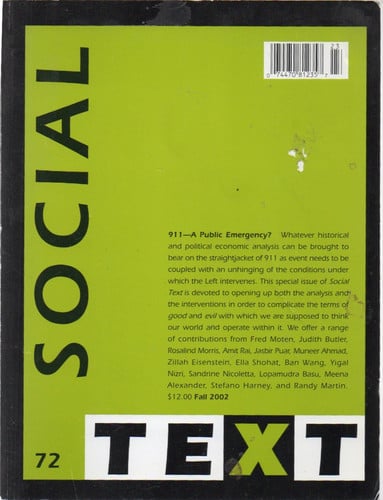
911 a Public Emergency?

Brent Hayes Edwards,Stefano Harney,Randy Martin,Ella Shohat,Timothy Mitchell,Fred Moten
Since September 11, public discourse has often been framed in terms of absolutes: an age of innocence gives way to a present under siege, while the United States and its allies face off against the Axis of Evil. This special issue of Social Text aims to move beyond these binaries toward thoughtful analysis. The editors argue that the challenge for the Left is to develop an antiterrorism stance that acknowledges the legacy of U.S. trade and foreign policy as well as the diversity of the Muslim faith and the dangers presented by fundamentalism of all kinds. Examining the strengths and shortcomings of area, race, and gender studies in the search for understanding, this issue considers cross-cultural feminism as a means of combating terrorism; racial profiling of Muslims in the context of other racist logics; and the homogenization of dissent. The issue includes poetry, photographic work, and an article by Judith Butler on the discursive space surrounding the attacks of September 11. This impressive range of contributions questions the meaning and implications of the events of September 11 and their aftermath. Contributors . Muneer Ahmad, Meena Alexander, Lopamudra Basu, Judith Butler, Zillah Eisenstein, Stefano Harney, Randy Martin, Rosalind C. Morris, Fred Moten, Sandrine Nicoletta, Yigal Nizri, Jasbir K. Puar, Amit S. Rai, Ella Shohat, Ban Wang
Duke University Press 2002-09-20 208 pages

Flashpoints: Israel, anti-semitism and the Holocaust

Abramovich, Dvir
Never one to shy away from controversy, Abramovich's thought-provoking collection of essays and intelligent writings are sure to arouse heated discussion. Mercilessly tackling everything from Mel Gibson's anti-Semitic rants, The Holocaust, Iran's pursuit of nuclear weapons and the UN's anti-Israel stance, Flashpoints offers unique perspectives on Israel, the Israeli-Palestinian conflict and the Jewish world. Whether you agree with him or not, one thing is certain: Abramovich's pieces will lead you on a journey of exploration and reflection, challenging what many people hold true about topics that are as relevant today as ever.
Hybrid Publishers 2014 292 pages

Wolfe von Lenkiewicz

Lenkiewicz, Wolfe von
This is the first major monograph on the work of one of Britain's most dynamic artists, Wolfe von Lenkiewicz. His striking paintings and drawings mine the hallowed halls of art history and popular culture in search of visual languages, imagery, themes and motifs that he can appropriate, adapt, use and abuse, bringing together different movements, genres, periods and styles in dialogues that are surprising, innovative and sometimes provocative. Lenkiewicz's imagination and energy seem to be inexhaustible, concocting endless amazing hybrids such as iconic Renaissance paintings invaded by characters from nineteenth-century Japanese woodblocks, French Revolutionary masterpieces spliced with German Romanticism, or Cubism infiltrated by Victorian children's illustration.
Anomie Publishing 2015 235 pages

In my opinion..: thoughts on religion, society and life by a very opinionated rabbi

Wein, Berel
F or several decades, informed readers sought out Rabbi Berel Wein'sopinion column in his weekly Destiny Foundation blog, in the Jerusalem Post, and other publications to gain his perspective on current issues. Theproducts of his highly educated and sensitive mind, the essays were uniquely"Wein"- always original, always refreshing in their candor, and subtly thought provoking. Who else could experience uplift from an orchid plant or discover thecore values of the Jewish nation in the words of Israel's taxi drivers?His sweeping gaze simultaneously takes in past, present, and future.Continually aware of history and its impact on today's events, he looks at anempty field in the Land of Israel and sees not only the farmer with his plow today,but one who worked the same land two thousand years ago. And with heartfeltfaith and a vibrant awareness of ancient prophecy, he envisions those who willharvest that field in the future. In this troubled, insecure age of ours, he provesthat one can, one must, be a realist and an optimist at the same time.The best of these valuable essays have been collected for this volume. If youare fan of Rabbi Wein's writing, you will feel as though you are encountering anold friend. If you are not already familiar with Rabbi Wein's take on life, you are infor a treat.
The Destiny Foundation 2020 345 pages

Devotion and commandment: the faith of Abraham in the Hasidic imagination

Green, Arthur
"What was piety like before the commandments were revealed? How did Abraham live in a way that fulfilled the ideals of piety without the Torah? This question, raised in the ancient Jewish theology of Philo and central to the struggle of Paul with his own Judaism and his emerging Christian faith, was raised once again by the Hasidic masters of Eastern Europe in the eighteenth century. In a series of powerful and spiritually searching sermons, the Hasidic masters reinterpret spiritually the ancient rabbis' insistence that the patriarchs lived within the Law. In centering their spiritualization of Judaism around the figure of Abraham, these latter-day Jewish thinkers express a position that stands midway between the claims of the Talmud and those of the Christian apostle. Arthur Green uses this Hasidic debate on the patriarchs and the commandments as a point of departure for a wide-ranging consideration of the relationship between piety and commandment in Hasidic Judaism. The result of this effort is a series of rather remarkable mystical defenses of the commandments and an original contribution of Hasidic thought to the ongoing history of Judaism"--
Hebrew Union College Press 2015 97 pages

Jewish philosophy for the twenty-first century: personal reflections

Hava Tirosh-Samuelson,Aaron W. Hughes
Jewish Philosophy for the Twenty-First Century encourages contemporary Jewish thinkers to reflect on the meaning of Judaism in the modern world by connecting these reflections to their own personal biographies. In so doing, it reveals the complexity of Jewish thought in the present moment. The contributors reflect on a range of political, social, ethical, and educational challenges that face Jews and Judaism today and chart a path for the future. The results showcase how Jewish philosophy encompasses the methodologies and concerns of other fields such as political theory, intellectual history, theology, religious studies, anthropology, education, comparative literature, and cultural studies. By presenting how Jewish thinkers address contemporary challenges of Jewish existence, the volume makes a valuable contribution to the humanities as a whole, especially at a time when the humanities are increasingly under duress for being irrelevant.
Brill 2014 541 pages

State of crisis

Bauman, Zygmunt
"Today we hear much talk of crisis and comparisons are often made with the Great Depression of the 1930s, but there is a crucial difference that sets our current malaise apart from the 1930s: today we no longer trust in the capacity of the state to resolve the crisis and to chart a new way forward. In our increasingly globalized world, states have been stripped of much of their power to shape the course of events. Many of our problems are globally produced but the volume of power at the disposal of individual nation-states is simply not sufficient to cope with the problems they face. This divorce between power and politics produces a new kind of paralysis. It undermines the political agency that is needed to tackle the crisis and it saps citizens' belief that governments can deliver on their promises. The impotence of governments goes hand in hand with the growing cynicism and distrust of citizens. Hence the current crisis is at once a crisis of agency, a crisis of representative democracy and a crisis of the sovereignty of the state. In this book Zygmunt Bauman and Carlo Bordoni explore the social and political dimensions of the current malaise. While this problems have been greatly exacerbated by the turmoil following the financial collapse of 2007-8, Bauman and Bordoni argue that the crisis facing Western societies is rooted in a much more profound series of transformations that stretch back further in time and are producing long-lasting effects. This highly original analysis of our current predicament by two of the world's leading social thinkers will be of interest to a wide readership."--Page 4 of cover.
Polity Press 2014-07-08 164 pages

From Odessa with love: political and literary essays from post-Soviet Ukraine

Davidzon, Vladislav
"The Tashkent-born Russian-American literary critic, editor, essayist, and journalist Vladislav Davidzon has been covering post-Soviet Ukraine for the past ten years, a tumultuous time for that country and the surrounding world. The 2014 "Revolution of Dignity" heralded a tremendous transformation of Ukrainian politics and society that has continued to ripple and reverberate throughout the world. These unprecedented events also wrought a remarkable cultural revolution in Ukraine itself. In late 2015, a year and a half after the 2014 Revolution swept away the presidency of the Moscow-leaning kleptocratic President Viktor Yanukovich, Davidzon and his wife founded a literary journal, The Odessa Review, focusing on newly emergent trends in film, literature, painting, design, and fashion. The journal became an East European cultural institution, publishing outstanding writers in the region and beyond. From his vantage point as a journalist and editor, Davidzon came to observe events and know many of the leading figures in Ukrainian politics and culture, and to write about them for a Western audience. Davidzon later found himself in the center of world events as he became a United States government witness in the Ukraine scandal that shook the presidency of Donald Trump. This eagerly anticipated debut tells the real story of what happened in Ukraine from the keen and resilient perspective of an observer at its center"-- Provided by publisher.
Academica Press 2021 321 pages

The house that hijack built

Karasick, Adeena
The House That Hijack Built explores the possibilities of meaning production when language is pushed to its limits of “logical” or normative semantic patterns. If “to hijack” is “to steal in transit,” this text focuses on how language, with its idioms and ideologies, is appropriated―hijacked and transported―to unknown destinations in the act of its transmission. In her fifth collection of poems / collages, Karasick explores the intersection between das Wahre (the true) and die Wahrheit (the truth), as a language at war with itself re-presents a “real world” reworded between narrations of “the real”―inscribed in ruptures, betrayals and unfulfilled promises―and speaks to a ‘real world’ that wreaks havoc with the very truth it seeks to inhabit. Included in this collection is a homolinguistic “trans’elation” of the first chapter of the Sefer Yetzirah. Known as The Book of Creation or The Book of the Letters, it is the oldest and most mysterious of all Kabalistic texts, dating back to 100 BCE. Its focus is on the 22 letters of the Hebrew alphabet―how they were formed, how they inter-relate, how they make meaning―the text itself inscribed through slippage, elision, rupture and undecideability, foregrounding language as a continuum of letters, names, mathematical equations and gates of meaning. By a technique of slight displacement, slipping one word under another, Karasick mimics Nietzsche’s Geschichte Eines Irrtums History of an Error, announcing the narration of a fabrication: how the “true world” finally becomes a fable.
Talonbooks 2004-09-15 128 pages

The NHS - beginning, middle and end? the autobiography of Dr John Marks

Marks, John
John Marks is something of a national treasure. Warm, funny, passionate, opinionated and occasionally contrary, he is a man whose life for more than 40 years marched in beat with that of the National Health Service. There is scarcely a medical issue or controversy in which John Marks was not involved. Abortion law reform, the doctors' 1970s revolt against the General Medical Council, the foundation of the Royal College of General Practitioners, countless NHS reorganizations, and the bloody battle over NHS pay beds and the pay of junior doctors are just a sample.Then there was the fierce, principled battle over how the medical profession and the public should respond to the terror of a new disease - AIDS. And the great war that was fought over the Conservatives introduction of market forces into the NHS in the late 1980s and early 1990s - an approach to running the NHS that lives on, reincarnated, under the current Labor government.In all of these John Marks played more than a walk-on part. In many he was a principal actor. For anyone wanting fully to understand the BMA's role in all this, this book is thus required reading. But it is much more than just a dry history of times past. It is laced with anecdote, from the horrifying to the hilarious, and on to high politics. John Marks' account of his life and times provides the tale of a warm, human, liberal and occasionally buccaneering man whose passion for life and causes leaves even those who do not always agree with him eager to count him among their friends.
Radcliffe Publishing Ltd 2008-05-20 279 pages