551 results for "History"

The double life of Doctor Lopez: spies, Shakespeare and the plot to poison Elizabeth I

Green, Dominic
Presents a very detailed account, including the English and European context, of the Lopez Affair, involving Dr. Roderigo Lopez, who gained wealth via international trade and became physician to Queen Elizabeth I. At the same time, he was a spy, with multiple masters, in England and abroad. His downfall and execution on the false charge of attempted regicide stemmed from political rivalry in England. His high status was related to the advantages, such as widespread contacts, that stemmed from his Converso background. Contemporary stereotyped attitudes toward Jews were reflected in Marlowe's "Jew of Malta" and Shakespeare's "The Merchant of Venice."
Century 2003 402 pages

Dossier : the secret history of Armand Hammer

Epstein, Edward Jay
When Armand Hammer died at the age of 92, he was chairman of the Occidental Petroleum Company, lauded for his financial support of cancer research and for his art collection. But behind the facade of respectability lay a lifetime of fraud, both personal and professional. Now, the bestselling author of The Assassination Chronicles reveals the true story of this manipulative and corrupt man. of photos.
Random House 1996-10-01 418 pages

The house of twenty thousand books

Abramsky, Sasha
"The House of Twenty Thousand Books is journalist Sasha Abramsky's elegy to the vanished intellectual world of his grandparents, Chimen and Miriam, and their vast library of socialist literature and Jewish history. A rare book dealer and self-educated polymath who would go on to teach at Oxford and consult for Sotheby's, Chimen Abramsky drew great writers and thinkers like Isaiah Berlin and Eric Hobsbawm to his north London home; his library grew from his abiding passion for books and his search for an enduring ideology. The books, documents, and manuscripts that covered every shelf at 5 Hillway were testaments to Chimen's quest -- from the Jewish orthodoxy of his boyhood, to the Communism of his youth, to the liberalism of his mature years. The House of Twenty Thousand Books is at once the story of a fascinating family and chronicle of the embattled twentieth century. The House of Twenty Thousand Books includes 43 photos. "--
New York Review Books 2015 359 pages

Called out but safe: : a baseball umpire's journey

Clark, Al
"If an umpire could steal the show in a Major League game, Al Clark might well have been the one to do it. Tough but fair, in his thirty years as a professional umpire he took on some of baseball's great umpire baiters, such as Earl Weaver, Billy Martin, and Dick Williams, while ejecting any number of the game's elite--once tearing a hamstring in the process. He was the first Jewish umpire in American League history, and probably the first to eject his own father from the officials' dressing room. But whatever Clark was doing--officiating at Nolan Ryan's three hundredth win, Cal Ripken's record breaker, or the "earthquake" World Series of 1989, or braving a labor dispute, an anti-Semitic tirade by a Cy Young Award winner, or a legal imbroglio--it makes for a good story. Called Out but Safe is Clark's outspoken and often hilarious account of his life in baseball from umpire school through the highlights to the inglorious end of his stellar career. Not just a source of baseball history and lore, Clark's book also affords a rare look at what life is like for someone who works for the Major Leagues' other team"--
University of Nebraska Press 2014 198 pages

A time to lead: for duty, honor and country

Clark, Wesley K.
General Clark became a major figure on the political scene when he was drafted by popular demand to run for the Democratic nomination for President of the United States in 2003. Here, General Clark uses his unique life experience--from his rough childhood in segregated Arkansas, through the horrors of Vietnam to the difficulties of negotiating peace and rebuilding national security after the Cold War--as a springboard to reveal his vision for America, at home and in the world, addressing the current state of our nation, the direction in which we are headed, and what we should hope to achieve.--From publisher description.
Palgrave Macmillan 2007 262 pages

Mark Rothko: toward the light in the chapel

Cohen-Solal, Annie
"Mark Rothko was not only one of the most influential American painters of the twentieth century; he was a scholar, an educator, and a deeply spiritual human being. Born Marcus Yakovlevich Rotkovitch, he emigrated from the Russian Empire to the United States at age ten, already well educated in the Talmud and carrying with him bitter memories of the pogroms and persecutions visited upon the Jews of Latvia. Few artists have achieved success as quickly, and by the mid-twentieth century, Rothko's artwork was being displayed in major museums throughout the world. In May 2012 his painting Orange, Red, Yellow was auctioned for nearly $87 million, setting a new Christie's record. Author Annie Cohen-Solal gained access to archival materials no previous biographer had seen. As a result, her book is an extraordinarily detailed portrait of Rothko the man and the artist, an uncommonly successful painter who was never comfortable with the idea of his art as a commodity"--
Yale University Press 2015-01-01 282 pages

The Todd Glass situation: a bunch of lies about my personal life and a bunch of true stories about my 30-year career in stand-up comedy

Glass, Todd
"A hilarious, poignant memoir from comedian Todd Glass about his decision at age forty-eight to finally live openly as a gay man--and the reactions and support from his comedy pals, from Louis CK to Sarah Silverman. Growing up in a Philadelphia suburb in the 1970s was an easy life. Well, easy as long as you didn't have dyslexia or ADD, or were a Jew. And once you added gay into the mix, life became more difficult. So Todd Glass decided to hide the gay part, no matter how comic, tragic, or comically tragic the results. It might have been a lot easier had he chosen a profession other than stand-up comedy. By age eighteen, Todd was opening for big musical acts like George Jones and Patti LaBelle. His career carried him through the Los Angeles comedy heyday in the 1980s, its decline in the 1990s, and its rebirth via the alternative comedy scene and the explosion in podcasting. But the harder he worked at his craft, the more difficult it became to manage his "situation." There were the years of abstinence and half-hearted attempts to "cure" himself. The fake girlfriends so that he could tell relationship jokes onstage. The staged sexual encounters to burnish his reputation offstage. It took a brush with death to cause him to rethink the way he was living his life; a rash of suicides among gay teens to convince him that it was finally time to come out to the world. Now, Todd has written an open, honest, and hilarious memoir in an effort to help everyone--young and old, gay and straight--breathe a little more freely. Peppered with anecdotes from his life among comedy's greatest headliners and tales of the occasionally insane lengths Todd went through to keep a secret that--let's face it--he probably didn't have to keep for as long as he did, The Todd Glass Situation is a front-row seat to the last thirty plus years of comedy history and a deeply personal story about one man's search for acceptance"--
Simon & Schuster 2014 235 pages

One from the Hart

Powers, Stefanie
The career of Stefanie Powers is one of so many stage, screen, and television credits that her name alone recalls memories as varied as her roles. Groomed for show business at an early age, she began her career at the tail end of the Studio System, a dynamic education in star quality and Hollywood history she happily admits was "one hell of a ride." She tells of the time she broke down in tears at a party over her divorce from actor Gary Lockwood, only to be comforted with hard-won, been-there advice from two guests she had never met: Elizabeth Taylor and Ava Gardner. She is also an award-winning stage actress, fitness advocate, and an internationally recognized animal conservationist. But in a lifetime of dear friends, no other had such a significant effect on Stefanie as Oscar-winning actor William Holden. Here, she reveals for the first time the extraordinary nine-year relationship they shared.--From publisher description.
Gallery Books 2010-11-02 260 pages

Once we all had gills: growing up evolutionist in an evolving world

Raff, Rudolf A.
In this book, Rudolf A. Raff reaches out to the scientifically queasy, using his life story and his growth as a scientist to illustrate why science matters, especially at a time when many Americans are both suspicious of science and hostile to scientific ways of thinking. Noting that science has too often been the object of controversy in school curriculums and debates on public policy issues ranging from energy and conservation to stem-cell research and climate change, Raff argues that when the public is confused or ill-informed, these issues tend to be decided on religious, economic, and political grounds that disregard the realities of the natural world. Speaking up for science and scientific literacy, Raff tells how and why he became an evolutionary biologist and describes some of the vibrant and living science of evolution. Once We All Had Gills is also the story of evolution writ large: its history, how it is studied, what it means, and why it has become a useful target in a cultural war against rational thought and the idea of a secular, religiously tolerant nation.
Indiana University Press 2012-07-16 329 pages

Scorpions: the battles and triumphs of FDR's great Supreme Court justices

Feldman, Noah
""Scorpions" tells the story of four great justices: their relationship with Roosevelt, with each other, and with the turbulent world of the Great Depression, World War II, and the Cold War. It also serves as a history of the modern Constitution itself, exploring the constitutional battles of the Roosevelt era (1940s and 1950s) and their contemporary relevance."--
Twelve 2010 513 pages

Jack Kemp: the bleeding-heart conservative who changed America

Kondracke, Morton,Barnes, Fred
"THE PURPOSE OF POLITICS IS NOT TO DEFEAT YOUR OPPONENT AS MUCH AS IT IS TO PROVIDE SUPERIOR LEADERSHIP AND BETTER IDEAS THAN THE OPPOSITION." --JACK KEMP The late 1970s were miserable for America. It was the post-Vietnam, post-Watergate era, a time of high unemployment, ruinous inflation, gasoline lines, Communist advances, and bottomed-out U.S. morale. In the 1980s, it all turned around: "stagflation" ended and nearly two decades of prosperity ensued. The Soviet Union retreated, then collapsed. America again believed in itself. And around the world, democratic capitalism was deemed "the end of history." Ronald Reagan's policies sparked the American renaissance, but the Gipper's leadership is only part of the story. The economic theory that underpinned America's success was pioneered by a star professional quarterback turned self-taught intellectual and "bleeding-heart conservative": Jack Kemp. Kemp's role in a pivotal period in American history is at last illuminated in this first-ever biography, which also has lessons for the politics of today. Kemp was the congressional champion of supply-side economics--the idea that lowering taxes would foster growth. Even today, almost no one advocates a return to a top income tax rate of 70 percent. Kemp didn't just challenge the Democratic establishment. He also encouraged his fellow Republicans to be growth (not austerity) minded, open their tent to minorities and blue-collar workers, battle poverty and discrimination, and once again become "the party of Lincoln." Kemp approached politics the same way he played quarterback for the Buffalo Bills: with a refusal to accept defeat. Yet he also was incapable of personal attack, arguing always on the level of ideas. He regarded opponents as adversaries, not enemies, and often cooperated with them to get things done. Despite many ups and downs, including failed presidential and vice-presidential bids, he represented a positive, idealistic, compassionate Republicanism. Drawing on never-published papers and more than one hundred Kemp Oral History Project interviews, noted journalists Morton Kondracke and Fred Barnes trace Kemp's life, from his childhood through his pro football career to his influential years as a congressman and cabinet secretary. As the American Dream seems to be waning and polarized politics stifles Washington, Kemp is a model for what politics ought to be. The Republican party and the nation are in desperate need of another Kemp.
Sentinel 2015 390 pages

Unearthed: a lost actress, a forbidden book, and a search for life in the shadow of the Holocaust

Frank, Meryl
"As child, Meryl Frank was the chosen inheritor of family remembrance. Her aunt Mollie, a formidable and cultured woman, insisted that Meryl never forget who they were, where they came from, and the hate that nearly destroyed them. Over long afternoons, Mollie told her about the city, the theater, and, above all else, Meryl's cousin, the radiant Franya Winter. Franya was the leading light of Vilna's Yiddish theater, a remarkable and precocious woman who cast off the restrictions of her Hasidic family and community to play roles as prostitutes and bellhops, lovers and nuns. Yet there was one thing her aunt Mollie would never tell Meryl: how Franya died. Before Mollie passed away, she gave Meryl a Yiddish book containing the terrible answer, but forbade her to read it. And for years, Meryl obeyed. Unearthed is the story of Meryl's search for Franya and a timely history of hatred and resistance. Through archives across four continents, by way of chance encounters and miraculous discoveries, and eventually, guided by the shocking truth recorded in the pages of the forbidden book, Meryl conjures the rogue spirit of her cousin-her beauty and her tragedy. Meryl's search reveals a lost world destroyed by hatred, illuminating the cultural haven of Vilna and its resistance during World War II. As she seeks to find her lost family legacy, Meryl looks for answers to the questions that have defined her life: what is our duty to the past? How do we honor such memories while keeping them from consuming us? And what do we teach our children about tragedy?"--
Hachette Books 2023 242 pages

The circle of guilt

Wertham, Fredric
In 1955 a New York City court sentenced Puerto Rican immigrant and teenage gang member Frank Santana to twenty-five years to life for second-degree murder. Fredric Wertham (1895-1981), one of the most influential authorities on child psychology in the twentieth century, was outraged and felt compelled to write The Circle of Guilt . He had conducted multiple interviews with Santana and created an extensive psychological profile on him. Wertham saw unsettling patterns in the ways in which the case was reported, investigated, and deliberated. Media portrayed the victim, a white teenager named Bill Blankenship, as a "model boy" and reported the killing as "unprovoked." In the furor surrounding the case, Santana was often called a "hoodlum." Wertham suspected otherwise. In The Circle of Guilt , the psychiatrist uncovers a paradigm of fear, racism, distrust, and prejudice. He argues that the press's presentation of the case reflected extreme cultural bigotry. Wertham also reveals Blankenship's activity within teen gangs and asserts that Santana's actions were shaped in part by his unmediated exposure to mass media. This reprinted edition includes a new introduction by history professor William Bush that places both the crime and Wertham's work into cultural and historical context. Bush argues that much of what Wertham decries in mass media and its impact on justice and race applies equally today. Longtime chief of psychiatry at Bellevue Hospital, Fredric Wertham authored Seduction of the Innocent . William Bush is visiting assistant professor of history at University of Nevada, Las Vegas.
University Press of Mississippi 2007 211 pages

Emma Lazarus

Schor, Esther H.
"Emma Lazarus's most famous poem gave a voice to the Statue of Liberty, but her remarkable life has remained a mystery until now. She was a woman so far ahead of her time that we are still scrambling to catch up with her-a feminist, a Zionist, and an internationally famous Jewish American writer before thse categories even existed. Drawing upon a cache of personal letters undiscovered until the 1980, Esther Schor brings this vital woman to life in all her complexity. Born into a wealthy Sephardic family in 1849, Lazarus published her first volume of verse at seventeen and gained entree into New York's elite literary circles. Although she once referred to her family as "outlaw" Jews, she felt a deep attachment to Jewish history and peoplehood. Her compassion for the downtrodden Jews of Eastern Europe-refugees whose lives had little in common with her own-helped redefine the meaning of America itself. In this groundbreaking biography, Schor argues persuasively for Lazarus's place in history as a poet, an activist, and a prophet of the world we all inhabit today-a world that she helped to invent."--Publisher's website. A portrait of the iconoclastic poet and activist whose words are are set on the Statue of Liberty follows the complex life and times of Emma Lazarus, from her early literary success, to her roles as a feminist, Zionist, and renowned Jewish-American writer.
Nextbook 2006-09-05 347 pages

Many subtle channels: in praise of potential literature

Levin Becker, Daniel
What sort of society could bind together Jacques Roubaud, Italo Calvino, Marcel Duchamp, and Raymond Queneau—and Daniel Levin Becker, a young American obsessed with language play? Only the Oulipo, the Paris-based experimental collective founded in 1960 and fated to become one of literature’s quirkiest movements. An international organization of writers, artists, and scientists who embrace formal and procedural constraints to achieve literature’s possibilities, the Oulipo (the French acronym stands for “workshop for potential literature”) is perhaps best known as the cradle of Georges Perec’s novel A Void, which does not contain the letter e. Drawn to the Oulipo’s mystique, Levin Becker secured a Fulbright grant to study the organization and traveled to Paris. He was eventually offered membership, becoming only the second American to be admitted to the group. From the perspective of a young initiate, the Oulipians and their projects are at once bizarre and utterly compelling. Levin Becker’s love for games, puzzles, and language play is infectious, calling to mind Elif Batuman’s delight in Russian literature in The Possessed. In recent years, the Oulipo has inspired the creation of numerous other collectives: the OuMuPo (a collective of DJs), the OuMaPo (marionette players), the OuBaPo (comic strip artists), the OuFlarfPo (poets who generate poetry with the aid of search engines), and a menagerie of other Ou-X-Pos (workshops for potential something ). Levin Becker discusses these and other intriguing developments in this history and personal appreciation of an iconic—and iconoclastic—group.
Harvard University Press 2012-04-30 338 pages

Why history matters: life and thought

Lerner, Gerda
All human beings are practicing historians," writes Gerda Lerner. "We live our lives; we tell our stories. It is as natural as breathing." It is as important as breathing, too. History shapes our self-definition and our relationship to community; it locates us in time and place and helps to give meaning to our lives. History can be the vital thread that holds a nation together, as demonstrated most strikingly in the case of Jewish history. Conversely, for women, who have lived in a world in which they apparently had no history, its absence can be devastating. In Why History Matters, Lerner brings together her thinking and research of the last sixteen years, combining personal reminiscences with innovative theory that illuminate the importance of history and the vital role women have played in it.Why History Matters contains some of the most significant thinking and writing on history that Lerner has done in her entire career--a summation of her life and work. The chapters are divided into three sections, each widely different from the others, each revelatory of Lerner as a woman and a feminist. We read first of Lerner's coming to consciousness as a Jewish woman. There are moving accounts of her early life as a refugee in America, her return to Austria fifty years after fleeing the Nazis (to discover a nation remarkable both for the absence of Jews and for the anti-Semitism just below the surface), her slow assimilation into American life, and her decision to be a historian. If the first section is personal, the second focuses on more professional concerns. Included here is a fascinating essay on nonviolent resistance, tracing the idea from the Quakers (such as Mary Dyer), to abolitionists such as Theodore Dwight Weld (the "most mobbed man" in America), to Thoreau's essay Civil Disobedience, then across the sea to Tolstoy and Gandhi, before finally returning to America during the civil rights movement of the 1950s. There are insightful essays on "American Values" and on the tremendous advances women have made in the twentieth century, as well as Lerner's presidential address to the Organization of American Historians, which outlines the contributions of women to the field of history and the growing importance of women as a subject of history. The highlight of the final section of the book is Lerner's bold and innovative look at the issues of class and race as they relate to women, an essay that distills her thinking on these difficult subjects and offers a coherent conceptual framework that will prove of lasting interest to historians and intellectuals.A major figure in women's studies and long-term activist for women's issues, a founding member of NOW and a past president of the Organization of American Historians, Gerda Lerner is a pioneer in the field of Women's History and one of its leading practitioners. Why History Matters is the summation of the work and thinking of this distinguished historian.
Oxford University Press 1997 249 pages

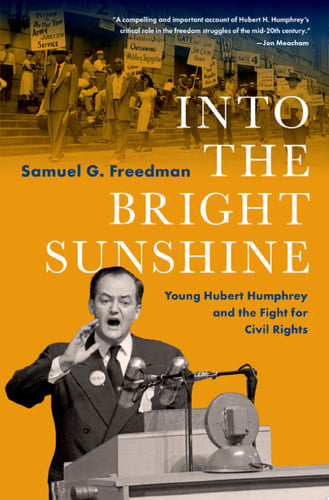
Into the bright sunshine: young Hubert Humphrey and the fight for civil rights

Freedman, Samuel G.
"Hubert Humphrey, a fallen hero and a dying man, rose on rickety legs to approach the podium of the Philadelphia Convention Hall, his pulpit for the commencement address at the University of Pennsylvania. He clutched a sheaf of paper with his speech for the occasion, typed and double-spaced by an assistant from his extemporaneous dictation, and then marked up in pencil by Humphrey himself. A note on the first page, circled to draw particular attention, read simply, "30 years ago--Here." In this place, at that time, twenty-nine years earlier to be precise, he had made history. From the dais now, Humphrey beheld five thousand impending graduates, an ebony sea of gowns and mortarboards, broken by one iconoclast in a homemade crown, two in ribboned bonnets, and another whose headgear bore the masking-tape message HI MA PA. In the horseshoe curve of the arena's double balcony loomed eight thousand parents and siblings, children, and friends. Wearing shirtsleeves and cotton shifts amid the stale heat, they looked like pale confetti from where Humphrey stood, and their flash cameras flickered away, a constellation of pinpricks"--
Oxford University Press 2023 488 pages

Two roads home: Hitler, Stalin, and the miraculous survival of my family

Finkelstein, Daniel
"An epic and beautifully written World War II family history that spans Europe, telling of two happy families uprooted by war, their incredible suffering in Hitler's and Stalin's camps, and the near-miraculous survival and rescue of the author's parents who met after the war. Daniel Finkelstein's grandfather Alfred Wiener was a German Jewish intellectual leader who tolled an early warning of the impending Holocaust and became an archivist of Nazi crimes. He relocated his family to safety in Amsterdam, where they became close with Anne Frank's family. But they were eventually separated, and Daniel's mother Mirjam was sent to Bergen-Belsen with her mother and sisters while Alfred worked feverishly to free them. Finkelstein's father, Ludwik, grew up in a prosperous Jewish family in Poland where his father was a patriotic hero of the Great War. But when Stalin took control, Finkelstein's grandfather was deported to Siberia, while Ludwik and his mother were sent to Kazahkstan, where they barely survived freezing winters and harrowing forced labor conditions. Love and Murder is a page-turning account of ingenuity, bravery and the almost unbelievable coincidences that brought Daniel's parents together. The story features secret archives, forgery and theft, and sweeps across Europe to show the expanse of the war. Moving, engrossing and inspiring, Love and Murder will profoundly touch all who read it"--
Doubleday 2023 374 pages

Freud in his time and ours

Roudinesco, Elisabeth
Élisabeth Roudinesco offers a bold and modern reinterpretation of the iconic founder of psychoanalysis. Based on new archival sources, this is Freud's biography for the twenty-first century--a critical appraisal, at once sympathetic and impartial, of a genius greatly admired and yet greatly misunderstood in his own time and in ours. Roudinesco traces Freuds life from his upbringing as the eldest of eight siblings in a prosperous Jewish-Austrian household to his final days in London, a refugee of the Nazis' annexation of his homeland. She recreates the milieu of fin de siecle Vienna in the waning days of the Habsburg Empire--an era of extraordinary artistic innovation, given luster by such luminaries as Gustav Klimt, Stefan Zweig, and Gustav Mahler. In the midst of it all, at the modest residence of Berggasse 19, Freud pursued his clinical investigation of nervous disorders, blazing a path into the unplumbed recesses of human consciousness and desire. Yet this revolutionary who was overthrowing cherished notions of human rationality and sexuality was, in his politics and personal habits, in many ways conservative, Roudinesco shows. In his chauvinistic attitudes toward women, and in his stubborn refusal to acknowledge the growing threat of Hitler until it was nearly too late, even the analytically-minded Freud had his blind spots. Alert to his intellectual complexity--the numerous tensions in his character and thought that remained unresolved--Roudinesco ultimately views Freud less as a scientific thinker than as the master interpreter of civilization and culture.
Harvard University Press 2016-11-07 580 pages