2328 results for "Jewish History"

Reactionary modernism: technology, culture, and politics in Weimar and the Third Reich

Herf, Jeffrey
Explores the paradox inherent in the German fascists' rejection of the rationalism of the Enlightenment while fully embracing modern technology. By associating technology with the Germans rather than the Jews, with beautiful form rather than the formlessness of the market, and with a strong state rather than a predominance of economic values and institutions, right-wing intellectuals reconciled Germany's strength with its romantic soul and national identity. Includes discussion on the transformation of anti-capitalist rhetoric to anti-Jewish rhetoric. See the index for references to antisemitism, and especially ch. 6, "Werner Sombart: Technology and the Jewish Question".
Cambridge University Press 1984 251 pages

Family matters

Laub, Gillian,Newhouse, Alana
"Family Matters zeroes in on the artist's family as an example of the way Donald Trump's knack for sowing discord and division has impacted communities, individuals, and households across the country. As Laub explains, "I began to unpack my relationship to my relatives--which turned out to be much more indicative of my relationship to the outside world than I had ever thought, and the key to exploring questions I had about the effects of wealth, vanity, childhood, aging, fragility, political conflict, religious traditions, and mortality." These issues became tangible in 2016, when Laub and her parents found themselves on opposing sides of the most divisive presidential election in recent US history; and further exacerbated in the lead-up to the 2020 election, in the wake of a global pandemic and protests in support of Black Lives Matter. Family Matters reveals Laub's willingness to confront ideas of privilege and unity, and to expose the fault lines and vulnerabilities of her relatives and herself. Ultimately, Family Matters celebrates the resiliency and power of family--including the family we choose--in the face of divisive rhetoric. In doing so, it holds up a highly personalized mirror to the social and political divides in the United States today." -- Publisher's description.
Aperture 2021 189 pages

The people of the book: philosemitism in England, from Cromwell to Churchill

Himmelfarb, Gertrude
The specific course of the Reformation in England in the 16th-17th centuries brought about interest in the Jewish Bible, i.e. the Old Testament, and the emergence of a self-image held by the British that they constitute a people of the Book, beside the Jews. This, in turn, gave rise to philosemitism, which marked British culture from the days of Cromwell to those of Churchill, being tinged in various tones, from millenarianism to philo-Zionism. However, the tradition of philosemitism in England was accompanied by manifestations of antisemitism; the same people who extolled the Jews opposed their admission to Parliament; people who defended Jewish rights in the 18th-19th centuries often shared anti-Jewish stereotypes of their time; and leaders who sympathized with Zionism could believe in a Jewish conspiracy against Christian civilization. Ch. 4 (pp. 83-117), "Fictional Heroes and Heroines", deals with 19th-century literature and shows how some writers (e.g. Walter Scott, Dickens, Trollope) could combine philosemitic and antisemitic motifs in their literary works.
Encounter Books 2011 183 pages

American shtetl: the making of Kiryas Joel, a Hasidic village in upstate New York

Stolzenberg, Nomi M.,Myers, David N.
A compelling account of how a group of Hasidic Jews established its own local government on American soil Settled in the mid-1970s by a small contingent of Hasidic families, Kiryas Joel is an American town with few parallels in Jewish history—but many precedents among religious communities in the United States. This book tells the story of how this group of pious, Yiddish-speaking Jews has grown to become a thriving insular enclave and a powerful local government in upstate New York. While rejecting the norms of mainstream American society, Kiryas Joel has been stunningly successful in creating a world apart by using the very instruments of secular political and legal power that it disavows. Nomi Stolzenberg and David Myers paint a richly textured portrait of daily life in Kiryas Joel, exploring the community's guiding religious, social, and economic norms. They delve into the roots of Satmar Hasidism and its charismatic founder, Rebbe Joel Teitelbaum, following his journey from nineteenth-century Hungary to post–World War II Brooklyn, where he dreamed of founding an ideal Jewish town modeled on the shtetls of eastern Europe. Stolzenberg and Myers chart the rise of Kiryas Joel as an official municipality with its own elected local government. They show how constant legal and political battles defined and even bolstered the community, whose very success has coincided with the rise of political conservatism and multiculturalism in American society over the past forty years. Timely and accessible, American Shtetl unravels the strands of cultural and legal conflict that gave rise to one of the most vibrant religious communities in America, and reveals a way of life shaped by both self-segregation and unwitting assimilation.
Princeton University Press 2024-02-20 496 pages

Introduction to the Bible

Hayes, Christine Elizabeth
"This book examines the small library of 24 books common to all Jewish and Christian Bibles--books that preserve the efforts of diverse writers over a span of many centuries to make sense of their personal experiences and those of their people, the ancient Israelites. Professor Christine Hayes guides her readers through the complexities of this polyphonous literature that has served as a foundational pillar of Western civilization, underscoring the variety and even disparities among the voices that speak in the biblical texts. Biblical authors wrote in many contexts and responded to a sweeping range of crises and questions concerning issues that were political, economic, historical, cultural, philosophical, religious, and moral. In probing chapters devoted to each of the 24 books of the Hebrew Bible, or Old Testament, Hayes reconstructs the meanings and messages of each book and encourages a deeper appreciation of the historical and cultural settings of ancient biblical literature"--
Yale University Press 2012-10-30 430 pages

The thieves of Ostia

Lawrence, Caroline
Flavia Gemina is brilliant at finding things, so it's natural for her to solve mysteries. The daughter of a ship's captain living in Ostia, the port of Rome, in AD79, she acquires a gang of three friends who help her. There is Jonathan, the Jewish boy (and secretly a Christian) who has just moved in next door; Nubia, the African slave girl Flavia's father buys to save her from a terrible fate; and Lupus, a ragged homeless boy who is mysteriously mute. Together they work out who severed the heads of the watchdogs that guard people's homes, and why he did it. Caroline Lawrence, a first-time writer, is a terrific storyteller who creates a wonderfully vivid picture of daily life in the colourful, bustling port of Ostia while never labouring the historical detail. THE THIEVES OF OSTIA is first and foremost a whodunnit, with lots of excitement and plot twists.
Orion Children's 2001 195 pages

The dentist of Auschwitz: a memoir

Jacobs, Benjamin
For well over a century, the United States has witnessed a prolonged debate over organic evolution and teaching of the theory in the nation's public schools. The controversy that began with the publication of Darwin's Origin of the Species had by the 1920s expanded to include theologians, politicians, and educators. The Scopes trial of 1925 provided the growing antievolution movement with significant publicity and led to a decline in the teaching of evolution in public schools. George E. Webb details how efforts to improve science education in the wake of Sputnik resurrected antievolution sentiment and led to the emergence of "creation science" as the most recent expression of that sentiment. Creationists continue to demand "balanced treatment" of theories of creation and evolution in public schools, even though their efforts have been declared unconstitutional in a series of federal court cases. Their battles have been much more successful at the grassroots level, garnering support from local politicians and educators. Webb attributes the success of creationists primarily to the lack of scientific literacy among the American public. Although a number of published studies have dealt with specific aspects of the debate, The Evolution Controversy in America represents the first complete historical survey of the topic. In it Webb provides an analysis of one of the most intriguing debates in the history of American thought.
University Press of Kentucky 1995 231 pages

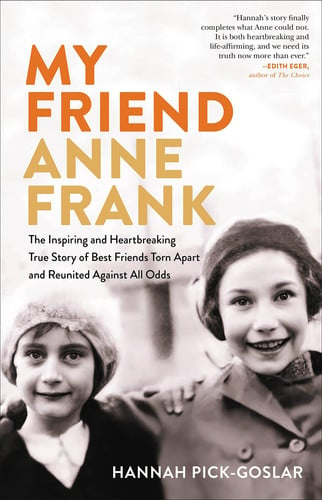
My friend Anne Frank: the inspiring and heartbreaking true story of best friends torn apart and reunited against all odds

Pick-Goslar, Hannah,Kraft, Dina
"In 1933, Hannah Pick-Goslar and her family fled Nazi Germany to live in Amsterdam, where she struck up a close friendship with her next-door neighbor, an outspoken and fun-loving young girl named Anne Frank. For several years, the inseparable pair enjoyed a carefree childhood of games, sleepovers, and treats with the other children in their neighborhood of Rivierenbuurt. But in 1942, Hannah and Anne's lives abruptly changed forever. As the Nazi occupation of Amsterdam progressed, Anne and the Frank family seemingly vanished, leaving behind unmade beds and dishes in the sink--but no trace of Anne's precious diary. Torn from her dear friend without warning, Hannah spent the next two years tormented by questions about Anne's fate, wondering if she had, by some miracle, managed to escape danger. In this long-awaited memoir, Hannah shares the story of her childhood during the Holocaust, from the introduction of anti-Jewish laws in Amsterdam to the gradual disappearance of classmates and, eventually, the Frank family, to Hannah and her family's imprisonment in the Bergen-Belsen concentration camp. As Hannah chronicles the experiences of her own life during and after the war, she provides a searing look at what countless children endured at the hands of the Nazi regime, as well as an intimate, never-before-seen portrait of the most recognizable victim of the Holocaust. Culminating in an astonishing fateful reunion, My Friend Anne Frank is the profoundly moving story of childhood and friendship during one of the darkest periods in the world's history"--Dust jacket flap.
Little, Brown Spark 2023 313 pages

A rainbow thread: an anthology of queer Jewish texts from the first century to 1969

Noam Sienna
This anthology for queer Jewish history draws from two millennia, five continents, and fifteen languages. Through poetry, drama, law, literature, memoirs and commentary, the book reveals a history long shared by two ancient cultures, Jewish and gay. It includes generous bibliographies, two indexes, and an extensive list of thematic links for focused study.--
Print-O-Craft 2019-02 426 pages

The correspondence of Walter Benjamin, 1910-1940

Benjamin, Walter
Called "the most important critic of his time" by Hannah Arendt, Walter Benjamin has emerged as one of the most compelling thinkers of our time as well, his work assuming a crucial place in current debates over the interactions of art, culture, and meaning. A "natural and extraordinary talent for letter writing was one of the most captivating facets of his nature", writes Gershom Scholem in his Foreword; and indeed, Benjamin's correspondence reveals the evolution of some of his most powerful ideas. Published here in English for the first time, these letters offer an intimate picture of Benjamin himself and the times in which he lived. Written in a day when letters were an important vehicle for the presentation and development of intellectual matters, Benjamin's correspondence is rich in insight into the circumstances behind his often difficult work. These letters provide a lively view of Benjamin's life and thought from his days as a student to his melancholy experiences as an exile in Paris. As he defends his changing ideas to admiring and skeptical friends – poets, philosophers, and radicals – we witness the restless self-analysis of a creative mind far in advance of his own time. Writing at length to Scholem and Theodor Adorno, and exchanging letters with Rainer Maria Rilke, Hannah Arendt, Hugo von Hofmannsthal, Max Horkheimer, Max Brod, Bertolt Brecht, and Kafka's friend Felix Weltsch, Benjamin elaborates his ideas about metaphor and language. He reflects on literary figures from Kafka to Karl Kraus, the "Jewish Question" and anti-Semitism, Marxism and Zionism. And he expounds his personal attitudes toward such subjects as the role of quotations in criticism, history, and tradition; the meaning of being a "collector"; and French culture and the national character. In sum, this magnificent collection is an exceptionally rich source of information and an essential key to understanding one of the preeminent figures of modern culture. --
University of Chicago Press 1994-06-15 651 pages

The list: a novel

Fletcher, Martin
"Winner of a Jewish National Book Award for his previous book, Walking Israel, NBC Special Correspondent Martin Fletcher uses meticulous research and his own family's history in this stunning novel. Dramatizing explosive events in London and Palestine in the years directly following World War II, The List follows the lives of Edith and Georg, Austrian refugees who are expecting their first baby in a world unfriendly to Jews. Anti-Semitism sweeps across the streets of London even as the world learns of the atrocities of the Holocaust. As Edith and Georg desperately search for surviving family members, they struggle to stay afloat in a world riddled with terrorism, assassination attempts, and fear"--
Thomas Dunne 2011-10-11 338 pages

Women on the margins: three seventeenth-century lives

Davis, Natalie Zemon
As she did with Martin Guerre, Natalie Zemon Davis here retrieves individual lives from historical obscurity to give us a window onto the early modern world. As women living in the seventeenth century, Glikl bas Judah Leib, Marie de l'Incarnation, and Maria Sibylla Merian, equally remarkable though very different, were not queens or noblewomen, their every move publicly noted. Rather, they were living "on the margins" in seventeenth-century Europe, North America, and South America. Yet these women - one Jewish, one Catholic, one Protestant - left behind memoirs and writings that make for a spellbinding tale and that, in Davis' deft narrative, tell us more about the life of early modern Europe than many an official history. All these women were originally city folk. Glikl bas Judah Leib was a merchant of Hamburg and Metz whose Yiddish autobiography blends folktales with anecdotes about her two marriages, her twelve children, and her business. Marie de L'Incarnation, widowed young, became a mystic visionary among the Ursuline sisters and cofounder of the first Christian school for Amerindian women in North America. Maria Sibylla Merian, a German painter and naturalist, produced an innovative work on tropical insects based on lore she gathered from the Carib, Arawak, and African women of Suriname. The resulting triptych suggests the range of experience, self-consciousness, and expression possible in seventeenth-century Europe and its outposts. It also shows how persons removed from the centers of power and learning ventured in novel directions, modifying in their own way Europe's troubled and ambivalent relations with other "marginal" peoples.
Harvard university press 1997 360 pages

Nazi propaganda for the Arab world

Herf, Jeffrey
Jeffrey Herf, a leading scholar in the field, offers the most extensive examination to date of Nazi propaganda activities targeting Arabs and Muslims in the Middle East during World War II and the Holocaust. He draws extensively on previously unused and little-known archival resources, including the shocking transcriptions of the "Axis Broadcasts in Arabic" radio programs, which convey a strongly anti-Semitic message.
Yale University Press 2010 335 pages

Historicism, the Holocaust, and Zionism: critical studies in modern Jewish thought and history

Katz, Steven T.
"[Of] the 12 well-crafted essays in this volume...the most useful are those dealing with the Holocaust." — Choice "Especially recommended for college-level students of Jewish history and culture." — The Bookwatch This is a critical exploration of the most repercussive topics in modern Jewish history and thought. A sequel to Katz's National Jewish Book Award-winning study, Post-Holocaust Dialogues, this book identifies the main issues in the contemporary Jewish intellectual universe and outlines a larger, more synthetic understanding of contemporary Jewish existence.
New York University Press 1992 315 pages

Israel: is it good for the Jews?

Cohen, Richard M.
"A very personal journey through Jewish history (and Cohen's own), and a passionate defense of Israel's legitimacy. Richard Cohen's book is part reportage, part memoir--an intimate journey through the history of Europe's Jews, culminating in the establishment of Israel. A veteran, syndicated columnist for The Washington Post, Cohen began this journey as a skeptic, wondering in a national column whether the creation of a Jewish State was "a mistake." As he recounts, he delved into his own and Jewish history and fell in love with the story of the Jews and Israel, a twice-promised land--in the Bible by God, and by the world to the remnants of Europe's Jews. This promise, he writes, was made in atonement not just for the Holocaust, but for the callous indifference that preceded World War II and followed it--and that still threatens. Cohen's account is full of stories--from the nineteenth century figures who imagined a Zionist country, including Theodore Herzl, who thought it might resemble Vienna with its cafes and music; to what happened in twentieth century Poland to his own relatives; and to stories of his American boyhood. Cohen describes his relationship with Israel as a sort of marriage: one does not always get along but one is faithful"--
Simon & Schuster 2014-09-16 275 pages