58,196 results in 0.07 seconds

Romanticism

Gerald Abraham
Romanticism--a concept more easily recognized than defined--dominated the artistic landscape of music from 1830-1890. Like the other volumes in the New Oxford History of Music series, this final volume to be published provides a detailed, scholarly critical survey of the music and composers of its period. Divided among different forms of music, the chapters, written by eminent scholars under the editorship of one of the most respected experts on nineteenth-century music, detail the work of Chopin, Schumann, Mendelssohn, Liszt, Brahms, Berlioz, Donizetti, Verdi, Wagner, Gounod, Bizet, Borodin, Mussorgsky, Tchaikovsky, Rimsky-Korsakov, Dvorak, Smetana, Faur�, Wolf, Puccini, Bruckner, Mahler, Strauss, C�sar Franck, and Debussy.
Oxford Univ Pr 1994 956 pages

Fowlers End

Gerald Kersh
An amazing comic novel by Kersh (Night and The City). It's the tale of a young man who enters the peculiar underworld of Cockney Theatre, and quickly finds himself wrapped up in scams, treachery, nitro-glycerine and midgets. This bawdy, rollicking novel, featuring in Sam Yudenow the most fittingly peculiar dialogue since Sheridan's Mrs. Malaprop graced the stage, is the last to be written by Kersh. Published in 1957, only a year after The Ginger Man's runaway success in London, the work may have suffered by its release from a mainstream UK publisher. (Where were the censors?) So to guarantee success this time around, when we print Fowlers End, we're going to go the extra mile and make sure to have ads in the back for some of the most spectular Olympia titles. Kersh deserves no less.
Disruptive Publishing 2006-10 392 pages

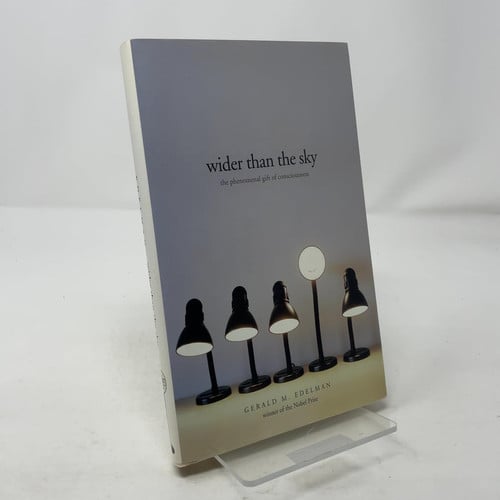
Wider than the sky: the phenomenal gift of consciousness

Edelman, Gerald M.
A neuroscientist demystifies the subject of consciousness in this up-to-date discussion of mind-body connections. How does the firing of neurons give rise to subjective sensations, thoughts, and emotions? How can the disparate domains of mind and body be reconciled? The quest for a scientifically based understanding of consciousness has attracted study and speculation across the ages. In this direct and non-technical discussion of consciousness, Dr. Gerald M. Edelman draws on a lifetime of scientific inquiry into the workings of the brain to formulate answers to the mind-body questions that intrigue every thinking person. Concise and understandable, the book explains pertinent findings of modern neuroscience and describes how consciousness arises in complex brains. Edelman explores the relation of consciousness to causation, to evolution, to the development of the self, and to the origins of feelings, learning, and memory. His analysis of the brain activities underlying consciousness is based on recent remarkable advances in biochemistry, immunology, medical imaging, neuroscience, and evolutionary biology, yet the implications of his book extend farther--beyond the worlds of science and medicine into virtually every area of human inquiry.
Yale University Press 2004-01-01 201 pages

Saul Bellow: "I was a Jew and an American and a writer"

Sorin, Gerald
"Born in 1915 to Russian Jewish immigrants, Saul Bellow was raised in the small town - "a medieval" shtetl he called it - of Lachine, Quebec, and then in a predominantly Jewish section of Montreal until the age of nine. He had a trilingual childhood which included Yiddish as well as English and French. In an insightful new look at Bellow's life and career, Gerald Sorin argues that Bellow's immersion in Yiddish and childhood memories of the vibrant Jewish life on Montreal's Napoleon and Dominique streets continued to echo in his adult inner ear and permeated almost all of his writing. Much of Bellow's creative power, including the dynamic, comic, and lusty language that became his literary signature, was shaped and informed by the fact that he was Jewish"--
Indiana University Press 2024 583 pages

Lucky life: poems

Stern, Gerald
This Lamont Prize-winning book offers all the joy, sadness, humor, beauty, and song that typically characterizes the work of the well-respected but unfortunately lesser-known American poet Gerald Stern. Stern, who has been writing since the 1960s, made a name for himself in 1977 with the publication of Lucky Life, now his most renowned collection. In Lucky Life Stern takes the reader on a journey, pausing everywhere from the streets of New York to post-Holocaust Germany to the soil of a lobelia plant. In an intimate and mature voice, he shares with us the lineage of his ancestors; his personal relationships; and bits of art, music, history--even the neighbors he chats with on the beach. His style is Whitmanesque, urging us to "listen a little for the spongy world" after it has rained, and reminding us how to "understand the power of maples." Reading Stern's poetry is like listening to the words of a loving grandparent who has been through his or her share of painful experiences but has come to terms with them through wisdom gained from a long life. Stern offers several reasons for surviving in this often senseless world, but one of the most outstanding is found in the title poem: "Lucky you can be purified over and over again. / Lucky there is the same cleanliness for everyone."
Houghton Mifflin 1977 88 pages

Living in the eighties

Gil Troy,Vincent J. Cannato
Some see the 1980s as a Golden Age, a "Morning in America" when Ronald Reagan revived America's economy, reoriented American politics, and restored Americans' faith in their country and in themselves. Others see the 1980s as a new "Gilded Age," an era that was selfish, superficial, glitzy, greedy, divisive, and destructive. This multifaceted exploration of the 1980s brings together a variety of voices from different political persuasions, generations, and vantage points. The volume features work by Reagan critics and Reagan fans (including one of President Reagan's closest aides, Ed Meese), by historians who think the 1980s were a disastrous time, those who think it was a glorious time, and those who see both the blessings and the curses of the decade. Their essays examine everything from multiculturalism, Southern conservatism, and Reaganomics, to music culture, religion, crime, AIDS, and the city. A complex, thoughtful account of a watershed in our recent history, this volume will engage anyone interested in this pivotal decade.
Oxford University Press 2009-10-22 212 pages

Under the Domim Tree

Gila Almagor
Winner of the Jewish Book Awards, this book shares the struggles and strength of three young girls growing up in post-Holocaust Israel as they learn to lean on each other while processing the loss and pain of all they have endured. Growing up in post-Holocaust Israel, Avita, Yola, and Mira are all living in Udim, a youth village nestled along Israel's coastal plain. But beyond sharing their home village, the girls are united through a common sorrow—the pain of longing for lost loved ones. As they grow through their struggles and come to terms with the tragedies that have happened, Avita, Yola, and Mira find friendship and comfort as they become closer, discover more about each other, and learn they are not alone. “It is impossible to come away from this novel without added insight into the impact of war and admiration for those who endure its horrors.” – Publishers Weekly
Simon & Schuster Books for Young Readers 2015-04-14 176 pages

The wandering who? a study of Jewish identity politics

Atzmon, Gilad
An investigation of Jewish identity politics and Jewish contemporary ideology using both popular culture and scholarly texts. Jewish identity is tied up with some of the most difficult and contentious issues of today. The purpose in this book is to open many of these issues up for discussion. Since Israel defines itself openly as the 'Jewish State', we should ask what the notions of 'Judaism', 'Jewishness', 'Jewish culture' and 'Jewish ideology' stand for. Gilad examines the tribal aspects embedded in Jewish secular discourse, both Zionist and anti Zionist; the 'holocaust religion'; the meaning of 'history' and 'time' within the Jewish political discourse; the anti-Gentile ideologies entangled within different forms of secular Jewish political discourse and even within the Jewish left. He questions what it is that leads Diaspora Jews to identify themselves with Israel and affiliate with its politics. The devastating state of our world affairs raises an immediate demand for a conceptual shift in our intellectual and philosophical attitude towards politics, identity politics and history.
Zero Books 2011-09-16 202 pages

The Seven Lively Arts

Seldes, Gilbert
“... But, beside those great men, there is a certain number of artists who have a distinct faculty of their own by which they convey to us a peculiar quality of pleasure which we cannot get elsewhere; and these, too, have their place in general culture, and must be interpreted to it by those who have felt their charm strongly, and are often the objects of a special diligence and a consideration wholly affectionate, just because there is not about them the stress of a great name and authority.” —Walter Pater
Independently published 2021-09-18 282 pages