

58,196 results in 0.08 seconds

The National experience

A Bintel Brif A Novel
New York Citys Lower East Side on the eve of WWI. Abraham Cahan, editor-in-chief of The Jewish Daily Forward, receives a letter addressed to his Bintel Brif column from a twenty-three-year-old girl who confesses to living in sin with her uncle and seeks his advice. The girls description of her plight inflames Cahans imagination; the enclosed photograph, a young woman in a white cotton shift gazing languidly up at the camera from her bed, overwhelms him with desire. Peering at the photograph, wondering if her slackened, unprotected presentation of herself was the aftermath of a feverish embrace, Cahan felt a ghostly invisible presence possess him, settling into the emptiness in his soul. Thus begins the drama of a righteous mans struggle to free himself from an obsession that threatens to destroy him and mortally wound his family. Desperate to fathom the mystery of her power, Cahan explores the girls past only to discover that her st

Dangerous men: the SAS and popular culture
In the popular imagination the Special Air Service Regiment, or SAS, is perceived as both protector and avenger of the Crown and emblematic of staunch British individualism. In Dangerous Men, John Newsinger analyses the recent glut of popular books, magazines and films based on the activities of the SAS and assesses the aggressive masculinity, graphic violence and military prowess that are represented in many of the works, and their use in perpetuating myths of muscle-flexing nationalism. The book is divided into four parts covering the myth of the SAS analysed through historical works, and its representation in personal memoirs, fiction, survival manuals, TV documentaries and Hollywood film. Through the works examined, Newsinger deconstructs a range of real and imagined scenarios in which the SAS are pitted against an array of perceived enemies of the state, including the representation of the its role in the storming of the Iranian Embassy and in conflicts from the Falklands to the Gulf. Among the works examined are the bestselling memoirs by Michael Paul Kennedy, Andy McNab, Peter de la Billiere, Chris Ryan, and Jenny Simpson; fiction by James Follett, Terence Strong, Gerald Seymour and the Soldier A-Z series; key historical accounts by Philip Warner,Tony Geraghty, James Adams, and Mark Urban; and acclaimed films such as Who Dares Wins and The Rock .

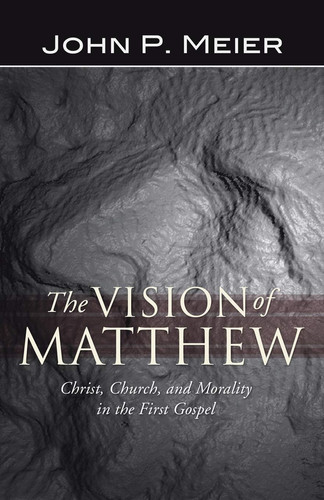
The Vision of Matthew Christ, Church, and Morality in the First Gospel
In this volume Father Meier explores how Matthew remodeled the form, the Christological message, and the moral demand of the gospel. Part I shows Matthew's church in crisis. It was experiencing a shift in its Christian existence: from a narrow Jewish-Christian past to a universal Gentile future. To preserve yet reinterpret the particularistic traditions of that Jewish-Christian past, Matthew drew up a model of salvation history and then reshaped the gospel message to fit it. Part II offers a mini-commentary on the whole gospel to illustrate this reshaping of the message. Pericope by pericope, Matthew presents Jesus as Son of God and Son of Man, and therefore as 'the' definitive teacher of his Church. Indeed, the nexus between Christ and his Church emerges as the outstanding characteristic of Matthew's gospel. Part III studies Matthew's construction of a unified moral vision on the basis of this connection between Christ and Church. The basic stance of Jesus and his disciples towards the Mosaic Law is one of fulfillment - a 'prophetic' fulfillment which involves at times a deepening of, at times the abrogation of, the letter of the Law.
Ideology
Study of the historical background and evolution of communist ideology and the resulting cultural changes in China - examines traditional Chinese philosophy, the role of intellectuals in revolutionary social movements, leadership and the ideology of the Chinese communist political party, present-day social change, political aspects of Chinese foreign policy, etc. Bibliography pp. 343 to 354.

Studies in impressionism

The Tate Gallery

No one like Him: the doctrine of God
Many contemporary theologians claim that the classical picture of God painted by Augustine and Aquinas is both outmoded and unbiblical. But rather than abandoning the traditional view completely, John Feinberg seeks a reconstructed model -- one that reflects the ongoing advances in human understanding of God's revelation while recognizing the unchanging nature of God and His Word. Feinberg begins by exploring the contemporary concepts of God, particularly the openness and process views, and then studies God's being, nature, and acts -- all to articulate a mediating understanding of God not just as the King, but the King who cares!

Theologies and Evil

Puff Piece
The folks that bring you Marlboro - Philip Morris - are wheezing, slowly dying. Cigarettes are out of favour with everyone, from world governments and investors to, increasingly, smokers. So, what's their plan? Prepare to be dazzled. Or, at the very least, befuddled. Philip Morris has announced they will shut down as a cigarette company, and relaunch as a health enterprise, dedicated to convincing the one billion smokers of the world to quit. The ever-curious John Safran leaves his apartment to find out what on God's green earth is going on. As he starts digging away he discovers a company up to brand new shenanigans, wangling their way into unexpected places, desperately trying to keep their tobacco business alive by brandishing a mysterious new doohickey called an IQOS. And not only that, now they're upending language itself, changing the meaning of words. Will they slip past bans by convincing governments they don't sell 'cigarettes' but rather 'HeatSticks', and that these don't emit 'smoke' but 'aerosol'? Can John get the real story out of them without his life catching fire? Wild, hilarious and thought-provoking, Puff Piece is a probing look into Big Tobacco and the vaping industry, and how words can be literally a matter of life and death.

Architecture of the absurd: how "genius" disfigured a practical art
Have you ever wondered why the Guggenheim is always covered in scaffolding? Why the slashes on the exterior of Libeskind's Jewish Museum, supposed to represent Jewish life in prewar Berlin, reappear, for no reason, on his Royal Ontario Museum in Toronto? Or why Gehry's design for an MIT lab for sensitive research has glass walls? Not to mention why, for $44.2 per square foot, it doesn't keep out the rain? You're not alone. In Architecture of the Absurd, John Silber dares to peek behind the curtain of "genius" architects and expose their willful disdain for their clients, their budgets, and the people who live or work inside their creations. In his twenty-five years as President of Boston University, Dr. Silber oversaw a building program totaling more than 13 million square feet. Here he constructs an unflinching case, beautifully illustrated, against the worst trends in contemporary architecture. He challenges architects to derive creative satisfaction from meeting the practical needs of clients and the public. He urges the directors of our universities, symphony orchestras, museums, and corporations to stop financing inefficient, overpriced architecture, and calls on clients and the public to tell the emperors of our skylines that their pretensions cannot hide the naked absurdity of their designs.

The last master
True Beethoven fans know that Beethoven is the greatest composer of all time, but in recent years Mozart's followers have grabbed most of the good tunes. Beethoven is admired but he is lost in our affection. John Suchet both admires Beethoven and likes him, and his three-volume fictional biography, THE LAST MASTER is a carefully researched labour of love. Not a street name or coffee-house in Vienna has gone unchecked. There are many studies of Beethoven and his music, but fewer biographies. His work is complex, and his letters are not immediately revealing in the way that Mozart's are. John Suchet makes his aims clear: within the framework of the historical evidence, he allows himself to imagine episodes which could have happened. Anything which turned out to be impossible has been rewritten until it met this criterion. The result is an awesomely impressive feat of scholarship as well as a compelling read.

Still small voices
Book by Wallach, John, Wallach, Janet

A-Z of Slimming
Exercise aids, appetite pills, aversion therapy, fad diets, massage parlours, metabolic charts - do YOU know what to believe will do the trick for you? In this witty directory to the myths and temptations of the slimming business, John Yudkin takes the mystique out of 'cellulite' and shows how you don't have to starve OR spend money to grow slim and healthy.

Electrons and phonons
This study of the theory of electrical and thermal conduction in metals, semiconductors, and insulators is written at a level appropriate to graduate students and research workers and assumes some knowledge of wave mechanics in its reader. The basic ideas of crystal lattice dynamics, electron zone structure, and transport theory are developed from first principles, and formulae for the macroscopic coefficients are deduced by self-contained mathematical arguments. Interpretation in terms of electronic structure, chemical purity, crystal structure, and crystal perfection is emphasized as a tool for further investigation but detailed discussion of individual means or alloys is avoided.

Invariant measures
In 1940-1941 von Neumann lectured on invariant measures at the Institute for Advanced Study at Princeton. This book is essentially a written version of those lectures. The lectures began with general measure theory and went on to Haar measure and some of its generalizations. Shizuo Kakutani was at the Institute that year, and he and von Neumann had many conversations on the subject. The conversations revealed facts and produced proofs. Quite a bit of the content of the course, especially toward the end, was discovered a few weeks before it appeared on the blackboard. The original version of these notes was prepared by Paul Halmos, von Neumann's assistant that year. Von Neumann read the handwritten version before it went to the typist and sometimes scribbled comments on the margins; he rewrote most of Chapter 6. This book is the first published version of the original notes.

I Wouldn't Leave Rome to Go to Heaven
In this wise and funny novel, three single women, all expatriates living in Rome, face middle age: Margaret walked out on her husband as soon as her son was old enough to leave home, and she's never regretted it. She relishes her solitary lifestyle until illness threatens her independence. Katja, a former model, still believes that Mr. Right will come along, and she fights hard to stay beautiful until he does. Francesca has recently ended a relationship with a man she hopes will be her last big mistake. She wants to slink into a cozy old age alone, but the dark-eyed men of Rome are impossible to ignore. Cover illustration by Augusto Ranocchi Author photo by Rudi Weislein

A short gentleman
How did Robert Purcell, distinguished barrister and perfect specimen of the British Establishment, end up in prison? An intellectual giant but an emotional pygmy, Robert is a man struggling to come to terms with the forces that have brought him down, from the wife who wanted him to change, to the ex-girlfriend who came back to haunt him, and the childhood bully who turned into an adult bully. Despite everything, Robert remains the same magnificently self-righteous man he always was, utterly resistant to therapy, change, and the emotional demands of the opposite sex.

