58,196 results in 0.07 seconds

The Coral Sea

Patti Smith
In linked pieces Patti Smith tells the story of a man on a journey to see the Southern Cross, who is reflecting on his life and fighting the illness that is consuming him. Metaphoric and dreamy, this tale of transformation arises from Smith's knowledge of Mapplethorpe as a young man and as a mature artist, his close relationship with his patron and friend, Sam Wagstaff, and his years surviving AIDS and his ascent into death. Rich in detail, it is filled with references to Mapplethorpe's work and shows the man beneath the persona. Set against photographs by Mapplethorpe, the work emerges as a hymn, a prayer, a fable wishing him Godspeed on his latest journey."She was once our savage Rimbaud, but suffering has turned her into our St. John of the Cross, a mystic full of compassion."--Edmund White
W. W. Norton & Company 1997 71 pages

Shakespeare's Rome: republic and empire : with a new preface

Cantor, Paul A.
For more than forty years, Paul Cantor’s Shakespeare’s Rome has been a foundational work in the field of politics and literature. While many critics assumed that the Roman plays do not reflect any special knowledge of Rome, Cantor was one of the first to argue that they are grounded in a profound understanding of the Roman regime and its changes over time. Taking Shakespeare seriously as a political thinker, Cantor suggests that his Roman plays can be profitably studied in the context of the classical republican tradition in political philosophy. In Shakespeare’s Rome , Cantor examines the political settings of Shakespeare’s Roman plays, Coriolanus and Antony and Cleopatra , with references as well to Julius Caesar . Cantor shows that Shakespeare presents a convincing portrait of Rome in different eras of its history, contrasting the austere republic of Coriolanus , with its narrow horizons and martial virtues, and the cosmopolitan empire of Antony and Cleopatra , with its “immortal longings” and sophistication bordering on decadence.
The University of Chicago Press 2017-07-05 228 pages

Religion and the Public Schools

Paul A. Freund,Robert Ulich
In "Constitutional Mandates and Choices," Paul Freund discusses the recent Supreme Court school-prayer decisions and the Constitution. Acknowledging the need for instilling tradition, morality, and reverence-the "religious component" called for by many-Freund still maintains that "the school-prayer decisions are more important for the doors they leave open than for those they shut. The study of religious tradition, training in moral analysis, and the cultivation of sensibilities beyond the intellectual are all left open and beckoning... Today the need is not to reform the First Amendment but to examine and reform our ideas and practices of moral education in the schools." After presenting a brief historical description of religious education in our Western Judeo-Christian civilization, and outlining the present situation in our public schools, Mr. Ulich, in "The Historical Present," declares that if by "religion" we do not mean allegiance to a particular creed, then, "whatever is the decision of the Supreme Court, it will never be able to divorce the religious from the educational spheres in our education system."
Harvard University Press 1965 84 pages

Selected poems

Celan, Paul
One of the major twentieth-century European poets, Paul Celan wrote poetry of exceptional linguistic brilliance and intensity drawn from his experiences, particularly of the war years and the loss of his parents in the death camps. In his verse he sought to express 'not only what the experience felt like, but also a sense of living, with comprehension, inside the experience'. WINNER OF THE FIRST EUROPEAN TRANSLATION PRIZE
Penguin Books 1996 358 pages

New World New Mind

Robert Ornstein,Paul Ehrlich
Robert Ornstein and Paul Ehrlich explain that we are causing our own problems because we have created a world where our basic mental functions are no longer suitable. We evolved over a period of millions of years to survive in small tribal families on the wild grassy plains of East Africa. Now the way we live has nothing to do with that time and place, but the mental tools that were developed to survive on the savanna have remained unchanged. These instincts were wonderfully adapted to the environment that shaped them. But that world, the world that made us, is gone. Now these same instincts are causing us to destroy the world that we made. The threats we face are of our own making, and we can unmake them. If people learn how we have come to this point, we can restore our hope for the future. New World New Mind describes the way our minds have evolved, and offers suggestions for how to cope with who we are in the world we live in now. Recent decades have seen remarkable progress in many areas. For example, despite the abject suffering of millions of people, it is nonetheless true that there has been unprecedented alleviation of poverty and disease for the world's poorest people. There are so many promising and astonishing advances in medicine, technology, and the social and physical sciences that if we give ourselves a chance to survive, our species could enter a golden age.
Malor Books 2020-09 320 pages

The Economic Foundations of Fascism

Paul Einzig
"Even the most superficial readers of the popular Press know today that Communism means the public ownership of the means of production. Fascism, on the other hand, Is still regarded principally as a political movement; The economic implications of the term are generally ignored. the meaning of the term ''corporate state' is unkown even to people whose general intelligence and special knowledge of foreign affairs and of economics is well above the average." -Paul Einzig
Lulu.com 2021-04-27 148 pages

The château: a novel

Goldberg, Paul
"We have proverb in Florida...You know why it's good to be on beach?" Bill smiles, but says nothing. He wants the guy to keep talking. "Because on beach you are surrounded by idiots on only three sides." "And on the remaining side you have what?" asks Bill. "Sharks..." Paul Goldberg, the acclaimed author of The Yid , takes us behind the scenes of a Florida condo board election, delivering a wild spin on Miami Beach, petty crime, Jewish identity, and life in Trump's America. It is January 2017 and Bill has hit rock bottom. Yesterday, he was William M. Katzenelenbogen, successful science reporter at The Washington Post . But things have taken a turn. Fired from his job, aimless, with exactly $1,219.37 in his checking account, he learns that his college roommate, a plastic surgeon known far and wide as the “Butt God of Miami Beach,” has fallen to his death under salacious circumstances. With nothing to lose, Bill boards a flight for Florida’s Gold Coast, ready to begin his own investigation—a last ditch attempt to revive his career. There’s just one catch: Bill’s father, Melsor. Melsor Yakovlevich Katzenelenbogen—poet, literary scholar, political dissident, small-time-crook—is angling for control of the condo board at the Château Sedan Neuve, a crumbling high-rise in Hollywood, Florida, populated mostly by Russian Jewish immigrants. The current board is filled with fraudsters levying “special assessments” on residents, and Melsor will use any means necessary to win the board election. And who better to help him than his estranged son? As he did in The Yid , Paul Goldberg has taken something we think we know and turned it on its ear. Featuring a colorful cast of characters, The Château guarantees that you will never look at condo boards, crime, kleptocracy, vodka, Fascism, or Florida the same way again.
Picador 2019-02-19 384 pages

Of One Blood Abolitionism and the Origins of Racial Equality

Paul Goodman
The abolition movement is perhaps the most salient example of the struggle the United States has faced in its long and complex confrontation with the issue of race. In his final book, historian Paul Goodman, who died in 1995, presents a new and important interpretation of abolitionism. Goodman pays particular attention to the role that blacks played in the movement. In the half-century following the American Revolution, a sizable free black population emerged, the result of state-sponsored emancipation in the North and individual manumission in the slave states. At the same time, a white movement took shape, in the form of the American Colonization Society, that proposed to solve the slavery question by sending the emancipated blacks to Africa and making Liberia an American "colony." The resistance of northern free blacks was instrumental in exposing the racist ideology underlying colonization and inspiring early white abolitionists to attack slavery straight on. In a society suffused with racism, says Goodman, abolitionism stood apart by its embrace of racial equality as a Christian imperative. Goodman demonstrates that the abolitionist movement had a far broader social basis than was previously thought. Drawing on census and town records, his portraits of abolitionists reveal the many contributions of ordinary citizens, especially laborers and women long overshadowed by famous movement leaders. Paul Goodman's humane spirit informs these pages. His book is a scholarly legacy that will enrich the history of antebellum race and reform movements for years to come. "[God] hath made of one blood all nations of men for to dwell on all the face of the earth."—Acts 17:26
University of California Press 2000-11-02 324 pages

From Benito Mussolini to Hugo Chavez: intellectuals and a century of political hero worship

Hollander, Paul
During the twentieth and twenty-first centuries, political dictators were not only popular in their own countries, but were also admired by numerous highly educated and idealistic Western intellectuals. The objects of this political hero-worship included Benito Mussolini, Adolph Hitler, Joseph Stalin, Mao Zedong, Fidel Castro and more recently Hugo Chavez, among others. This book seeks to understand the sources of these misjudgements and misperceptions, the specific appeals of particular dictators, and the part played by their charisma, or pseudo-charisma. It sheds new light not only on the political disposition of numerous Western intellectuals - such as Martin Heidegger, Eric Hobsbawm, Norman Mailer, Ezra Pound, Susan Sontag and George Bernard Shaw - but also on the personality of those political leaders who encouraged, and in some instances helped to design, the cult surrounding their rise to dictatorship.
Cambridge University Press 2016 325 pages

High Times Presents Paul Krassner's Pot Stories for the Soul

Paul Krassner
To solicit these stories, Paul Krassner contacted 250 friends and acquaintances and announced the project in High Times and on the air. Including "The Bust at Ken Kesey's Place, " "How the Yippies Mailed 30,000 Joints to Perfect Strangers, " and "The Acid Trip of a Death Row Prisoner, " these true tales range from funny to bizarre to poignant.
Trans-High Corporation 1999 219 pages

Pot Stories for the Soul

Paul Krassner
The pieces in Pot Stories for the Soul are funny, whimsical, bizarre, poignant, informational, shocking, and, yeah, soulful. They are about love, hate, escape, reality, the paranormal, Allen Ginsberg, Ken Kesey, Michelle Phillips, Hunter Thompson, Abbie Hoffman, Wavy Gravy and peanut butter. Ultimately, these stories reveal the wide, weird, and wonderful subculture of stoners, where the reefers are mad, the joints are fat, and the buzz lasts for six-and-a-half days. Mainstream America has had an uneasy relationship with marijuana. Once a legal substance, the 1930s saw a massive campaign against the "Devil's Harvest" that led to pot being rendered illegal. In the 1960s, marijuana became one of the defining elements of the counterculture before once again being shunted to the sidelines. Over the last decade, however, marijuana has gone mainstream and has been the topic of seminars, expos, concerts, comedy routines, movies, TV shows, and college courses across the country. Originally published by High Times in 1999, Pot Stories for the Soul won the Firecracker Alternative Book Award and also became a Quality Paperback Book Club selection. This brand-new edition includes several new essays by Paul Krassner, plus his foreword, his afterword, and the evolution of cannabis sanity in between.
Catapult 2012-06-12 368 pages

Skepticism and humanism: the new paradigm

Kurtz, Paul
As we begin the third millennium there is cause for cautious optimism regarding the human prospect. Democratic revolutions and the doctrine of universal human rights have captured the imagination of large sectors of humanity, while major advances in science and technology continue to conquer disease and extend life, contributing to rising standards of living, affluence, and cultural freedom on a worldwide basis. Paradoxically, at the same time ancient authoritarian fundamentalist religions have grown in vitriolic intensity along with bizarre New Age, media-driven paranormal belief systems. Also surprising is the resurgence of primitive tribal and ethnic loyalties, unleashing wars of intolerance and bitterness. In Skepticism and Humanism, Paul Kurtz locates these threatening developments within a long-standing and largely unchallenged theological worldview. He proposes, as an alternative to religion, a new cultural paradigm rooted in scientific naturalism, rationalism, and a humanistic outlook. An estimated 60 percent of scientists are atheists or agnostics. However, the skeptical world view has been given little currency even in advanced societies, because of a cultural prohibition against the criticism of religion. At the same time, science has become increasingly narrow and specialized so that few people can draw on its broader intellectual and cultural implications. Skepticism and Humanism attempts to meet this need. It defends skepticism as a method for developing reliable knowledge by using scientific inquiry and reason to test all claims to truth. It also defends scientific naturalism-an evolutionary view of nature, life, and the human species. Kurtz sees the dominant religious doctrines as drawn from an agricultural/nomadic past, and emphasizes the need for a new outlook applicable to the postindustrial information age. At the same time, he rejects postmodernism for abandoning science and embracing a form of nihilism. There can be no doubt that as a new global civilization emerges, scientific naturalism, rationalism, and secular humanism have something significant to say about the meaning of life. Skepticism and Humanism shows how they can to foster democratic values and social prosperity. The book will be important for philosophers, scientists, and all those concerned with contemporary issues. Paul Kurtz taught at Trinity College, Vassar College, and State University of New York at Buffalo. He is founder of Prometheus Books, a major publisher of philosophical works. He is the author of some thirty books including Toward a New Enlightenment (available from Transaction) Humanist Manifesto 2000, and A Secular Humanist Declaration. He is chairman of the Committee for the Scientific Investigation of Claims of the Paranormal, and editor-in-chief of Free Inquiry magazine.
Transaction Publishers 2001 306 pages

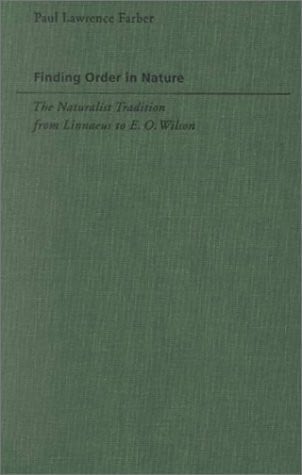
Finding order in nature: the naturalist tradition from Linnaeus to E.O. Wilson

Farber, Paul Lawrence
Since emerging as a discipline in the middle of the eighteenth century, natural history has been at the heart of the life sciences. It gave rise to the major organizing theory of life--evolution--and continues to be a vital science with impressive practical value. Central to advanced work in ecology, agriculture, medicine, and environmental science, natural history also attracts enormous popular interest. In Finding Order in Nature Paul Farber traces the development of the naturalist tradition since the Enlightenment and considers its relationship to other research areas in the life sciences. Written for the general reader and student alike, the volume explores the adventures of early naturalists, the ideas that lay behind classification systems, the development of museums and zoos, and the range of motives that led collectors to collect. Farber also explores the importance of sociocultural contexts, institutional settings, and government funding in the story of this durable discipline. "The quest for insight into the order of nature leads naturalists beyond classification to the creation of general theories that explain the living world. Those naturalists who focus on the order of nature inquire about the ecological relationships among organisms and also among organisms and their surrounding environments. They ask fundamental questions of evolution, about how change actually occurs over short and long periods of time. Many naturalists are drawn, consequently, to deeper philosophical and ethical issues: What is the extent of our ability to understand nature? And, understanding nature, will we be able to preserve it? Naturalists question the meaning of the order they discover and ponder our moral responsibility for it." -- from the Introduction
Johns Hopkins University Press 2000 136 pages