1166 results for "American History"

Down the Great Unknown John Wesley Powell's 1869 Journey of Discovery and Tragedy Through the Grand Canyon

Edward Dolnick
0n May 24, 1869, a one-armed Civil War veteran named John Wesley Powell and a ragtag band of nine mountain men embarked on the last great quest in the American West. No one had ever explored the fabled Grand Canyon; to adventurers of that era it was a region almost as mysterious as Atlantis -- and as perilous. The ten men set out down the mighty Colorado River in wooden rowboats. Six survived. Drawing on rarely examined diaries and journals, Down the Great Unknown is the first book to tell the full, true story.
HarperCollins 2002-09-17 400 pages

Three songs, three singers, three nations: the William E. Massey Sr. lectures in the history of American civilization 2013

Marcus, Greil
Greil Marcus has been one of the most distinctive voices in American music criticism for over forty years. His books, including Mystery Train and The Shape of Things to Come, traverse soundscapes of folk and blues, rock and punk, attuning readers to the surprising, often hidden affinities between the music and broader streams of American politics and culture. Drawn from Marcus’s 2013 Massey Lectures at Harvard, his new work delves into three episodes in the history of American commonplace song: Bascom Lamar Lunsford’s 1928 “I Wish I Was a Mole in the Ground,” Geeshie Wiley’s 1930 “Last Kind Words Blues,” and Bob Dylan’s 1964 “Ballad of Hollis Brown.” How each of these songs manages to convey the uncanny sense that it was written by no one illuminates different aspects of the commonplace song tradition. Some songs truly did come together over time without an identifiable author. Others draw melodies and motifs from obscure sources but, in the hands of a particular artist, take a final, indelible shape. And, as in the case of Dylan’s “Hollis Brown,” there are songs that were written by a single author but that communicate as anonymous productions, as if they were folk songs passed down over many generations.
Harvard University Press 2015-10-07 164 pages

The POLITICS OF BAD FAITH The Radical Assault on America's Future

David Horowitz
In this intellectual companion piece to his acclaimed autobiography, Radical Son, David Horowitz argues that, even in this supposedly post-ideological, post-Cold War era, the historic themes of that conflict still drive our politics and animate our cultural debates. With keen political insight and a masterly grasp of history, he examines how the political Left, including those who describe themselves as liberals, has refused to learn from the past -- particularly from the checkered records of progressive movements for social justice. This important work is a cohesive and searing document for all who refuse to bury their heads in the sand while American institutions and beliefs are corrupted by the politics of bad faith masquerading under the guise of social justice.
Simon and Schuster 2000-03-03 224 pages

"They take our jobs!": and 20 other myths about immigration

Chomsky, Aviva
"Revised and expanded edition of the groundbreaking book which demystifies twenty-one of the most widespread myths and beliefs about immigrants and immigrations. In "They Take Our Jobs!" Aviva Chomsky challenges the underlying assumptions that fuel misinformed claims about immigrants, radically altering our notions of citizenship, discrimination, and U.S. history. Since it was first published, many of the same myths about immigration such as "immigrants take American jobs," " immigrants don't pay taxes," and "immigrants increase crime" continue to be perpetuated and used to promote aggressive anti-immigration policies. In a new introduction, Chomsky reflects on the events of the past ten years. She analyzes declining Mexican immigration patterns, illuminates Mexico's little-known Southern Border Program, and assesses Obama's complicated legacy as "deporter-in-chief" which, Chomsky argues, inadvertently laid the groundwork for Trump's anti-immigrant racism"--
Beacon Press 2018-04-24 243 pages

What then must we do? straight talk about the next American revolution

Alperovitz, Gar
Never before have so many Americans been more frustrated with our economic system, more fearful that it is failing, or more open to fresh ideas about a new one. The seeds of a new movement demanding change are forming. But just what is this thing called a new economy, and how might it take shape in America? In What Then Must We Do? Gar Alperovitz speaks directly to the reader about where we find ourselves in history, why the time is right for a new-economy movement to coalesce, what it means to build a new system to replace the crumbling one, and how we might begin. He also suggests what the next system might look like―and where we can see its outlines, like an image slowly emerging in the developing trays of a photographer's darkroom, already taking shape
Chelsea Green Publishing 2013 205 pages

Truth has a power of its own: conversations about a people's history

Zinn, Howard,Suarez, Ray
"Truth Has a Power of Its Own is an engrossing collection of never-before-published conversations with Howard Zinn, conducted by the distinguished broadcast journalist Ray Suarez in 2007, that covers the course of American history from Columbus to the War on Terror from the perspective of ordinary people--including slaves, workers, immigrants, women, and Native Americans. Viewed through the lens of Zinn's own life as a soldier, historian, and activist and using his paradigm-shifting People's History of the United States as a point of departure, these conversations explore the American Revolution, the Civil War, the labor battles of the nineteenth and twentieth centuries, U.S. imperialism from the Indian Wars to the War on Terrorism, World Wars I and II, the Cold War, and the fight for equality and immigrant rights, all from an unapologetically radical standpoint. Longtime admirers and a new generation of readers alike will be fascinated to learn about Zinn's thought processes, rationale, motivations, and approach to his now-iconic historical work."--Amazon.com.
The New Press 2022 223 pages

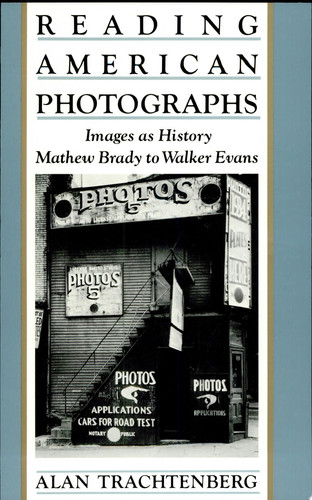
Reading American photographs: images as history, Mathew Brady to Walker Evans

Trachtenberg, Alan
Winner of the Charles C. Eldredge Prize In this book, Alan Trachtenberg reinterprets some of America's most significant photographs, presenting them not as static images but rather as rich cultural texts suffused with meaning and historical content. Reading American Photographs is lavishly illustrated with the work of such luminaries as Mathew Brady, Timothy O'Sullivan, and Walker Evans--pictures that document the American experience from 1839 to 1938. In an outstanding analysis, Trachtenberg eloquently articulates how the art of photography has both followed and shaped the course of American history, and how images captured decades ago provocatively illuminate the present.
Hill and Wang 1989 326 pages

Counselor: a life at the edge of history

Sorensen, Theodore C.
In this gripping memoir, John F. Kennedy's closest advisor recounts in full for the first time his experience counseling Kennedy through the most dramatic moments in American history.... from the decision to go to the moon to the Cuban Missile Crisis, when JFK requested that the thirty-four-year-old Sorensen draft the key letter to Khrushchev at the most critical point of the world's first nuclear confrontation. After Kennedy was assassinated, Sorensen stayed with President Johnson for a few months before leaving to write a biography of JFK. In 1968 he returned to Washington to help run Robert Kennedy's presidential campaign. Through it all, Sorensen never lost sight of the ideals that brought him to Washington and to the White House, working tirelessly to promote and defend free, peaceful societies.--From publisher's description.
Harper 2008-05-06 556 pages

American reckoning: inside Trump's trial-and my own

Alter, Jonathan
"As one of a handful of journalists allowed in the courtroom, for 23 days Jonathan Alter sat just feet away from the most dangerous threat to democracy in American history, watching the spectacle of the century: the felony trial of Donald Trump. Highly publicized but untelevised and thus largely hidden from public view, this landmark trial offered hope of real justice amid a grueling eight-year national ordeal and foreshadowed the drama of the 2024 presidential election. Alter shares everything he witnessed--from eviscerating takes on the colorful characters to the chilling legal ups and downs--to offer a barbed account of the trial and its aftermath, including fresh reporting about the historic events of the summer of 2024. A Zelig of journalism experiencing a crisis of faith in the good sense of the American people, Alter chronicles the shaping of his political consciousness and his bracing, unpredictable relationships with Jimmy and Rosalynn Carter, Bill and Hillary Clinton, Barack Obama, John McCain, and Joe Biden, whose decision to stand down in favor of former prosecutor Kamala Harris put the criminal trial front and center as Americans render their own verdict at the polls."--
BenBella Books, Inc 2024-10-22 245 pages

Offside: soccer and American exceptionalism

Markovits, Andrei S.
"Soccer is the world's favorite pastime, a passion for billions around the globe. In the United States, however, the sport is a distant also-ran behind football, baseball, basketball, and hockey. Why is America an exception? And why, despite America's leading role in popular culture, does most of the world ignore American sports in return? Offside is the first book to explain these peculiarities, taking us on a thoughtful and engaging tour of America's sports culture and connecting it with other fundamental American exceptionalisms. In so doing, it offers a comparative analysis of sports cultures in the industrial societies of North America and Europe. The authors argue that when sports culture developed in the late nineteenth and early twentieth centuries, nativism and nationalism were shaping a distinctly American self-image that clashed with the non-American sport of soccer. Baseball and football crowded out the game. Then poor leadership, among other factors, prevented soccer from competing with basketball and hockey as they grew. By the 1920s, the United States was contentedly isolated from what was fast becoming an international obsession. The book compares soccer's American history to that of the major sports that did catch on. It covers recent developments, including the hoopla surrounding the 1994 soccer World Cup in America, the creation of yet another professional soccer league, and American women's global preeminence in the sport. It concludes by considering the impact of soccer's growing popularity as a recreation, and what the future of sports culture in the country might say about U.S. exceptionalism in general." http://www.loc.gov/catdir/description/prin021/00061115.html
Princeton University Press 2001-04-22 367 pages

Facing the beast: courage, faith, and resistance in a new dark age

Wolf, Naomi
"From New York Times bestselling author Naomi Wolf, Facing the Beast is a devastating, detailed account of wrongthink, deplatforming, and an unexpected political, personal, and spiritual transformation that followed during one of the most divisive times in American history. In this uncompromising investigation into today's most urgent issues, Naomi Wolf uses her own wildly politicized pilgrimage-from New York Times bestselling author and high-level Democratic consultant to a journalist cast out from the elite political and social circles she once moved through-as a stunning narrative framework that is both chilling and incisive. Wolf's sin? Doing the job that good journalists once prided themselves on: asking questions, challenging authority, and, during one of the most politically divisive moments in modern history, exposing the many failures of the public health response during the COVID-19 pandemic by chronicling the dangerous descent of our democracy into tyranny, censorship, and totalitarianism. Unable to remain silent in the shadows and unwilling to collude with the mainstream, Wolf bravely covers topics that few other writers dare to address critically for fear of being deplatformed. Facing the Beast explores reproductive rights, medical freedom, the uncurious thought-policing of the "progressive" left, the Second Amendment, the criminal relationship between the FDA and Pfizer-Wolf's clear writing repeatedly shines light in the dark corners of our fractured society. A decades-long champion of free speech, freedom of the press, and the Constitution, Wolf found herself not only in the midst of a political rebirth but a spiritual transformation as well-one in which the events of the day could only be described in terms of good, evil, and a metaphysical quest on the nature of reality. For readers of Matt Taibbi, Glenn Greenwald, and Bari Weiss, Facing the Beast is a fearless indictment of legacy media and the political class, as well as a brutal reminder that searching for and defending the truth can be dangerous. "Naomi Wolf is one of the bravest, clearest-thinking people I know. The reason you hear the forces of repression so desperately trying to dismiss her is because she is right."-Tucker Carlson"--
Chelsea Green Publishing 2023 232 pages

The Venona Secrets The Definitive Exposé of Soviet Espionage in America

Herbert Romerstein,Eric Breindel
The Venona Secrets presents one of the last great, untold stories of World War II and the Cold War. In 1995, secret Soviet cable traffic from the 1940s that the United States intercepted and eventually decrypted finally became available to American historians. Now, after spending more than five years researching all the available evidence, espionage experts Herbert Romerstein and Eric Breindel reveal the full, shocking story of the days when Soviet spies ran their fingers through America's atomic-age secrets. Included in The Venona Secrets are the details of the spying activities that reached from Harry Hopkins in Franklin Roosevelt s White House to Alger Hiss in the State Department to Harry Dexter White in the Treasury. More than that, The Venona Secrets exposes: • Information that links Albert Einstein to Soviet intelligence and conclusive evidence showing that J. Robert Oppenheimer gave Moscow our atomic secrets. • How Soviet espionage reached its height when the United States and the Soviet Union were supposedly allies in World War II. • The previously unsuspected vast network of Soviet spies in America. • How the Venona documents confirm the controversial revelations made in the 1940s by former Soviet agents Whittaker Chambers and Elizabeth Bentley. • The role of the American Communist Party in supporting and directing Soviet agents. • How Stalin s paranoia had him target Jews (code-named Rats ) and Trotskyites even after Trotsky’s death. • How the Soviets penetrated America’s own intelligence services. The Venona Secrets is a masterful compendium of spy versus spy that puts the Venona transcripts in context with secret FBI reports, congressional investigations, and documents recently uncovered in the former Soviet archives. Romerstein and Breindel cast a spotlight on one of the most shadowy episodes in recent American history - a past when by our very own government officials, whether wittingly or unwittingly, shielded treason infected Washington and Soviet agents.
Skyhorse Publishing 2014-12-08 608 pages

The Gettysburg Gospel The Lincoln Speech That Nobody Knows

Gabor Boritt
Lincoln scholar Gabor Boritt dispels a century of myths and legends to reveal the true meaning of the Gettysburg Address as Abraham Lincoln intended it in this "magisterial work [and] instant classic" (Doris Kearns Goodwin). The words Abraham Lincoln spoke at the dedication of the Soldiers' National Cemetery at Gettysburg comprise perhaps the most famous speech in history. Many books have been written about the Gettysburg Address and yet, as Lincoln scholar Gabor Boritt shows, there is much that we don't know about the speech. In The Gettysburg Gospel he tears away a century of myths, lies, and legends to give us a clear understanding of one of the greatest American's most important speeches. In the aftermath of the bloodiest battle ever fought in North America, the little town of Gettysburg was overwhelmed. This was where Lincoln had to come to explain why the horror of war must continue. Boritt shows how Lincoln responded to the politics of the time, as well as how and when he wrote the various versions of his remarks. Few people initially recognized the importance of the speech, but over the years it would grow into American scripture, acquiring new and broader meanings. Based on years of scholarship as well as a deep understanding of Lincoln and of Gettysburg itself, The Gettysburg Gospel is an indispensable book for anyone interested in the Gettysburg Address, Abraham Lincoln, the Civil War, or American history
Simon and Schuster 2008-02-05 432 pages

Freedom's Detective The Secret Service, the Ku Klux Klan and the Man Who Masterminded America's First War on Terror

Charles Lane
Chronicles the story of the Reconstruction-era Secret Service and its battle against the KKK's effort to suppress the emancipated African-American vote, sharing particular insights into the career of controversial Secret Service chief, Hiram C. Whitley. In the years following the Civil War, a new battle began. Newly freed African American men had gained their voting rights and would soon have a chance to transform Southern politics. Former Confederates and other white supremacists mobilized to stop them. Thus, the KKK was born. After the first political assassination carried out by the Klan, Washington power brokers looked for help in breaking the growing movement. They found it in Hiram C. Whitley. He became head of the Secret Service, which had previously focused on catching counterfeiters and was at the time the government's only intelligence organization. Whitley and his agents led the covert war against the nascent KKK and were the first to use undercover work in mass crime--what we now call terrorism--investigations. Like many spymasters before and since, Whitley also had a dark side. His penchant for skulduggery and dirty tricks ultimately led to his involvement in a conspiracy that would bring an end to his career and transform the Secret Service. Populated by intriguing historical characters--from President Grant to brave Southerners, both black and white, who stood up to the Klan--and told in a brisk narrative style, Freedom's Detective reveals the story of this complex hero and his central role in a long-lost chapter of American history.
Hanover Square Press 2021-03-02 352 pages

The federal impeachment process: a constitutional and historical analysis

Gerhardt, Michael J.
As President Trump and Congressional Democrats battle over the findings of the Mueller report, talk of impeachment is in the air. But what are the grounds for impeaching a sitting president? Who is subject to impeachment? Is impeachment effective as a safeguard against presidential misconduct? What challenges does today’s highly partisan political climate pose to the impeachment process, and what, if any, meaningful alternatives are there for handling presidential misconduct? For more than twenty years, The Federal Impeachment Process has served as the most complete analysis of the constitutional and legal issues raised in every impeachment proceeding in American history. Impeachment, Michael J. Gerhardt shows, is an inherently political process designed to expose and remedy political crimes—serious breaches of duty or injuries to the Republic. Subject neither to judicial review nor to presidential veto, it is a unique congressional power that involves both political and constitutional considerations, including the gravity of the offense charged, the harm to the constitutional order, and the link between an official’s misconduct and duties. For this third edition, Gerhardt updates the book to cover cases since President Clinton, as well as recent scholarly debates. He discusses the issues arising from the possible impeachment of Donald Trump, including whether a sitting president may be investigated, prosecuted, and convicted for criminal misconduct or whether impeachment and conviction in Congress is the only way to sanction a sitting president; what the “Emoluments Clause” means and whether it might provide the basis for the removal of the president; whether gross incompetence may serve as the basis for impeachment; and the extent to which federal conflicts of interest laws apply to the president and other high ranking officials. Significantly updated, this book will remain the standard work on the federal impeachment process for years to come.
The University of Chicago Press 2019-04-12 295 pages

The case against the Supreme Court

Chemerinsky, Erwin
Most Americans share the perception that the Supreme Court is objective, but Erwin Chemerinsky, one of the country's leading constitutional lawyers, shows that this is nonsense and always has been. The Court is made up of fallible individuals who base decisions on their own biases. Today, the Roberts Court is promoting a conservative agenda under the guise of following a neutral methodology, but notorious decisions, such as Bush vs. Gore and United Citizens, are hardly recent exceptions. This devastating book details, case by case, how the Court has largely failed throughout American history at its most important tasks and at the most important times. Only someone of Chemerinsky's stature and breadth of knowledge could take on this controversial topic. Powerfully arguing for term limits for justices and a reassessment of the institution as a whole. The Case Against the Supreme Court is a timely and important book that will be widely read and cited for decades to come.
Viking 2014 386 pages

Who Are You Calling a Woolly Mammoth? Prehistoric America

Elizabeth Levy,J. R. Havlan
America's Horrible Histories are a rollicking read through the fascinating, the horrible, the absolutely awesome, and the positively wacky world of American history. Thoroughly researched, historically accurate, and hilariously illustrated, each book in this new series mixes facts and fun to tell the story of our glorious (and sometimes gory) past. There's even a wisecracking historical guide: a cockroach!
Scholastic 2001-09 128 pages