1206 results for "Technology"

Tech-Savvy Parenting A Guide to Raising Safe Children in a Digital World

Nikki Bush,Arthur Goldstuck
*Are you a parent looking to make sense of a daunting digital world, with new technical challenges appearing daily? * Feel you're not keeping up with the demands of technology? * Feel you're not keeping up with your children's use of social media? * Worried it's getting harder to keep your children safe in the digital world? Tech-Savvy Parenting brings together the experience, research, observations and advice of respected parenting expert Nikki Bush, and leading technology commentator Arthur Goldstuck. This insightful duo will help you get a handle on what's happening in the digital space to ensure your children are safe and savvy in this fast-changing world. They'll guide you through the terminology, dangers and opportunities of technology, while placing children's use of all things digital firmly in the context of the relationship between parents and their children. For families to remain connected, both online and offline, and for young people to develop into responsible digital citizens, parents must bridge the digital divide to their children by understanding the attraction of social media and technology, how communication is changing, and how technology is changing the world. This book is filled with practical advice that will help you to navigate the digital space, together with your children, with greater confidence.
Bookstorm 2015-01-13 256 pages

I Am Not Dead-- Yet!, Or, "The Corpse Moved" A Medical Memoir

Robby Benson
A riveting medical memoir actor/writer/director Robby Benson takes us on a candid journey from athletic soft-spoken heartthrob on Broadway and film, to husband, father, professor and courageous survivor of 4 open-heart surgeries. From One on One, Ice Castles, The Chosen, and Disney's Beauty and the Beast to directing Ellen and Friends, the funny and explicit narrative is a must for fans and essential reading for heart patients, patients of all kinds, their loved ones, and anyone searching for what should be the template for healthcare in America. New York Times #1 bestselling author, Michael F. Roizen, M.D. praised I'm Not Dead... Yet : "When you read this funny and courageously blunt book, you'll understand how to gain the vibrancy that Robby and his wife, Karla, have. ...What a great read and what an important story for all patients and their families dealing with a challenging illness."
ValorEditions.com 2012 384 pages

No Snowflake in an Avalanche The Military Religious Freedom Foundation, Its Battle to Defend the Constitution and One Family's Courageous War Against Religious Extremism in High Places

Michael L. Weinstein
No Snowflake in an Avalanche goes deep inside the world of religious extremism in America s military and political infrastructure from the perspective of Michael L. Mikey Weinstein proud Academy graduate and father of graduates who single-handedly brought to light the Evangelicals' utter disregard of the constitutional principle of separation of church and state that is so essential to the nations military mission. Weinsteins war pits him and his small band of fellow graduates, cadets, and concerned citizens of varying religious backgrounds against a program of Christian fundamentalist indoctrination that could transform our fighting men and women into right-thinking warriors more befitting a theocracy than a democracy.
Rare Bird Books 2012-02 224 pages

Do we still need doctors?

Lantos, John D.
Do We Still Need Doctors? is a personal account from the front lines of the moral and political battles that are reshaping America's health care system. Using compelling firsthand experiences, clinical vignettes, and moral arguments, John D. Lantos, a pediatrician, asks whether, as we proceed with the redesign of our health care system, doctors will - or should - continue to fulfill the roles and responsibilities that they have in the past. Interspersing moving personal stories of his young patients suffering from AIDS, cancer, and other chronic or terminal illnesses with his own stirring dilemmas of truth telling, creative navigation of HMO bureaucracy, and reflections on the identity crisis of medical education, Dr. Lantos reveals how changes in our health care system and new technologies are fostering new ways of understanding and responding to illness. He taps into the public's sense of wanting doctors and hospitals to do something other than what they do now and the frustrating disagreement about what they should do in the future. Do We Still Need Doctors? neither demonizes nor idealizes managed care or for-profit medicine. Instead, Dr. Lantos argues that managed care continues a trend toward rationalizing disease and streamlining treatment that doctors themselves have initiated and sustained over the last fifty years. Illness and death will always resist rationalizing, and in order to respond to them, doctors and patients alike need to re-imagine what healing is or ought to be.
Routledge 1999 214 pages

User Interface Design for Programmers

Avram Joel Spolsky
Most programmers' fear of user interface (UI) programming comes from their fear of doing UI design. They think that UI design is like graphic design—the mysterious process by which creative, latte-drinking, all-black-wearing people produce cool-looking, artistic pieces. Most programmers see themselves as analytic, logical thinkers instead—strong at reasoning, weak on artistic judgment, and incapable of doing UI design. In this brilliantly readable book, author Joel Spolsky proposes simple, logical rules that can be applied without any artistic talent to improve any user interface, from traditional GUI applications to websites to consumer electronics. Spolsky's primary axiom, the importance of bringing the program model in line with the user model, is both rational and simple. In a fun and entertaining way, Spolky makes user interface design easy for programmers to grasp. After reading User Interface Design for Programmers , you'll know how to design interfaces with the user in mind. You'll learn the important principles that underlie all good UI design, and you'll learn how to perform usability testing that works.
Apress 2013-05-25 144 pages

The Indispensable Man The Story Of Thomas Alva Edison's Life And Inventive Genius

David Sarnoff,Mary Pickford,Harvey S. Firestone Jr.
""The Indispensable Man: The Story Of Thomas Alva Edison's Life And Inventive Genius"" by David Sarnoff is a detailed biography of one of the most influential inventors of all time. Thomas Alva Edison is known for his inventions that changed the world, including the phonograph, the motion picture camera, and the electric light bulb. The book explores Edison's life, from his early years as a curious child to his rise as a successful inventor and entrepreneur. It covers his struggles and failures, as well as his many successes, including his development of the first industrial research laboratory. Sarnoff delves into Edison's creative process, examining how he came up with his ideas and how he worked to turn them into reality. The book also explores Edison's personal life, including his relationships with his family and his colleagues. Overall, ""The Indispensable Man"" provides a comprehensive look at the life and work of Thomas Alva Edison, offering insights into his genius and his lasting impact on the world.The Story Of Thomas Alva Edison's Life And Inventive Genius Seen In 130 Photographs, The Most Unusual Collection About The Inventor Ever Assembled. Additional Authors Are Thomas W. Martin, Giorgio Valerio, Sherman R. Knapp, And Walker L. Cisler. Edited By George E. Probst.This scarce antiquarian book is a facsimile reprint of the old original and may contain some imperfections such as library marks and notations. Because we believe this work is culturally important, we have made it available as part of our commitment for protecting, preserving, and promoting the world's literature in affordable, high quality, modern editions, that are true to their original work.
Literary Licensing, LLC 2012-06 130 pages

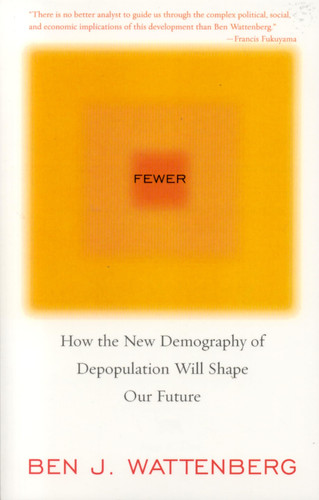
Fewer How the New Demography of Depopulation Will Shape Our Future

Ben J. Wattenberg
For at least 650 years, since the time of the Black Plague, the world's population has headed in only one direction: up. But within a few decades the number of people on earth will level off and then will likely decline over an extended period of time. In Fewer, the author explains how and why birthrates and fertility rates are now falling at an alarming rate in countries throughout the world--both modern and less developed. And he explores the major implications--for world politics, the environment, and the international economy--of this momentous shift. Illustrated with 23 clarifying charts.
Bloomsbury Academic 2004 241 pages

The sounds of poetry: a brief guide

Pinsky, Robert
This work discusses why how a poem sounds when it is spoken is as important as what it says; includes information on how accent, duration, and syntax affect a poem. In it the author presents a manual of proposals on how to read poems, or, more accurately, how to "hear more of what is going on in poems." That distinction, in his view, is vital. He draws on dozens of poems to show how poets use the "technology", the sounds, of poetry to create works of art that are performed in us when we read them aloud.
Farrar, Straus and Giroux 1999-09 129 pages

I Still Have It ... I Just Can't Remember Where I Put It Confessions of a Fiftysomething

Rita Rudner
While there are people who actually embrace getting older (although we confess not to know any) most try to deny it. Rita Rudner is no exception. When she reached 50, she couldn't even bear to admit it: "It was more comfortable getting a laugh and telling people I was filthy than having to say the word fffiffffty," she writes. In her hysterically dead-on book I Still Have It...I Just Can't Remember Where I Put It , she relates her absurd adventures as a woman of a certain age navigating the strange and terrifyingly funny world of "near-sighted insights." In chapters such as "Artificially Hip"; "Older Than Springtime, Younger Than Angela Lansbury"; "I Won't Blog, Don't Ask Me"; and "The Advantage of Vintage," Rudner tackles body issues, style, and technology, and looks at the wonders and surprises of life on the dark side of 50. So put on your bifocals and get ready to laugh. Just don't blame Rita if your laugh lines become visibly deeper. "Sexy deadpan is comedian Rita Rudner's trademark style, never more in evidence than in I Still Have It ... I Just Can't Remember Where I Put It ... Pure vaudeville, a kick at any age."-- O, The Oprah Magazine
Crown Publishing Group 2009-05-05 272 pages

Someone is hiding something: what happened to flight MH370?

Belzer, Richard,Wayne, David,Noory, George
Someone Is Hiding Something is the book the authorities don't want you to read. Whatever the truth may be, you are being misled-and it's time for it to stop. A year after the disappearance of Malaysia Airlines Flight 370, no sign of the plane has been found-no debris, no bodies and no black box. Richard Belzer, George Noory and David Wayne want to know why. As well as scrutinizing the theories for the disappearance put forward by governments and circulating in the media, Belzer, Noory and Wayne believe it's time to think outside the square. In this revealing book, they consider ten possible crash causes, including pilot error, hijacking and a shoot-down. Could this have been the work of extra-terrestrials, suicide by the pilots, or a stunt carried out by the CIA? Someone Is Hiding Something is the book the authorities don't want you to read. Whatever the truth may be, you are being misled-and it's time for it to stop. ' Airplanes must come down eventually. They can land safely or they may crash. But airplanes don't just disappear ... Someone is hiding something.' Dr. Mahathir Hohamad, Former Prime Minister of Malaysia 'This did not have to happen, there is technology to track these aircraft and everybody will say that, Boeing or Airbus.' Sir Tim Clark, CEO, Emirates Airlines 'This is an important book because it shows how The Powers That Be are up to their old tricks. Be vigilant! Study this. Question authority!' Jesse Ventura 'The Vienna-based Comprehensive Nuclear-Test-Ban Treaty Organization confirmed that neither an explosion nor a plane crash on land or on water had been detected.' Stephane Dujarric, Spokesperson for United Nations Secretary-General Ban Ki-Moon
Nero 2015 257 pages

God Wants You to Be Rich

Paul Zane Pilzer
In God Wants You to Be Rich , bestselling author Paul Zane Pilzer provides an original, provocative view of how to accumulate wealth and why it is beneficial to all of humankind. A theology of economics, this book explores why God wants each of us to be rich in every way -- physically, emotionally, and financially -- and shows the way to prosperity, well-being, and peace of mind. Pilzer explains that the foundation of our economic system is based on our Judeo-Christian heritage and includes chapters on a variety of financial issues from outsourcing and unemployment to the rise of technology and real estate. Table of Contents 1. God Wants You to Be Rich 2. The Covenant 3. The Search for Camelot 4. Economic Alchemy 5. What's Happening to Our Jobs 6. The Workplace of the 21st Century 7. Money 8. Government 9. Leadership Appendix: The Principles and Six Laws of Economic Alchemy
Simon and Schuster 1997-03-27 288 pages

Postcapitalism: a guide to our future

Mason, Paul
"Over the past two centuries or so, capitalism has undergone profound changes--economic cycles that veer from boom to bust--from which it has always emerged transformed and strengthened. Surveying this turbulent history, Paul Mason's Postcapitalism argues that we are on the brink of a change so big and so profound that this time capitalism itself, the immensely complex system within which entire societies function, will mutate into something wholly new. At the heart of this change is information technology, a revolution that is driven by capitalism but, with its tendency to push the value of much of what we make toward zero, has the potential to destroy an economy based on markets, wages, and private ownership. Almost unnoticed, in the niches and hollows of the market system, swaths of economic life are beginning to move to a different rhythm. Vast numbers of people are changing how they behave and live, in ways contrary to the current system of state-backed corporate capitalism. And as the terrain changes, new paths open. In this bold and prophetic book, Mason shows how, from the ashes of the crisis, we have the chance to create a more socially just and sustainable economy. Although the dangers ahead are profound, he argues that there is cause for hope. This is the first time in human history in which, equipped with an understanding of what is happening around us, we can predict and shape the future"--
Farrar, Straus and Giroux 2016 340 pages

Virtually human: the promise - and the peril - of digital immortality

Rothblatt, Martine Aliana
"Virtually Human explores what the not-too-distant future will look like when cyberconsciousness--simulation of the human brain via software and computer technology--becomes part of our daily lives. Meet Bina48, the world's most sentient robot, commissioned by Martine Rothblatt and created by Hanson Robotics. Bina48 is a nascent Mindclone of Martine's wife that can engage in conversation, answer questions, and even have spontaneous thoughts that are derived from multimedia data in a Mindfile created by the real Bina. If you're active on Twitter or Facebook, share photos through Instagram, or blogging regularly, you're already on your way to creating a Mindfile--a digital database of your thoughts, memories, feelings, and opinions that is essentially a back-up copy of your mind. Soon, this Mindfile can be made conscious with special software--Mindware--that mimics the way human brains organize information, create emotions and achieve self-awareness. This may sound like science-fiction, but the nascent technology already exists. Thousands of software engineers across the globe are working to create cyberconsciousness based on human consciousness and the Obama administration recently announced plans to invest in a decade-long Brain Activity Map project. Virtually Human is the only book to examine the ethical issues relating to cyberconsciousness and Rothblatt, with a Ph. D. in medical ethics, is uniquely qualified to lead the dialogue"--
Picador 2015-10-06 350 pages

An Introduction to the Study of Language

Leonard Bloomfield
Excerpt from An Introduction to the Study of Language This little book is intended, as the title implies, for the general reader and for the student who is entering upon linguistic work. Its purpose is the same, accordingly, as that of Whitney's Language and the Study of Language and The Life and Growth of Language, hooks which fifty years ago represented the attainments of linguistic science and, owing to their author's clearness of view and conscientious discrimination between ascertained fact and mere surmise, contain little to which we cannot today subscribe. The great progress of our science in the last half-century is, I believe, nevertheless sufficient excuse for my attempt to give a summary of what is now known about language. That the general reader needs such information as is here given was recognized by Whitney, who wrote, in the preface of his first-named book: 'It can hardly admit of question that at least so much knowledge of the nature, history, and classifications of language as is here presented ought to be included in every scheme of higher education.' While questions of a linguistic nature are everywhere a frequent subject of discussion, it is surprising how little even educated people are in touch with the scientific study of language. About the Publisher Forgotten Books publishes hundreds of thousands of rare and classic books. Find more at www.forgottenbooks.com This book is a reproduction of an important historical work. Forgotten Books uses state-of-the-art technology to digitally reconstruct the work, preserving the original format whilst repairing imperfections present in the aged copy. In rare cases, an imperfection in the original, such as a blemish or missing page, may be replicated in our edition. We do, however, repair the vast majority of imperfections successfully; any imperfections that remain are intentionally left to preserve the state of such historical works.
LULU Press 2015-06-14 345 pages

One Child at a Time The Global Fight to Rescue Children from Online Predators

Julian Sher
From a renowned investigative reporter, the true story behind a horrifying Internet abuse epidemic - and the heroes who are out to stop it. The Internet has helped make child abuse terrifyingly common - it is the new face of crime in the 21st century. There are tens, probably hundreds of thousands of children whose sexual abuse has been electronically recorded and distributed on the Internet. As Julian Sher reveals, the men perpetrating these crimes include lawyers, priests, doctors and politicians. They pick their victims from the streets of Bangkok to Boy Scout troops in England, while the police - from a crack image analyst with the Toronto police to an FBI agent who poses as a thirteen-year-old girl online - work desperately to nab the predators. One Child at a Time goes behind the headlines to show how law officers are fighting back against this tide of abuse, from daring rescues in homes to the seizures of millions of dollars in the offshore bank accounts of the porn merchants. In riveting detail, Julian Sher shows how clue by clue, and image by image, investigators are using cutting edge tools, turning the technology of the Internet against the perpetrators as they race to find and rescue the victims - children who otherwise have no voice. This important book explores the ramifications of a worldwide struggle, from the need for updated legal powers to the unexpected effects the Internet has had on our social fabric. It also includes a full list of resources for concerned parents. Though sometimes harrowing, One Child at a Time is alsoinspiring - and never less than absolutely relevant. In their efforts to rescue the child victims of one of today's most pervasive and insidious crimes, police must be creative, dogged and go well beyond the borders drawn on any map. . . Canadian cop Paul Gillespie changed the way that police around the world tackle Internet porn. He decided that if the system was broken, he was going to send an email to Bill Gates and ask for help. Gates not only answered, but Microsoft ended up kicking in millions of dollars, working with Gillespie's team to develop the Child Exploitation Tracking System, a searchable database to track and investigate Web predators and their victims. It soon spread across Canada, and then to the UK, Australia and the U.S. Older men pretend to be young and caring, luring lonely young girls in chat rooms. But when they show up to meet their victim, they discover the FBI is waiting to arrest them. Emily Vacher, one of the FBI's top Internet undercover operatives, specializes in trapping the predators at their own game of deception. The photos of the child's abuse were everywhere on the Net, but no one knew who or where she was. In a frantic 36-hour hunt, using CSI-type sleuthing to find clues in the pictures, Canadian, American and European police rescued a girl from North Carolina. Jim Gamble, one of the most senior police officers in the UK, has spearheaded the creation of a Virtual Global Taskforce to patrol the web 24/7. It was time for a sheriff to tame the wild, wild Web, Gamble decided. Now children have a redreport abuse button on chat room software and browsers they can click any time they feel threatened. It is time for the children's stories-too often hidden in the dark corners of the Web-to be told. Their torment has been etched in their memories-and the memories of the police officers dedicated to rescuing them. It is what scars them. But it is also what spurs them on. Because they know behind every picture or video lies a little, frightened child. Detective Sergeant Paul Gillespie of the Toronto Police's Exploited Child Unit can't shake the lingering echoes of some of the worst videos he has seen of shackled children: Sometimes, he says, you can hear the children cry. --from One Child at a Time
Random House Canada 2007 327 pages

Reboot: a blueprint for happy, human business in the digital age

Stockwood, Jason
The tech revolution will hit us all soon. How can any organisation survive and thrive? Headlines predict that whole industries will be decimated by Artificial Intelligence and automation. Some bosses and bankers are rubbing their hands at the prospect of cost savings and staff cuts. But there is another way. New technology can also empower teams, fuel creativity and make people happier. At Simply Business, twice voted the UK's best company to work for, big data and automated systems are being harnessed to generate positive growth, staff are currently trialling a four-day week in their Northampton office. In this bold blueprint, CEO Jason Stockwood - named by the Sunday Times as the UK's best leader - shows how any organisation can think freshly and benefit from technology by putting its people first.
Virgin Books 2018 231 pages