58,196 results in 0.08 seconds

Uprooted: how 3,000 years of Jewish civilisation in the Arab world vanished overnight

Julius, Lyn
Who are the Jews from Arab countries? What were relations with Muslims like? What made Jews leave countries where they had been settled for thousands of years? What lessons can we learn from the mass exodus of minorities from the Middle East? Lyn Julius undertakes to answer all these questions and more in Uprooted, the culmination of ten years of work studying these issues. Jews lived continuously in the Middle East and North Africa for almost 3,000 years. Yet, in just 50 years, their indigenous communities outside Palestine almost totally disappeared as more than 99 percent of the Jewish population fled. Some 650,000—including a minority of ideological Zionists—went to Israel. Before the Holocaust they constituted ten percent of the world's Jewish population, and now over 50 percent of Israel's Jews are refugees from Arab and Muslim countries, or their descendants. This same process is now repeating in Christian and other minority communities across the Middle East. This book assesses how well these Jews have integrated into Israel and how their struggles have been politicized. It charts the growing clamour for recognition, redress and memorialization for these Jewish refugees, and looks at how their cause can contribute to peace and reconciliation between Israel and the Muslim world.
Vallentine Mitchell 2018 340 pages

Tradition in a rootless world: women turn to Orthodox Judaism

Davidman, Lynn
The past two decades in the United States have seen an immense liberalization and expansion of women's roles in society. Recently, however, some women have turned away from the myriad, complex choices presented by modern life and chosen instead a Jewish orthodox tradition that sets strict and rigid guidelines for women to follow. Lynn Davidman followed the conversion to Orthodoxy of a group of young, secular Jewish women to gain insight into their motives. Living first with a Hasidic community in St. Paul, Minnesota, and then joining an Orthodox synagogue on the upper west side of Manhattan, Davidman pieced together a picture of disparate lives and personal dilemmas. As a participant observer in their religious resocialization and in interviews and conversations with over one hundred women, Davidman also sought a new perspective on the religious institutions that reach out to these women and usher them into the community of Orthodox Judaism.
University of California Press 1991 254 pages

Mind, life, and universe: conversations with great scientists of our time

Margulis, Lynn,Punset, Eduard
Nearly forty of the world's most esteemed scientists discuss the big questions that drive their illustrious careers. Co-editor Eduardo Punset—one of Spain's most loved personages for his popularization of the sciences—interviews an impressive collection of characters drawing out the seldom seen personalities of the world's most important men and woman of science. In Mind, Life and Universe they describe in their own words the most important and fascinating aspects of their research. Frank and often irreverent, these interviews will keep even the most casual reader of science books rapt for hours. Can brain science explain feelings of happiness and despair? Is it true that chimpanzees are just like us when it comes to sexual innuendo? Is there any hard evidence that life exists anywhere other than on the Earth? Through Punset's skillful questioning, readers will meet one scientist who is passionate about the genetic control of everything and another who spends her every waking hour making sure African ecosystems stay intact. The men and women assembled here by Lynn Margulis and Eduardo Punset will provide a source of endless interest. In captivating conversations with such science luminaries as Jane Goodall, James E. Lovelock, Oliver Sachs, and E. O. Wilson, Punset reveals a hidden world of intellectual interests, verve, and humor. Science enthusiasts and general readers alike will devour Mind, Life and Universe, breathless and enchanted by its truths.
Chelsea Green Pub 2007 358 pages

On the way out, turn off the light: poems

Piercy, Marge
"Another winning collection from one of our most read and enjoyed poets: a bountiful group of poems that reflect on language, nature, old age, young love, Judaism, and our current politics--all in her usual direct and mind-tingling fashion. "Words are my business," Marge Piercy begins her twentieth collection of poetry, a glance back at a lifetime of learning, loving, grieving, and fighting for the disenfranchised; and a look forward at what the future holds for herself, her family and friends, and her embattled country. In the opening pages, Piercy tells of her childhood in Detroit, with its vacant lots and scrappy children, the bike that gave her wings, her ambition at fourteen to "gobble" down all knowledge, a too early marriage ("I put on my first marriage / like a girdle my skinny body / didn't need.") We then leap into the Twilight Zone "after the knee has been replaced," where she is "learning to be quiet," learning to give praise despite it all. There are funny poems about medicine ads with their dire warnings, and some possible plusses about being dead: "I will never have to do another load of laundry . . ." There is "comfort in old bodies coming together," in a partner's warmth--"You're always warm: warm hands / smooth back sleek as a Burmese cat./ Sunny weather outside and in." Piercy has long been known for her political poems and her love of cats, and here there are plenty of both. Illegal immigrants, dying languages, fraught landscapes, abortion, President-speak. She examines her nonbeliever's need for religious holidays and spiritual depth, and the natural world is appreciated throughout. On the Way Out, Turn Off the Light is yet more proof of Piercy's love and mastery of language--it is moving, stimulating, funny, and full of the stuff of life"--
Alfred A. Knopf 2020-09-29 187 pages

Human ecology, human economy

Mark Diesendorf,Clive Hamilton
'A brilliant synthesis of ecology and economics that provides a sure guide to a sustainable future. It is a must for all environmentalists and economists.' Charles Birch 'Written by an impressive list of experts across a number of disciplines, this readable text provides not only analysis but vigorous criticism-and answers.' Robyn Williams 'This book is such a useful guide to responsible decision-making that it should be supplied in bulk to senior government officials and managers in the private sector.' Ian Lowe 'This is a fine contribution to ecological economics coming from Australia, and of interest worldwide.' Herman E Daly Human well-being is wholly dependent upon the continued good health of the Earth s ecosystems. Human behaviour as it interacts with the biophysical environment is enormously complex, as governments (and individuals) who must make decisions about resource use are becoming increasingly aware. Human Ecology, Human Economy provides the basic concepts and tools for understanding how to analyse that interaction. The book is designed to be used as a text for undergraduate and graduate students in environmental studies, human and social ecology, ecological economics, futures studies, and science and technology studies. It is also intended for interested members of the public and for policy-makers working on environmental issues, especially where these intersect with economic policy. Human Ecology, Human Economy not only covers the basic concepts, but also moves to some of the frontiers of thinking in several case studies. It uses a problem and solution oriented approach which crosses disciplinary boundaries, drawing together elements from biology, economics, philosophy and political science. Professor Mark Diesendorf is Director of the Institute for Sustainable Futures at the University of Technology, Sydney and Vice President of the Sustainable Energy Industries Council of Australia. Among the books he has edited are The Magic Bullet and Energy And People. Dr Clive Hamilton is Executive Director of the Australia Institute, Canberra and teaches in the Public Policy Program at the Australian National University. His books include Capitalist Industrialisation In Korea, The Mystic Economist and The Economic Dynamics Of Australian Industry.
Routledge 2021-03-31 400 pages

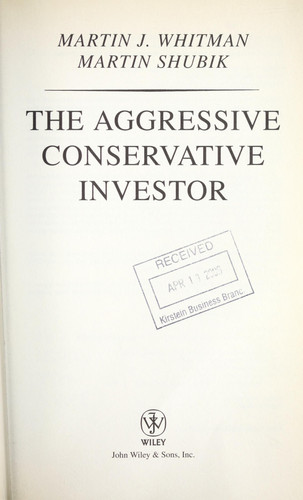
The aggressive conservative investor

Whitman, Martin J.
One of the best books ever written on value investing and distressed securities The Aggressive Conservative Investor is a no-holds-barred presentation of one of the most successful investment strategies of all time-value investing in distressed securities/companies. With painful honesty and terrific storytelling, the authors show investors how to analyze and evaluate stocks just like controlling owners-based on the assumption that stock price rarely reflects real value. Using numerous case studies, Whitman and Shubik present risk-minimizing methods that also provide high rewards. Still relevant today, this classic work includes a new introduction discussing the dramatic changes that have taken place in the value investing world since the book was first published in 1979.
Wiley 2006 426 pages

Small strangers: the experiences of immigrant children in America, 1880-1925

Klapper, Melissa R.
Children are the largely neglected players in the great drama of American immigration. In one of history's most remarkable movements of people across national borders, almost twenty-five million immigrants came to the United States in the late nineteenth and early twentieth centuries—from Mexico, Japan, and Canada as well as the more common embarkation points of southern and eastern Europe. Many of them were children. Together with the American-born children of immigrants, they made up a significant part of turn-of-the-century U.S. society. Small Strangers recounts and interprets their varied experiences to illustrate how immigration, urbanization, and industrialization—all related processes—molded modern America. Growing up in crowded tenements, insular mill towns, rural ethnic enclaves, or middle-class homes, as they came of age they found themselves increasingly caught between Old World expectations and New World demands. The encounters of these children with ethnic heritage, American values, and mass culture helped shape the twentieth century in a United States still known symbolically around the world as a nation of immigrants.
Ivan R. Dee 2007-04-26 219 pages

The changing world of Mongolia's nomads

Goldstein, Melvyn C.
This illustrated book offers the first inside view of how the breakup of the Soviet bloc has affected this farthest republic and its nomadic peoples. The first Western scholars to be given permission to conduct fieldwork in Mongolia, Melvyn Goldstein and Cynthia Beall lived among a community of herders to study how they were adapting to Mongolia's transition to democracy and a market economy. Weathering temperatures below zero, living in the nomads' ger, drinking suteytsai (milk-tea), eating bordzig (a pastry made from wheat dough) and pieces of solid fat (a Mongolian delicacy), Goldstein and Beall studied the seasonal migrations and traditional lifestyle of the nomads. They also watched as a herders' collective under the Marxist-Leninist system made the difficult transition to a shareholding company through the government's privatization reforms. The book's magnificent photographs and accompanying text introduce us to a proud people undergoing enormous change as their country emerges from years under communism. The Changing World of Mongolia's Nomads promises an engaging read for anyone interested in nomads, Mongolia, East and Central Asia, and the transformation of the Soviet Union.
University of California Press 1994 176 pages

Dynamics of the Arab-Israel Conflict Past and Present: Intellectual Odyssey II

Michael Brecher
This book comprises findings from the author's wide-ranging research since 1948 on the unresolved Arab/Israel protracted conflict. Brecher reflects back on his detailed analysis of the UN Commission created in November 1947, and his near-seven decades of research and publications on this complex protracted conflict continued since the first of nine Arab/Israeli wars. The book includes an analysis of the crucial early phase of the unresolved struggle for control of Jerusalem in 1948-49 and beyond, based on extensive interviews with Israel’s leaders and prominent Egyptian senior officials, journalists and academics. It addresses the many diverse attempts at conflict resolution, including a peace plan to resolve the Arab/Israel conflict of the author's own design. It concludes with historical reflections about Israel’s behavior, domestically and externally, in 1948-1949 and 2008 and beyond. No other book on this protracted conflict contains so many important interviews with the first two generations of Israeli leaders and Egyptian officials and academics, and no other author can speak from such a deep and prolonged engagement.
Springer International Publishing 2018-07-13 410 pages