4101 results for "Novel"

The exiles return

De Waal, Elisabeth
"The Exiles Return is set in Occupied Vienna in 1954-5. It describes five people who grew up there before the war and have come back to see if they can re-establish the life they have lost. The novel begins with Professor Kuno Adler, who is Jewish and fled Vienna after the Anschluss (the events of March 1938 when Hitler's troops marched into Austria). He is returning from New York to try and take up his old life as a research scientist. We realise through his confrontation with officialdom and with the changed fabric of the city (the lime trees are there no longer, it is hard to know who behaved well during the war and who was a Nazi sympathiser) that a refugee who goes back has a very difficult time. Next we are introduced to a wealthy Greek named Kanakis..."--Publisher description.
Persephone Books 2013 310 pages

Miss Granby's secret, or, The bastard of Pinsk

Farjeon, Eleanor
How much did Aunt Addie know? How much did she feel? Aunt Addie better known to the world at large as Adelaide Granby, the fabulously successful author of 49 volumes of gushing, melodramatic Victorian romance. Upon her death in 1912, flowers and cards pour in, including one particularly lavish set "From Stanislaw", whom her independent-minded, suffragette niece Pamela decides was "darling Aunt Addie's Grande Passion." Pamela also inherits a stack of Aunt Addie's secret papers, including youthful diaries and her unintentionally hilarious unpublished first novel, written when she was only 16, entitled The Bastard of Pinsk (a "bastard", 16-year-old Adelaide was sure, being "A very noble Hero of Royal Blood.") As Pamela explores these documents and talks with those who knew her aunt when, seeking the real-life source of her romantic sensibility, the reader is drawn irresistibly into the intrigue. In a novel both sentimental and brutally honest, nostalgic for and horrified by the sentiments of the past, hilarious and poignant, all at once, the brilliant Eleanor Farjeon poses surprisingly powerful questions about what makes a love "real" and how much one really needs to know to experience it... This new edition features a superb introduction by twentieth-century women's historian Elizabeth Crawford. "Naughtiness of a definitely mauve tint." Beatrice Sherman, New York Times
Dean Street Press 2024 340 pages

The hideout

Hostovský, Egon
A kind, blundering Czech engineer is pressured by the Nazi government to hand over his invention, which could be key to their military operations. He flees to Paris, hoping to sell his invention to the French government instead; yet when the Germans invade France, he is forced into hiding, and spends months in a dark, damp cellar. Alone, he dwells on his memories - of his troubled marriage, and his decision to leave his wife behind in Czechoslovakia. When he is given the unexpected chance to redeem himself, both to his wife and history, he seizes it with utter determination - even though this heroic act will be his last. A powerful and moving novel about one man's final, fatal, heroic act of resistance in Nazi France.
Pushkin 2017-07-25 128 pages

Crossover queries: dwelling with negatives, embodying philosophy's others

Wyschogrod, Edith
Exploring the risks, ambiguities, and unstable conceptual worlds of contemporary thought, Crossover Queries brings together the wide-ranging writings, across twenty years, of one of our most important philosophers. Ranging from twentieth-century European philosophy--the thought of Heidegger, Foucault, Derrida, Levinas, Janicaud, and others--to novels and artworks, music and dance, from traditional Jewish thought to Jain and Buddhist metaphysics, Wyschogrod's work opens radically new vistas while remaining mindful that the philosopher stands within and is responsible to a philosophical legacy conditioned by the negative. Rather than point to a Hegelian dialectic of overcoming negation or to a postmetaphysical exhaustion, Wyschogrod treats negative moments as opening novel spaces for thought. She probes both the desire for God and an ethics grounded in the interests of the other person, seeing these as moments both of crossing over and of negation. Alert to the catastrophes that have marked our times, she exposes the underlying logical structures of nihilatory forces that have been exerted to exterminate whole peoples. Analyzing the negations of biological research and cultural images of mechanized and robotic bodies, she shows how they contest the body as lived in ordinary experience. "Crossover Queries brings together important essays on a remarkable range of topics by one of our most insightful cultural critics. Commenting on philosophical and theological issues that have shaped the recent past as well as scientific and technological questions that will preoccupy us in the near future, Wyschogrod consistently alerts us to the urgency of problems whose importance few recognize. To avoid the challenge these essays pose is to avoid responsibility for a future that appears to be increasingly fragile."--Mark C. Taylor, Columbia University
Fordham University Press 2006 566 pages

The thrilling life of Pauline de Lammermoor

Ravel, Edeet
Nearly 14, Pauline has discovered that her life is far more interesting if she records it as a great work of fiction -- featuring, of course, herself as the tragic heroine. Pauline's hand-wringing accounts of misbehaving boyfriends, backstabbing friends, and general angst are intermingled with more serious issues like her parents' divorce and her beloved teacher's loss of a best friend to AIDS. Laced with the pop-culture references young readers love, Pauline's "novel" reveals the realities of today's teenage life.
Raincoast Books 2007 212 pages

The cat

Ravel, Edeet
From acclaimed author Edeet Ravel comes a profound and heart-wrenching story that captures the essence of grief and hope in the midst of tragedy. Single mother Elise is completely devoted to her eleven-year-old son; he is her whole world. But that world is destroyed in one terrifying moment when her son is killed in a car accident just outside their home. Suddenly alone, surrounded by memories, Elise faces a future that feels unspeakably bleak—and pointless. Lost, angry and desolate, Elise rejects everyone who tries to reach out to her. But as despair threatens to engulf her, she realizes, to her horror, that she cannot join her son: she must take care of his beloved cat. At first she attempts to carry out this task entirely by herself, shut away from a frightening new reality that seems surreal and incomprehensible. But isolation proves to be impossible, and before long others insinuate themselves into her life—friends, enemies, colleagues, neighbours, a former lover—bringing with them the fragile beginnings of survival. Powerfully moving and deeply humane, The Cat is an unforgettable novel about the extraordinary resilience of the human spirit.
Penguin 2012-09-11 221 pages

The Big Fix

Ed Lacy
The Big Fix by Ed Lacy Author of the 1958 Edgar Award-winning novel Room to Swing! On the night Irish Tommy Cork's murder was planned, nothing very much out of the ordinary happened. Tommy was in the ring, taking a pasting-as usual. Back to the ropes, almost sitting on the second strand, Tommy crouched, gloved hands up in front of his face like a leather fence. He was fighting a strong youngster who was now whaling away with both hands in a moment of wild enthusiasm. Most of his blows were blocked, or ducked by Tommy's weaving head, but those few that didn't miss landed with loud thud sounds on the kidneys, head, or in the stomach, visibly shaking up the pale "old man."
Wilder Publications, Incorporated 2013-12 186 pages

Esther: a Jerusalem love story

Waysman, Dvora
This novel holds within its pages an unusual love story that spans three decades and three continents. When Max first meets Esther, she is a young Australian girl filled with passion for life and boundless enthusiasm. His love for her continues through all the changes that take place in her life - her move from London, where they meet, to Jerusalem where she explores the Judaism that until then was just on the fringe of her life; the literary prize she wins that brings her back into his orbit; her commitment to Israel that breaks their relationship; and then finally, a coincidental meeting in the middle of a war in Lebanon. Max never stops loving Esther, even as she matures from a naive girl to a woman of depth and wisdom. Love takes many forms, and readers will experience all the complexities of emotion as they discover the ties that bind a man to a woman.
Simcha Press 2000-09-01 230 pages

Feral

Deena Metzger
This novel, based on a true story, is one woman's journey out of the strictures of cultural mores and societal values of what is sane, judicious, and appropriate and into the world of the primal intelligences that churn within all of us. A girl is found in a tree, alone, seemingly frightened and unwilling to communicate with anyone. And yet she displays a certain intelligence that beckons to the woman, intrigues her with its innate and often hidden language. The woman finds herself drawn into a world of beauty and fear, intensity and passion, that eventually brings her to a new awareness of what is missing in the left-brain intelligence that so dominates our assumptions of reality. This brilliant work will bring you to the edge of what you know to be true, challenging the very tenets of your existence and opening the door to what is missing in all our lives: the awakened animal consciousness whose wild intelligence renews our passion for life, for nature, and completes our sensibilities so that we can live as equals in the web of all life as human animals, alive to the very core of our being.
Hand To Hand Publ 2011-01-15 179 pages

Whatever love means

Baddiel, David
Like most people, Vic Mullan, habitual drug-user, professional layabout, and amoralist extraordinaire, can remember where he was and what he was doing on the day of Princess Diana's death. Yes, he can remember it particularly well: he was at home, beginning an affair with Emma, his best friend's wife.The opening sections of David Baddiel's second novel chart the history of an intense and passionately sexual liaison set against the background of the most hysterical - in both senses of the word - time in recent memory. But as the months wear on, and life and love return to normal, so things become more complex between Vic and Emma. And then, tragedy - a real, local, small-scale tragedy, as opposed to a national, iconic, mythological one - intervenes. Part-satire, part-love story, part-whodunnit, and part-meditation on the nature of sex and death, Whatever Love Means is truly a tale for our times
Little, Brown and Company 1999 310 pages

Time On My Hands My Misadventures In Time Travel

Daniel M. Kimmel
First there was Jar Jar Binks Must Die, the Hugo-Award finalist collection of essays discussing science fiction film which Analog called "intelligent and entertaining" and F&SF called "terrific." Then came Shh! It's a Secret, the comedy science fiction novel that Publishers Weekly called "a freewheeling, laugh-out-loud satire." Now Daniel M. Kimmel is back with Time On My Hands, his quirky take on time travel, lost love, divided loyalties, and the eternal search for really good scotch. Time On My Hands investigates the myriad time travel troubles over which most science fiction readers have pondered, but it presents a fresh take on the time travel novel by adhering to the Aristotelian Unity of Time: it all takes place within a single day. In the book, Professor Price tells the story of how he came to be in possession of a time travel device (which he may or may not have invented), and how he found his future hiding in his past. But the discovery of time travel will necessitate far more than just building a really cool machine: it'll take the efforts of many people to figure out how to talk about time travel, the requirements necessary to be an ethical time traveler, and just whose office it is when my yesterday becomes your tomorrow without the courtesy of a knock on the door. Film critic and professor Daniel M. Kimmel has taught film and media classes at Emerson College, Boston University, and Suffolk University. His book on the history of FOX TV, The Fourth Network, received the Cable Center Book Award. His other books include a history of DreamWorks, The Dream Team, and I'll Have What She's Having: Behind the Scenes of the Great Romantic Comedies. He earned his undergraduate degree from the University of Rochester (where much of Time On My Hands is set) and his law degree from Boston University.
Fantastic Books 2017-02-21 192 pages

Cosella Wayne: or, will and destiny

Wilburn, Cora
The first novel written and published in English by an American Jewish woman Published serially in the spiritualist journal Banner of Light in 1860, Cosella Wayne: Or, Will and Destiny is the first coming-of-age novel, written and published in English by an American Jewish woman, to depict Jews in the United States and transforms what we know about the history of early American Jewish literature. The novel never appeared in book form, went unmentioned in Jewish newspapers of the day, and studies of nineteenth-century American Jewish literature ignore it completely. Yet the novel anticipates many central themes of American Jewish writing: intermarriage, generational tension, family dysfunction, Jewish-Christian relations, immigration, poverty, the place of women in Jewish life, the nature of romantic love, and the tension between destiny and free will. The narrative recounts a relationship between an abusive Jewish father and the rebellious daughter he molested as well as that daughter’s struggle to find a place in the complex social fabric of nineteenth-century America. It is also unique in portraying such themes as an unmarried Jewish woman’s descent into poverty, her forlorn years as a starving orphaned seamstress, her apostasy and return to Judaism, and her quest to be both Jewish and a spiritualist at one and the same time. Jonathan Sarna, who introduces the volume, discovered Cosella Wayne while pursuing research at the Israel Institute for Advanced Studies in Jerusalem. This edition is supplemented with selections from Cora Wilburn’s recently rediscovered diary, which are reprinted in the appendix. Together, these materials help to situate Cosella Wayne within the life and times of one of nineteenth-century American Jewry’s least known and yet most prolific female authors.
The University of Alabama Press 2019-10-22 294 pages

For the Love of the Father

Chochana Boukhobza
For the Love of the Father is about the effect of exile on a Jewish family from Tunisia as they immigrate to Paris, France. It is a gripping novel that tells a story at once intimate and universal. Universal in that it narrates the traumatic experience of displacement and of the challenges of resettlement in a new country, shared historically by many people, especially in postcolonial times as well as in today's refugee crisis. In Boukhobza's novel, the Saada clan represents but one family of the nearly 500,000 Jews who were uprooted from their native countries of Algeria, Tunisia and Morocco in the 1950's and 60's; many of these families had roots there going back to before the Arab conquest in the 7th century. As many as 235,000 settled in France during this period; and, with their identities and stories deeply anchored in their North African and Judeo-Arabic cultural heritage, a unique character and flavor was added to the multicultural immigrant narratives to flourish in France in the late 1900's.
Penguin Random House LLC 2019-10-31 174 pages

Ben preserve us

Bermant, Chaim
I bring you up to believe that nothing is good enough for you, and you grow up to be good for nothing. Thus, Mrs. Bindle, on learning that Ben, her only-begotten son, has decided to be a Rabbi; what is more, a Rabbi in a small provincial town in Scotland. Her anxiety proves to be not unjustified, although Ben's chosen career has its compensations-perhaps Helen, the promiscuous teenage daughter of his housekeeper; perhaps Simmy, the young wife of an elderly parishioner; perhaps the whole incident-prone pace of the pawky Scottish town in which this richly-human story is set. Chaim Bermant's third novel has all the wit, warmth and colour of its critically-acclaimed forerunners.
Bloomsbury Reader 2012 160 pages

Cybill Unbound

Catherine Hiller
Cybill Berenson, mother of three, newly divorced at age 42, is sure the most passionate years of her life are behind her. Then she meets Mel, a sexual shaman who takes her to new heights-and new depths. After their liaison ends, she feels a new openness to pleasure, and she sees that the conventional life is not for her. She falls in love with Quinn, a much younger man; she travels to the Burning Man festival on her own; she edits a book called Adultery Now (which outrages her children); she takes lovers while in her fifties and sixties. Cybill never stops seeking the thrill of deep connection to another human being. When a lover calls her his soul-mate, Cybill realizes "it was for moments like this, and not sex, that she had love affairs." John Updike described Hiller's story collection, Skin, as "Good, brave and joyful fiction." The same can be said about Cybill Unbound-a novel like Fear of Flying for those over forty. "Uh-oh! Cybill's witty rationalizations for her bold adventures are seeming all too rational to me." -Kathleen Rockwell Lawrence, author of The Last Room in Manhattan
Heliotrope Books LLC 2023-02-14 186 pages

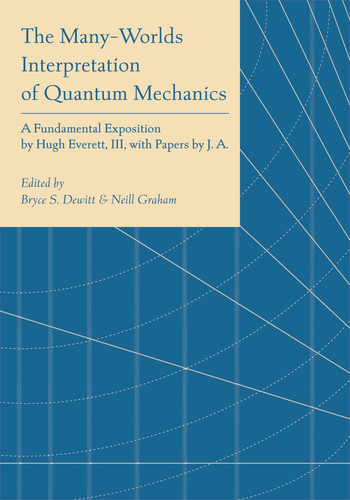
The many-worlds interpretation of quantum mechanics: a fundamental exposition

Bryce Seligman Dewitt,Neill Graham
A novel interpretation of quantum mechanics, first proposed in brief form by Hugh Everett in 1957, forms the nucleus around which this book has developed. In his interpretation, Dr. Everett denies the existence of a separate classical realm and asserts the propriety of considering a state vector for the whole universe. Because this state vector never collapses, reality as a whole is rigorously deterministic. This reality, which is described jointly by the dynamical variables and the state vector, is not the reality customarily perceived; rather, it is a reality composed of many worlds. By virtue of the temporal development of the dynamical variables, the state vector decomposes naturally into orthogonal vectors, reflecting a continual splitting of the universe into a multitude of mutually unobservable but equally real worlds, in each of which every good measurement has yielded a definite result, and in most of which the familiar statistical quantum laws hold. The volume contains Dr. Everett's short paper from 1957, "'Relative State' Formulation of Quantum Mechanics," and a far longer exposition of his interpretation, entitled "The Theory of the Universal Wave Function," never before published. In addition, other papers by Wheeler, DeWitt, Graham, and Cooper and Van Vechten provide further discussion of the same theme. Together, they constitute virtually the entire world output of scholarly commentary on the Everett interpretation.Originally published in 1973.The Princeton Legacy Library uses the latest print-on-demand technology to again make available previously out-of-print books from the distinguished backlist of Princeton University Press. These editions preserve the original texts of these important books while presenting them in durable paperback and hardcover editions. The goal of the Princeton Legacy Library is to vastly increase access to the rich scholarly heritage found in the thousands of books published by Princeton University Press since its founding in 1905.
Princeton University Press 2025-03-25 264 pages

Atrocity: a literary history

Robbins, Bruce
" Exploring literary representations of mass violence, Robbins traces the emergence of a cosmopolitan recognition of atrocity. Mass violence did not always have a name. Like conquest, atrocity was not always seen as violating a moral norm or inviting indignation. Could the concept of atrocity even exist before people could accuse their own country of mass violence committed against the inhabitants of another country? Drawing on a vast archive, Bruce Robbins seeks to give atrocity a literary history. With penetrating insight, Robbins takes up such literary representations of atrocity as Bartolomé de las Casas's account of his fellow Spaniards' atrocities, Kurt Vonnegut's Slaughterhouse-Five , Grimmelshausen's 1668 novel Simplicissimus , David Mitchell's Cloud Atlas , Gabriel García Márquez's One Hundred Years of Solitude , Homero Aridjis's short novel Smyrna in Flames , and Tolstoy's Hadji Murat . What's achieved is a profound exploration of the longer trajectory of the emergence of abhorrence and indignation in the face of mass violence and a critical examination of the conditions for the emergence of cosmopolitanism-the ability to look at your own nation with the critical eyes of a stranger. In the presence of atrocity, what we want most is for someone to bear witness. What is it literature can do with atrocity that simple testimony cannot? Robbins answers by showing how literature goes beyond the legal paradigm of accusation. Meanwhile, venturing from the Bible to Zadie Smith, Robbins pursues the bold proposition that, in the midst of relentlessly repetitive slaughter and nameless, shapeless, irredeemable suffering, humanity's moral history might include a cosmopolitan arc"--
Stanford University Press 2025 276 pages