58,196 results in 0.08 seconds

How to be a Grown-up

Margaret Feinberg
Sure, being a grown-up is fun, but it's also hard-that's the part no one tells you. So, the author of twentysomething, along with her husband, a longtime youth minister, have put together a manual for life on your own. Whether you're leaving the nest for the first time or moving back into your old room they give you tips on how to manage pesky roommates (moms and dads included). Wondering how to manage that bank account or deal with a bear of a boss? They've got the 411. Trying to impress a date with your cooking? Or just trying to find someone to date? They've got help for you too! For recent and seasoned grads alike, this book is a perfect jump-start to a well balanced, FUN adulthood.
MJF Books 2005 221 pages

Promises of Blessing An Adult Coloring Book

Margaret Feinberg
Be Blessed through God's Word as You De-Stress, Meditate, and Create! In this harried, stressed-out world, it's good to slow down, relax, and get creative. Filled with Scriptures that emphasize the abundance of God's generosity to us, Promises of Blessing will refresh the mind and calm the soul. Adult coloring books are a great way to express creativity, and this beautiful, intricately designed book is sure to inspire with its fresh artwork and thoughtful Scriptures. The pages are perforated for easy removal to display artwork or share with a friend. Presenting the truth of God's kindness and generosity in a fun and creative format, Promises of Blessing encourages you to drink deeply from Scripture as you color and create. Space is included for reflections, prayers, or even doodles. Gather your favorite markers, crayons, or colored pencils and start coloring!
Baker Publishing Group 2016-08-02 64 pages

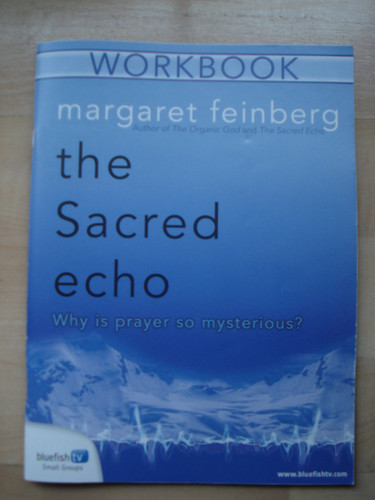
The Sacred Echo Participant's Guide Workbook

Margaret Feinberg
Are you ready to shake up your prayer life forever? Often when God speaks, He will echo the same message through a sermon, a passage of Scripture, a chance conversation, or an unexpected encounter. When we begin looking for these sacred echoes, we are better able to recognize God's voice in our life and walk more confidently in the fullness of all God has for us. Through six sessions and weekly homework (20 minutes or less), The Sacred Echo: Hearing God's Voice in Every Area of My Life DVD Bible Study will help you: Recognize God’s leading in your life Walk more confidently into all God has for you Discover joy in talking to God Experience a fresh and renewed prayer life With the breathtaking Rocky Mountains as a backdrop, let’s explore the wonders of prayer in-depth and learn to grow closer to God through Scripture together. For an added bonus, pick up the Sacred Echo Book and Workbook Combination Special to dive even deeper into sacred echoes we hear over and over again.
Bluefish 49 pages

My mother's body

Piercy, Marge
My Mother's Body, Marge Piercy's tenth book of poetry, takes its title from one of her strongest and most moving poems, the climax of a powerful sequence of Poems to her mother. Rooted in an honest, harrowing, but ally ecstatic confrontation of the mother / daughter relationship in all its complexity and intimacy, it is at the same time an affirmation of continuity and identification. "The Chuppah" comprises poems actually used in her wedding ceremony with Ira Wood. This section sings with powerfully female love poetry. There is also a sustained and direct use of her Jewish identity and faith in these poems, as there is in a number of other poems throughout the volume. Readers of Piercy's previous collections will not be surprised to encounter her mixture of the personal and the political, her love of animals and the Cape landscape. There are poems about doing housework, about accidents, about dreaming, about bag ladies, about luggage, about children's fears of nuclear holocaust; about tomcats, insects in the rafters, the influence of a name, appleblossoms and blackberries, pollution, and some of the ways women objectify one another. In "Does the light fail us, or do we fail the light?" Piercy writes with lacerating honesty about our relationships with the elderly and about hers with her father. Some of the most moving poems are domestic, as in the final sequence, "Six underrated pleasures," which finds in daily women's tasks both pleasure and mystery, affirmation of serf and connection with the mother. In all, My Mother's Body is one of Piercy's most powerful and balanced collections.
Knopf 1985-03-12 143 pages

The high cost of living

Piercy, Marge
"For Leslie, the heroine of this searching novel, the cost of living - and loving - is getting higher and higher. First of all, she is miserable for having lost her lover, Valerie, to another woman. And she has begun to doubt just about everything about her life. Now, she is involved in a strange erotic triangle with Honor, an adolescent virgin who has romantic ideals and Bernie, a homosexual street hustler trying to settle down. Leslie and Bernie both want Honor. They also want each other. But all Honor wants is a little spice in her life. Here is a powerful, searing novel of three young dreamers caught up in a lifestyle they can neither accept nor change."--Author's website (viewed May 1, 2023).
Women's Press 1979 268 pages

Names: poems

Hacker, Marilyn
“[Hacker] powerfully brings her formal mastery and her political sensibility together.”— American Poet In Names , Marilyn Hacker juxtaposes glimpses of contemporary lives with dialogues undertaken in signal poetic voices. Using her signature wit, passion, and mastery of received and invented forms, she convinces us to believe in a world made possible by language—prescient, playful, polyglot, and often breathtaking. from “Ghazal: The Beloved”: Lines that grapple doubt, written because of the beloved: when grief subsides, what survives the loss of the beloved? Your every declaration is suspect. That was, at least, the departing gloss of the beloved. Were you merely a servant of the state or (now you give the coin a toss) of the beloved? How pure you were, resistant in an orchard. Peace with justice: the cause of the beloved.
W.W. Norton 2011-05-03 112 pages

Dimensions of Darwinism: themes and counterthemes in twentieth century evolutionary theory

Marjorie Grene
Originally published in paperback in 1986, the essays in this book discuss questions about the growth and conceptual structure of the modern evolutionary synthesis, or 'neo-Darwinism'. Written by biologists, historians and philosophers, the collection provides a penetrating analysis of the development, meaning and problems of twentieth-century evolutionary theory. Part I includes discussion of the role of eugenics in shaping the biological interests of R. A. Fisher; the abandonment of Lamarckism; the influence of systematics and the concepts of adaptation and random drift in the development of Sewall Wright's theory; and explanation of how the synthesis 'hardened' in the decades following its original presentation. Part II examines the history of mimetic theory as a case study in evolutionary thought, while Part III introduces the reader to some aspects of the German tradition. Finally, Part IV addresses the debates that existed around the time of publication.
Cambridge University Press 1986-03-31 336 pages

True color

Cohen, Mark
Mark Cohen first came to the attention of the photography world in 1973 with a solo exhibition at the Museum of Modern Art, New York. This iconic show proved to the art world that Cohen was the heir apparent to the explosive street photography of the 60s. Now, after the wild success of his first monograph of black-and-white work, Grim Street (powerHouse Books, 2005), Cohen's masterful color work will be seen for the very first time. Rich with the subtle colors of the seventies, True Color is a tour through Wilkes-Barre, the Pennsylvania mining town Cohen calls home, from the vantage of this unique artist. Originally an experiment in the difference between color and black-and-white photography, the pictures included in True Color, commissioned by the George Eastman House, became a project of their own. Cohen captures faces and actions from the ordinary to the bizarre, documenting life as it was lived on the streets on Wilkes-Barre. These photographs are an astonishing collection of Americana, and a complex testament to the vision of one of the era's most intense and successful photographers.
PowerHouse 2007 111 pages

When Government Speaks: Politics, Law, and Government Expression in America

Yudof, Mark G. G.
Government's ever-increasing participation in communication processes, Mark Yudof argues, threatens key democratic values that the First Amendment was designed to protect. Government control over the exchange of ideas and information would be inconsistent with citizen autonomy, informed consent, and a balanced and mutually responsive relationship between citizens and their government. Yet the danger of government dominance must be weighed against the necessary role of government in furthering democratic values by proposing and promotion policies and by disseminating information and educating citizens. Restraints on government's ability to control communications processes are desirable, but excessive or inappropriate restrictions threaten democracy. Professor Yudof identifies a number of formal and informal checks on government as disseminator, withholder, and controller of ideas and information. Where more controls are needed, the strengthening of pluralism and legislative oversight is generally the answer. Constitutional redress in the courts should be sought only in extreme instances, he cautions, to avoid judicial interference with legitimate policy objectives.
University of California Press 2009-04-03 344 pages

Lost and Found in Johannesburg

Mark Gevisser
An inner life of Johannesburg that turns on the author’s fascination with maps, boundaries, and transgressionsThis singular memoir begins with a transgression—the invasion of a private home in Johannesburg. But it is far more than the story of a theft. Lost and Found in Johannesburg is a luminous exploration of place, one in which the author’s and the reader’s assumptions are constantly being tested. As a child growing up in apartheid South Africa, Mark Gevisser was obsessed with maps—and with Holmden’s Register , Johannesburg’s street guide, in particular. He played a game called Dispatcher with this eccentric guide, transporting himself across the city into places that would otherwise be forbidden to him. It was through Dispatcher that he discovered apartheid by realizing that he could not find an access route to the neighboring township of Alexandra and, later, by realizing that Soweto was not mapped at all. This was the beginning of his lifelong obsession with maps and photographs, and what they tell us about borders and boundaries—how we define ourselves by staying within them or by transgressing them. This memoir is an account of getting lost in one’s hometown, and then finding oneself as a gay Jewish South African who was raised under apartheid and who eventually married a man of a different race as the country moved toward freedom. Using maps, shards of memory, photographs, and stories, Gevisser constructs a stunning portrait of race and sexuality, heritage and otherness.
Jonathan Ball 2014 354 pages