464 results for "American History"

The Great War: styles and patterns of the 1910s

Shep, R. L.
A wonderful mix of the more liberated American women's fashions and 'dashing' British military and civilian uniforms. Often called "The Forgotten Era", the "Teens" bridge the gap between the Edwardians and the Flappers. American women's fashions are amazingly soft and informal while the British cling to a more formal look. We have combined The American Garment Cutter for Women's Garments with British patterns and articles from the West End Gazette to cover all types of clothing for men and women, plus British military uniforms and civilian uniforms such as Red Cross, policemen, chauffeurs, etc. There are many fashion illustrations and a department store catalog of 1915.
R.L. Shep 1998-04-01 236 pages

The age of monopoly capital: selected correspondence of Paul A. Baran and Paul M. Sweezy, 1949-1964

Baran, Paul A.,Sweezy, Paul M.
The rich correspondence that preceded the publication of Monopoly Capital Paul A. Baran and Paul M. Sweezy were two of the leading Marxist economists of the twentieth century. Their seminal work, Monopoly Capital: An Essay on the American Economic and Social Order, published in 1966, two years after Baran's death, was in many respects the culmination of fifteen years of correspondence between the two, from 1949 to 1964. During those years, Baran, a professor of economics at Stanford, and Sweezy, a former professor of economics at Harvard, then co-editing Monthly Review in New York City, were separated by three thousand miles. Their intellectual collaboration required that they write letters to one another frequently and, in the years closer to 1964, almost daily. Their surviving correspondence consists of some one thousand letters. The letters selected for this volume illuminate not only the development of the political economy that was to form the basis of Monopoly Capital, but also the historical context—the McCarthy Era, the Cold War, the Cuban Missile Crisis—in which these thinkers were forced to struggle. Not since Marx and Engels carried on their epistolary correspondence has there has been a collection of letters offering such a detailed look at the making of a prescient critique of political economy—and at the historical conditions from which that critique was formed.
Monthly Review Press 2017-07-24 528 pages

Speaking freely: a memoir

Hentoff, Nat
"Continuing the story that began in his widely praised Boston Boy, Nat Hentoff in Speaking Freely guides us through more than forty years of his life in journalism, a career as various as his passions, and follows our social history from the civil rights and antiwar movements to the most incendiary battles (such as abortion) of the present day. Hentoff first evokes New York in the fifties, when he wrote for the jazz magazine Down Beat and came to know some of the most talented jazzmen of all time--Duke Ellington, Thelonious Monk, Charles Mingus, and Dizzy Gillespie, to name only a few. He looks back to his apprenticeship under George Seldes and I. F. Stone, two unyieldingly independent journalists whom he credits with charting his direction in the field. And he recounts his associations with a wide array of Americans, from Malcolm X, who was a friend, to Louis Farrakhan, who has labeled Hentoff "the Antichrist" ; from Adlai Stevenson to John Cardinal O'Connor; and from the "utterly singular" editor of The New Yorker, William Shawn, to uncelebrated heroes far afield from Manhattan and Washington. As a staff writer for the Village Voice and a syndicated columnist for the Washington Post, Hentoff has gained a reputation as one of the nation's most respected, uncompromising, and controversial writers on civil liberties and on the difficult issues and wide-ranging forms of injustice manifest in our age." -- Provided by Publisher.
Knopf 1997-09-16 303 pages

The situation of poetry: contemporary poetry and its traditions

Pinsky, Robert
In this book Robert Pinsky writes about contemporary poetry as it reflects its modernist and Romantic past. He isolates certain persistent ideas about poetry's situation relative to life and focuses on the conflict the poet faces between the nature of words and poetic forms on one side, and the nature of experience on the other. The author ranges for his often surprising examples from Keats to the great modernists such as Stevens and Williams, to the contents of recent magazines. He considers work by Ammons, Ashbery, Bogan, Ginsberg, Lowell, Merwin, O'Hara, and younger writers, offering judgments and enthusiasms from a viewpoint that is consistent but unstereotyped. Like his poetry, Robert Pinsky's criticism joins the traditional and the innovative in ways that are thoughtful and unmistakably his own. His book is a bold essay on the contemporary situation in poetry, on the dazzling achievements of modernism, and on the nature or "situation" of poetry itself.
Princeton University Press 1976 187 pages

American Taboo A Murder in the Peace Corps

Philip Weiss
In 1975, a new group of Peace Corps volunteers landed on the island nation of Tonga. Among them was Deborah Gardner -- a beautiful twenty-three-year-old who, in the following year, would be stabbed twenty-two times and left for dead inside her hut. Another volunteer turned himself in to the Tongan police, and many of the other Americans were sure he had committed the crime. But with the aid of the State Department, he returned home a free man. Although the story was kept quiet in the United States, Deb Gardner's death and the outlandish aftermath took on legendary proportions in Tonga. Now journalist Philip Weiss "shines daylight on the facts of this ugly case with the fervor of an avenging angel" (Chicago Tribune), exposing a gripping tale of love, violence, and clashing ideals. With bravura reporting and vivid, novelistic prose, Weiss transforms a Polynesian legend into a singular artifact of American history and a profoundly moving human story.
HarperCollins 2005-06-28 416 pages

Third wave capitalism: how money, power, and the pursuit of self-interest have imperiled the American dream

Ehrenreich, John
In Third Wave Capitalism, John Ehrenreich documents the emergence of a new stage in the history of American capitalism. Just as the industrial capitalism of the nineteenth century gave way to corporate capitalism in the twentieth, recent decades have witnessed corporate capitalism evolving into a new phase, which Ehrenreich calls "Third Wave Capitalism." Third Wave Capitalism is marked by apparent contradictions: Rapid growth in productivity and lagging wages; fabulous wealth for the 1 percent and the persistence of high levels of poverty; increases in the standard of living and increases in mental illness, personal misery, and political rage; the apotheosis of the individual and the deterioration of democracy; increases in life expectancy and out-of-control medical costs; an African American president and the incarceration of a large percentage of the black population. Ehrenreich asserts that these phenomena are evidence that a virulent, individualist, winner-take-all ideology and a virtual fusion of government and business have subverted the American dream. Greed and economic inequality reinforce the sense that each of us is "on our own." The result is widespread lack of faith in collective responses to our common problems. The collapse of any organized opposition to business demands makes political solutions ever more difficult to imagine. Ehrenreich traces the impact of these changes on American health care, school reform, income distribution, racial inequities, and personal emotional distress. Not simply a lament, Ehrenreich's book seeks clues for breaking out of our current stalemate and proposes a strategy to create a new narrative in which change becomes possible.--Book flap
ILR Press, an imprint of Cornell University Press 2016-04-07 244 pages

A caring society: the New Deal, the worker, and the Great Depression : a history of the American worker, 1933-1941

Bernstein, Irving
A combination of social history, labor history and a history of the New Deal, interweaving stories of migrant workers, laborers and policy makers. One chapter is devoted to the arts of the period and their portrayals of workers. Summaries of several leftist plays are also given, including plays by Clifford Odets, Lillian Hellman,, and Erskine Caldwell. Also has several pages of photographs of Depression scenes and leaders of the period.
Houghton Mifflin 1985 338 pages

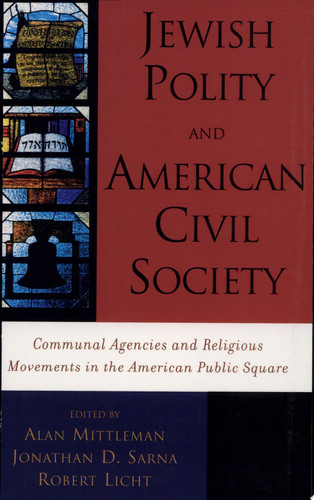
Jewish polity and American civil society: communal agencies and religious movements in the American public sphere

Alan Mittleman,Robert Licht,Jonathan D. Sarna
Jewish Polity and American Civil Society is a study of the civic and political engagements of American Jews as mediated by their communal and denominational institutions. The book explores how the various branches of the organized Jewish community seek to influence public affairs. Over the course of the last century, Jewish agencies and religious movements have tried to shape public debate and public policy on such issues as civil rights, church-state relations, and American foreign policy. The book sets the history of Jewish engagement in these areas into historical context; analyzes the motives, strategies, and tactics of various Jewish groups, and evaluates their successes and failures. The book also explores the underlying idea-the public philosophy-that informs American Jews' understanding of civic and political engagement.
Rowman & Littlefield 2002-07-23 420 pages

Between the lines: readings on Israel, the Palestinians, and the U.S. "war on terror"

Honig-Parnass, Tikva
This compilation of essays, edited by a Palestinian writer and an Israeli journalist, constitutes a challenge to critically rethink the Israeli-Palestinian conflict. Between the Lines presents a groundbreaking study that brings together insights from across the lines of conflict to put the latest chapter of Israeli apartheid and Palestinian resistance into context. Contributors include: Marwan Bargouti, Dr. Azmi Bishara, Dr. Sami Shalom Chetrit, Dr. Saleh Abdel Jawwad, Husam Khader, Eileen Kuttab, Dr. Yitzhak Laor, Dr. Adi Ophir, Dr. Ilan Pappe, Linda Tabar, Graham Usher and Dr. Jamal Zahalqa. "The destruction of a nation is not an everyday event in history. It is being carried out before our eyes, systematically and consciously, with cruelty and self-righteousness, and with the backing of the global superpower. These acute and informed essays develop a perspective on the background and unfolding of these events that is remote from anything likely to be heard in the West. They merit close attention and thoughtful consideration." --Noam Chomsky "This collection provides a lucid and critical analysis of the Israeli and American policies in the Middle East. The disastrous repercussions of this unholy alliance are presented in this collection through incisive and timely contributions. In the best tradition of [the journal] Between the Lines, readers will be rewarded by this collection that unmasks and exposes what the mainstream media refuses to report or admit." --Ilan Pappe, Israeli historian and author of A History of Modern Palestine Toufic Haddad is a Palestinian American activist who was formerly co-editor with Tikva Honig-Parnass of the Jerusalem-based magazine Between the Lines. Tikva Honig-Parnass is a Jewish Israeli active in radical anti-occupation movements.
Haymarket Books 2007 405 pages

Jumping the line: the adventures and misadventures of an American radical

Herrick, William
An eye-opening account of time served in the great battles of our century - for workers' rights, against Fascism, Communism, and racism - Jumping the Line is the life story of an American original. William Herrick relates his adventures and misadventures on the front lines of the Spanish Civil War, in (and very much out of) the Communist Party, driving a tractor on a communal farm in Michigan, jumping the line as a hobo, organizing African American sharecroppers in Georgia, at work with Orson Welles, and immersed in his own writing. When Paul Berman interviewed Herrick in the Village Voice in 1986, for the fiftieth anniversary of the Spanish Civil War, Herrick's remarks so incensed other veterans of the Abraham Lincoln battalion that they picketed the paper. What William Herrick has to say doesn't always go down easily. But for those who like the truth, with a dash of wit and a healthy dose of history, it can be exhilarating.
University of Wisconsin Press 1998 283 pages

Wounded titans: American presidents and the perils of power

Lerner, Max
Max Lerner taught generations of Americans about their government: who rules, why, and how. For almost half a century, the office of the presidency preoccupied his prodigious energies and unparalleled expertise. Lerner not only wrote about the men who inhabited the Oval Office during that time, he knew them personally, from Franklin D. Roosevelt to Bill Clinton - and he knew what made them tick. Here, collected for the first time, are Lerner's complete writings on the presidency and American presidents. Wounded Titans contains Lerner's classic essays on the presidency and its development. Here, too, are his most famous presidential portraits of Jefferson and Lincoln - the presidents he believed most significantly shaped both the office and our perception of it - as well as of the men who inherited the modern-day office created by Roosevelt. Each portrait combines a rigorous and unblinking analysis of its subject's place in history with a sympathetic appreciation of his humanity. Everything about the office of the presidency fascinated Lerner, including how someone ran for it. This volume also contains the best of Lerner's campaign journalism, written for his widely syndicated column, which appeared in the New York Post for over four decades.
Arcade Pub 1996 437 pages

Full Circle A Memoir

Edith Kurzweil
This is a personal history of the twentieth century as seen through the eyes of Edith Kurzweil, author, teacher, editor of Partisan Review, and a recent recipient of the National Medal of Humanities. The book opens with Kurzweil early adolescence in Vienna during the Nazi takeover. It ends with the author finding herself in the new century. In between, she kept moving on and interrogating the world around her. The reader follows Kurzweil on her perilous journey, at the age of fourteen, to Belgium, through France, Spain, and Portugal, alone with her younger brother. Her fantasies of reunion with her parents in New York kept her going but came to naught: she had not expected to fall from a wealthy childhood into the life of the working-class poor, as a millinery apprentice or a diamond cutter. Instead of entering college life, she eventually became a conventional American housewife. Unhappy and anxious, she anticipated the social changes in America, and returned to Europe with her second husband and her two children. She arrived at the beginning of the Italian miracle--its post-war revitalization. In Milan she met many Americans as an active member of its community and of the British-American club. After personal tragedy she returned to New York, and only then pursued her early intellectual ambitions. The author eventually became a professor of sociology and quickly climbed up the academic ladder. Just as she had been as a little girl, she still "wanted to know everything," beginning with her study of Italian entrepreneurs and going on to European history and French thought, to psychoanalysis and anti-Semitism. Her early writings prompted William Phillips, co-founder and editor of Partisan Review, to invite her into the elite circle of New York intellectuals. She worked alongside him, first as a reader, then as executive editor, and took over the editorship of the legendary journal during its final period. Kurzweil's journey was one of courage, and of emotional and intellectual growth. Full Circle will be of interest to intellectual and cultural historians, literary and Holocaust scholars, and American studies specialists.
Taylor & Francis Group 2017-10-06 310 pages

The Americanist

Aaron, Daniel
“I have read all of Daniel Aaron’s books, and admired them, but in The Americanist I believe he has composed an intellectual and social memoir for which he will be remembered. His self-portrait is marked by personal tact and admirable restraint: he is and is not its subject. The Americanist is a vision of otherness: literary and academic friends and acquaintances, here and abroad. Eloquently phrased and free of nostalgia, it catches a lost world that yet engendered much of our own.” —Harold Bloom “ The Americanist is the absorbing intellectual autobiography of Daniel Aaron, who is the leading proponent and practitioner of American Studies. Written with grace and wit, it skillfully blends Daniel Aaron’s personal story with the history of the field he has done so much to create. This is a first-rate book by a first-rate scholar.” —David Herbert Donald, Professor Emeritus, Harvard University The Americanist is author and critic Daniel Aaron’s anthem to nearly a century of public and private life in America and abroad. Aaron, who is widely regarded as one of the founders of American Studies, graduated from the University of Michigan, received his Ph.D. from Harvard, and taught for over three decades each at Smith College and Harvard. Aaron writes with unsentimental nostalgia about his childhood in Los Angeles and Chicago and his later academic career, which took him around the globe, often in the role of America’s accidental yet impartial critic. When Walt Whitman, whom Aaron frequently cites as a touchstone, wrote, “I am large, I contain multitudes,” he could have been describing Daniel Aaron—the consummate erudite and Renaissance individual whose allegiance to the truth always outweighs mere partisan loyalty. Not only should Aaron’s book stand as a resplendent and summative work from one of the finest thinkers of the last hundred years, it also succeeds on its own as a first-rate piece of literature, on a par with the writings of any of its subjects. The Americanist is a veritable Who’s Who of twentieth-century writers Aaron interviewed, interacted with, or otherwise encountered throughout his life: Ralph Ellison, Robert Frost, Lillian Hellman, Richard Hofstadter, Alfred Kazin, Sinclair Lewis, Malcolm Muggeridge, John Crowe Ransom, Upton Sinclair, Edmund Wilson, Leonard Woolf, and W. B. Yeats, to name only a few. Aaron’s frank and personal observations of these literary lights make for lively reading. As well, scattered throughout The Americanist are illuminating portraits of American presidents living and passed—miniature masterworks of astute political observation that offer dazzlingly fresh approaches to well-trod subjects.
University of Michigan Press 2007-02-26 199 pages

Prologue to annihilation: ordinary American and British Jews challenge the Third Reich

Norwood, Stephen H.
"American and British appeasement of Nazism during the early years of the Third Reich went far beyond territorial concessions. In Prologue to Annihilation: Ordinary American and British Jews Challenge the Third Reich, Stephen H. Norwood examines the numerous of ways that the two nations' official position of tacit acceptance of Jewish persecution enabled the policies that ultimately led to the Final Solution and how Nazi annihilationist intentions were clearly discernible even during the earliest years of Hitler's rule. Further, Norwood looks at the nature and impact of American and British Jewish resistance to Nazi persecution and the efforts of Jews at the grassroots level to press Jewish organizations to respond more forcefully to the Nazi menace. He examines the worldwide protest and boycott movements against Germany and German goods as well as mass demonstrations by working-class and lower-middle-class Jews in many American and British cities. Prologue to Annihilation details how the events of 1930-1936 tested American and British societies' willingness to accept Nazism and its anti-Jewish philosophy and illuminates the divisions that existed even within the Jewish community about how best to challenge Nazi antisemitic policies and atrocities"--
Indiana University Press 2021 347 pages

Redrawing the boundaries: the transformation of English and American literary studies

Greenblatt, Stephen J.,Gunn, Giles
In this collection of essays, twenty-four leading scholars examine the major developments that have expanded the horizons of English and American literary studies during recent decades.Redrawing the Boundaries reviews the significant scholarship for major historical periods and surveys new directions in literary criticism and in composition studies. Each essay is accompanied by an annotated list of suggestions for further reading; the book concludes with an extensive list of works cited and a name index.For scholars, teachers, and students of literature, this remarkable work provides an essential overview of traditions and innovations that make up English and American literary studies today. -- Amazon.com.
Modern Language Association of America 1992 595 pages

The Warren Court in Historical and Political Perspective

Mark V. Tushnet
The tenure of Earl Warren as chief justice of the United States Supreme Court (1953-69) was marked by a series of decisions unique in the history of the Court for the progressive agenda they bespoke. What made the Warren Court special? How can students of history and political science understand the Warren Court as part of constitutional history and politics? To answer such questions, nine well-known legal scholars and historians explore how each justice contributed to the distinctiveness of the Warren Court in Supreme Court history.
University of Virginia Press 1993 220 pages