58,196 results in 0.07 seconds

The Preventive State: the Challenge of Preempting Serious Harms While Preserving Essential Liberties

Dershowitz, Alan
"If reliable but uncertain intelligence predicted a mass casualty terrorist attack and indicated likely suspects, what preventive actions would be constitutionally authorized? Detention? Interrogation? Torture? What if the attack involved a weaponized virus? Should the government compel widespread inoculation that might kill hundreds of people while saving millions? What if an article describing how to circumvent the inoculation mandate was about to be published? Should censorship of the article be authorized? These are the sorts of questions Alan Dershowitz has been asking for more than 60 years, in his teaching, writing, and litigation. Now, at age 86, he has written his magnum opus. In it, he suggests an overarching jurisprudential framework that would set limits to the ballooning power of what he calls "the preventive state." This important book offers unprecedented insights into one of the most underexamined developments of our age: the growing magnitude and frequency of cataclysmic threats, coupled with the increasingly effective--but increasingly intrusive--tools intended to predict and prevent them. Dershowitz responds to the urgent need for a jurisprudence that provides balance and accountability as both dangers and preventive capabilities increase, threatening our security and our liberties. This masterful analysis should be read by everyone who cares about security, liberty, and democracy."--
Encounter Books 2025 220 pages

Holy writ as oral lit: the Bible as folklore

Dundes, Alan
This book helps us resolve some of the mysteries and contradictions that evolved during the Bible's pre-written legacy and that persist in the Great Book today. Most biblical scholars acknowledge that both the Old and New Testaments were orally transmitted for decades before appearing in written form. With great reverence for the Bible, Dundes offers a new and exciting way to understand its variant texts. He uses the analytical framework of folklore to unearth and contrast the multiple versions of nearly every major biblical event, including the creation of woman, the flood, the ten commandments (there were once as many as eleven or twelve), the names of the twelve tribes, the naming of the disciples, the Sermon on the Mount, the Lord's Prayer, and the words inscribed on the Cross, among many others.
Rowman & Littlefield 1999-01-14 131 pages

Never try to teach a pig to sing: still more urban folklore from the paperwork empire

Dundes, Alan
Never Try to Teach a Pig to Sing documents the thriving folklore tradition that circulates in the workplace. Alan Dundes and Carl Pagter have collected more than two hundred and fifty "signs of the times"--the office memoranda, parodies, cartoons, and poems that daily make their way through copy machines, interoffice mail systems, and fax machines and are affixed to bulletin boards and water coolers. The rich vein of urban folklore tapped by this imaginative volume constitutes a great testament to one of the world's most prolific authors--anonymous. The popularity of the items featured in this timely book is apparent by their reproduction in mass or popular cultural form--as greeting cards, plaques, and bumper stickers--reminding us of the inevitable interplay between folklore and mass culture. Dundes and Pagter clearly demonstrate the existence of folklore in the modern urban technological world and refute the notion that folklore reflects only the past.
Wayne State University Press 1991 433 pages

The Blood libel legend: a casebook in anti-Semitic folklore

Alan Dundes
Alan Dundes, in this casebook of an anti-Semitic legend, demonstrates the power of folklore to influence thought and history. According to the blood libel legend, Jews murdered Christian infants to obtain blood to make matzah. Dundes has gathered here the work of leading scholars who examine the varied sources and elaborations of the legend. Collectively, their essays constitute a forceful statement against this false accusation. The legend is traced from the murder of William of Norwich in 1144, one of the first reported cases of ritualized murder attributed to Jews, through nineteenth-century Egyptian reports, Spanish examples, Catholic periodicals, modern English instances, and twentieth-century American cases. The essays deal not only with historical cases and surveys of blood libel in different locales, but also with literary renditions of the legend, including the ballad “Sir Hugh, or, the Jew’s Daughter” and Chaucer’s “The Prioress’s Tale.” These case studies provide a comprehensive view of the complex nature of the blood libel legend. The concluding section of the volume includes an analysis of the legend that focuses on Christian misunderstanding of the Jewish feast of Purim and the child abuse component of the legend and that attempts to bring psychoanalytic theory to bear on the content of the blood libel legend. The final essay by Alan Dundes takes a distinctly folkloristic approach, examining the legend as part of the belief system that Christians developed about Jews. This study of the blood libel legend will interest folklorists, scholars of Catholicism and Judaism, and many general readers, for it is both the literature and the history of anti-Semitism.
University of Wisconsin Press 1991-10-15 385 pages

International Handbook of Behavior Modification and Therapy

Alan S. Bellack,Michel Hersen,Alan E. Kazdin
It is particularly gratifying to prepare a second edition of a book, because there is the necessary impli cation that the first edition was well received. Moreover, now an opportunity is provided to correct the problems or limitations that existed in the first edition as well as to address recent developments in the field. Thus, we are grateful to our friends, colleagues, and students, as well as to the reviewers who have expressed their approval of the first edition and who have given us valuable input on how the revision could best be structured. Perhaps the first thing that the reader will notice about the second edition is that it is more extensive than the first. The volume currently has 41 chapters, in contrast to the 31 chapters that comprised the earlier version. Chapters 3, 9, 29, and 30 of the first edition either have been dropped or were combined, whereas 14 new chapters have been added. In effect, we are gratified in being able to reflect the continued growth of behavior therapy in the 1980s. Behavior therapists have addressed an ever-increasing number of disorders and behavioral dysfunctions in an increasing range of populations. The most notable advances are taking place in such areas as cognitive approaches, geriatrics, and behavioral medicine, and also in the treatment of childhood disorders.
Springer US 2012-10-12 471 pages

Paul the convert: the apostolate and apostasy of Saul the Pharisee

Segal, Alan F.
Although Paul's writings have been intensively studied by Christian theologians, they have been dismissed by Jewish scholars as the meditations of an antagonistic apostate who broke completely with his Jewish past. In this revisionist account of Paul's work, Alan Segal argues that Paul's life can be better understood by taking his Jewishness seriously, and that Jewish history can be illuminated greatly by examining Paul's writings. By reading Paul from the viewpoint of the religion he left behind, Segal sheds new light on the man who played a critical role in both Judaism and Christianity.
Yale University Press 1990-01-01 368 pages

My way: Berlusconi in his own words

Friedman, Alan
"From cruise-ship crooner to real-estate tycoon, billionaire media mogul to the longest-serving and most controversial Prime Minister Italy has ever known, Silvio Berlusconi's life has been nothing less than a whirlwind of epic transformations. A self-made hero of the people to some, while a sex-crazed, interest-driven opportunist to others, this polarising figure evokes strong reactions from both sides of the political spectrum - adored and despised in equal measure by the Italian electorate, and seen as something of an enigma by the rest of the world."--Publisher's web site.
Biteback Publishing 2015 300 pages

Bat out of hell: an eco-thriller

Gold, Alan
"From the jungles of Indonesia to the very heart of New York City comes a plague that kills 100 percent of its victims. Medicine's greatest nightmare, this modern black death is caused by the most virulent and uncontrollable mutant virus humanity has ever witnessed. And medicine can do nothing to stop its merciless spread. Scientist Debra Hart and her team of experts are tasked by the United Nations to stop the disease. Racing against time, they must find the cause and the cure and figure out why this deadly disease-spread by bats-is killing thousands in cities across the globe. Debra and her team will struggle to stop the disease from spreading to millions more, even if it means killing off every bat alive. But fighting to prevent her are manic animal rights' activists who rail against species genocide, even if it means risking the deaths of human beings. And hidden behind a cloak of secrecy is a crazed academic who'll even kill top American government officials to save one living creature. This is the nightmare scenario that Debra faces as the public becomes so terrified of bats that entire communities become vigilantes. "--
Yucca 2015 276 pages

The gift of evil

Gold, Alan
When Josh Krantz wants to reclaim his grandparents' house from the Slovakian government, he has another agenda; to expose the evil crimes committed by Stalin's henchmen against the Krantz family and thousands of others. He engages the services of New York lawyer Sarah Kaplan, and together they travel to Slovakia to begin their fight. Dr Laco Plastov, an archaeologist who is amazed by the engravings on Sarah's ancient amulet, joins the two Americans on their crusade. They discover an organisation called the Syndicate, set up to protect these killers of innocent people during Stalin's regime. Armed with information that will expose them and bring them to justice, Sarah, Josh and Laco become involved in a deadly and strategic contest.
HarperCollins 1998-01-21 556 pages

Does Judaism condone violence? holiness and ethics in the Jewish tradition

Mittleman, Alan
We live in an age beset by religiously inspired violence. Terms such as "holy war" are the stock-in-trade of the evening news. But what is the relationship between holiness and violence? Can acts such as murder ever truly be described as holy? In Does Judaism Condone Violence?, Alan Mittleman offers a searching philosophical investigation of such questions in the Jewish tradition. Jewish texts feature episodes of divinely inspired violence, and the position of the Jews as God's chosen people has been invoked to justify violent acts today. Are these justifications valid? Or does our understanding of the holy entail an ethic that argues against violence?Reconstructing the concept of the holy through a philosophical examination of biblical texts, Mittleman finds that the holy and the good are inextricably linked, and that our experience of holiness is authenticated through its moral consequences. Our understanding of the holy develops through reflection on God's creation of the natural world, and our values emerge through our relations with that world. Ultimately, Mittleman concludes, religious justifications for violence cannot be sustained.
Princeton University Press 2018-08-28 227 pages

Holiness in Jewish thought

Alan Mittleman
Holiness is a challenge for contemporary Jewish thought. The concept of holiness is crucial to religious discourse in general and to Jewish discourse in particular. "Holiness" seems to express an important feature of religious thought and of religious ways of life. Yet the concept is ill defined. This collection explores what concepts of holiness were operative in different periods of Jewish history and bodies of Jewish literature and offers preliminary reflections on their theological and philosophical import today. The contributors illumine some of the major episodes concerning holiness in the history of the development in the Jewish tradition. They are challenged to think about the problems and potential implicit in Judaic concepts of holiness, to make them explicit, and to try to retrieve the concepts for contemporary theological and philosophical reflection. Not all of the contributors push into philosophical and theological territory, but they all provide resources for the reader to do so. Holiness is elusive but it need not be opaque. This volume makes Jewish concepts of holiness lucid, accessible, and intellectually engaging.
Oxford University Press 2018 241 pages

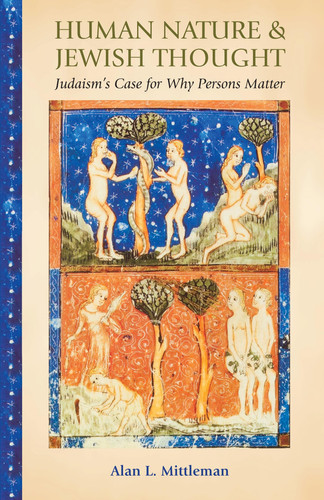
Human nature & Jewish thought: Judaism's case for why persons matter

Mittleman, Alan
This book explores one of the great questions of our time: How can we preserve our sense of what it means to be a person while at the same time accepting what science tells us to be true-namely, that human nature is continuous with the rest of nature? What, in other words, does it mean to be a person in a world of things? Alan Mittleman shows how the Jewish tradition provides rich ways of understanding human nature and personhood that preserve human dignity and distinction in a world of neuroscience, evolutionary biology, biotechnology, and pervasive scientism. These ancient resources can speak to Jewish, non-Jewish, and secular readers alike. Science may tell us what we are, Mittleman says, but it cannot tell us who we are, how we should live, or why we matter. Traditional Jewish thought, in open-minded dialogue with contemporary scientific perspectives, can help us answer these questions. Mittleman shows how, using sources ranging across the Jewish tradition, from the Hebrew Bible and the Talmud to more than a millennium of Jewish philosophy. Among the many subjects the book addresses are sexuality, birth and death, violence and evil, moral agency, and politics and economics. Throughout, Mittleman demonstrates how Jewish tradition brings new perspectives to-and challenges many current assumptions about-these central aspects of human nature. A study of human nature in Jewish thought and an original contribution to Jewish philosophy, this is a book for anyone interested in what it means to be human in a scientific age.
Princeton University Press 2015 215 pages

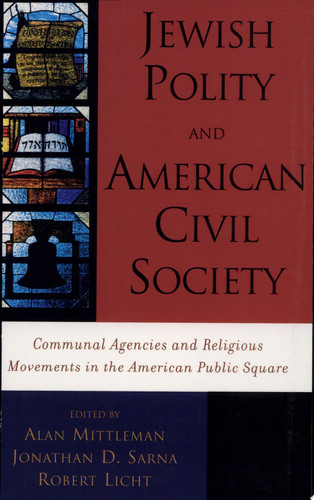
Jewish polity and American civil society: communal agencies and religious movements in the American public sphere

Alan Mittleman,Robert Licht,Jonathan D. Sarna
Jewish Polity and American Civil Society is a study of the civic and political engagements of American Jews as mediated by their communal and denominational institutions. The book explores how the various branches of the organized Jewish community seek to influence public affairs. Over the course of the last century, Jewish agencies and religious movements have tried to shape public debate and public policy on such issues as civil rights, church-state relations, and American foreign policy. The book sets the history of Jewish engagement in these areas into historical context; analyzes the motives, strategies, and tactics of various Jewish groups, and evaluates their successes and failures. The book also explores the underlying idea-the public philosophy-that informs American Jews' understanding of civic and political engagement.
Rowman & Littlefield 2002-07-23 420 pages

The scepter shall not depart from Judah: perspectives on the persistence of the political in Judaism

Mittleman, Alan
The title of political theorist Alan L. Mittleman's captivating new book is drawn from the patriarch Jacob's blessing to his children and grandchildren. The blessing contains the promise that Judah will become a royal house, perhaps forever. Kings, of course, ceased in Israel, but politics did not. Regime replaced regime. National independence was compromised and lost, regained and lost again. Yet the attention to things political was never lost. Old texts were applied to new political realities. Political awareness and thought, constantly transformed and adapted to new historical exigencies, persisted among the Jews. In The Scepter Shall Not Depart from Judah , Mittleman looks at some of the central problems of political philosophy-such as fundamental rights and the common good-from the point of view of rabbinic Judaism. At the same time, he considers conceptual issues in Judaism-such as covenant and tradition-from the perspective of political philosophy. Mittleman's sources range from the ancient rabbis to contemporary political theorists, making this volume an important one for courses and research in both Jewish studies and political theory.
Lexington Books 2000-02-09 185 pages