7908 results for "Science"

Ninety-nine more maggots, mites, and munchers

Berenbaum, M.
What lives in a reindeer's nose? Glad you asked. In this sequel to Ninety-nine Gnats, Nits, and Nibblers , National Medal of Science winner May Berenbaum offers another classic compendium of creepy-crawly cameos. Read up on our myriad arthropodan indignities and allies as Berenbaum reveals: Why the rove beetle gives mind-altering drugs to ants How the snail-killing fly enjoys its escargot Why Piophila casei doesn't care when you eat its larvae What strange fate awaits a honey ant worker engorged with nectar As lively as a fly in the buttermilk, Ninety-nine More Maggots, Mites, and Munchers is a who's who and what's THAT? guide to Lilliputian life-forms both familiar and obscure.
University of Illinois Press 1993 285 pages

Honey, I'm homemade: sweet treats from the beehive across the centuries and around the world

May R. Berenbaum
Honey, I'm Homemade: Sweet Treats from the Beehive across the Centuries and around the World showcases a wealth of recipes for cookies, breads, pies, puddings, and cakes that feature honey as an essential ingredient. Noted entomologist May Berenbaum also details the fascinating history of honey harvesting and consumption around the world, explains the honey bee's extraordinary capacity to process nectar into concentrated sweetness, and marvels at honey's diverse flavors and health benefits. Honey is a unique food because of its power to evoke a particular time and place. Every time it is collected from a hive, honey takes on the nuanced flavors of a particular set of flowers--clover, orange blossoms, buckwheat, or others--at a certain point in time processed and stored by a particular group of bees. Honey is not just a snapshot of a time and place--it's the taste of a time and place, and it lends its flavors to the delectable baked goods and other treats found here. More than a cookbook, Honey, I'm Homemade is a tribute to the remarkable work of Apis mellifera, the humble honey bee whose pollination services allow three-quarters of all flowering plant species to reproduce and flourish. Sales of the book will benefit the University of Illinois Pollinatarium--the first freestanding science outreach center in the nation devoted to flowering plants and their pollinators. Because so much depends on honey bees, and because people have benefited from their labors for millennia, Honey, I'm Homemade is the perfect way to share and celebrate honey's sweetness and delight.
University of Illinois Press 2010-10-07 163 pages

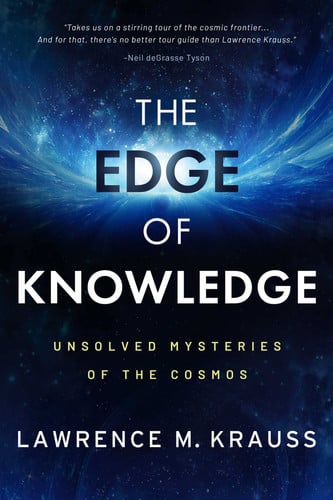
The edge of knowledge: unsolved mysteries of the cosmos

Krauss, Lawrence M.
Lawrence Krauss explores the greatest unanswered questions at the forefront of science today, and likely for the coming century and beyond. Internationally known theoretical physicist and bestselling author Lawrence Krauss explores science’s greatest unanswered questions. Three of the most important words in science are “I don't know.” Not knowing implies a Universe of opportunities—the possibility of discovery and surprise. Our understanding of science has advanced immeasurably over the last five hundred years, yet many fundamental mysteries of existence persist: How did our Universe begin? How big is the Universe? Is time travel possible? What’s at the center of a black hole? How did life on Earth arise? Are we alone? What is consciousness, and can we create it? These mysteries define the scientific forefront—the threshold of the unknown. To explore that threshold is to gain a deeper understanding of just how far science has progressed. Covering time, space, matter, life, and consciousness, Krauss introduces readers to topics that will shape the state of science for the next century, providing us all passport to our own journeys of exploration and discovery.
Post Hill Press 2023-05-09 220 pages

Do not leave your language alone: the hidden status agendas within corpus planning in language policy

Fishman, Joshua A.
This book, focused on corpus planning in language policy, provides a broad, integrative framework and also discusses multiple languages in detail. It provides readers with great familiarity with a wide range of language cases and at the same time gives them the theoretical tools and analysis to see how they inter-relate. The novelty of this volume is twofold: First, it deals with corpus planning alone (modernizing a language per se), and second, it does so in terms of a systematization of the often unconscious language status aspirations that both guide language planners themselves and motivate the lay public (the target population of all language planning). Corpus planning is going on all over the world today and inevitably becomes an expression of the societal goals, ideologies, and aspirations of the societies and cultures that support it. The implication is that the distinction between corpus and status planning, which has a long tradition in language planning research, must be critically re-examined. DO NOT Leave Your Language Alone: The Hidden Status Agendas Within Corpus Planning in Language Policy begins with a brief introduction to language planning as a whole, to corpus planning in particular, and to the unavoidability of a status component in the execution of all corpus planning past, present, and future. Topics of the central chapters include: *corpus planning and status planning: separates, opposites, or Siamese twins?; *the directions and dimensions of corpus planning; *does "folksiness" come before or after "cleanliness"?; *the bi-polar dimension of uniqueness vs. Westernization; *the classicization vs. "panification" bi-polar dimension; *the Ausbau vs. Einbau bi-polar dimension; *the interdependence and independence of dimensional clusters; and *can opposites and incommensurables be combined? Written at an introductory level assuming no prior knowledge of the field, this book is intended as a text for higher undergraduate and lower graduate level courses in language planning and policy. It is equally valuable for researchers in the field of language planning, policy, and politics, as well as those in sociolinguistics, political science, and communication studies more generally--that is, for all who are interested in fostering or limiting human intervention in the language change processes that are ongoing worldwide. Finally, an introduction to corpus planning that is full of historical vignettes, good humor, visual illustrations, and cutting-edge thought!
Lawrence Erlbaum Publishers 2006 158 pages

The last European war, September 1939/December 1941

Lukacs, John
This absorbing study of the first--and decisive--phase of World War II tells not only how events happened but why they happened as they did. Eminent historian John Lukacs presents an extraordinary narrative of these two years, followed by a detailed sequential analysis of the lives of the peoples and then of the political, military, and intellectual relations and events. "Lukacs's book is consistently interesting, surprising, and provocative." --James Joll, New York Times Book Review "This dispassionate, humorous, serious, and brilliantly written book marks an important step forward in our understanding of a past that is still within living memory." -- Economist "An excellent, valuable, and highly readable book. . . . It makes both fascinating and extraordinarily valuable reading. It is a major contribution to historical scholarship." --Joseph G. Harrison , Christian Science Monitor "A brilliant, original study of what this era meant--socially, politically, artistically, intellectually--in the lives of the peoples of Europe. . . . [Lukacs's] grasp of emotional as well as intellectual history is commanding." -- New Yorker "Deserves to be widely read, seriously considered, and vigorously debated." --Gordon Wright, American Historical Review
Yale University Press 2001-01-01 562 pages

The truth about crime: sovereignty, knowledge, social order

Comaroff, Jean
In this book, renowned anthropologists Jean and John L. Comaroff make a startling but absolutely convincing claim about our modern era: it is not by our arts, our politics, or our science that we understand ourselves it is by our crimes. Surveying an astonishing range of forms of crime and policing from petty thefts to the multibillion-dollar scams of too-big-to-fail financial institutions to the collateral damage of war they take readers into the disorder of the late modern world. Looking at recent transformations in the triangulation of capital, the state, and governance that have led to an era where crime and policing are ever more complicit, they offer a powerful meditation on the new forms of sovereignty, citizenship, class, race, law, and political economy of representation that have arisen. To do so, the Comaroffs draw on their vast knowledge of South Africa, especially, and its struggle to build a democracy founded on the rule of law out of the wreckage of long years of violence and oppression. There they explore everything from the fascination with the supernatural in policing to the extreme measures people take to prevent home invasion, drawing illuminating comparisons to the United States and United Kingdom. Going beyond South Africa, they offer a global criminal anthropology that attests to criminality as the constitutive fact of contemporary life, the vernacular by which politics are conducted, moral panics voiced, and populations ruled
The University of Chicago Press 2016-12-05 347 pages

History, metaphors, fables: a Hans Blumenberg reader

Blumenberg, Hans
"The philosopher Hans Blumenberg (1920-1996) has, in the quarter-century since his death, become a modern classic in his native Germany, making him one of the most important philosophers of the post-war period. This collection offers an invaluable guide, containing both his most important philosophical essays as well as selections of his non-academic writings that appeared in newspapers and cultural magazines. The topics covered include modernity and secularization, the philosophy of history, the history of science and technology, language philosophy and rhetoricity, aesthetics and literary theory, philosophical anthropology, theology, and mythical thought"--
Cornell University Press 2020 609 pages

Nevermore

Wajsbrot, Cécile
A meditation on loss and recovery through the act of translation and its recuperative powers. An unnamed translator mourning the loss of a close friend retreats to Dresden to translate the "Time Passes" section of Virginia Woolf's novel To the Lighthouse . Translating this lyrical evocation of time and its devastations in a city with which the writer has no connections and where neither her language nor Woolf's are spoken offers an interruption to the course of her life. She immerses herself in this prose poem of ephemerality. The narrator delves into phrases from "Time Passes" and subjects them to the inexact science and imperfect art of translation. This, in turn, leads her to wide-ranging reflections on other instances of loss, destruction, and recovery--the Chernobyl disaster, the High Line in New York City, the bombing of Dresden and Wallmann's commemorative Bell Requiem Dresden, the evacuation of the Hebridean island Foula, Hiroshi Sugimoto's photographs of seascapes, Debussy's "La cathédrale engloutie," and Ceri Richards's series of paintings by the same name. She reflects on places that are destined for decay and yet are returning to life, broken worlds in which there is still strength for a new beginning. In Tess Lewis's visionary English translation, Cécile Wajsbrot's lyrical exploration of the role of the writer and translator becomes an exquisite meditation on loss and recovery.
Seagull Books 2024 192 pages

The language war

Lakoff, Robin Tolmach
Robin Lakoff gets to the heart of one of the most fascinating and pressing issues in American society today: who holds power and how they use it, keep it, or lose it. In a brilliant and vastly entertaining discussion of news events that have occupied an enormous amount of media space--political correctness, the Anita Hill/Clarence Thomas hearings, Hillary Rodham Clinton as First Lady, O. J. Simpson's murder trial, the Ebonics controversy, and the Clinton sex scandal--Lakoff shows that the struggle for power and status at the end of the century is being played out as a war over language. Controlling language is a basis for all power, she says, and therefore it is worth fighting for. As a result, newly emergent groups, especially blacks and women, are contending with middle- to upper-class white men for a share in "language rights." Lakoff's introduction to linguistic theories and the philosophy of language lays the groundwork for an exploration of news stories that meet what she calls the UAT (Undue Attention Test). As the stories became the subject of talk-show debates, late-night comedy routines, Web sites, and magazine articles, they were embroidered with additional meanings, depending on who was telling the story. Race, gender, or both are at the heart of these stories, and each one is about the right to construct meanings from languagein short, to possess power. Because language tells us how we are connected to one another, who has power and who does not, the stories reflect the language war. We use language to analyze what we call "reality," the author argues, but we mistrust how language is used today--witness the "politics of personal destruction" following the Clinton impeachment. Yet Lakoff sees in the struggle over language a positive goal: equality in the creation of our national discourse. Her writing is accessible and witty, and her excerpts from the media are used to great effect.
University of California Press 2000 322 pages

Supported Decision-making From Justice for Jenny to Justice for All!

Jonathan Martinis,Peter David Blanck
How would you feel if you weren’t allowed to make decisions about your life? What if someone had the power to tell you where to live, who to spend time with, and what to do? What if that person had control of your money and health care? Isn't that hard to imagine? Yet, hundreds of thousands of people with disabilities face this situation, every day, when they in a guardianship. When a court decides that a person needs a guardian, it appoints someone to make decisions for that person, usually in all areas of life. While guardianship may be helpful to some people, when people who can make their own decisions are put in guardianship, they can lose their rights and have a worse quality of life. That's what happened to Jenny Hatch, a young woman with Down syndrome. Before she was put in guardianship, Jenny lived in her own apartment, worked, spent time with friends, and went to a church she chose. After the court ordered her into guardianship, Jenny was put in a group home, against her will, with her cell phone and laptop taken away, cut off from her friends and not allowed to go to her job and church.In this book, Jonathan Martinis and Peter Blanck tell Jenny’s story, including how she lost her rights under guardianship and won them back when she showed the court that she uses Supported Decision-Making (SDM) to make her own decisions with help from people she trusts. They’ll also show you how you can use SDM in your life, with family members, or people you support. They’ll give you practical tips and model language to help you request, receive, and use SDM in the programs and life areas people with disabilities use every day, including Special Education, Vocational Rehabilitation, Person Centered Planning, Health Care, Money Management, and others. As you read this book, you’ll learn that SDM is for almost everyone and almost everyone can use SDM. The authors hope that people with disabilities and their families, friends, and professionals will use this book to help them develop customized SDM plans that protect their rights and empower them to make their own decisions.
Independently published 2020 193 pages

The Making of Global Capitalism The Political Economy of American Empire

Sam Gindin,Leo Panitch
The all-encompassing embrace of world capitalism at the beginning of the twenty-first century was generally attributed to the superiority of competitive markets. Globalization had appeared to be the natural outcome of this unstoppable process. But today, with global markets roiling and increasingly reliant on state intervention to stay afloat, it has become clear that markets and states aren’t straightforwardly opposing forces. In this groundbreaking work, Leo Panitch and Sam Gindin demonstrate the intimate relationship between modern capitalism and the American state, including its role as an “informal empire” promoting free trade and capital movements. Through a powerful historical survey, they show how the US has superintended the restructuring of other states in favor of competitive markets and coordinated the management of increasingly frequent financial crises. The Making of Global Capitalism , through its highly original analysis of the first great economic crisis of the twenty-first century, identifies the centrality of the social conflicts that occur within states rather than between them. These emerging fault lines hold out the possibility of new political movements transforming nation states and transcending global markets.
Verso Books 2025-08-05 480 pages

Given time. II

Derrida, Jacques
"Between 1978 and 1979, Jacques Derrida delivered a seminar on the themes of "the gift" and "time" titled "Donner-le temps." The first part of that seminar was published in 1991. Given Time II is an archival discovery of the second installment that was promised but never came to fruition during Derrida's lifetime. The eight seminar sessions collected here represent Derrida's most advanced work on the problematic of the gift in Heidegger's thought, with deep dives into some of the richest and most difficult texts in the Heideggerian corpus, such as the essays "The Origin of the Work of Art," "The Thing," and "On Time and Being." Beyond Heidegger, Derrida skillfully engages Claude Lévi-Strauss, Marcel Mauss, Maurice Blanchot, Jacques Lacan, and others on the topic of the gift. The themes discussed include the act of giving and receiving gifts, the necessary link between time and the gift, being as some "thing" given that exceeds things and beings as such, the sacrificial gift, and others. Through these analyses, Derrida begins to identify the paradox of gift giving: For the gift to be received as a gift, it must not appear as such, since its mere appearance as gift puts it in the cycle of repayment and debt. Given Time II is a remarkable and uniquely Derridean treatment of an important subject in the work of Heidegger and beyond"-- Provided by publisher.
The University of Chicago Press 2026-03-18 224 pages

Time maps

Zerubavel, Eviatar
" Time Maps extends beyond all of the old clichés about linear, circular, and spiral patterns of historical process and provides us with models of the actual legends used to map history. It is a brilliant and elegant exercise in model building that provides new insights into some of the old questions about philosophy of history, historical narrative, and what is called straight history."-Hayden White, University of California, Santa Cruz Who were the first people to inhabit North America? Does the West Bank belong to the Arabs or the Jews? Why are racists so obsessed with origins? Is a seventh cousin still a cousin? Why do some societies name their children after dead ancestors? As Eviatar Zerubavel demonstrates in Time Maps , we cannot answer burning questions such as these without a deeper understanding of how we envision the past. In a pioneering attempt to map the structure of our collective memory, Zerubavel considers the cognitive patterns we use to organize the past in our minds and the mental strategies that help us string together unrelated events into coherent and meaningful narratives, as well as the social grammar of battles over conflicting interpretations of history. Drawing on fascinating examples that range from Hiroshima to the Holocaust, from Columbus to Lucy, and from ancient Egypt to the former Yugoslavia, Zerubavel shows how we construct historical origins; how we tie discontinuous events together into stories; how we link families and entire nations through genealogies; and how we separate distinct historical periods from one another through watersheds, such as the invention of fire or the fall of the Berlin Wall. Most people think the Roman Empire ended in 476, even though it lasted another 977 years in Byzantium. Challenging such conventional wisdom, Time Maps will be must reading for anyone interested in how the history of our world takes shape.
University of Chicago Press 2003 180 pages

On anthropological knowledge: three essays

Sperber, Dan
What can be understood of other cultures? And what can we learn about people in general from the study of other cultures? In the three closely related essays that constitute this book and which have already created considerable controversy in their original French versions, and been rewritten and expanded for this edition, Dan Sperber discusses these fundamental issues of anthropology. In the first essay he analyses the way in which anthropology is written and read. In the second, he offers a novel rationalist alternative to cultural relativism, based on both anthropological and psychological arguments, and illustrated by his own fieldwork in Ethiopia. The third essay provides an assessment of the work of Lévi-Strauss, in which the arguments of the previous two essays are linked with an incisive critique of Lévi-Strauss' contribution to the study of cultural variation.
Cambridge University Press & Editions de la Maison des Sciences de l'Homme 1985-06-30 110 pages

God and Golem, Inc. : A Comment on Certain Points where Cybernetics Impinges on Religion

Wiener, Norbert.
The new and rapidly growing field of communication sciences owes as much to Norbert Wiener as to any one man. He coined the word for it--cybernetics. In God & Golem, Inc., the author concerned himself with major points in cybernetics which are relevant to religious issues.The first point he considers is that of the machine which learns. While learning is a property almost exclusively ascribed to the self-conscious living system, a computer now exists which not only can be programmed to play a game of checkers, but one which can "learn" from its past experience and improve on its own game. For a time, the machine was able to beat its inventor at checkers. "It did win," writes the author, "and it did learn to win; and the method of its learning was no different in principle from that of the human being who learns to play checkers.A second point concerns machines which have the capacity to reproduce themselves. It is our commonly held belief that God made man in his own image. The propagation of the race may also be interpreted as a function in which one living being makes another in its own image. But the author demonstrates that man has made machines which are "very well able to make other machines in their own image," and these machine images are not merely pictorial representations but operative images. Can we then say: God is to Golem as man is to Machines? in Jewish legend, golem is an embryo Adam, shapeless and not fully created, hence a monster, an automation.The third point considered is that of the relation between man and machine. The concern here is ethical. "render unto man the things which are man's and unto the computer the things which are the computer's," warns the author. In this section of the book, Dr. Wiener considers systems involving elements of man and machine.The book is written for the intellectually alert public and does not involve any highly technical knowledge. It is based on lectures given at Yale, at the Société Philosophique de Royaumont, and elsewhere.
MIT Press 1964

The Oxford handbook of the history of phenomenology

Dan Zahavi
This Oxford Handbook offers a broad critical survey of the development of phenomenology, one of the main streams of philosophy since the nineteenth century. It comprises thirty-seven specially written chapters by leading figures in the field, which highlight historical influences, connections and developments, and offer a better comprehension and assessment of the continuity as well as diversity of the phenomenological tradition. The handbook is divided into three distinct parts. The first part addresses the way phenomenology has been influenced by earlier periods or figures in the history of philosophy. The second part contains chapters targeting prominent phenomenologists: How was their work affected by earlier figures, how did their own views change over time, and what kind of influence did they exert on subsequent thinkers? The contributions in the third part trace various core topics such as subjectivity, intersubjectivity, embodiment, spatiality, imagination etc. in the work of different phenomenologists, in order to explore how the notions were transformed, enriched, and expanded up through the century. This volume will be a source of insight for philosophers, students of philosophy, and for people working in other disciplines of the humanities, social sciences, and sciences, who are interested in the phenomenological tradition. It is an authoritative guide to how phenomenology started, how it developed, and where it is heading.
Oxford University Press 2023-07-27 800 pages

Dr Karl's Short Back and Science

Karl Kruszelnicki
Lean back and settle in for cutting-edge scientific snippets from the trend-setting Dr Karl Kruszelnicki.In Short Back & Science, Dr Karl combs through some of the greatest scientific conundrums of our age, such as what is killing half the bacteria on Earth every two days and why don't mole rats get cancer? Why would anyone pay $40 million for a cup of tea, and how did a toilet seat help to end the First World War? Are bananas really slippery, radioactive and loaded with potassium? What do clouds weigh? And why are there scientists running around naked in the Antarctic? Brushing aside any hype about coconuts and antioxidants, there is no one better to trim down to the facts than Australia's most trusted scientist, Dr Karl.
Pan Macmillan Australia Pty, Limited 2015-10-27 304 pages