676 results for "Biography"

The Koch Papers My Fight Against Anti-Semitism

Edward I. Koch,Ed Koch,Rafael Medoff
For more than three decades, Ed Koch has been one of America's most interesting and outspoken political figures. In this provocative new book, Koch with Rafael Medoff guides readers through the major battles in his life-long fight against anti-Semitism. Interviews, speeches, new essays, never-before published personal correspondence, and more highlight his leadership--on campuses, in the media, on the streets of New York City, and in the halls of power in Washington, DC. The book also features personal letters from Henry Louis Gates, former President George Bush, and other prominent figures. Koch will reveal startling information for the first time here, and his writings are controversial, piercing, teasing, and questioning. This book will ignite discussion for years to come
Macmillan 2009-03-17 256 pages

A perilous advantage: the best of Natalie Clifford Barney

Barney, Natalie Clifford
"Finally, the writing of one of the century's most notorious lesbians is available in English. Though best known for hosting the avant garde of Paris for thirty years--Colette, Renee Vivien, Marcel Proust and Gertrude Stein, to mention a few--she was also a writer who challenged the male-dominated literary establishment both in the content and the form of her work. Now we can discover her views on the people, places and events of that exciting and stimulating era for ourselves. Here is a spirited translation of Barney's thought-provoking work by one of Britain's most interesting writers"--Back cover.
New Victoria Publishers 1992 198 pages

Freud in his time and ours

Roudinesco, Elisabeth
Élisabeth Roudinesco offers a bold and modern reinterpretation of the iconic founder of psychoanalysis. Based on new archival sources, this is Freud's biography for the twenty-first century--a critical appraisal, at once sympathetic and impartial, of a genius greatly admired and yet greatly misunderstood in his own time and in ours. Roudinesco traces Freuds life from his upbringing as the eldest of eight siblings in a prosperous Jewish-Austrian household to his final days in London, a refugee of the Nazis' annexation of his homeland. She recreates the milieu of fin de siecle Vienna in the waning days of the Habsburg Empire--an era of extraordinary artistic innovation, given luster by such luminaries as Gustav Klimt, Stefan Zweig, and Gustav Mahler. In the midst of it all, at the modest residence of Berggasse 19, Freud pursued his clinical investigation of nervous disorders, blazing a path into the unplumbed recesses of human consciousness and desire. Yet this revolutionary who was overthrowing cherished notions of human rationality and sexuality was, in his politics and personal habits, in many ways conservative, Roudinesco shows. In his chauvinistic attitudes toward women, and in his stubborn refusal to acknowledge the growing threat of Hitler until it was nearly too late, even the analytically-minded Freud had his blind spots. Alert to his intellectual complexity--the numerous tensions in his character and thought that remained unresolved--Roudinesco ultimately views Freud less as a scientific thinker than as the master interpreter of civilization and culture.
Harvard University Press 2016-11-07 580 pages

Not Prince Hamlet: literary and theatrical memoirs

Meyer, Michael Leverson
Michael Meyer's translations of Strindberg and Ibsen have often been described as definitive, as have his biographies of both writers. His Strindberg translations made him the first Englishman to receive the Gold Medal of the Swedish Academy, and his life of Ibsen won the Whitbread Biography prize. He has now turned his attention to his own life and his friendships with some of this century's most famous literary and theatrical names.
Secker & Warburg 1989 291 pages

The investigator: fifty years of uncovering the truth

Lenzner, Terry F.
The Los Angeles Times once called investigative lawyer Terry Lenzner “one of the most powerful and dreaded private investigators in the world.” In his fifty-year career, Lenzner has worked with politicians, celebrities, governments, and corporations worldwide; with a steadfast commitment to the truth, he has uncovered facts that have shaped policy and influenced major legal battles. In this captivating memoir, Lenzner speaks about his varied career and high-profile cases for the first time. At the Justice Department in 1964, he investigated the murder of three civil rights workers—an infamous event that inspired the film Mississippi Burning . He led the national Legal Services Program for the poor, prosecuted organized crime in New York, defended peace activist Philip Berrigan, and represented CIA operative Sid Gottlieb. As a counsel to the Senate Watergate Committee, Lenzner investigated Nixon’s dirty tricks and followed the money trail that led to the Watergate burglary and cover-up. He was the first person to deliver a congressional subpoena to a sitting U.S. president. He uncovered cost overruns of the Alaska oil pipeline, helped identify the Unabomber, investigated the circumstances of Princess Diana’s death, and cleared Hugo Chavez of false corruption charges. Lenzner also worked with President Clinton’s defense team during the impeachment hearings. The Investigator is a riveting personal account: Lenzner astounds with anecdotes of scandal and intrigue, offers lessons in investigative methods, and provides an eye-opening look behind some of the most talked-about media stories and world events of our time.
Blue Rider Press, a member of Penguin Group (USA) 2013 371 pages

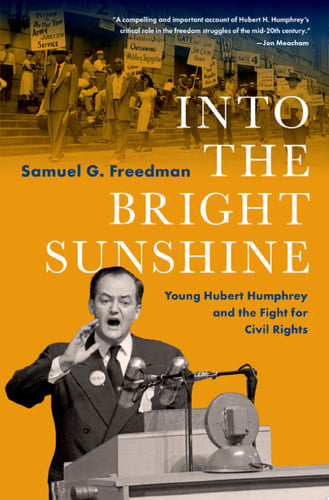
Into the bright sunshine: young Hubert Humphrey and the fight for civil rights

Freedman, Samuel G.
"Hubert Humphrey, a fallen hero and a dying man, rose on rickety legs to approach the podium of the Philadelphia Convention Hall, his pulpit for the commencement address at the University of Pennsylvania. He clutched a sheaf of paper with his speech for the occasion, typed and double-spaced by an assistant from his extemporaneous dictation, and then marked up in pencil by Humphrey himself. A note on the first page, circled to draw particular attention, read simply, "30 years ago--Here." In this place, at that time, twenty-nine years earlier to be precise, he had made history. From the dais now, Humphrey beheld five thousand impending graduates, an ebony sea of gowns and mortarboards, broken by one iconoclast in a homemade crown, two in ribboned bonnets, and another whose headgear bore the masking-tape message HI MA PA. In the horseshoe curve of the arena's double balcony loomed eight thousand parents and siblings, children, and friends. Wearing shirtsleeves and cotton shifts amid the stale heat, they looked like pale confetti from where Humphrey stood, and their flash cameras flickered away, a constellation of pinpricks"--
Oxford University Press 2023 488 pages

Laboratory for world destruction: Germans and Jews in Central Europe

Wistrich, Robert S.
The Austro-Hungarian Empire was rife with ethnic tensions that undermined the possibilities for Jewish assimilation in Central Europe. The Jews were trapped between rising German nationalism and other nationalisms. Discusses various Jewish and non-Jewish attitudes toward the "Jewish problem", whereby Jews were often stereotyped (e.g. by Rosa Luxemburg) or were considered to need a solution separate from that of European majority peoples (e.g. Nathan Birnbaum and Max Nordau). Views Nietzsche as belonging more to the philosemites than the antisemites, for whom he had great scorn; however, his complexity and obscurity provided ammunition for antisemites, including the Nazis. Herzl believed that a Jewish state was needed to provide a home for Jews suffering from antisemitism. Freud's experience of antisemitism, combined with his negative view of human nature, left no room for illusions about Austrian and German acceptance of Jews. Karl Kraus exhibited elements of Jewish self-hatred when he identified the worst elements of contemporary journalism and capitalism with Jews. Karl Lueger used political antisemitism to become mayor of Vienna. He provided a model for Hitler, who imbibed antisemitic attitudes and stereotypes from the cauldron of nationalisms that was Austria-Hungary.
Published by University of Nebraska Press for the Vidal Sassoon International Center for the Study of Antisemitism (SICSA), the Hebrew University of Jerusalem 2007 404 pages

Pedigree

Modiano, Patrick
" It's a book less on what I did than on what others, mainly my parents, did to me " Taking in a vast gallery of extraordinary characters from Paris' post-war years, Pedigree is an autobiographical portrait of Post-War Paris and a tumultuous childhood - a childhood replete with insecurity and sorrow that informed the oeuvre of France's Nobel Laureate. With his sometime-actress mother and shady businessman father barely functioning in any parental role, the young Modiano spent his childhood being packed off to the care of others, or held at a safe distance in a grimy boarding school - which he ran away from several times. His impecunious mother had "a heart of stone"; his womanising father once called the police when his son asked him for money, and later ceased all contact with him. But for all his parents' indifference, it is the death of his younger brother when Modiano is eleven that cuts deepest, leaving a wound that can never be healed.
MacLehose Press 2016-09 109 pages

The play goes on: a memoir

Simon, Neil
In his critically acclaimed Rewrites, Neil Simon talked about his beginnings - his early years of working in television, his first real love, his first play, his first brush with failure, and, most moving of all, his first great loss. Simon's same willingness to open his heart of the reader permeates The Play Goes On. This second act takes the reader from the mid-1970s to the present, a period in which Simon wrote some of his most popular and critically acclaimed plays, including the Brighton Beach trilogy and Lost in Yonkers, for which he won the Pulitzer Prize. Simon experienced enormous professional success during this time, but in his personal life he struggled to find that same sense of happiness and satisfaction. After the death of his first wife, he and his two young daughters left New York for Hollywood. There he remarried, and when that foundered he remarried again. Told with his characteristic humor and unflinching sense of irony, The Play Goes On is rich with stories of how Simon's art came to imitate his life. Simon's forty-plus plays make up a body of work that is a long-running memoir in its own right, yet here, in a deeper and more personal book than his first volume, Simon offers a revealing look at an artist in crisis but still able and willing to laugh at himself. -- from back cover.-- Provided by publisher.
Simon & Schuster 2002 352 pages

A good place to come from

Torgov, Morley
From Publishers Weekly Sault Ste. Marie's Jewish community in the 1930s, where Torgov grew up, is evoked in this Canadian memoir. Containing many mirthful moments, the book is deeply moving as well. Holding center stage is the author's profane, choleric, intolerant father. There is little about the boy's mother, who died when he was only 10, or the stepmother whom Torgov Sr. wed and then quickly divorced. Most of the fun as well as the sadness arises from duels between father and son and the latter's childhood escapades, such as conniving with a sympathetic maid to feast on forbidden foods. Torgov also brings to life members of the insular town's Jewish and Christian communities in his endearing anecdotes. Copyright 1986 Reed Business Information, Inc.
St. Martin's Press 1986 186 pages

White boy: a memoir

Naison, Mark
How does a Jewish boy who spent the bulk of his childhood on the basketball courts of Brooklyn wind up teaching in one of the city's pioneering black studies departments? Naison's odyssey begins as Brooklyn public schools respond to a new wave of Black migrants and Caribbean immigrants, and established residents flee to virtually all-white parts of the city or suburbs. Already alienated by his parents' stance on race issues and their ambitions for him, he has started on a separate ideological path by the time he enters Columbia College. Once he embarks on a long-term interracial relationship, becomes a member of SDS, focuses his historical work on black activists, and organizes community groups in the Bronx, his immersion in the radical politics of the 1960s has emerged as the center of his life. Determined to keep his ties to the Black community, even when the New Left splits along racial lines, Naison joined the fledgling African American studies program at Fordham, remarkable then as now for its commitment to interracial education.This memoir offers more than a participant's account of the New Left's racial dynamics; it eloquently speaks to the ways in which political commitments emerge from and are infused with the personal choices we all make.
Temple University Press 2002-03-08 225 pages

The alphabet in my hands: a writing life

Agosín, Marjorie
Marjorie Agosín writes of a beloved childhood nanny: "Since I was Jewish she baptized me with holy water brought forth from the fonts of nearby churches. She told me to stay very still so I wouldn't sprout horns. . . . I was somewhere between taciturn and happy gazing into the mirror as if approaching the edge of a cliff . . . and I watched myself in the deep, transparent veil of this night of all nights." Many of the themes expressed in this vignette--cultural dissonance, family, and community--are poetically intertwined throughout The Alphabet in My Hands . Agosín takes us on a personal journey of discovery that is as much internal reflection as it is an exodus across continents and decades. Agosín's childhood and early adolescence were spent with her Jewish family in Chile. While her family raised her to regard her Jewish heritage with loving awareness, they also participated in the dominant Catholic culture--an aunt organized Easter egg hunts and her mother admired the beauty of Chile's Catholic churches. The young Agosín became keenly aware of her dual identity in her country, both as a participant and an outsider. The second half of The Alphabet in My Hands recounts the events that forced her family to emigrate to America: the overthrow of Salvador Allende by General Augusto Pinochet. Agosín writes of her new life in Athens, Georgia, of the sudden loss of all that was familiar. Ostracized as an emigrant--a "non-white" with a strange foreign accent--her high school years were made even more painful by the news from Chile: prisoners taken and classmates disappearing or shot. Years later, Agosín goes back to Chile and she travels there with her own children. As she stares down at her old homeland from the plane, she writes: "Why do I love this place that forced us into exile, that punished my father for being a Jew?" And in the final chapter of The Alphabet in My Hands , this award-winning poet addresses two important topics: her current residence in New England and the central role of writing and literature in her life.
Rutgers University Press 2000 187 pages

Heretic's heart: a journey through spirit & revolution

Adler, Margot
Adler was a young woman determined to be taken seriously and to be an agent of change - on her own terms, free from dogma and authoritarian constraints. From campus activism at the University of California at Berkeley to civil-rights work in Mississippi, from antiwar protests to observing the socialist revolution in Cuba, she found those chances in the 1960s. Heretic's Heart illuminates the events, ideas, passions, and ecstatic commitments of the decade like no other memoir.
Beacon Press 1997 309 pages