898 results for "Evolution"

Complexities: beyond nature & nurture

Susan McKinnon,Sydel Silverman
Recent years have seen a growing impetus to explain social life almost exclusively in biological and mechanistic terms, and to dismiss cultural meaning and difference. Daily we read assertions that everything from disease to morality—not to mention the presumed characteristics of race, gender, and sexuality—can be explained by reference primarily to genetics and our evolutionary past. Complexities mobilizes experts from several fields of anthropology—cultural , archaeological, linguistic, and biological—to offer a compelling challenge to the resurgence of reductive theories of human biological and social life. This book presents evidence to contest such theories and to provide a multifaceted account of the complexity and variability of the human condition. Charting a course that moves beyond any simple opposition between nature and nurture, Complexities argues that a nonreductive perspective has important implications for how we understand and develop human potential.
University of Chicago Press 2005-06 330 pages

Artificial Life

Steven Levy
This enthralling book alerts us to nothing less than the existence of new varieties of life. Some of these species can move and eat, see, reproduce, and die. Some behave like birds or ants. One such life form may turn out to be our best weapon in the war against AIDS. What these species have in common is that they exist inside computers, their DNA is digital, and they have come into being not through God's agency but through the efforts of a generation of scientists who seek to create life in silico. But even as it introduces us to these brilliant heretics and unravels the intricacies of their work. Artificial Life examines its subject's dizzying philosophical implications: Is a self-replicating computer program any less alive than a flu virus? Are carbon-and-water-based entities merely part of the continuum of living things? And is it possible that one day "a-life" will look back at human beings and dismiss us as an evolutionary way station -- or, worse still, a dead end? "From the Trade Paperback edition.
Random House Value Publishing 1994-05-29

Social Darwinism in American Thought, 1860-1915

Richard Hofstadter
Social Darwinism in American Thought examines the overall influence of Darwin on American social theory and the notable battle waged among thinkers over the implications of evolutionary theory for social thought and political action. Theorists such as Herbert Spencer and William Graham Sumner adopted the idea of the struggle for existence as justification for the evils--as well as the benefits--of laissez-faire modern industrial society. Others, such as William James and John Dewey, argued that human planning was needed to direct social development and improve on the natural order. Hofstadter's classic study of the ramifications of Darwinism is a major analysis of the social philosophies that animated intellectual movements of the Gilded Age and the Progressive Era.
University of Pennsylvania Press 1944-01-29 208 pages

Nothing created everything: the scientific impossibility of atheistic evolution

Comfort, Ray
Richard Dawkins is arguably the modern poster boy for Charles Darwin. However, a key difference radically separates the two men. Darwin believed in the existence of God and calls God the "Creator" seven times in "The Origin of Species." Dawkins, in contrast, claims, "The more you understand the significance of evolution, the more you are pushed...towards atheism." It seems Professor Dawkins thinks Charles Darwin didn't understand his own theory. Just months after the 2009 discovery of the supposed "missing link," author Ray Comfort turns the tables on evolutionists. In "Nothing Created Everything," he examins the evidence for evolution and shows it is lacking. He demonstrates that when it comes to explaining how life began, atheists and evolutionists offer faith not facts. Ironically, atheists insist nothing created everything, a scientific impossibility. In a conversational tone, Comfort speaks to both atheists and believers and urges this discussion be based on hard evidence. And when it is, he insists, people will realize evolution is a theory that can't be tested or measured and therefore can't be scientific.
WND Books 2009 222 pages

Slanted Truths: Essays on Gaia, Symbiosis and Evolution

Margulis, Lynn,Sagan, Dorion
This enticing collection is as devoted to the profound power of figures of speech as any oration of old Hellas. Metaphor reigns as we encounter the identification of our Earth as a Single, integrative organism, a tale told in image and passion. The discoveries and conjectures upon which this grand view rest are here as well. I have enjoyed these two dozen pieces hugely. No family tree of animal life but must somewhere disclose a cousinly infolding. We are compact of life past, and the looped handing down is more complex than the Mendel-Morgan dance of chromosomes and genes. That dance is essential, certainly, but it is the vital editing of an epic and many-rooted work, a book more like the Bible than like one great artists Remembrance of Things Past. We follow a few old shelves of bound DNA, not just a single book. Our major biochemical package for oxidative metabolism was de scribed in a small DNA manual, somehow engulfed to become an or ganelle within a lucky ancient ancestral anaerobe, and passed ever since viii FOREWORD from mother to offspring outside of the chromosome shuffie. The sperm do carry half the compact genetic message of the human DNA, but they are too small to transfer this equally essential symbiotic one that comes down from the mothers, within roomy egg after roomy egg.
Copernicus 2011-11-25 396 pages

The roots of American communism

Draper, Theodore
In this definitive history of the evolution of the Com- munist Party in America--from its early background through its founding in 1919 to its emergence as a legal entity in the 1920s--Theodore Draper traces the native and foreign strains that comprised the party. He emphasizes its shifting policies and secrets as well as its open activities. He makes clear how the party in its infancy "was transformed from a new expression of American radicalism to the American appendage of a Russian revolutionary power," a fact that Draper develops in his succeeding volume, American Communism and Soviet Russia. In his special, prescient way, Theodore Draper himself had the final words on American Communism: "It is like a museum of radical politics. In its various stages, it has virtually been all things to all men... There are many ways of trying to understand such a movement, but the first task is historical. In some respects, there is no other way to understand it, or at least to avoid seriously misunderstanding it. Every other approach tends to be static, one-sided or unbalanced." Draper correctly notes that the formative period of the American Communist movement has remained a largely untold and even unknown story. In part, the reasons for this are that the Communist movement, although a child of the West, grew to power in the Soviet East. But Draper rescues this chapter with deep appreciation for the fact that communism was not something that happened just in Russia, but also in the United States. This is a must read for scholars and laypersons alike. This volume is conceived as an independent and self-contained study of the American Communist movement. Draper correctly notes that the formative period is largely untold and even unknown. In part, the reasons for this are that the Communist movement, although a child of the West, grew to power in the Soviet East. Draper appreciates the fact that communism was not something that happened only in Russia, but also took place in the United States. That experience is the focus of this volume.
Routledge 2018 498 pages

Leviticus 23-27: a new translation with introduction and commentary

Milgrom , Jacob
Jacob Milgrom, a rabbi and Bible scholar, has devoted the bulk of his career to examining the laws of the Torah. His incisive commentary on Leviticus, which began with Leviticus 1-16, continues in this last volume of three. It provides an authoritative and comprehensive explanation of ethical values concealed in Israel's rituals. Although at first glance Leviticus seems far removed from the modern-day world, Milgrom's thoughtful and provocative comments and notes reveal its enduring relevance to contemporary society. Leviticus 23-27 brings us to the climactic end of the book and its revolutionary innovations, among which are the evolution of the festival calendar with its emphasis on folk traditions, and the jubilee, the priestly answer to the socio-economic problems of their time. With English translations that convey the nuance and power of the original Hebrew, this trilogy will take its place alongside the best of the Anchor Bible Commentaries.
Yale University Press 2001 2714 pages

Women after all: sex, evolution, and the end of male supremacy

Konner, Melvin
Overview: A lively, richly informed argument for the natural superiority of women from the acclaimed author of The Tangled Wing. There is a human genetic fluke that is surprisingly common, due to a change in a key pair of chromosomes. In the normal condition the two look the same, but in this disorder one is malformed and shrunken beyond recognition. The result is a shortened life span, higher mortality at all ages, an inability to reproduce, premature hair loss, and brain defects variously resulting in attention deficit, hyperactivity, conduct disorder, hypersexuality, and an enormous excess of both outward and self-directed aggression. It is called maleness. In Women After All, Melvin Konner traces the arc of evolution to explain the relationships between women and men. With patience and wit he explores the knotty question of whether men are necessary in the biological destiny of the human race. He draws on multiple, colorful examples from the natural world-such as the mating habits of the octopus, black widow, angler fish, and jacana-and argues that maleness in humans is hardly necessary to the survival of the species. In characteristically humorous and engaging prose, Konner sheds light on our biologically different identities, while noting the poignant exceptions that challenge the male/female divide. We meet hunter-gatherers such as those in Botswana, whose culture gave women a prominent place, invented the working mother, and respected women's voices around the fire. Recent human history has upset this balance, as a dense world of war fostered extreme male dominance. But our species has been recovering over the past two centuries, and an unstoppable move toward equality is afoot. It will not be the end of men, but it will be the end of male supremacy and a better, wiser world for women and men alike. Provocative and richly informed, Women After All is bound to be controversial across the sexes
W.W. Norton & Company 2015-02-24 404 pages

Six Impossible Things Before Breakfast The Evolutionary Origins of Belief

Lewis Wolpert
Why do 70 percent of Americans believe in angels, while others are convinced that they were abducted by aliens? What makes people believe in improbable things when all the evidence points to the contrary? And don't almost all of us, at some time or another, engage in magical thinking? In Six Impossible Things Before Breakfast, evolutionary biologist Lewis Wolpert delves into the important and timely debate over the nature of belief, looking at its psychological foundations to discover just what evolutionary purpose it could serve. Wolpert takes us through all that science can tell us about the beliefs we feel are instinctive. He deftly explores different types of belief those of children, of the religious, and of those suffering from psychiatric disorders and he asks whether it is possible to live without belief, or whether it is a necessary component of a functioning society."
W.W. Norton & Company 2007 243 pages

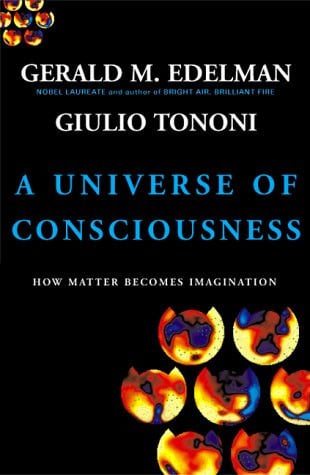
A universe of consciousness: how matter becomes imagination

Edelman, Gerald Maurice
In A Universe of Consciousness, Gerald Edelman builds on the radical ideas he introduced in his monumental trilogy-Neural Darwinism, Topobiology, and The Remembered Present-to present for the first time an empirically supported full-scale theory of consciousness. He and the neurobiolgist Giulio Tononi show how they use ingenious technology to detect the most minute brain currents and to identify the specific brain waves that correlate with particular conscious experiences. The results of this pioneering work challenge the conventional wisdom about consciousness.
Basic Books 2000 274 pages

Is Earth exceptional? the quest for cosmic life

Livio, Mario
"For a long time, scientists have wondered how life has emerged from inanimate chemistry, and whether Earth is the only place where it exists. Charles Darwin speculated about life on Earth beginning in a warm little pond. Some of his contemporaries believed that life existed on Mars. It once seemed inevitable that the truth would be known by now. It is not. For more than a century, the origins and extent of life have remained shrouded in mystery. But, as Mario Livio and Jack Szostak reveal in Is Earth Exceptional?, the veil is finally lifting. The authors describe how life's building blocks-from RNA to amino acids and cells-could have emerged from the chaos of Earth's early existence. They then apply the knowledge gathered from cutting-edge research across the sciences to the search for life in the cosmos: both life as we know it and life as we don't. Why and where life exists are two of the biggest unsolved problems in science. Is Earth Exceptional? is the ultimate exploration of the question of whether life is a freak accident or a chemical imperative"-- Provided by publisher.
Basic Books 2024-09 329 pages

Singing the master: the emergence of African American culture in the Plantation South

Abrahams, Roger D.
“Impressive…A scrupulously researched work enlarging our understanding of an integral aspect of slave culture.”–-The Washington Post Book World What was it like to be a slave on a plantation of the antebellum South? How did the fiction of the happy slave and myth of the plantation “family” evolve? How did slaves create a performance style that unified them, while simultaneously entertaining and mocking the master? The answers to these questions may be found in the groundbreaking study of the corn-shucking ceremonies of the prewar South, where white masters played host to local slaves and watched their “guests” perform exuberant displays of singing and dancing. Drawing on the detailed written and oral histories of masters, slaves, and Northern commentators, distinguished folklorist Roger Abrahams peels through layers of racism and nostalgia surrounding this celebration to uncover its true significance in the lives and imagination of both blacks and whites – and in the evolution of an enduring African-American culture.
Pantheon Books 1992 341 pages

The science of language: interviews with James McGilvray

Chomsky, Noam
"Noam Chomsky is one of the most influential thinkers of our time, yet his views are often misunderstood. In this previously unpublished series of interviews, Chomsky discusses his iconoclastic and important ideas concerning language, human nature and politics. In dialogue with James McGilvray, Professor of Philosophy at McGill University, Chomsky takes up a wide variety of topics - the nature of language, the philosophies of language and mind, morality and universality, science and common sense, and the evolution of language. McGilvray's extensive commentary helps make this incisive set of interviews accessible to a variety of readers. The volume is essential reading for those involved in the study of language and mind, as well as anyone with an interest in Chomsky's ideas"--
Cambridge University Press 2012-03-15 321 pages

The making of home

Flanders, Judith
The idea that 'home' is a special place, a separate place, a place where we can be our true selves, is so obvious to us today that we barely pause to think about it. But, as Judith Flanders shows in her fascinating new book, 'home' is a relatively new idea. When in 1900 Dorothy assured the citizens of Oz that 'There is no place like home', she was expressing a view that was the climax of 300 years of change. In The Making of Home, Flanders traces the evolution of the house from the sixteenth to the early twentieth century across northern Europe and America, and shows how the 'homes' we know today bear only a faint resemblance to 'homes' though history. Along the way she investigates the development of ordinary household items - from cutlery, chairs and curtains, to the fitted kitchen, plumbing and windows - while also dismantling many domestic myths.
Atlantic Books 2014 346 pages

Shipwreck with spectator: paradigm of a metaphor for existence

Blumenberg, Hans
This elegant essay exemplifies Blumenberg's ideas about the ability of the historical study of metaphor to illuminate essential aspects of being human. Originally published in the same year as his monumental Work on Myth, Shipwreck with Spectator traces the evolution of the complex of metaphors related to the sea, to shipwreck, and to the role of the spectator in human culture from ancient Greece to modern times. The sea is one of humanity's oldest metaphors for life, and a sea journey, Blumenberg observes, has often stood for our journey through life. We all know the role that shipwrecks can play in this journey, and at some level we have all played witness to others' wrecks, standing in safety and knowing that there is nothing we can do to help, yet fixed comfortably or uncomfortably in our ambiguous role as spectator. Through Blumenberg's seemingly inexhaustible knowledge of letters, from ancient texts through nineteenth-century reminiscences and modern speeches, we see layer upon layer revealed in the meanings humans have given to these metaphors; and in this way we begin to understand what metaphors can do that more straightforward modes of expression cannot. This edition of Shipwreck with Spectator also includes "Prospect for a Theory of Nonconceptuality", an essay that recounts the evolution of Blumenberg's ideas about metaphorology in the years following his early manifesto "Paradigms for a Metaphorology".
MIT Press 1997 124 pages

Lynn Margulis: the life and legacy of a scientific rebel

Dorion Sagan
Tireless, controversial, and hugely inspirational to those who knew her or encountered her work, Lynn Margulis was a scientist whose intellectual energy and interests knew no bounds. Best known for her work on the origins of eukaryotic cells, the Gaia hypothesis, and symbiogenesis as a driving force in evolution, her work has forever changed the way we understand life on Earth. When Margulis passed away in 2011, she left behind a groundbreaking scientific legacy that spanned decades. In this collection, Dorion Sagan, Margulis's son and longtime collaborator, gathers together the voices of friends and colleagues to remark on her life and legacy, in essays that cover her early collaboration with James Lovelock, her fearless face-off with Richard Dawkins during the so-called "Battle of Balliol" at Oxford, the intrepid application of her scientific mind to the insistence that 9/11 was a false-flag operation, her affinity for Emily Dickinson, and more. Margulis was elected to the National Academy of Sciences in 1983, received the prestigious National Medal of Science in 1999, and her papers are permanently archived at the Library of Congress. Less than a month before her untimely death, Margulis was named one of the twenty most influential scientists alive - one of only two women on this list, which include such scientists as Stephen Hawking, James Watson, and Jane Goodall.
Chelsea Green Publishing 2012 205 pages

Secular philosophy and the religious temperament: essays 2002-2008

Nagel, Thomas
"This volume collects recent essays and reviews by Thomas Nagel in three subject areas. The first section, including the title essay, is concerned with religious belief and some of the philosophical questions connected with it, such as the relation between religion and evolutionary theory, the question of why there is something rather than nothing, and the significance for human life of our place in the cosmos. It includes a defense of the relevance of religion to science education. The second section concerns the interpretation of liberal political theory, especially in an international context. A substantial essay argues that the principles of distributive justice that apply within individual nation-states do not apply to the world as a whole. The third section discusses the distinctive contributions of four philosophers to our understanding of what it is to be human - the form of human consciousness and the source of human values"--BOOK JACKET
Oxford University Press 2010 171 pages

Clocks for the Ages: How Scientists Date The Past

SILVERBERG, Robert
Geochronology is the name of the game & Silverberg plays for high stakes--all or nothing: for the ordinary nonspecialist this will be a burdensomely comprehensive cumulative history of the theories that have been advanced about the human past, beginning with the most unrefined notions chained on pain of heresy to Genesis. Archbishop Ussher calculated the age of the earth arithmetically according to the bible. His figures were accepted almost until Darwinism opened up conceptual horizons & Smith's nomenclature yielded a primitive relative calendar. Some means of assigning absolute numerical values was still wanting when Becquerel stumbled on radioactivity & started the Atomic Clock ticking, but here's where the reader without considerable mathematical aptitude & stamina may turn off: Silverberg explicates the physical properties of the atom & the progressive discoveries of half-life, isotopes & the neutron, all of which must be assimilated if the breakthroughs & contingencies are to be appreciated. "Rutherford realized that the heat of radioactive decay would serve to keep the interior of the planet warm for a much longer time than the 20 million years Kelvin had estimated as the earth's age"; "radioactivity could supply a new & far more accurate figure for the age of the earth, if only a way could be found to measure the rate at which the decay of radioactive elements occurs." Indeed with more research ways were found for dating the earth's crust, the ice ages, evolutionary Homo Sapiens, archeological finds, even tree-rings--& the methods are many: lead-uranium, helium, zircon, rubidium-strontium, potassium-argon, carbon 14... For each method as for each application, we must go thru the procedural motions in detail, & not only where the technique is proved viable but also where (5 pages later, say) it's proved erroneous. Colloquially, this encompasses everything under the sun that admits of chronological measurement (see index); more meaningfully, it embodies both the sum & the substance of Silverberg's other works (see bibliography). An interdisciplinary study for the extra-disciplined inquirer.--Kirkus (edited)
Macmillan 1971 244 pages