955 results for "Psychology"

The ways of the will and other essays

Farber, Leslie H.
The psychologist Leslie Farber, who died in 1981, has been revered as one of the most astute observers of the human condition and a writer of penetrating wisdom. His essays, on topics as diverse as the pornographic anguish of jealousy and the despair of psychotherapy, were collected in 1966 (The Ways of the Will) and 1976 (Lying, Despair, Jealousy, Envy, Sex, Suicide, Drugs, and the Good Life) and have been out of print for nearly twenty years. Based partly on his experiences as a therapist, but more importantly on his special insight, Dr. Farber's observations provide us with a unique glimpse into ourselves that is frequently startling, but in the end always consoling.
BasicBooks 2000-11-14 315 pages

An Absorbing Errand How Artists and Craftsmen Make Their Way to Mastery

Janna Malamud Smith
An Absorbing Errand uses stories of artists' lives, personal anecdotes, and insights from the author's work as a psychotherapist to examine the psychological obstacles that prevent people from staying with, and relishing, the process of art–making. Each chapter is devoted to a problem intrinsic to the creative process and illustrates how these very obstacles, once understood, can become prime sources of the energy that actually fuels the mastery of art–making. Ultimately, An Absorbing Errand provides a philosophical, historical, and analytical look at the creative impulse and how certain artists from a wide field mastered their craft. From Julia Child to Charlie Chaplin, Lady Gaga to Michael Jackson, famous painters to established writers, Smith shows us how each overcame the obstacles they faced in the pursuit of their creative visions. Many people carry within their hearts an aching sense that they have something they want to express through art; or that they will not feel complete until they've brought out some hidden part of themselves. Yet they cannot begin to do the work of bringing their creative idea into the world. Or, maybe they've begun over and over, but they can't stay with their labor long enough to finish it. An Absorbing Errand is a supportive companion, an enlightened and compassionate ballast, a guide for anyone who has ever picked up a pencil to write, or a paint brush to paint, or any tool —from chisel to loom— to pursue any serious craft, and then put it down again frustrated, discouraged, and unable to continue. An Absorbing Errand is unlike any book about creating art of any kind, and aspiring and working artists alike will find it both original and invaluable.
Catapult 2013-08-06 272 pages

Dogs never lie about love: reflections on the emotional world of dogs

Masson, J. Moussaieff
Dogs fill our hearts with love and our minds with wonder, but their emotional lives have remained unexplored since Darwin 125 years ago. Now in Dogs Never Lie About Love, controversial psychoanalyst Jeffrey Masson brilliantly navigates the rich inner landscape of "our best friends. "As he guides readers through the surprising depth of canine emotional complexity, Jeffrey Masson draws from myth and literature, from scientific studies, and from the stories and observations of dog trainers and dog lovers around the world. But the stars of the book are the author's own three dogs whose delightful and mysterious behavior provides the way to exploring a wide range of subjects--from emotions like gratitude, compassion, loneliness, and disappointment to speculating what dogs dream of and how their powerful sense of smell shapes their perception of reality. As he sweeps aside old prejudices on animal behavior, Masson reaches into a rich universe of dog feeling to its essential core, their "master emotion": love. Like the dogs he loves, Masson's writing will capture the reader with its playful, mysterious, and serious sides. Its surprising insights provide a new dimension of understanding for dog owners everywhere.
Three Rivers Press 1997 274 pages

Methods in neuronal modeling

Christof Koch,Idan Segev
Methods in Neuronal Modeling is the first technical handbook on computational neuroscience. Written for researchers and theoreticians alike, it outlines methods and techniques used for simulating on digital computers the functional properties of single neurons from synapses, dendrites, single cells; and small invertebrate networks to large scale neural networks in the mammalian nervous system. The use of new experimental tools such as selective staining methods, membrane patch electrodes, voltage and calcium-dependent dyes, and multielectrode recordings, together with the, advent of universally available powerful computing, makes it possible to construct detailed and realistic models of neuronal systems. Methods in Neuronal Modeling addresses such questions as what can and should be simulated and what techniques should be used; what experimental parameters are crucial for such simulations, and whether these models may be verified experimentally. Chapters cover simulation of passive dendritic trees, compartmental models of single cells including neurons with a number of different ionic channels, calcium current dynamics, simulations of small invertebrate networks, simulations of the mammalian cortex, connectionists' models, and the use of parallel computers in modeling neural networks. Although the chapters were written by several authors, they are uniform in structure and notation. Detailed examples are given to clarify the different approaches. Each chapter concludes with a description of the model discussed and the details of its implementation on the computer. Christof Koch is an Assistant Professor of Computation and Neural Systems at the California Institute of Technology. Idan Segev is a Lecturer in Neurobiology at the Institute of Life Science, Hebrew University of Jerusalem. Methods in Neuronal Modeling inaugurates the new series in Computational Neuroscience, edited by Terrence J. Sejnowski and Tomaso Poggio. A Bradford Book.
MIT Press 1989-01 524 pages

Conversations with anorexics

Bruch, Hilde
from Publisher's Weekly: This posthumous collection of case material illustrates the treatment modality successfully employed by psychiatrist Bruch with patients suffering from the eating disorder of anorexia. Two of her associates at Baylor College of Medicine in Houston have edited this final work, taped by the author before her death in 1984. Bruch makes the reader privy to the therapeutic transaction between her patients who are in what she describes as "the relentless pursuit of thinness.'' Emphasizing the conversational ambiance of the therapy and discounting heretofore unsuccessful approaches of psychoanalysis and behavior modification, she helped her patients to heal. The dramatic dialogues in the cases presented allow us to hear these desperate young anorexic women individually explore their thwarted development, under the direction of a compassionate physician who guides them towards wellness. from Library Journal: Psychiatrist Bruch was a pioneer in developing psychotherapy for anorexia victims. Author of half a dozen books, her first work, Eating Disorders, appeared 15 years ago. She taped her interactions with clients, and these form the nucleus of this final book. Bruch's strength is her straightforward writing: it is honest, simple, and effective.
Basic Books 1988-05-15 216 pages

Vital involvement in old age

Erikson, Erik H.
Erikson's now-famous concept of the life cycle delineates eight stages of psychological development through which each of us progresses. The last stage, old age, challenges the individual to rework the past while remaining involved in the present. The authors begin this work with their theory of life's stages through old age. In Part two, they discuss their interviews with twenty-nine octogenarians, on whom life history data has been collected for over fifty years. Part three is a discussion of the life history of the protagonist in Ingmar Bergman's film Wild Strawberries. In Part four, "Old age in our society", the authors offer suggestions for "vital involvement." Erik H. Erikson is winner of the Pulitzer Prize and the National Book Award.
W.W. Norton 1986 352 pages

Faith, hope, and healing: inspiring lessons learned from people living with cancer

Siegel, Bernie S.
faith, hope & healing Inspiring Lessons Learned from People Living with Cancer "Bernie Siegel is one of the greatest healers of our time. The stories he shares in Faith, Hope, and Healing demonstrate the healing effect of treating cancer not just with conventional medicine but by changing the way you think about your disease, the way you act toward those who love and care for you, and the way you feel about yourself. The mind is the most powerful tool you have for fighting back." -Deepak Chopra, author of Jesus: A Story of Enlightenment Praise for Bernie Siegel for Prescriptions for Living "Bernie Siegel is a brilliant beacon broadcasting a message of hope. When high-tech medicine is supplemented with love and compassion, we have not only curing but also healing, which is what Siegel's message is all about." -Larry Dossey, M.D., author of Healing Words for Help Me to Heal "If you or a loved one have to go through major medical care . . . this book can be . . . life-saving and soul-saving." -Andrew Weil, M.D., the New York Times bestselling author of Spontaneous Healing and Eight Weeks to Optimum Health for 365 Prescriptions for the Soul "Bernie Siegel dispenses spiritual medicine that's good for you, and feels good too! I highly recommend these daily doses of eternal wisdom." -Marianne Williamson, author of Everyday Grace "Bernie is one of the world's most respected doctors. I would pay close attention to any prescription he offers. I read from this each day." -Wayne Dyer, author of Getting in the Gap "Dr. Siegel's soul medicine is dispensed in perfect doses to uplift, inspire, enlighten, and heal you. As always, Bernie's wisdom and love gave me goosebumps, or should I say god-bumps. Buy a carton of this medicine-in-a-book and administer it to everyone you love." -Joan Borysenko, Ph.D., author of Inner Peace for Busy People for Love, Magic, and Mudpies "Dr. Bernie Siegel has been my mentor and friend for many years. His wisdom has been a beacon of healing and humor. Love, Magic, and Mudpies is as funny, wise, and practical as its magical author. Every parent needs this book." -Christiane Northrup, M.D., author of Mother-Daughter Wisdom "Love, Magic, and Mudpies is a wonderful, wise, and very funny antidote to the No-Parent-Is-Perfect-Enough school of parenting. Bernie Seigel's delightful new book could only have been written by a seasoned father and grandfather who is also a pioneer of holistic medicine." -Rachel Naomi Remen, M.D., author of Kitchen Table Wisdom "Dr. Bernie Siegel is a living demonstration of the healing power of commitment, compassion, and love. What he offers the world in Love, Magic, and Mudpies is a testimony of his wisdom. No matter what ails you, a dose of Bernie Siegel and his work is sure to work magic in your soul." -Iyanla Vanzant, author of One Day My Soul Just Opened Up for Peace, Love & Healing "Bernie Siegel [is] a doctor who loves. In this age of massive, impersonal medical technology, his advocacy of human caring is a necessity." -Larry LeShan, Ph.D., author of Cancer as a Turning Point "I was enthralled with this book. [This] truly great book ... combines sound thought with captivating humor." -Norman Vincent Peale
John Wiley & Sons 2009-04-06 226 pages

Divided memory: the Nazi past in the two Germanys

Herf, Jeffrey
The memory of the Nazi past emerged in both postwar German states divided along political lines. In both states the political elites, oriented toward the future (building socialism in the GDR, returning Germany to the West in the FRG), tended not to focus on Nazi crimes, including the Holocaust. In both countries, however, there were minority groups which insisted on preservation of the Holocaust memory in Germany. In the GDR, it was a communist group (including Paul Merker) which had functioned in Mexico during the Nazi period which stressed the centrality of the anti-Jewish policy in Nazi Germany. In the FRG it was a group which included Social Democrats and President Heuss; it regarded the admission of German responsibility for the Holocaust as a precondition for the moral healing of the nation. Contrary to all expectations, it the FRG which faced the memory of the Holocaust, while in the "anti-fascist" GDR it was suppressed. With the rise of the SPD to power in the FRG, and the collapse of communism in the GDR in 1989, the Holocaust emerged as a major topic in German political discourse, preserved in reunified Germany.
Harvard University Press 1997 527 pages

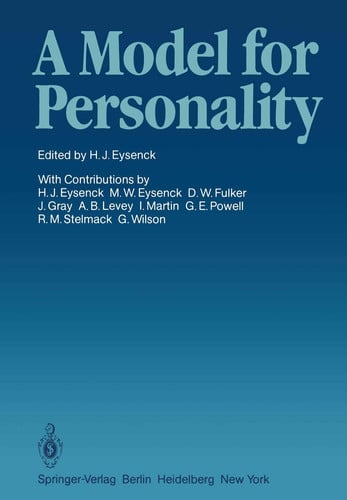
A Model for Personality

H.J. Eysenck
H. J. Eysenck This book is not an introduction to personality research, it is not a textbook, and above all it is not a model of personality. The title, A Modelfor Personality, was chosen on purpose to indicate that we are here concerned with a discussion of how models in this field ought to be constructed, what their functions were, and whether such models or paradigms could with advantage be produced at this stage of development. One particular aspect of personality, extraversion introversion (E), has been chosen to exemplify the desiderata which emerge from such a discussion. It is not suggested that personality and E are synonymous - merely that this particular dimension is perhaps better known than any other, has had more experimental work done on it than any other and has acquired a better theoretical substructure, and more links with genetics and physiology, than any other. Hence it seems most likely to serve as an example of how a satisfactory model of personality might ultimately be constructed, i. e. by analogy with E. Other dimensions of personality, such as neuroticism-stability or psycho tic ism-superego functioning, are mentioned in the discussion, but only when they overlap or interrelate with E. The book uses E as an example to illustrate the way in which a model of personality can be constructed, but it is in no way a summary of all that is known about E.
Springer Berlin Heidelberg 2011-10-26 287 pages