

14302 results for "History"

The fall of the house of Roosevelt: brokers of ideas and power from FDR to LBJ
In the 1930s a band of smart and able young men, some still in their twenties, helped Franklin D. Roosevelt transform an American nation in crisis. They were the junior officers of the New Deal. Thomas G. Corcoran, Benjamin V. Cohen, William O. Douglas, Abe Fortas, and James Rowe helped FDR build the modern Democratic Party into a progressive coalition whose command over power and ideas during the next three decades seemed politically invincible. This is the first book about this group of Rooseveltians and their linkage to Lyndon Johnson's Great Society and the Vietnam War debacle. Michael Janeway grew up inside this world. His father, Eliot Janeway, business editor of Time and a star writer for Fortune and Life magazines, was part of this circle, strategizing and practicing politics as well as reporting on these men. Drawing on his intimate knowledge of events and previously unavailable private letters and other documents, Janeway crafts a riveting account of the exercise of power during the New Deal and its aftermath. He shows how these men were at the nexus of reform impulses at the electoral level with reform thinking in the social sciences and the law and explains how this potent fusion helped build the contemporary American state. Since that time efforts to reinvent government by "brains trust" have largely failed in the U.S. In the last quarter of the twentieth century American politics ceased to function as a blend of broad coalition building and reform agenda setting, rooted in a consensus of belief in the efficacy of modern government. Can a progressive coalition of ideas and power come together again? The Fall of the House of Roosevelt makes such a prospect both alluring and daunting.

Heroic conservatism: why Republicans need to embrace America's ideals (and why they deserve to fail if they don't)
Journalist and speechwriter Gerson uses his own experiences in the upper tier of the Bush White House to show why America needs a conservatism that is heroic in its aspirations--including "compassionate conservative" proposals to confront global AIDS, combat poverty in America, and promote human rights and dignity abroad--initiatives that Gerson fought for during his time in government. Gerson has a unique ability to frame complex issues in a way that both challenges and inspires, and here he delivers a new manifesto for the Republican Party and a memoir of a history-shaping Presidency.--From publisher description.

The forgotten presidents: their untold constitutional legacy
Their names linger in memory mainly as punch lines, synonyms for obscurity: Millard Fillmore, Chester Arthur, Calvin Coolidge. They conjure up not the White House so much as a decaying middle school somewhere in New Jersey. But many forgotten presidents, writes Michael J. Gerhardt, were not weak or ineffective. They boldly fought battles over constitutional principles that resonate today. Gerhardt, one of our leading legal experts, tells the story of The Forgotten Presidents. He surveys thirteen administrations in chronological order, from Martin Van Buren to Franklin Pierce to Jimmy Carter, distinguishing political failures from their constitutional impact. Again and again, he writes, they defied popular opinion to take strong stands. Martin Van Buren reacted to an economic depression by withdrawing federal funds from state banks in an attempt to establish the controversial independent treasury system. His objective was to shrink the federal role in the economy, but also to consolidate his power to act independently as president. Prosperity did not return, and he left office under the shadow of failure. Grover Cleveland radically changed his approach in his second (non-consecutive) term. Previously he had held back from interference with lawmakers; on his return to office, he aggressively used presidential power to bend Congress to his will. Now seen as an asterisk, Cleveland consolidated presidential authority over appointments, removals, vetoes, foreign affairs, legislation, and more. Jimmy Carter, too, proves surprisingly significant. In two debt-ceiling crises and battles over the Panama Canal treaty, affirmative action, and the First Amendment, he demonstrated how the presidency's inherent capacity for efficiency and energy gives it an advantage in battles with Congress, regardless of popularity. Gerhardt explains the many things these and ten other presidents have in common that explain why, in spite of any of their excesses, they have become forgotten chief executives. Incisive, myth-shattering, and compellingly written, this book shows how even obscure presidents championed the White House's prerogatives and altered the way we interpret the Constitution.

The Basic Fault: Therapeutic Aspects of Regression
In this volume, Michael Balint, who over the years made a sustained and brilliant contribution to the theory and technique of psychoanalysis, develops the concept of the 'basic fault' in the bio-psychology structure of every individual, involving in varying degree both mind and body. Balint traces the origins of the basic fault to the early formative period, during which serious discrepancies arise between the needs of the individual and the care and nurture available. These Discrepancies create a kind of deficiency state.On the basis of this concept, Balint assumes the existence of a specific area of the mind in shich all the processes have an exclusively two-person structure consisting of the individual and the individual's primary object. Its dynamic force, originating from the basic fault has the overwhelming aim of 'putting things right'. This area is contrasted with two the area of the Oedipus complex, which has essentially a triangular structure comprising the individual and two of his objects, and whose characteristic dynamism has the form of a conflict; and the area of creation, in which there are no objects in the proper sense, and whose characteristic force is the urge to create, to produce

The Holy Land
This long-awaited reprint of Avi-Yonah's landmark work covers a period of historical geography in the land of Israel that has seen little additional comparable research. Spanning the Exilic, Intertestamental, New Testament, and later Roman periods, this volume is invaluable for Old Testament, Early Judaism, New Testament, and Talmudic studies. Professor Anson Rainey adds a useful toponymic index as well as text revisions. A new foreword is presented by Yoram Tsafrir, director of the Jewish National and University Library.

The Temple Bombing
Describes the bombing of the Temple, Atlanta's oldest synagogue, in October 1958, against the background of anti-Black and anti-Jewish violence prevalent in the South at the time. States that "whites aimed at blacks through the Jews, " and that 10% of the bombs in the South in 1954-59 exploded at synagogues, rabbis' homes, and Jewish community centers. The target of the Atlanta bombing was the Temple's rabbi, Jacob M. Rothschild, a vigorous advocate of racial integration. Describes Rothschild's activities, as well as those of George Michael Bright, a member of the neo-Nazi Columbians and the racist National States' Rights Party, one of five men indicted in the Temple bombing. Describes the trials of the accused, none of whom were convicted; Bright's trial ended in a deadlock and declaration of a mistrial, while the other four were acquitted.

Max Wertheimer Productive Thinking
Max Wertheimer (1880-1943), a pioneer of 20th-century psychology, had a major influence on the development of cognitive psychology, especially the psychology of perception and of productive thinking. His work "Productive Thinking" (1945), written in New York, is regarded as a milestone in creativity research. Consisting of many examples of creative thought processes - from geometric tasks to socio-psychologically relevant conflict resolutions to the development of Einstein's theory of relativity - the book leads the reader through a multi-faceted body of thought in the psychology of thinking. Only a few texts in psychology have remained significant even after a period of three quarters of a century - Max Wertheimer's Productive Thinking is such an exception. This book, which also presents an exposition of Gestalt psychology, highlights the "productive" (insightful) versus automatic (unreflected) thought processes for many areas of life. In addition to examples from school teaching, the chapter on the emergence of Albert Einstein's theory of relativity is of lasting interest to today's generation of psychologists, pedagogues, brain researchers, neuroscientists and philosophers. Wertheimer had the unique opportunity to analyze Einstein's thinking in direct conversation. An introductory commentary by Viktor Sarris for this new edition of the first publication of Productive Thinking in 1945 offers a detailed account of the genesis and reception of Wertheimer's work.

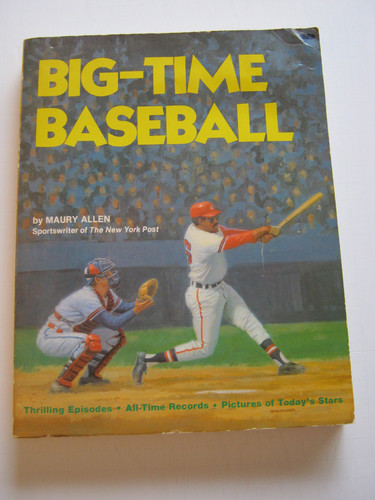
Big-time baseball: a complete record of the national sport
A potpourri of major league happenings between 1900 and 1978. Includes records, anecdotes, photographs, and biographical information.
The iron king
"The Iron King--Philip the Fair--is as cold and silent, as handsome and unblinking as a statue. He governs his realm with an iron hand, but he cannot rule his own family: his sons are weak and their wives adulterous; while his red-blooded daughter Isabella is unhappily married to an English king who prefers the company of men. A web of scandal, murder and intrigue is weaving itself around the Iron King; but his downfall will come from an unexpected quarter. Bent on the persecution of the rich and powerful Knights Templar, Philip sentences Grand Master Jacques de Molay to be burned at the stake, thus drawing down upon himself a curse that will destroy his entire dynasty..."--Page [4] of cover.

They Who Knock at Our Gates A Complete Gospel of Immigration
This work has been selected by scholars as being culturally important, and is part of the knowledge base of civilization as we know it. This work is in the "public domain in the United States of America, and possibly other nations. Within the United States, you may freely copy and distribute this work, as no entity (individual or corporate) has a copyright on the body of the work. Scholars believe, and we concur, that this work is important enough to be preserved, reproduced, and made generally available to the public. We appreciate your support of the preservation process, and thank you for being an important part of keeping this knowledge alive and relevant.

Fighting power: German and US Army performance, 1939-1945
Analyses the performance of two key parties engaged in fighting during World War II.

The ruling class of Judaea: the origins of the Jewish revolt against Rome, A.D. 66-70
Goodman examines the background of the AD 66 Judean revolt against Rome. He attempts to explain both the rebellion itself and its temporary success by discussing the role of the Jewish ruling class in the sixty years preceding the war and in the independent state that lasted until AD 70. The author shows that the revolt's ultimate cause was a misunderstanding by Rome of the status criteria of Jewish society.

The Martin Duberman reader: the essential historical, biographical, and autobiographical writings
For the past fifty years, prize-winning historian Martin Duberman’s groundbreaking writings have established him as one of our preeminent public intellectuals. Founder of the first graduate program in LGBT studies in the country, he is perhaps best known for his biographies of Paul Robeson, Lincoln Kirstein, and Howard Zinn—works that have been hailed as “magnificent” (USA Today), “enthralling” (The Washington Post), “splendid” and “definitive” (Studs Terkel, Chicago Sun-Times), and “refreshing and inspiring” (The New York Times). Duberman is also an equally gifted playwright and essayist, whose piercingly honest memoirs Cures and Midlife Queer have been called “witty and searingly candid” (Publishers Weekly), “wrenchingly eloquent” (Newsday), and “a moving chronicle” (The Nation). His writings have explored the shocking attempts by the medical establishment to “cure” homosexuality; Stonewall, before and after; the age of AIDS; the struggle for civil rights; the fight for economic and racial justice; and Duberman’s vision for reclaiming a radical queer past from the creeping centrism of the gay movement. The Martin Duberman Reader assembles the core of Duberman’s most important writings, offering a wonderfully comprehensive overview of our lives and times—and giving us a crucial touchstone for a new generation of activists, scholars, and readers.

Making constitutional law: Thurgood Marshall and the Supreme Court, 1961-1991
Making Constitutional Law: Thurgood Marshall and the Supreme Court, 1961-1991 focuses on the second half of a brilliant and unique career. When tapped by LBJ in 1967 to ascend to the High Court, the seasoned Marshall - as the first African-American Justice - brought desegregation to the bench in word, thought, and deed. But as Mark V. Tushnet illustrates in this book, Marshall, a Great Society liberal, brought many other progressive concepts and convictions.

The healing of America
A lecturer shares the principles she believes are needed to reunite the country, emphasizing a return to the spiritual roots that underlie the founding of America, including the power of nonviolence and the power of community. 500,000 first printing.

Jefferson measures a moose
Thomas Jefferson was wild about numbers. He was constantly counting, measuring, and observing things that caught his interest. He loved sharing his discoveries and reading the discoveries of others. But when a famous Frenchman published a book about America, Jefferson was appalled: all the information in the book was wrong. The author insisted that America was a wretched, dismal place, where birds could not sing, dogs could not bark, and everything and everyone was puny and weak. Thomas Jefferson resolved to set the record straight - with numbers - and prove to the world that the new nation was worthy of investment.

Destruction and sorrow beneath the heavens: reportage
"Destruction and Sorrow beneath the Heavens is both a travel memoir and the chronicle of a distinct intellectual shift as one of the most captivating contemporary writers and thinkers begins to engage with the cultures of Asia and the legacies of its interactions with Europe in a newly globalized society. Rendered in English by award-winning translator Ottilie Mulzet, Destruction and Sorrow beneath the Heavens is an important work, marking the emergence of Krasznahorkai as a truly global novelist"-- Amazon.com

March on
inspired by recent women's marches, sisters Lucy and Grace Lang's book for very young children honors the centennial of the passage of the 19th Amendment, which secured women's right to vote in the United States. As the world churns, all parents are striving to raise informed, courageous children, equipped to handle a changing and dangerous world in the most responsible and productive ways possible. March On! draws on the iconography of the women's march that started it all, the historic 1915 New York City women's march, highlighting the tremendous potential for collective activism, in rhyme, coupled with unique and diverse pictures to appeal to both children's imaginations and adults' familiarity with archetypal American imagery.

The joyful beggar: a novel of St. Francis of Assisi
In this magnificent and stirring novel, Louis de Wohl turns his famed narrative skill to the story of the soldier and merchant's son who might have been right-hand man to a king ... and who became instead the most beloved of all saints. Set against the tempestuous background of 13th Century Italy and Egypt, here is the magnificent and inspiring story of Francis Bernardone, the brash, pleasure-loving young officer who was to become immortalized as St. Francis of Assisi. The story teems with action, pageantry and intrigue with finely conceived characters-the beautiful, saintly Clare, Frederick, the hawk-faced King of Sicily and Holy Roman Emperor, the Sultan Al Kamil, Pope Innocent III. The scene shifts from Assisi, Rome and Sicily to the deadly sands of Egypt. This book was made into a feature film by 20th Century Fox entitled Francis of Assisi , now available on video from Ignatius Press.
