993 results for "Biography"

Artists' SoHo: 49 episodes of intimate history

Kostelanetz, Richard
How a little-known industrial neighborhood in New York unintentionally became a nexus of creative activity for a brief burst of time. During the 1960s and 1970s in New York City, young artists exploited an industrial wasteland to create spacious studios where they lived and worked, redefining the Manhattan area just south of Houston Street. Its use fueled not by city planning schemes but by word-of-mouth recommendations, the area soon grew to become a world-class center for artistic creation indeed, the largest urban artists' colony ever in America--let alone the world. Richard Kostelanetz's Artists' SoHo not only examines why the artists came and how they accomplished what they did but also delves into the lives and works of some of the most creative personalities who lived there during that period, including Nam June Paik, Robert Wilson, Meredith Monk, Richard Foreman, Hannah Wilke, George Macuinas, and Alan Suicide. Gallerists followed the artists in fashioning themselves, their homes, their buildings, and even their streets into transiently prominent exhibition and performance spaces. SoHo pioneer Richard Kostelanetz's extensively researched intimate history is framed within a personal memoir that unearths myriad perspectives: social and cultural history, the changing rules for residency and ownership, the ethos of the community, the physical layouts of the lofts, the types of art produced, venues that opened and closed, the daily rhythm, and the gradual invasion of "new people." Artists' SoHo also explores how and why this fertile bohemia couldn't last forever. As wealthier people paid higher prices, galleries left, younger artists settled elsewhere, and the neighborhood became a "SoHo Mall" of trendy stores and restaurants. Compelling and often humorous, Artists' SoHo provides an analysis of a remarkable neighborhood that transformed the art and culture of New York City over the past five decades.
Empire State Editions, an imprint of Fordham University Press 2015 272 pages

Inside the economist's mind: conversations with eminent economists

Paul A. Samuelson,William A. Barnett
By focusing on the human side as well as the intellectual dimensions of how economists work and think, this collection of interviews with top economists of the 20th century becomes a startling and lively introduction to the modern world of macroeconomics. A fun read! For more information, frequent updates, and to comment on the forthcoming book, visit William A. Barnett's weblog at http://economistmind.blogspot.com/. Acclaim for Inside the Economist's Mind "In candid interviews, these great economists prove to be fabulous story tellers of their lives and times. Unendingly gripping for insiders, this book should also help non-specialists understand how economists think." Professor Julio Rotemberg, Harvard University Business School, and Editor, Review of Economics and Statistics. "Economics used to be called the 'dismal science'. It will be impossible for anybody to hold that view anymore ... This is science with flesh and blood, and a lot of fascinating stories that you will find nowhere else." Dr. Jean-Pascal Bénassy, Paris-Jourdan Sciences Économiques, Paris, France "This book provides a rare and intriguing view of the personal and professional lives of leading economists ... It is like A Beautiful Mind , scaled by a factor of 16 [the number of interviews in the book]." Professor Lee Ohanian, University of California at Los Angeles " ... if you want an insider view of how economics has been developing in the last decades, this is the (only) book for you." Professor Giancarlo Gandolfo, University of Rome ‘La Sapienza,’ Rome "Here we see the HUMAN side of path-breaking research, the personalities and pitfalls, the DRAMA behind the science." Professor Francis X. Diebold, University of Pennsylvania, Philadelphia
Blackwell Pub 2007 419 pages

Making constitutional law: Thurgood Marshall and the Supreme Court, 1961-1991

Tushnet, Mark V.
Making Constitutional Law: Thurgood Marshall and the Supreme Court, 1961-1991 focuses on the second half of a brilliant and unique career. When tapped by LBJ in 1967 to ascend to the High Court, the seasoned Marshall - as the first African-American Justice - brought desegregation to the bench in word, thought, and deed. But as Mark V. Tushnet illustrates in this book, Marshall, a Great Society liberal, brought many other progressive concepts and convictions.
Oxford University Press 1997 246 pages

Jefferson measures a moose

Rockliff, Mara
Thomas Jefferson was wild about numbers. He was constantly counting, measuring, and observing things that caught his interest. He loved sharing his discoveries and reading the discoveries of others. But when a famous Frenchman published a book about America, Jefferson was appalled: all the information in the book was wrong. The author insisted that America was a wretched, dismal place, where birds could not sing, dogs could not bark, and everything and everyone was puny and weak. Thomas Jefferson resolved to set the record straight - with numbers - and prove to the world that the new nation was worthy of investment.
Candlewick Press 2020-08-04 48 pages

The Devil's playground: a century of pleasure and profit in Times Square

Traub, James
As Times Square turns 100, New York Times Magazine contributing writer James Traub tells the story of how this mercurial district became one of the most famous and exciting places in the world. The Devil’s Playground is classic and colorful American history, from the first years of the twentieth century through the Runyonesque heyday of nightclubs and theaters in the 1920s and ’30s, to the district’s decline in the 1960s and its glittering corporate revival in the 1990s. First, Traub gives us the great impresarios, wits, tunesmiths, newspaper columnists, and nocturnal creatures who shaped Times Square over the century since the place first got its name: Oscar Hammerstein, Florenz Ziegfeld, George S. Kaufman, Damon Runyon, Walter Winchell, and “the Queen of the Nightclubs,” Texas Guinan; bards like A. J. Liebling, Joe Mitchell, and the Beats, who celebrated the drug dealers and pimps of 42nd Street. He describes Times Square’s notorious collapse into pathology and the fierce debates over how best to restore it to life. Traub then goes on to scrutinize today’s Times Square as no author has yet done. He writes about the new 42nd Street, the giant Toys “R” Us store with its flashing Ferris wheel, the new world of corporate theater, and the sex shops trying to leave their history behind. More than sixty years ago, Liebling called Times Square “the heart of the world”—not just the center of the world, though this crossroads in Midtown Manhattan was indeed that, but its heart. From the dawn of the twentieth century through the 1950s, Times Square was the whirling dynamo of American popular culture and, increasingly, an urban sanctuary for the eccentric and the untamed. The name itself became emblematic of the tremendous life force of cities everywhere. Today, Times Square is once again an awe-inspiring place, but the dark and strange corners have been filled with blazing light. The most famous street character on Broadway, “the Naked Cowboy,” has his own website, and Toys “R” Us calls its flagship store in Times Square “the toy center of the universe.” For the giant entertainment corporations that have moved to this safe, clean, and self-consciously gaudy spot, Times Square is still very much the center of the world. But is it still the heart?
Random House 2004-03-16 313 pages

Crusaders in the courts: how a dedicated band of lawyers fought for the civil rights revolution

Greenberg, Jack
This book is both a powerful personal memoir and the definitive history of an organization that helped change American society. Jack Greenberg was a key figure at the NAACP Legal Defense and Educational Fund (LDF) for some thirty-five years. Most of the cases we associate from that period--school integration, equal employment, fair housing, voter registration--were LDF cases, either argued by Greenberg himself or litigated under his direction. Greenberg represented Martin Luther King, Jr., in Birmingham and won for him the right to march from Selma to Montgomery. Under Greenberg's leadership, the LDF forced the University of Mississippi to admit James Meredith and integrated the University of Alabama when George Wallace stood in the schoolhouse door. Greenberg won the cases in which the Supreme Court repudiated the "all deliberate speed" doctrine, which had made school desegregation intolerably slow. Through the 1970s and 1980s, LDF tackled most of the important cases that enforced the new civil rights legislation of the 1960s involving public accommodations, employment, education, and health care, and started the campaigns for prisoners' rights and against capital punishment. More than a history of the litigation that made the LDF so important, the book offers unique insights into its strategies, courtroom techniques, values, and personal relationships. Filled with stories only Greenberg could tell of his experiences with Thurgood Marshall, Martin Luther King, Jr., Marian Wright Edelman, Lani Guinier, Roy Wilkins, Vernon Jordan, Charlayne Hunter-Gault, Lyndon Johnson, and scores of others, Crusaders in the Courts is an epic saga of a critical period in American history as well as the poignant personal story of the evolution of a white Jewish lawyer into a major civil rights advocate.
BasicBooks 1994 634 pages

Towers of Gold: how one Jewish immigrant named Isaias Hellman created California

Dinkelspiel, Frances
Isaias Hellman, a Jewish immigrant, arrived in California in 1859 with little money in his pocket and his brother Herman by his side. By the time he died, he had effectively transformed Los Angeles into the modern metropolis we see today. In Frances Dinkelspeil's groundbreaking history, the early days of California are seen through the life of a man who started out as a simple store owner only to become California's premier money man of the late 19th and early 20th centuries. Growing up as a young immigrant, Hellman quickly learned the use to which capital could be put, founding Los Angeles's Farmers and Merchants Bank, that city's first successful bank, and transforming Wells Fargo into one of the West's biggest financial institutions. He invested money with Henry Huntington to build trolley lines, lent Edward Doheny the funds that led him to discover California's huge oil reserves, and assisted Harrison Gray Otis in acquiring full ownership of the Los Angeles Times. Hellman led the building of Los Angeles's first synagogue, the Wilshire Boulevard Temple, helped start the University of Southern California, and served as Regent of the University of California. His influence, however, was not limited to Los Angeles. He controlled the California wine industry for almost 20 years, and after San Francisco's devastating 1906 earthquake and fire, calmed the financial markets there in order to help that great city rise from the ashes. With all of these accomplishments, Isaias Hellman almost single-handedly brought California into modernity --
St. Martin's Press 2008 376 pages

Algiers, Third World capital: freedom fighters, revolutionaries, Black Panthers

Mokhtefi, Elaine
A fascinating portrait of life with the Black Panthers in Algiers: a story of liberation and radical politics Following the Algerian war for independence and the defeat of France in 1962, Algiers became the liberation capital of the Third World. Elaine Mokhtefi, a young American woman immersed in the struggle and working with leaders of the Algerian Revolution, found a home here. A journalist and translator, she lived among guerrillas, revolutionaries, exiles, and visionaries, witnessing historical political formations and present at the filming of The Battle of Algiers. Mokhtefi crossed paths with some of the era's brightest stars: Frantz Fanon, Stokely Carmichael, Timothy Leary, Ahmed Ben Bella, Jomo Kenyatta, and Eldridge Cleaver. She was instrumental in the establishment of the International Section of the Black Panther Party in Algiers and close at hand as the group became involved in intrigue, murder, and international hijackings. She traveled with the Panthers and organized Cleaver's clandestine departure for France. Algiers, Third World Capital is an unforgettable story of an era of passion and promise.
Verso Books 2018 242 pages

Musts, maybes, and nevers: a book about the movies

Picker, David V.
"From James Bond to the Beatles, from Saturday Night Fever to Grease, from Daniel Day-Lewis to Dustin Hoffman, from Steve Martin to Cheech and Chong. As president of United Artists, Paramount, and Columbia, producer of The Jerk, Lenny, and The Crucible, [David Picker's] seen it all, loved it all (well, most of it), and now he's sharing it all. When the show is over you will have learned about the deals, the hits, the flops, the good guys, the bad guys, and all the rest"--Amazon.com.
CreateSpace Independent Publishing 2013 330 pages

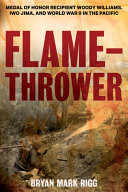
Flamethrower: Medal of Honor recipient Woody Williams, Iwo Jima, and World War II in the Pacific

Rigg, Bryan Mark
"Imagine strapping on a highly flammable 70-pound pack and entering combat as a surefire walking target-and you'd only begin to understand the job, and the horror, of Marine Corps flamethrower man. That's precisely what Hershel "Woody" Williams did in World War II, most importantly in February 1945 on Iwo Jima, one of the Pacific War's toughest battles. A few days into the battle, Marines were fighting hard for an airfield, and his captain asked Woody if he could do anything. He responded, "I'll try"-and for the next four hours, he virtually singlehandedly took on and ultimately destroyed seven enemy pillboxes and helped secure the airfield. Accomplished military historian Bryan Mark Rigg reconstructs Williams' remarkable story, from his youth in West Virginia to his experiences on Guadalcanal, Saipan, Guam, and most significantly Iwo Jima. In Rigg's telling, Williams's Medal of Honor action is not "just" a brave deed, but one of only a few strategically significant brave deeds-one that secured a strategic objective during a major campaign. Rigg tells Williams' story vividly, and objectively, and places it in the context of the broader Pacific theater of World War II."--
Stackpole Books 2020 544 pages

Casanova The World of a Seductive Genius

Laurence Bergreen
“Sexy, surprising, funny, insightful, and wildly entertaining” ( Huffington Post )—the definitive biography of Giacomo Casanova, the impoverished boy who became the famous writer, notorious libertine, and self-invented genius in decadent eighteenth-century Europe. Today, “Casanova” is a synonym for “great lover,” yet the real story of this remarkable figure is little known. A figure straight out of a Henry Fielding novel, Giacomo Casanova was erotic, brilliant, impulsive, and desperate for recognition; a self-destructive genius. Over the course of his lifetime, he claimed to have seduced more than one hundred women, among them married women, young women in convents, girls just barely in their teens, women of high and low birth alike. Abandoned by his mother, an actress and courtesan, Casanova was raised by his illiterate grandmother, coming of age in a Venice filled with spies and political intrigue. He was intellectually curious and read forbidden books, for which he was jailed. He staged a dramatic escape from Venice’s notorious prison, I Piombi, the only person known to have done so. He then fled to France, ingratiated himself at the royal court, and invented the national lottery that still exists to this day. He crisscrossed Europe, landing for a while in St. Petersburg, where he was admitted to the court of Catherine the Great. He corresponded with Voltaire and met Mozart and Lorenzo da Ponte—assisting them as they composed the timeless opera Don Giovanni . And he wrote what many consider the greatest memoir of the era, the twelve-volume Story of My Life . Laurence Bergreen’s Casanova recounts this astonishing life in rich, intimate detail, and at the same time, paints a dazzling portrait of eighteenth-century Europe, filled with a cast characters from serving girls to kings and courtiers, “great fun for any history lover” ( Kirkus Reviews ).
Simon & Schuster 2018-02-13 544 pages

The Second Oswald

Richard H. Popkin
Who killed Kennedy? Many keen minds have their doubts about the findings of the Warren Commission. Could Oswald have fired 3 shots in 5.6 seconds with the inaccurate rifle he had - and hit a moving target? Did he even kill patrolman Tippit (the bullets in the body were smaller than the barrel of his revolver)? Was the brown paper bag made only to attract attention? Was Bullet No. 399 a plant? Suppose there was a Second Oswald - a man very similar physically and an expert marksman? Such a man was seen both before and at the time of the murder. Was there a rifleman on the knoll as well as at the Book Depository window? If so this was one of the greatest - and most successful conspiracies of modern times... THE SECOND OSWALD has been called "the first plausible and significant argumentation on the Kennedy assassination." It takes into account the books by Edward J. Epstein, Mark Lane and Harold Weisberg. Too much was attempted too quickly. Professor Popkin believes that Lee Harvey Oswald may have been innocent and no more than a decoy in a plot to kill the President. His job may have been to divert suspicion and be arrested. A startling alternative to the 'Single Assassin' theory. For an author bio and photo, reviews and a reading sample, visit bosonbooks.com.
C & M Online Media, Incorporated 2008-03 152 pages

Conqueror of the Seas the Story of Magellan

Stefan Zweig
This work has been selected by scholars as being culturally important, and is part of the knowledge base of civilization as we know it. This work is in the "public domain in the United States of America, and possibly other nations. Within the United States, you may freely copy and distribute this work, as no entity (individual or corporate) has a copyright on the body of the work. Scholars believe, and we concur, that this work is important enough to be preserved, reproduced, and made generally available to the public. We appreciate your support of the preservation process, and thank you for being an important part of keeping this knowledge alive and relevant.
Creative Media Partners, LLC 2022-10-26 386 pages

Remembering America A Voice from the Sixties

Richard N. Goodwin
From the speechwriter and top adviser to presidents Kennedy and Johnson: A behind-the-scenes history of the most momentous decade in American politics. Richard N. Goodwin entered public service in 1958 as a law clerk for Supreme Court Associate Justice Felix Frankfurter. He left politics ten years later in the aftermath of Senator Robert F. Kennedy's assassination. Over the course of one extraordinary decade, Goodwin orchestrated some of the noblest achievements in the history of the US government and bore witness to two of its greatest tragedies. His eloquent and inspirational memoir is one of the most captivating chronicles of those turbulent years ever published. From the Twenty-One quiz-show scandal to the heady days of John F. Kennedy's presidential campaign to President Lyndon Johnson's heroic vote wrangling on behalf of civil rights legislation, Remembering America brings to life the most fascinating figures and events of the era. As a member of the Kennedy administration, Goodwin charted a new course for US relations with Latin America and met in secret with Che Guevara in Uruguay. He wrote Johnson's historic civil rights speech, "We Shall Overcome," in support of the Voting Rights Act of 1965 and formulated the concept of the Great Society and its programs, which sought to eradicate poverty and racial injustice. After breaking with Johnson over the president's commitment to the Vietnam War, Goodwin played a pivotal role in bringing antiwar candidate Eugene McCarthy to within a few hundred votes of victory in the 1968 New Hampshire primary. Three months later, he was with his good friend Robert F. Kennedy in Los Angeles the night that the young senator's life--and the progressive movement that had rapidly brought about such significant change--came to a devastating end. Throughout this critical decade, Goodwin held steadfast to the passions and principles that had first led him to public service. Remembering America is a thrilling account of the breathtaking victories and heartbreaking disappointments of the 1960s, and a rousing call to action for readers committed to justice today.
Open Road Integrated Media, Incorporated 2014-09-30 828 pages