911 results for "History"

Legacy: one family, a cup of tea and the company that took on the world

Harding, Thomas
A panoramic new history of modern Britain, as told through the story of one extraordinary family, and one groundbreaking company. In the early 1800s, Lehmann Gluckstein and his family escaped the pogroms of Eastern Europe and made their way to Whitechapel in London's East End. There, starting with nothing, they worked tirelessly to pull themselves out of poverty, creating a small tobacco factory that grew to become the largest catering company in the world: J. Lyons. For over a century, Lyons was on every high street, in every home, in every coffee and teacup. It was an ascent from rags to riches in the face of many obstacles: poverty, hatred and anti-Semitism stood between this poor immigrant family and the British Dream. Legacy charts the rise and fall of one of the most influential dynasties in British history through the lives of five astonishing generations. Both sweeping and intimate, it is a story of sacrifice and selflessness, betrayal and personal tragedy, and Empire and its cost. It is also an illuminating new exploration of Britain and its place in the world, from the bestselling author of Hanns and Rudolf and The House by the Lake.
William Heinemann 2019 561 pages

Opening the great depths: the bathyscaph Trieste and pioneers of undersea exploration

Polmar, Norman,Mathers, Lee J.
Developed by French physicist Auguste Piccard and his son Jacques, the bathyscaph Trieste was a scientific marvel that allowed unprecedented scientific, technical, and military feats in the ocean depths. France and the United States both acquired and subsequently developed variants of the original bathyscaph. While both France and the United States employed the bathyscaph as a tool for scientific investigation of the deepest ocean depths, the U.S. Navy developed and employed the Trieste for military missions as well. From its earliest years, participants in the Trieste program realized that they were making history, blazing a trail into previously unexplored and unexploited depths, developing new capabilities and opening a new frontier. Comparisons with developments in space and the space-race between the United States and the Soviet Union often were made concerning the Trieste program and contemporary developments in undersea technologies and capabilities. The Trieste opened the entire oceans to exploration, exploitation, and operations. The bathyscaph was a first-generation system, a Model-T that spawned an entirely new industry and encouraged new concepts for deep-ocean naval operations. Advances in deep-sea technologies lacked the gee-whiz factor of the concurrent space race, but were highly significant in the development of new technology, new knowledge, and new military capabilities. Opening the Great Depths is the story of the three Trieste deep-ocean vehicles, their officers and enlisted men, and the civilians, often told in their own words, documenting for the first time the earliest years of humanity's probing into Earth's final frontier.
Naval Institute Press 2021 359 pages

The cruel years: American voices at the dawn of the twentieth century

William Loren Katz,Laurie R. Lehman
The Cruel Years provides readers with a vivid picture of what life was like a hundred years ago, not for the rich and famous but for ordinary working Americans. The story is told in the words of twenty-two fascinating people who lived by laboring long hours at farms and factories and mines. A preface by Howard Zinn and an introduction by William Loren Katz provide an easy-to-follow historical map that places these hard-hitting, first-person narratives in the context of their troubled times and within the larger picture of U.S. growth and development. Here are the no-nonsense words of a young immigrant trying to survive as a sweatshop operator in New York City, a hard working farmer's wife who has writing ambitions; a black southern sharecropper seeking fulfillment under a new system of slavery; a young Puerto Rican passing the Statue of Liberty and ready for new challenges; a Chinese immigrant, a Mexican immigrant, and a Japanese immigrant struggling to rise from lower rungs on the social and economic ladder; an Irish girl of sixteen deciding to become a political agitator; a black southern woman trying to fend off the hurts of Jim Crow; a coal miner telling of the lethal dangers of his work; and a black cowhand rejoicing in the thrill of the cattle trails.
Beacon Press 2003-04-15 274 pages

The year I was Peter the Great

Kalb, Marvin L.
The year 1956 was an extraordinary year in modern Russian history. It was called "the year of the thaw"--a time when Stalin's dark legacy of dictatorship died in February only to be reborn later that December. This historic arc from rising hope to crushing despair opened with a speech by Nikita Khrushchev, then the unpredictable leader of the Soviet Union. He astounded everyone by denouncing the one figure who, up to that time, had been hailed as a "genius," a wizard of communism--Josef Stalin himself. Now, suddenly, this once unassailable god was being portrayed as a "madman" whose idiosyncratic rule had seriously undermined communism and endangered the Soviet state. This amazing switch from hero to villain lifted a heavy overcoat of fear from the backs of ordinary Russians. It also quickly led to anti-communist uprisings in Eastern Europe, none more bloody and challenging than the one in Hungary, which Soviet troops crushed at year's end. Marvin Kalb, then a young diplomatic attaché at the U.S. Embassy in Moscow, observed this tumultuous year that foretold the end of Soviet communism three decades later. Fluent in Russian, a doctoral candidate at Harvard, he went where few other foreigners would dare go, listening to Russian students secretly attack communism and threaten rebellion against the Soviet system, traveling from one end of a changing country to the other and, thanks to his diplomatic position, meeting and talking with Khrushchev, who playfully nicknamed him Peter the Great. In this, his fifteenth book, Kalb writes a fascinating eyewitness account of a superpower in upheaval and of a people yearning for an end to dictatorship
The Brookings Institution 2017-10-10 290 pages

A modern heretic and a traditional community: Mordecai M. Kaplan, Orthodoxy, and American Judaism

Gurock, Jeffrey S.
Mordecai M. Kaplan, the founder of the Reconstructionist movement, was the most influential and controversial radical Jewish thinker in the twentieth century. This book follows Kaplan from his earliest days as a member the New York Orthodox community, through his period of private estrangement, into his public divorce from Orthodoxy and ultimately through his many decades as reconstructionism's leader. The book is also a social history of American Orthodoxy and American Judaism over the last century.
Columbia University Press 1997 220 pages

The work of mourning

Derrida, Jacques
Jacques Derrida is, in the words of the New York Times , "perhaps the world's most famous philosopher—if not the only famous philosopher." He often provokes controversy as soon as his name is mentioned. But he also inspires the respect that comes from an illustrious career, and, among many who were his colleagues and peers, he inspired friendship. The Work of Mourning is a collection that honors those friendships in the wake of passing. Gathered here are texts—letters of condolence, memorial essays, eulogies, funeral orations—written after the deaths of well-known figures: Roland Barthes, Paul de Man, Michel Foucault, Louis Althusser, Edmond Jabès, Louis Marin, Sarah Kofman, Gilles Deleuze, Emmanuel Levinas, Jean-François Lyotard, Max Loreau, Jean-Marie Benoist, Joseph Riddel, and Michel Servière. With his words, Derrida bears witness to the singularity of a friendship and to the absolute uniqueness of each relationship. In each case, he is acutely aware of the questions of tact, taste, and ethical responsibility involved in speaking of the dead—the risks of using the occasion for one's own purposes, political calculation, personal vendetta, and the expiation of guilt. More than a collection of memorial addresses, this volume sheds light not only on Derrida's relation to some of the most prominent French thinkers of the past quarter century but also on some of the most important themes of Derrida's entire oeuvre-mourning, the "gift of death," time, memory, and friendship itself. "In his rapt attention to his subjects' work and their influence upon him, the book also offers a hesitant and tangential retelling of Derrida's own life in French philosophical history. There are illuminating and playful anecdotes—how Lyotard led Derrida to begin using a word-processor; how Paul de Man talked knowledgeably of jazz with Derrida's son. Anyone who still thinks that Derrida is a facetious punster will find such resentful prejudice unable to survive a reading of this beautiful work."—Steven Poole, Guardian "Strikingly simpa meditations on friendship, on shared vocations and avocations and on philosophy and history."— Publishers Weekly
University of Chicago Press 2003-09-15 262 pages

Jacob's cane: a Jewish family's journey from the four lands of Lithuania to the ports of London and Baltimore

New, Elisa
Drawn to an image of her great-grandfather's ornately carved cane, scholar Elisa New embarked on a journey to discover the origins of her precious family heirloom. Treading back across the paths of her ancestors, she travels from Baltimore to the Baltic to London in order to find and understand an immigrant world profoundly affected by modern German culture, from the Enlightenment through the Holocaust. Deeply ambitious in its narrative sweep, Jacob's Cane captures the rich texture of life on several continents as New's family searches to establish itself in the tobacco trade. A fascinating history of one family's story of progress, innovation, and struggle, Jacob's Cane will change the way we think about the Jewish American experience.
Basic Books 2009-09-22 328 pages

The best American history essays on Lincoln

Sean Wilentz,Organization of American Historians
This new volume in the Best American History Essays series brings together classic writing from top American historians on one of our greatest presidents. Ranging from incisive assessments of his political leadership, to explorations of his enigmatic character, to reflections on the mythos that has become inseparable from the man, each of these contributions expands our understanding of Abraham Lincoln and shows why he has been such an object of enduring fascination. Contributions include:* James McPherson on Lincoln the military strategist* Richard Hofstadter on the Lincoln legend* Edmund Wilson on his contribution to American letters* John Hope Franklin on the Emancipation Proclamation* James Horton on Lincoln and race* David M. Potter on the secession* Richard Current on Lincoln's political genius* Mark Neely on Lincoln and civil liberties
Palgrave Macmillan 2009-02-13 252 pages

John Turner: an intimate biography of Canada's 17th prime minister

Paikin, Steve
One of the most glamorous and successful politicians in Canadian history In this masterful and engaging biography, acclaimed journalist Steve Paikin brings to life John Turner (1929-2020), one of the most glamorous and successful politicians in Canadian history. Born in England, raised in BC, Turner was a champion sprinter and a Rhodes scholar who captured the national imagination as escort for Princess Margaret on her 1959 Canadian tour. Elected to Parliament in 1962, he served in Prime Minister Lester Pearson's cabinet and as Pierre Trudeau's attorney general, minister of justice, and finance minister. In 1984, he won a hotly-contested Liberal leadership contest and served a brief four months as Canada's seventeenth prime minister before falling to Brian Mulroney in a Progressive Conservative landslide. In this surprisingly candid and personal book, Paikin draws on unprecedented access to Turner's personal and public papers to show how he struggled to meet the towering expectations that came with his abundant gifts, and keep his faith in Canadian democracy despite the challenges of his own career.
Sutherland House Books 2022-11-15 337 pages

Loud and clear: the memoir of an Israeli fighter pilot

Spector, Iftach
A recently retired Israeli Air Force general and its second-highest-scoring fighter ace, Iftach Spector is one of Israel’s living legends. He was the leader of the flight that attacked the USS Liberty in 1967. After the 1967 and 1973 wars, in which he commanded a squadron of fighter-bombers, he rose to head the IAF’s Training and War Lessons Section and later became its the Chief of Operations. He was one of the eight Israeli pilots who attacked Saddam Hussein’s nuclear reactor at Osirik in 1981. In 2003, his career took an even more dramatic turn: he was the senior signatory of the famous “Pilots’ Letter,” in which Spector and 27 other Israeli pilots stated their refusal to bomb targets in Palestine where collateral damage would likely be severe. His maverick conscience is well on display in this artfully written memoir, which is currently a 10-week-and-counting bestseller in Israel and has been licensed in Brazil as well. The son of a family that immigrated to Palestine at the turn of the 20th century, whose father and mother served in the Palmach, Israel’s early clandestine commando force, Spector has written a rich and reflective meditation on loyalty, on what is right and wrong in war, and on his dedication to the idea and reality of the state of Israel. The Pilots’ Letter ended Spector’s military career, but also made him one of the most compelling and celebrated defenders of the conscience of the Jewish state. In that battle, as in his previous battles against Nasser’s MiGs, his mother’s constant lesson to him sustained him: “All from within.” General Spector’s first book, A DREAM IN BLACK AND AZURE (1992; never translated into English), won the Sade Literary Award, given to him personally by Prime Minister Yitzhak Rabin. He has a B.A. in history and Middle East Studies from Tel Aviv University and a masters in political science from UCLA, both with honors.
Zenith Press 2009-06-15 426 pages

Yoshimasa and the Silver Pavilion: the creation of the soul of Japan

Keene, Donald
During Yoshimasa's reign, the aesthetic taste of the Japanese was shaped: the n› theater flourished, Japanese gardens were developed, and the tea ceremony had its origins in a small room at the Silver Pavilion. Flower arrangement, ink painting, and shoin-zukuri architecture began or became of major importance under Yoshimasa. Poets introduced their often barely literate warlord-hosts to the literary masterpieces of the past and taught them how to compose poetry. Even the most barbarous warlord came to want the trappings of culture that would enable him to feel like a civilized man. This long-neglected but critical period in Japanese history at last has the thorough treatment it deserves.
Columbia University Press 2006-02-22 224 pages

Napoleon: a concise biography

Bell, David A.
This book provides a concise, accurate, and lively portrait of Napoleon Bonaparte's character and career, situating him firmly in historical context. David Bell emphasizes the astonishing sense of human possibility--for both good and ill--that Napoleon represented. By his late twenties, Napoleon was already one of the greatest generals in European history. At thirty, he had become absolute master of Europe's most powerful country. In his early forties, he ruled a European empire more powerful than any since Rome, fighting wars that changed the shape of the continent and brought death to millions. Then everything collapsed, leading him to spend his last years in miserable exile in the South Atlantic. Bell emphasizes the importance of the French Revolution in understanding Napoleon's career. The revolution made possible the unprecedented concentration of political authority that Napoleon accrued, and his success in mobilizing human and material resources. Without the political changes brought about by the revolution, Napoleon could not have fought his wars. Without the wars, he could not have seized and held onto power. Though his virtual dictatorship betrayed the ideals of liberty and equality, his life and career were revolutionary.
Oxford University Press 2015 139 pages

Life so far

Friedan, Betty
At last Betty Friedan herself speaks about her life and career. With the same unsparing frankness that made The Feminine Mystique one of the most influential books of our era, Friedan looks back and tells us what it took -- and what it cost -- to change the world. Betty Friedan's The Feminine Mystique, published in 1963, started the women's movement; it sold more than four million copies and was recently named one of the one hundred most important books of the century. In Life So Far, Friedan takes us on an intimate journey through her life -- a lonely childhood in Peoria, Illinois; salvation at Smith College; her days as a labor reporter for a union newspaper in New York (from which she was dismissed when she became pregnant); unfulfilling and painful years as a suburban housewife; finding great joy as a mother; and writing The Feminine Mystique, which grew out of a survey of her Smith classmates and started it all. Friedan chronicles the secret underground of women in Washington, D.C., who drafted her in the early 1960s to spearhead an "NAACP" for women, and recounts the courage of many, including some Catholic nuns who played a brave part in those early days of NOW, the National Organization for Women. Friedan's feminist thinking, a philosophy of evolution, is reflected throughout her book. She recognized early that the women's movement would falter if institutions did not change to reflect the new realities of women's lives, and she fought to keep the movement practical and free of extremism, including "man-hating." She describes candidly the movement's political infighting that brought her to the point of legal action and resulted in a long breach with fellow leaders Gloria Steinem and Bella Abzug. Friedan is frank about her twenty-two-year marriage to Carl Friedan, an advertising entrepreneur. She writes about the explosive cycle of drinking, arguing, and physical battering she endured and explores her prolonged inability to leave the marriage. (They are now friends and the grandparents of nine.) Friedan was not only pivotal in the founding of NOW, she was also the driving force behind the creation of the National Abortion and Reproductive Rights Action League (NARAL), the National Women's Political Caucus (NWPC), and the First Women's Bank and Trust Company. She made history by introducing the issue of sex discrimination as an argument against the ratification of a Supreme Court nominee. She convinced the Secretary General of the United Nations to declare 1975 the International Year of the Woman. In this volume, Friedan brings to extraordinary life her bold and contentious leadership in the movement. She lectures, writes, leads think tanks, and organizes women and men to work together in political, legal, and social battles on behalf of women's rights. It is exactly this breadth of vision that makes Friedan's memoir an important and compelling work.
Simon & Schuster 2000-05-10 399 pages

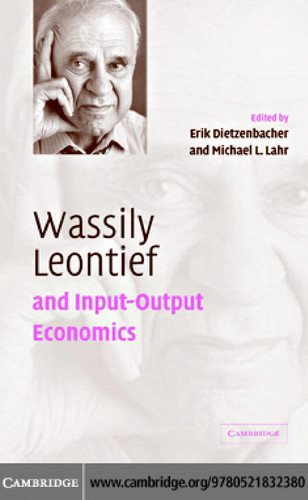
Wassily Leontief and input-output economics

Wassily Leontief,Erik Dietzenbacher,Michael L. Lahr
Wassily Leontief (1905–1999) was the founding father of input-output economics, for which he received the Nobel Prize in 1973. This book offers a collection of papers in memory of Leontief by his students and close colleagues. The first part, 'Reflections on Input-Output Economics', focuses upon Leontief as a person and scholar as well as his personal contributions to economics. It includes contributions by Nobel Laureate Paul A. Samuelson who shares his memories of a young Professor Leontief at Harvard and ends with the last joint interview with Wassily and his wife, to date previously unpublished. The second part, 'Perspectives of Input-Output Economics', includes theoretical and empirical research inspired by Leontief's work and offers a wide-ranging sample of the state of interindustry economics, a field Leontief founded. This is a strong collection likely to appeal to a wide range of professionals in universities, government, industry and international organizations.
Cambridge University Press 2004-03-25 396 pages

Generation exodus: the fate of young Jewish refugees from Nazi Germany

Laqueur, Walter
Relates the multiple ways adopted by young German Jews (born mainly between 1914-28) to escape from Nazi Germany. Their destinations included Palestine, Great Britain, the USA, South America, and China. Dwells on the routes of escape - sometimes dangerous, and on the organizational framework of the escape - sometimes part of a political underground. Some young persons managed to survive in Germany. Many Jews, both those who escaped and those who remained in Germany, joined the anti-Nazi struggle in multiple forms - from the underground in Berlin to joining up with the Red Army. Many countries of destination were reluctant to accept the refugees, in part due to antisemitism. Other possible frameworks (e.g. communists) were also not eager to help Jews. The majority of the émigrés did not return to Germany after the war.
Brandeis University Press, Published by University Press of New England 2001 345 pages

Speaking freely: my life in publishing and human rights

Bernstein, Robert L.,Merlino, Doug
What do Dr. Seuss, William Faulkner, Toni Morrison, Andrei Sakharov, and James Michener have in common? They were all published by Bob Bernstein during his twenty-five-year run as president of Random House, before he brought the dissidents Liu Binyan, Jacobo Timerman, Natan Sharansky, and Václav Havel to worldwide attention in his role as the father of modern human rights. Starting as an office boy at Simon & Schuster in 1946, Bernstein moved to Random House in 1956 and succeeded Bennett Cerf as president ten years later. The rest is publishing and human rights history. In a charming and self-effacing work, Bernstein reflects for the first time on his fairy tale publishing career, hobnobbing with Truman Capote and E.L. Doctorow; conspiring with Kay Thompson on the Eloise series; attending a rally for Random House author George McGovern with film star Claudette Colbert; and working with publishing luminaries including Dick Simon, Alfred Knopf, Robert Gottlieb, André Schiffrin, Peter Osnos, Susan Peterson, and Jason Epstein as Bernstein grew Random House from a $40 million to an $800 million-plus "money making juggernaut," as Thomas Maier called it in his biography of Random House owner Si Newhouse. In a book sure to be savored by anyone who has worked in the publishing industry, fought for human rights, or wondered how Theodor Geisel became Dr. Seuss, Speaking Freely beautifully captures a bygone era in the book industry and the first crucial years of a worldwide movement to protect free speech and challenge tyranny around the globe.
The New Press 2016 341 pages