692 results for "History"

Early rabbinic writings

Maccoby, Hyam
Rabbinic texts are often cited in New Testament and Old Testament studies, but hitherto there has been no easy way for a student to grasp the scope and variety of the relevant rabbinic writings. This book introduces the student to the full range of the early rabbinic writings, with a thorough introduction and notes, so that both a bird's eye view of the literature as well as close aquaintance with typical and important texts can be obtained. This will enable the reader to embark on further study with a clearer orientation. The book also aims to correct many mistaken views about rabbinic Judaism arising from outdated conceptions of the relation between Christianity and Judaism.
Cambridge University Press 1988-05-12 245 pages

Identity papers: contemporary narratives of American Jewishness

Meyers, Helene
Identity Papers argues that contemporary Jewish American literature revises our understanding of Jewishness and Jewish difference. Moving beyond the reductive labeling of texts and authors as “too Jewish” or “not Jewish enough,” and focusing instead on narratives that portray Jewish regeneration through feminist Orthodoxy, queerness, off-whiteness, and intermarriage, Helene Meyers resists a lachrymose view of contemporary Jewish American life. She argues that such gendered, sexed, and raced debates about Jewish identity become opportunities rather than crises, signs of creative potential rather than symptoms of assimilation and deracination. Thus, feminist debates within Orthodoxy are allied to Jewish continuity by Rebecca Goldstein, Allegra Goodman, and Tova Mirvis; the geography of Jewish identity is racialized by Alfred Uhry, Tony Kushner, and Philip Roth; and the works of Jyl Lynn Felman, Judith Katz, Lev Raphael, and Michael Lowenthal queer the Jewish family as they reveal homophobia to be an abomination. Even as Identity Papers expands Jewish literary horizons and offers much-needed alternatives to the culture wars between liberal and traditional Jews, it argues that Jewish difference productively troubles dominant narratives of feminist, queer, and whiteness studies. Meyers demonstrates that the evolving Jewish American literary renaissance is anything but provincial; rather, it is engaged with categories of difference central to contemporary academic discourses and our national life.
SUNY Press 2012-07-02 239 pages

Tales of the neighborhood: Jewish narrative dialogues in late antiquity

Hasan-Rokem, Galit
In this lively and intellectually engaging book, Galit Hasan-Rokem shows that religion is shaped not only in the halls of theological disputation and institutions of divine study, but also in ordinary events of everyday life. Common aspects of human relations offer a major source for the symbols of religious texts and rituals of late antique Judaism as well as its partner in narrative dialogues, early Christianity, Hasan-Rokem argues. Focusing on the "neighborhood" of the Galilee that is the birthplace of many major religious and cultural developments, this book brings to life the riddles, parables, and folktales passed down in Rabbinic stories from the first half of the first millennium of the Common Era.
University of California Press 2003-02-06 208 pages

Conversations with My Body Essays on My Life as a Jewish Woman

Elana Sztokman
Elana Sztokman arrived in Israel in 1993 as a young religious mother wearing a long skirt and a hat covering her hair. Today, nearly 30 years later, after spending years fighting for women's rights in Orthodoxy, writing books about gender in religion, and eventually leaving that world behind, she confronts the personal struggles behind the public persona, revealing the traumas from her past that affected her entire relationship with her body. From two-time winner of the National Jewish Book Council Award comes a refreshing and very personal exploration of cultures of the female body in Jewish life. This collection of essays - marking the 25-year anniversary of her feminist awakening and spanning a diverse career of research, writing, and advocacy around Jewish women's experiences - offers political and personal insights and retrospectives on some of the most burning issues today. Topics include: sexuality, relationships, body-image, body-cover, ritual immersion, fat-shaming, slut-shaming, domestic violence, and sexual abuse. Elana brings her characteristic honesty, courage, wit, and profound insight into her writing, and shares some of her own traumas that set her on a sometimes tortuous life path.
Lioness Books 2022-09 362 pages

Jewish-Christian Dialogue: Jewish Justification

Novak, David
Many studies written about the Jewish-Christian relationship are primarily historical overviews that focus on the Jewish background of Christianity, the separation of Christianity from Judaism, or the medieval disputations between the two faiths. This book is one of the first studies to examine the relationship from a philosophical and theological viewpoint. Carefully drawing on Jewish classical sources, Novak argues that there is actual justification for the new relationship between Judaism and Christianity from within Jewish religious tradition. He demonstrates that this new relationship is possible between religiously committed Jews and Christians without the two major impediments to dialogue: triumphalism and relativism. One of the very few books on this topic written by a Jewish theologian who speaks specifically to modern Christian concerns, it will provide the groundwork for a more serious development of Jewish-Christian dialogue in our day.
Oxf. U. P. (N. Y.) 1992 194 pages

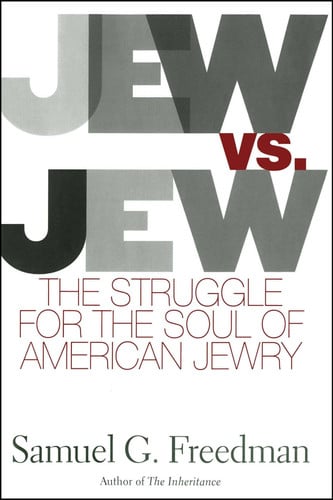
Jew Vs Jew The Struggle For The Soul Of American Jewry

Samuel G. Freedman
At a time when American Jews should feel more secure and cohesive than ever, civil war is tearing apart their community. Congregations, neighborhoods, even families are taking sides in battles about Jewish identity and Jewish authenticity. The conflict pits fundamentalist against secularist, denomination against denomination, even liberal against conservative within each branch of Jewry. Jew vs. Jew tells the story of how American Jewry has increasingly -- and perhaps terminally -- broken apart in the last forty years. Jew vs. Jew stretches in time from 1960 to 2000. It travels the country from Florida to New England, from Los Angeles to the Catskills in New York, from Cleveland to Denver, and it also crosses the ocean to Israel to show how tensions within the Jewish state inflame those among American Jews. The flash-points range from conversion standards to the role of women, from the peace process in Israel to the sexual climate on an Ivy League campus. But behind them all, as Samuel Freedman writes, lie common causes. First, far from unifying American Jews, Israel now divides them on both political and religious grounds. Second, neither America nor the larger world presents Jews with a single enemy against whom to coalesce. Third, and most important, nothing in the Jewish history of persecution, oppression, and exile prepared the Chosen People for the challenge posed by America, the challenge of being absorbed into a tolerant and diverse nation, being accepted so thoroughly that the intermarriage rate tops 50 percent. Jew vs. Jew introduces readers to memorable places and characters. Freedman describes one of the final summers at a Labor Zionist camp in the Catskills whose brand of secular Jewishness is becoming obsolete because Zionism succeeded in creating Israel. He tells the story of Orthodox and Reform Jews in a Cleveland suburb who are fighting about the construction of several synagogues -- and, on a deeper level, about whether unity or pluralism ought to be the goal of Jewish life. He portrays a Florida Jew so violently opposed to the Oslo peace accords that he planted a bomb in a synagogue where Shimon Peres was speaking. He tells about a Los Angeles congregation that spent three years debating whether or not to honor the Biblical matriarchs in its liturgy.We come to know the Long Island neighbors who cannot tolerate sharing even a property line because their versions of Jewish identity are so irreconcilably different. Jew vs. Jew is a work of vigorous reporting, lucid writing, and intellectual curiosity. And even as it chronicles an embittered and polarized community, it refuses to take sides or pass judgment. Instead, with compassion and acuity, Jew vs. Jew bears witness.
Simon & Schuster 2007-09-21 400 pages

The philosophy of Chabad

Mindel, Nissan
Few luminaries in Jewish history, particularly in modern times, have made such a lasting and profound contribution to our spiritual heritage as Rabbi Schneur Zalman of Liadi (1745-1812). His works embrace the entire spectrum of Jewish thought - mysticism, philosophy, psychology, ethics and law - and represent an expression of unparalled creative genius.This richly detailed biography traces Rabbi Schneur Zalman's life from his childhood and formative years to his trials and triumph as a leader who revolutionized Jewish life. It reveals many hitherto unknown facts, and offers the reader considerable insight into his extraordinary strength of character. Vilified by many of his contemporaries and arrested by the Czar, Rabbi Schneur Zalman emerged victorious; today his teachings continue to inspire and vitalize Jewish life all over the world.
Chabad Research Center, Kehot Publication Society 1985 255 pages

Judaism and the challenges of modern life

Moshe Halbertal,Donniel Hartman
Much more than a particular period in world history, modernity has fundamentally transformed how we think and live, and especially how we understand and relate to religious traditions. As the 'ghetto walls' have fallen, both empirically and metaphorically, Judaism is compelled to compete in an open marketplace of ideas. Jews can no longer count on an assumedly necessary Jewish identity or commitment, nor on the rallying force of anti-Semitism to ensure an individual and collective sense of belonging. Rather Jewish moral, spiritual and historical values and ideas must be read with new eyes and challenged to address modernity's proliferating array of questions and realities. The pertinent questions modern Jewry faces are how to embrace modernity as Jews and what such an embrace means for the meaning and future of Jewish life. This collection of essays, authored by scholars of the Shalom Hartman Institute, addresses three critical challenges posed to Judaism by modernity: the challenge of ideas, the challenge of diversity, and the challenge of statehood, and provides insights and ideas for the future direction of Judaism. Providing readers with new insights into Judaism and the Jewish people in contemporary times, the collection explores a wide range of issues that includes: the significance of Israel for the future of Judaism; the Jewish people as a people; the relationship between monotheism and violence; revelation and ethics; Judaism and the feminist challenge; and Judaism and homosexuality.
Continuum 2007-12-11 192 pages

Mind, body and Judaism: the interaction of Jewish law with psychology and biology

David Shatz,Joel B. Wolowelsky
Sovereignty over the Temple Mount in Jerusalem is one of the most difficult problems in the ongoing Israeli-Palestinian conflict. Although it is a present-day bone of contention, its roots go back into the distant past. Israelites, Christians, and Muslims had fought over this holy site, and built on it a succession of shrines. The book leads the reader into the intricate history, geography, and politics of this unique site. It relates the roots of its holiness, describes the succession of temples built on it, and explains how in the twentieth century its sanctity become interwined with the national aspirations of both Jews and Arabs. It explains why the Temple Mount is considered the holiest site for the Jews, and how it became holy also to the Muslims. The book also explores the role of evangelical Christians, who, alongside a segment of the Jewish population, see the Temple Mount as the center of messianic aspirations, fed by the myriad of Jewish, Christian, and Muslim legends and myths which evolved around it. The book is richly illustrated with photographs, sketches, maps, and plans.
Michael Scharf Publication Trust of Yeshiva University Press 2004 257 pages

Judaism The Evidence of the Mishnah

Jacob Neusner
Jacob Neusner has--in over sixty scholarly works, fourteen textbooks, and thirteen collections of essays--laid the foundation and completed the structure for a new understanding of the history of Judaism. The present volume is the capstone effort to date in this endeavor. Neusner reconstructs and interprets the Mishnah's intellectual history, presenting a picture of the beginnings and first major expression of Judaism. "What makes this account distinctively historical," writes Neusner in his Introduction, "will be our sustained effort to relate the unfolding of the ideas of the Mishnah to the historical setting of the philosophers of the document, to compare context and concept, to ask about the interplay between idea and social, material reality." Neusner succeeds in this specific task and in the greater task of providing a work with methodological significance for the entire field of the history of religions.
Wipf and Stock Publishers 2003-09-26 440 pages

Confronting Creation How Judaism Reads Genesis

Jacob Neusner
By setting forth the book of Genesis as it is re-presented in the rabbinic statement Genesis Rabbah, Neusner demonstrates the way in which Judaism confronted creation and the Genesis story. In 'Confronting Creation', the author presents a new, analytical translation of Genesis Rabbah, a document that came to closure around 400 C.E. What made that particular time crucial in the life of Israel and the Jewish people is an event that also helped shape the entire history of Western civilization - the rise of Christianity to the status of the official religion of the Roman Empire. The Judaic sages' rereading of the Torah's accounts of the beginning of the world and of Israel took place during a time of significant change in Western civilization. That fact explains the importance of this reading of Genesis to Western civilization, because Genesis Rabbah illuminates the Judaic tradition in contemplating God's creation of the world.
Wipf and Stock Publishers 2004-06-15 400 pages

The Jew and the other

Benbassa, Esther
In the current situation of polarization in the Middle East, it is easy to lose sight of the fact that a long tradition of dialogue and openness toward the "Other" exists in many strands of Jewish thought. Himself or herself the quintessential Other in a world in which she or he has existed dispersed, in exile, as a minority, the Jew has consistently envisioned the self in relation to surrounding societies. Esther Benbassa and Jean-Christophe Attias show that alterity is a useful and morally compelling notion with which to structure Judaism's historically specific and politically charged encounters with deity, femininity, the Christian West, and the Muslim East. In Benbassa and Attias's view, the Other may be rejected, but it is also a mirror, both reminding the Jew of ethical duties and constituting a source of temptation and danger. Sometimes, the authors find, the Other is the enemy. They note that it is with the enemy that peace is made, peace with the Other and peace with the self. The Jew and the Other , which is an extended commentary on a dozen Biblical verses and which follows the five books of the Pentateuch, offers the history of that encounter as an inextricable part of the Jewish condition and is itself a meditation on this encounter.
Cornell University Press 2004 157 pages

The heart of the matter: studies in Jewish mysticism and theology

Green, Arthur
Judaism, like all the great religions, has a strand within it that sees inward devotion, the opening of the human heart to God’s presence, to be the purpose of its entire edifice of praxis, liturgy, and way of life. This voice is not always easy to hear in a tradition where so much attention is devoted to the how rather than the why of religious living. The devotional claim, certainly a key part of Judaism’s biblical heritage, has reasserted itself in the teachings of individual mystics and in the emergence of religious movements over the long course of Jewish history. This volume represents Arthur Green’s own quest for such a Judaism—as a rabbi, as a scholar, and as a contemporary seeker. This collection of essays brings together Green’s scholarly writings, centered on the history of early Hasidism, and his highly personal approach to a rebirth of Jewish spirituality in our own day. In choosing to present them in this way he asserts a claim that they are all of a piece. They represent one man’s attempt to wade through history and text, language and symbol, and an array of voices both past and present while always focusing on the essential questions: “What does it mean to be a religious human being, and what does Judaism teach us about how to be one?” This, the author considers to be the heart of the matter.
The Jewish Publication Society 2015-04-01 366 pages

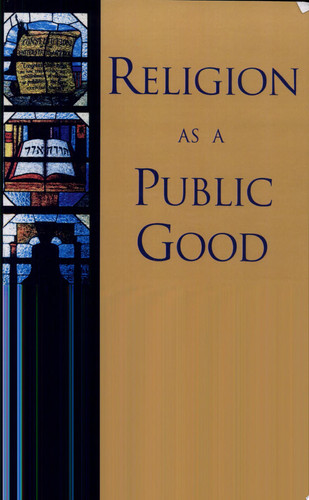
Religion as a public good: Jews and other Americans on religion in the public square

Alan Mittleman
Religion as a Public Good: Jews and Other Americans on Religion in the Public Square explores the often controversial topic of how religion ought to relate to American public life. The sixteen distinguished contributors, both Jewish and Christian, reflect on the topic out of their own disciplines-social ethics, political theory, philosophy, law, history, theology, and sociology. and take a stand based on their religious convictions and political beliefs. The volume is at once scholarly and committed, polemic and civil, reflective and activist. Written in the shadow of 9/11, it invites a new consideration of how religion enhances democratic public life with full awareness of the dangers that religion can sometimes pose. The volume is polemical, as befits the topic, but also civil, as befits a dialogue about an issue of profound significance for democratic citizenship.
Rowman & Littlefield 2003-12-09 336 pages

Holiness in Jewish thought

Alan Mittleman
Holiness is a challenge for contemporary Jewish thought. The concept of holiness is crucial to religious discourse in general and to Jewish discourse in particular. "Holiness" seems to express an important feature of religious thought and of religious ways of life. Yet the concept is ill defined. This collection explores what concepts of holiness were operative in different periods of Jewish history and bodies of Jewish literature and offers preliminary reflections on their theological and philosophical import today. The contributors illumine some of the major episodes concerning holiness in the history of the development in the Jewish tradition. They are challenged to think about the problems and potential implicit in Judaic concepts of holiness, to make them explicit, and to try to retrieve the concepts for contemporary theological and philosophical reflection. Not all of the contributors push into philosophical and theological territory, but they all provide resources for the reader to do so. Holiness is elusive but it need not be opaque. This volume makes Jewish concepts of holiness lucid, accessible, and intellectually engaging.
Oxford University Press 2018 241 pages

Jewish Theology Systematically and Historically Considered

Kaufmann Kohler
"The most important book on Jewish learning of this season, and one of the leading works published within the past few years....The work is a pioneer of its kind, in English as well as in other languages, in so far as it is a 'systematic' study of the subject....All other attempts made hitherto by German and other Jewish scholars at a presentation of Jewish theology have been of a limited scope....Kohler, on the other hand, through writing from the standpoint of the Reformer, does not refrain from giving the viewpoint of Orthodox or Conservative Judaism, which he endeavors to present fairly, howsoever much he disagrees with it....And never does Dr. Kohler better sustain his reputation as a scholar, nor use his vast learning to greater advantage, than in this splendid compendium of Jewish theology....Kohler's work covers the entire range of Jewish theological development, thus justifying its claim that it is a 'systematic' exposition of the subject where other works of a like nature dealt only with a partial survey. A mere glance at the table of contents reveals the immensity of the task performed, while a careful study of the book itself shows that the work is not only all-inclusive and exhaustive, but that it was executed with a charm and grace seldom to be met with in a work of so 'dry' a nature....The book is a truly valuable contribution to the treasure-house of Jewish learning for which its eminent author deserves the gratitude of the Jewish community. It is a book which will be read with pleasure and profit by student and layman alike." -The American Jewish Chronicle "In truth, Dr. Kohler's extended work of Jewish theology, the first of its kind, is an epoch-making contribution not only in the field of Jewish theological study, but also in the larger field of the study of comparative religion. Judging by the many favorable and even enthusiastic criticisms with which the book was received by scholars in the non-Jewish world, we are justified in believing that this work was, and will be instrumental in no small degree in correcting the utterly vicious and false view of Jewish theology, broadcasted in Christian circles.... Father Time often rectifies the encomiastic estimates made of living men so that men who were exalted in their day sink into insignificance and sometimes into oblivion with the passing of those who knew them. In the case of Dr. Kohler, I believe, that we may say, even now, that in the light of his signal and path-finding contributions in the field of Jewish scholarship, his eminence as a scholar in Israel will not be fugitive." -Hebrew Union College Monthly "Of all branches of Jewish study theology was hitherto the most neglected one. While here and there articles were written dealing with certain theological problems, no comprehensive book covering the entire field of Jewish theology and presenting a systematic treatment of the fundamental beliefs and doctrines of Judaism has heretofore appeared. Dr. Kohler's book is the first attempt in this direction....The method of Dr. Kohler in treating the subject of Jewish theology is a very excellent one and should be take as a starting point by future writers on the subject. He divides the subject into three parts God, where all questions relating to God, his nature and relation to the world are discussed; Man, dealing with man's relation to God and the world; and Israel and the Kingdom of God, describing the Jewish Mission and the destiny of Israel in history...The great scholarship displayed in it, the warmth and enthusiasm, the beautiful and simple style...and the zeal and earnestness, as well as the store of knowledge on traditional theology contained in it, will always serve as a source of inspiration to all those who respect earnestness and scholarship no matter how much their opinions may differ from the author's." -The Jewish Forum
CreateSpace Independent Publishing Platform 2017-12-19 588 pages

The Pentateuch And The Haftaroth (1889)

Abraham Benisch
The Pentateuch And The Haftaroth is a book written by Abraham Benisch in 1889. The book is a comprehensive guide to the Jewish scriptures, specifically the first five books of the Hebrew Bible, known as the Pentateuch, and the related readings from the Prophets, known as the Haftaroth. The Pentateuch, which includes the books of Genesis, Exodus, Leviticus, Numbers, and Deuteronomy, is considered the foundation of Jewish law and tradition. The Haftaroth, on the other hand, are selections from the books of the Prophets that are read in synagogues on Sabbaths and holidays, and are meant to complement the themes of the Torah portion.Benisch's book provides a detailed analysis of each section of the Pentateuch and the corresponding Haftarah reading, examining the historical context, literary style, and theological themes of each passage. The book also includes translations of the Hebrew text, as well as commentary and interpretation from various Jewish scholars throughout history.Overall, The Pentateuch And The Haftaroth is a valuable resource for anyone seeking a deeper understanding of Jewish scripture and tradition.This scarce antiquarian book is a facsimile reprint of the old original and may contain some imperfections such as library marks and notations. Because we believe this work is culturally important, we have made it available as part of our commitment for protecting, preserving, and promoting the world's literature in affordable, high quality, modern editions, that are true to their original work.
Kessinger Publishing 2009-06 438 pages

Space and Spatiality in Modern German-Jewish History

Simone Lässig,Miriam Rürup
What makes a space Jewish? This wide-ranging volume revisits literal as well as metaphorical spaces in modern German history to examine the ways in which Jewishness has been attributed to them both within and outside of Jewish communities, and what the implications have been across different eras and social contexts. Working from an expansive concept of "the spatial," these contributions look not only at physical sites but at professional, political, institutional, and imaginative realms, as well as historical Jewish experiences of spacelessness. Together, they encompass spaces as varied as early modern print shops and Weimar cinema, always pointing to the complex intertwining of German and Jewish identity.
Berghahn 2017-06 327 pages