601 results for "History"

Meditations on Crime

Harper Simon
"Everyone is fascinated by crime." "When you look at the history of song, romantic love songs may be the dominant mode of songwriting, but second would probably be songs involving crime--murder ballads, political protest songs; crime is a major theme in all songwriting," says Harper Simon. He offers a new and expansive contribution to this legacy with Meditations on Crime , an ambitious multi-media project that includes an album he produced of musical collaborations with a sweeping range of contributors (Julia Holter, Gang Gang Dance, King Khan, the Sun Ra Arkestra) and a book he edited featuring essays by such notables as Miranda July, Hooman Majd, and Jerry Stahl, alongside artwork from giants like Cindy Sherman, Tracey Emin, Julian Schnabel, and Raymond Pettibon. The genesis of Meditations on Crime came in 2016 as the confluence of several ideas. Simon was interested in collaborating with musicians he knew and admired, to create a vinyl LP with an accompanying book--"a beautiful physical object to stand outside the digital world." Given what America was going through during that particular election year, though, he also thought it was a time that called for something more politically charged. Meditations on Crime --if you get down to it, crime is politics and politics is crime, so crime can go a lot of different ways. It seemed to be a way of approaching the moment that was a little more subtle and left space to explore." The songs were developed in a variety of ways: Sometimes Simon sent his collaborators guitar tracks or demos he was working on and had them write over that, sometimes he collaborated on lyrics. On the Sun Ra Arkestra track, he composed melodic themes and went to the group's home base of Philadelphia with the legendary producer Hal Willner, where they fleshed out two songs (Willner passed away in 2020 from Covid; "to have that creative moment with him makes it really touching for me," says Simon. As he reached out to more musicians ("I kind of just went with my gut, and one person led to the next"), Simon retained a consistent backing band for most of the tracks to keep some cohesion. He played most of the guitars, with Paz Lenchantin from the Pixies on bass and Carla Azar, who has played with everyone from Jack White to PJ Harvey to The Who, on drums, as well as members of Ariel Pink's band and Nick Zinner from the Yeah Yeah Yeah's. For the book, Simon points to "On Crime," the essay by Nigerian novelist and poet Ben Okri, as a central piece. "It almost felt like an introduction because it was so philosophical," he says. "It really set the tone and the book started to become less political and more interesting. Once that tone was set, you could go to this beautiful essay on war crimes by Janine di Giovanni, the famous foreign correspondent. You could see it go to a humorous piece by Jerry Stahl or an interview with Kenneth Anger. Wayne Kramer from the MC5 has a foundation called Jail Guitar Doors that brings musical instruments and songwriting to prisoners, and has spent time in prison himself, so I thought he would have an interesting perspective."
Hat & Beard, LLC 2023-11-07 352 pages

Athens and Jerusalem: god, humans, and nature

Novak, David
"What is the relation of philosophy and theology? This question has been a matter of perennial concern in the history of Western thought. Written by one of the premier philosophers in the areas of Jewish ethics and interfaith issues between Judaism and Christianity, Athens and Jerusalem contends that philosophy and theology are not mutually exclusive. Based on the Gifford Lectures David Novak delivered at the University of Aberdeen in 2017, this book explores the commonalities and common concerns that exist between philosophy and theology on metaphysical, epistemological, and ethical questions. Where are they different and where are they the same? And, how can they speak to one another?"--
University of Toronto Press 2019 373 pages

The future for philosophy

Brian Leiter
Introduction / Brian Leiter -- Ancient philosophy for the Twenty-First Century / Julia Annas -- Philosophy and history in the history of modern philosophy / Don Garrett -- The hermeneutics of suspicion: recovering Marx, Nietzsche, and Freud / Brian Leiter -- Past the linguistic turn? / Timothy Williamson -- The mind-body problem at century's turn / Jaegwon Kim -- The representational character of experience / David J. Chalmers -- The need for social epistemology / Alvin I. Goldman -- The ends of the sciences / Philip Kitcher -- From causation to explanation and back / Nancy Cartwright -- ) ( 11 [2] 505 0 Normative ethics: back to the future / Thomas Hurka -- Toward an ethics that inhabits the world / Peter Railton -- Projection and objectification / Rae Langton -- Existentialism, quietism, and the role of philosophy / Philip Pettit. ).
Clarendon 2006 357 pages

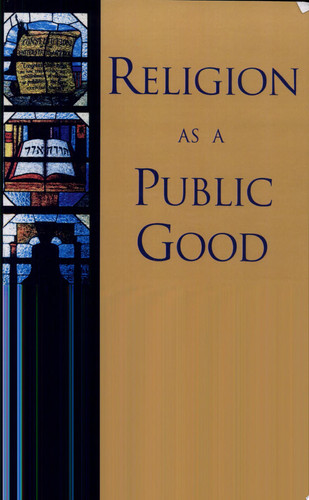
Religion as a public good: Jews and other Americans on religion in the public square

Alan Mittleman
Religion as a Public Good: Jews and Other Americans on Religion in the Public Square explores the often controversial topic of how religion ought to relate to American public life. The sixteen distinguished contributors, both Jewish and Christian, reflect on the topic out of their own disciplines-social ethics, political theory, philosophy, law, history, theology, and sociology. and take a stand based on their religious convictions and political beliefs. The volume is at once scholarly and committed, polemic and civil, reflective and activist. Written in the shadow of 9/11, it invites a new consideration of how religion enhances democratic public life with full awareness of the dangers that religion can sometimes pose. The volume is polemical, as befits the topic, but also civil, as befits a dialogue about an issue of profound significance for democratic citizenship.
Rowman & Littlefield 2003-12-09 336 pages

"Nazi fantasy": Vilém Flusser and history as site of experiment

Morris-Reich, Amos
"This book brings together Vilém Flusser and intellectual Jewish history of the second half of the twentieth century. Flusser is viewed today by many scholars as the most original theoretician of media and photography in the second half of the twentieth century, and yet this is the first monograph about him in English. Combining elements of Flusser's biography with a rigorous study of his writing, this book shows that concepts of 'virtuality', 'medium', and 'embodiment' underpin not only Flusser's understanding of technological media, such as photography, but also his understanding of evolution and of real or imaginary biological organisms. This book argues that Flusser contended with Nazism in his writings on these biological and ecological themes. Two threads - and their relationship - are explored: the first bears on Nazism as undergirded by a biological perspective - an attempt to eradicate a population taken to be parasitic; in the second, Nazism is simply viewed as 'stupid'. Such a line of inquiry necessarily leads to and includes our dealing with the 'Nazi fantasy', because fantasy was fused into Nazism's own vision. This book will not only be an ideal resource for students and scholars of intellectual Jewish history but will interest anyone seeking an introduction to Flusser and the philosophy of science within the context of Nazism"--
Routledge 2025 138 pages

Orpheus, a General History of Religions

Salomon Reinach,Florence Simmonds
This work has been selected by scholars as being culturally important, and is part of the knowledge base of civilization as we know it. This work is in the "public domain in the United States of America, and possibly other nations. Within the United States, you may freely copy and distribute this work, as no entity (individual or corporate) has a copyright on the body of the work. Scholars believe, and we concur, that this work is important enough to be preserved, reproduced, and made generally available to the public. We appreciate your support of the preservation process, and thank you for being an important part of keeping this knowledge alive and relevant.
Creative Media Partners, LLC 2022-10-27 466 pages

The Performer Art, Life, Politics

Richard Sennett
An acclaimed sociologist's exploration of the connections among performances in life, art, and politics "A thought-provoking, essayistic and touchingly personal exploration of the ethics and aesthetics of performance from one of the leading intellectuals of our time."--Lucasta Miller, The Spectator , "Best Books of 2024" "Constantly fascinating and often illuminating."--Simon Callow, New York Review of Books In The Performer , Richard Sennett explores the relations between performing in art (particularly music), politics, and everyday experience. It focuses on the bodily and physical dimensions of performing, rather than on words. Sennett is particularly attuned to the ways in which the rituals of ordinary life are performances. The book draws on history and sociology, and more personally on the author's early career as a professional cellist, as well as on his later work as a city planner and social thinker. It traces the evolution of performing spaces in the city; the emergence of actors, musicians, and dancers as independent artists; the inequality between performer and spectator; the uneasy relations between artistic creation and social and religious ritual; the uses and abuses of acting by politicians. The Janus-faced art of performing is both destructive and civilizing.
Yale University Press 2025-10-28 256 pages

The Search for Historical Meaning Hegel and the Postwar American Right

Paul Gottfried
Praised by President Richard Nixon as his favorite read for 1987, The Search for Historical Meaning presents the postwar American conservative movement against a background of ideas with which it has only rarely been identified. This important book--updated with a new preface--examines the influence of Hegelian concepts on the historical attitudes and cultural judgments of prominent postwar conservatives who, because of their concern with personal freedom as a political and ontological value, denounced Hegel while ascribing their own Hegelian ideas to less offensive sources. Gottfried argues that the lack of a true historical perspective was a serious defect in the postwar American conservative movement, and it grew worse in the years that followed. Essential reading for conservative thinkers, political philosophers, and American political historians, The Search for Historical Meaning concludes with an incisive examination of the American conservative movement that has implications for today.
Northern Illinois University Press 2010 178 pages

Man and Technics A Contribution to a Philosophy of Life

Oswald Spengler
In this new and revised edition of Oswald Spengler’s classic, Man and Technics , Spengler makes a number of predictions that today, more than eighty years after the book was first published, have turned out to be remarkably accurate. Spengler predicted that industrialisation would lead to serious environmental problems and that countless species would become extinct. He also predicted that labour from Third World countries would increasingly outcompete Western workers by doing the same work for much lower wages, and that industrial production would therefore move to other parts of the world, such as East Asia, India, and South America. According to Spengler, technology has not only made it possible for man to harness the forces of nature; it has also alienated him from nature. Modern technology now dominates our culture instead of that which is natural and organic. After having made himself the master of nature, man has himself become technology’s slave. ‘The victor, crashed, is dragged to death by the team’, Spengler summarises. Finally, Spengler foresaw that Western man would eventually grow weary of his increasingly artificial lifestyle and begin to hate the civilisation he himself created. There is no way out of this conundrum as the unrelenting progress of technological development cannot be halted. The current high-tech culture of the West is therefore doomed, destined to be consumed from within and destroyed. A time will come, Spengler writes, when our giant cities and skyscrapers have fallen in ruins and lie forgotten ‘just like the palaces of old Memphis and Babylon’. It remains to be seen if this last, and most dire, of Spengler’s prophecies will also come true.
Arktos 2015-01-30 82 pages

Spinoza and the Sciences

Marjorie Glicksman Grene,Professor Marjorie Grene,Debra Nails
I. Spinoza and Seventeenth Century Science.- Spinoza in the Century of Science.- Spinoza and Cartesian Mechanics (translated by Debra Nails and Pascal Gallez).- Spinoza and the Rise of Modern Science in the Netherlands.- II. Spinoza: Scientist.- Spinoza: Scientist and Theorist of Scientific Method.- Spinoza and Euclidean Arithmetic: The Example of the Fourth Proportional (translated by David Lachterman).- III. Spinoza and the Human Sciences: Politics and Hermeneutics.- Towards a Canonic Version of Classical Political Theory.- Some New Light on the Roots of Spinoza's Science of Bible Study.- IV. Scientific-Metaphysical Reflections.- Self-Knowledge as Self-Preservation?.- Spinoza's Version of the Eternity of.- V. Spinoza and Twentieth Century Science.- Parallelism and Complementarity: The Psycho-Physical Problem in Spinoza and in the Succession of Niels Bohr.- Res Extensa and the Space-Time Continuum.- Einstein and Spinoza (translated by Michel Paty and Robert S. Cohen).- VI. Bibliography.- Annotated Bibliography of Spinoza and the the Mind Sciences.- Index Locorum.- General Index.
Springer 2011-11-04 360 pages

Antisemitism and modernity: innovation and continuity

Maccoby, Hyam
Discusses the origins of antisemitism and especially its development in the modern world. Traces antisemitism to religious origins, to the fact that Christianity and Islam are both derived from Judaism and therefore have an Oedipal relationship to Judaism. Argues that non-religious antisemitism is all the more potent because of its unacknowledged religious roots. The modern world never quite emerged from the medieval world, and one of its unwanted legacies is its burden of antisemitism. Some of the chapters in this book are adaptations of articles published in "Midstream" (February & November 1970, May 1973, and March 1976), the "Times Literary Supplement" (25 June 1999), and "The Critical Survey" 3 (1967). Contents:
Routledge 2006 191 pages

Complaint: grievance among friends

Ronell, Avital
"Everyone has a complaint, but nobody likes a complainer. Rather than making things better a complaint can just make things worse. Often its only relief is the harmless and temporary release of steam. But it can also pose as criticism in one of several seemingly respectable forms. In Complaint, Avital Ronell looks at how complaints and complainers have been treated in literature and philosophy, in feedback loops that pay little attention to injustice and suffering. Beginning with Hamlet, and with open awareness of her own experiences, Ronell proceeds to show how complaining is aggravated, distracted, stifled, and transformed. She looks at exemplary complaints made by Friedrich Nietzsche, Hannah Arendt, and Barbara Johnson. She examines the complaint riven history of deconstruction. Renowned for her courage in taking on painful subjects with candor and wit, Ronell dares to listen to the haunting complaints of the dead"--
University of Illinois Press 2018-04-02 244 pages

Causation in Early Modern Philosophy Cartesianism, Occasionalism, and Preestablished Harmony

Steven M. Nadler
Three general accounts of causation stand out in early modern philosophy: Cartesian interactionism, occasionalism, and Leibniz's preestablished harmony. The contributors to this volume examine these theories in their philosophical and historical context. They address them both as a means for answering specific questions regarding causal relations and in their relation to one another, in particular, comparing occasionalism and the preestablished harmony as responses to Descartes's metaphysics and physics and the Cartesian account of causation. Philosophers discussed include Descartes, Gassendi, Malebranche, Arnauld, Leibniz, Bayle, La Forge, and other, less well-known figures.
Pennsylvania State University Press 1993-04 232 pages

Essays on Marx's Theory of Value

Isaak Illich Rubin
Isaak Illich Rubin (12 June 1886, Dinaburg, now Latvia - 27 November 1937, Aktobe, now Kazakhstan) was a Soviet Marxian economist. His main work Essays on Marx's Theory of Value was published in 1924. He was executed in 1937 during the course of the Great Purge, but his ideas have since been rehabilitated. Rubin's main work emphasised the importance of Marx's theory of commodity fetishism in the labor theory of value. Against those who counterposed Marx's early interest in alienation with his later economic theory, Rubin argued that Marx's mature economic work represented the culmination of his lifetime project to understand how human creative power is shaped, defined, and limited by social structures, which take on a uniquely "objective" economic form under capitalism. Significantly, Rubin is at pains to argue that simple commodity production is not a historical phenomenon that developed into capitalism, as it is often understood by both Marxists and critics of Marx; rather, it is a theoretical abstraction that explains one aspect of a fully developed capitalist economy. The concept of value, as understood by Rubin, cannot exist without the other elements of a full-blown capitalist economy: money, capital, the existence of a proletariat, and so on. Rubin's work was never reissued in the Soviet Union after 1928, but in 1972 Essays on Marx's Theory of Value was translated into English by Fredy Perlman and Milos Samardzija. This work became a foundation stone of the "value-form" approach to Marxist theory, exemplified by Hans-Georg Backhaus, Chris Arthur, Geert Reuten, and the "Konstanz-Sydney" group (Michael Eldred, Mike Roth, Lucia Kleiber, and Volkbert Roth). In this interpretation of Marx, "it is the development of the forms of exchange that is seen as the prime determinant of the capitalist economy rather than the content regulated by it". Capitalism is here understood as a method of regulating human labor by giving it the social form of an exchangeable commodity (the "value-form"), rather than a disguised or mystified system that is otherwise similar in content to other class-based societies. According to Arthur, the rediscovery of Rubin's "masterly exegesis" was "the most important single influence on the value form approach to Capital". (wikipedia.org)
IndoEuropeanPublishing.com 2019-01-15 216 pages

Philippines

Cixous, Hélène
Philippines is Hélène Cixous's reverie or 'true dreaming' which intertwines Freud's uneasy views on telepathy, autobiographical memories conflating Algeria and Paris, childhood and adult life, shared with her brother 'Pete', and literary evocations from Proust and George du Maurier's forgotten novel Peter Ibbetson. Amid telepathic conversations, real or imagined, and life events uncannily answering one another from a distance, Cixous's dense evocative journey ceaselessly 'returns to its starting point' and, like the twin almonds in one shell evoked by the title, reveals intimate, secret bonds between scenes and beings, real and fictional. Its interpretive sharpness delivered with stylistic elegance and candour will make this study typical of Cixous's art, which plies between literature and criticism, appealing not only to scholars and critics interested in psychoanalysis, autobiography and the act of reading, but also to a broader readership captivated by the hallucinatory coincidences between life, dream and fiction, when 'Reality is the dream. The dream is the true reality'.
Polity 2011-02-07 82 pages