7908 results for "Science"

The power of precedent

Gerhardt, Michael J.
The role that precedent plays in constitutional decisionmaking is a perennially divisive subject among scholars of law and American politics. The debate rages over both empirical and normative aspects of the issue: To what extent are the Supreme Court, Congress, and the executive branch constrained by precedent? To what extent should they be? Taking up a topic long overdue for comprehensive treatment, Michael Gerhardt connects the vast social science data and legal scholarship to provide the most wide-ranging assessment of precedent in several decades. The Power of Precedent clearly outlines the major issues in the continuing debates on the significance of precedent and evenly considers all sides. For the Supreme Court, precedents take many forms, including not only the Court's past opinions, but also norms, historical practices, and traditions that the justices have deliberately chosen to follow. In these forms, precedent exerts more force than is commonly acknowledged. This force is encapsulated in the implementation and recognition of what Gerhardt calls the "golden rule of precedent," a major dynamic in constitutional law. The rule calls upon justices and other public authorities to recognize that since they expect others to respect their own precedents, they must provide the same respect to others' precedents. Gerhardt's extensive exploration of precedent leads him to formulate a more expansive definition of it, one that encompasses not only the prior constitutional decisions of courts but also the constitutional judgments of other public authorities. Gerhardt concludes his study by looking at what the future holds for the concept, as he examines the decisions and attitudes toward precedent exhibited by the shift from the Rehnquist to the Roberts Court.
Oxford University Press 2008-02-12 340 pages

Believers: faith in human nature

Konner, Melvin
"An anthropologist examines the nature of religiosity, and how it shapes and benefits humankind. Believers is a scientist's answer to attacks on faith by some well-meaning scientists and philosophers-- a firm rebuke of the "Four Horsemen": Richard Dawkins, Daniel Dennett, Sam Harris, and Christopher Hitchens, known for writing about religion as something irrational and ultimately harmful. Konner, who was raised as an Orthodox Jew but has lived his adult life without such faith, explores the psychology, development, brain science, evolution, and even genetics of the varied religious impulses we as a species experience. Conceding that faith is not for everyone, he views religious people with a sympathetic eye; his own upbringing, his apprenticeship in the trancedance religion of the African Bushmen, and his friends in Christian, Buddhist, Hindu, Muslim, and other faiths have all shaped his perspective. He concludes that religion does much good as well as undoubted harm, and that for at least a large minority of humanity, the belief in things unseen neither can nor should go away"--
W. W. Norton & Company 2019-09-10 244 pages

Food and evolution: toward a theory of human food habits

Marvin Harris,Eric B. Ross
"Many topics of interest to health professionals, such as vegetarianism, dietary fibers, lactose intolerance, favism, cannibalism and changes in nutritional status wrought by the decline of hunter-gathering and the rise of horticulture. Many sections will appeal to the general reader." --Journal of Applied Nutrition The old adage "you are what you eat" may be more accurate than anyone could have ever imagined. This unprecedented interdisciplinary effort by scholars in primatology, biological anthropology, archaeology, nutrition, psychology, agricultural economics, and cultural anthropology suggests that there is a systematic theory behind why humans eat what they eat. Includes discussions ranging in time from prehistory to the present, and from the most simple societies to the most complex, including South American Indian groups, African hunter-gatherers, and countries such as India, Bangladesh, Peru, and Mexico. "Exceptionally well-edited. High quality individual papers are of comparable scope and are uniformly well referenced and detailed in presentation of supporting data Introductory and concluding chapters as well as section overviews create an integrated whole." --Choice "Compelling...complete and...recommended." --Science Books & Films "Should be of value to all nutrition educators who have an interest in the social, cultural, and international aspects of foods and nutrition." --Journal of Nutrition Education
Temple University Press 1987 633 pages

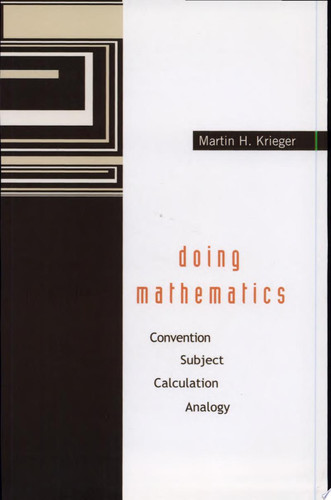
Doing mathematics: convention, subject, calculation, analogy

Krieger, Martin H.
This book discusses some ways of doing mathematical work and the subject matter that is being worked upon and created. It argues that the conventions we adopt, the subject areas we delimit, what we can prove and calculate about the physical world, and the analogies that work for mathematicians--all depend on mathematics, what will work out and what won't. And the mathematics, as it is done, is shaped and supported, or not, by convention, subject matter, calculation, and analogy. The causes studied include the central limit theorem of statistics, the sound of the shape of a drum, the connection between algebra and topology, the stability of matter, the Ising model, and the Langlands Program in number theory and representation theory. Contents: Convention: How Means and Variances are Entrenched as Statistics; Subject: The Fields of Topology; Appendix: The Two-Dimensional Ising Model of a Ferromagner; Calculation: Strategy, Structure, and Tactics in Applying Classical Analysis; Analogy; A Syzygy Between a research Program in Mathematics and a Research Program in Physics, Each of Which is Itself an Analogy; Mathematics in Concreto. Readership: Mathematicians, Physicists, philosophers and historians of science.
World Scientific 2003 454 pages

The Warren court in historical and political perspective

William Nelson Cromwell Professor of Law Mark Tushnet
The tenure of Earl Warren as chief justice of the United States Supreme Court (1953-69) was marked by a series of decisions unique in the history of the Court for the progressive agenda they bespoke. What made the Warren Court special? How can students of history and political science understand the Warren Court as part of constitutional history and politics? To answer such questions, nine well-known legal scholars and historians explore how each justice contributed to the distinctiveness of the Warren Court in Supreme Court history.
University Press of Virginia 1993 220 pages

The Unreasonable Virtue of Fly Fishing

Mark Kurlansky
National Outdoor Book Award Winner for Outdoor Literature From the award-winning, bestselling author of Cod- the irresistible story of the science, history, art, and culture of the least efficient way to catch a fish. Fly fishing, historian Mark Kurlansky has found, is a battle of wits, fly fisher vs. fish-and the fly fisher does not always (or often) win. The targets-salmon, trout, and char; and for some, bass, tarpon, tuna, bonefish, and even marlin-are highly intelligent, athletic animals. The allure, Kurlansky learns, is that fly fishing makes catching a fish as difficult as possible. The flies can be beautiful and intricate, some made with over two dozen pieces of feather and fur; the cast is a matter of grace and rhythm, with different casts and rods yielding varying results. Kurlansky is known for his deep dives into specific subjects, from cod to oysters to salt. But he spent his boyhood days on the shore of a shallow pond. Here, where tiny fish weaved under a rocky waterfall, he first tied string to a branch, dangled a worm into the water, and unleashed his passion for fishing. Since then, his love of the sport has led him around the world's countries, coasts, and rivers-from the wilds of Alaska to Basque country, from Ireland and Norway to Russia and Japan. And, in true Kurlansky fashion, he absorbed every fact, detail, and anecdote along the way. The Unreasonable Virtue of Fly Fishing marries Kurlansky's signature wide-ranging reach with a subject that has captivated him for a lifetime-combining history, craft, and personal memoir to show readers, devotees of the sport or not, the necessity of experiencing nature's balm first-hand.
Bloomsbury USA 2022-04-26 304 pages

Mathematics and logic

Kac, Mark
A description of the historical development of mathematics with a brief survey of high points and trenchant influences, originally published in 1986 by Praeger. A remarkable bargain. Fascinating study considers the origins and nature of mathematics, its development and role in the history of scientific thinking, impact of high-speed computers, 20th-century changes in the foundations of mathematics and mathematical logic, mathematization of science and technology, much more. Compelling reading for mathematicians, physicists, students₇anyone interested in the evolution of mathematical thought. 34 illustrations. 1968 edition.
Dover 1992 170 pages

All Things Are Possible

SHESTOV, LEV
"All Things Are Possible" is a philosophical work by Lev Shestov, a Russian existentialist philosopher, first published in 1905 under the pseudonym J. I. Ivanov. The book is a collection of aphoristic essays and reflections that delve into Shestov's critique of rationalism, his exploration of the irrational aspects of existence, and his advocacy for the primacy of personal freedom and faith over rational thought and universal truths. Shestov argues that conventional philosophy and science seek to impose order and rationality on the chaos of existence, thereby limiting the infinite possibilities inherent in life. He posits that true knowledge and understanding come from a personal and existential confrontation with the unknown, where all things are possible for those who reject the constraints of rationality and dogma. The book challenges the reader to question the foundations of their beliefs and to embrace the uncertainty and absurdity of life. Shestov's work is a call to intellectual and spiritual liberation, urging individuals to break free from the confines of established norms and to explore the depths of their own existence without fear. "All Things Are Possible" is notable for its intense, passionate prose and its influence on later existentialist thinkers. It remains a seminal work for those interested in existential philosophy, the critique of rationalism, and the exploration of the existential dimensions of faith and despair.
Independently published 2024-02-18 180 pages

White papers, black marks: architecture, race, culture

Lokko, Lesley Naa Norle
Architecture/Race and Ethnic Studies The first sustained examination of the hidden and explicit ways racial ideology is expressed in the built environment. Mapping the relationship between race and architecture, the authors of this volume explore the vexed if often unspoken ways in which notions of "difference" figure in the shaping of the built environment. The terms of architectural design and study-"space, site, form, architect, and user"-are derived from the historical task of adapting space to an existing socioeconomic structure. Exposing the racial subtext in this language of vision and logic, this book brings to light the complex connection between the question of identity and the questions architecture poses: Whose pleasures are pursued, who gets to build what, whose histories and experiences are represented, whose voice is heard? The heavily illustrated volume is structured by scale: from the scale of the urban (1:125,000) to the "middle" scale of 1:1,250 (exile, "in-between-ness") to 1:1, the scale of detail, the intimate, the personal. The authors, working from a wide variety of backgrounds, take up topics ranging from Victorian attitudes toward racial hierarchy to a rereading of the Argentinean urbanscape through tango, from the disintegration along racial lines of the contemporary U.S. city to the racially polarized profession of architecture in South Africa. Whether investigating issues of black spatial identity or tracing the visual-textual-material threading of race through an architectural project, whether focusing on Europe in the 1400s or Australia today, their work reclaims a hidden cultural experience built into the very walls that frame our lives. Contributors: Araya Asgedom, Hampton U; Ana Erradonea Betancour, University College, London; Kwasi Boateng, Southbank U and U of Science and Technology, Ghana; J. Yolande Daniels, U of Michigan; Felecia Davis, Cornell U; Kim Dovey, U of Melbourne; Peter Hasdell, University College, London; Edward Ihejirika, Kingston U; Jane M. Jacobs, U of Melbourne; Mathilde Lochert, U of Melbourne and RMIT University, Australia; Chris Nasah; Malindi Neluheni; N. Ola Uduku, U of Liverpool; Mitchell Squire, Iowa State U; Michael Stanton, American U, Beirut; Imogen Ward Kouao, U of East London. Lesley Naa Norle Lokko is assistant professor of architecture at the University of Illinois at Chicago. Translation Inquiries: Athlone
University of Minnesota Press 2000 378 pages

I'm not a racist, but--: the moral quandary of race

Blum, Lawrence A.
Not all racial incidents are racist incidents, Lawrence Blum says. "We need a more varied and nuanced moral vocabulary for talking about the arena of race. We should not be faced with a choice of 'racism' or nothing." Use of the word "racism" is pervasive: An article about the NAACP's criticism of television networks for casting too few "minority" actors in lead roles asks, "Is television a racist institution?" A white girl in Virginia says it is racist for her African-American teacher to wear African attire. Blum argues that a growing tendency to castigate as "racism" everything that goes wrong in the racial domain reduces the term's power to evoke moral outrage. In "I'm Not a Racist, But . . .", Blum develops a historically grounded account of racism as the deeply morally-charged notion it has become. He addresses the question whether people of color can be racist, defines types of racism, and identifies debased and inappropriate usages of the term. Though racial insensitivity, racial anxiety, racial ignorance and racial injustice are, in his view, not "racism," they are racial ills that should elicit moral concern. Blum argues that "race" itself, even when not serving distinct racial malfeasance, is a morally destructive idea, implying moral distance and unequal worth. History and genetic science reveal both the avoidability and the falsity of the idea of race. Blum argues that we can give up the idea of race, but must recognize that racial groups' historical and social experience has been shaped by having been treated as if they were races.
Cornell University Press 2002 259 pages

I didn't come here to lie: my life and education

Lewis, Karen,Todd-Breland, Elizabeth
"An intimate, inspiring memoir by educator and labor union leader Karen Lewis, a formidable fighter, a staunch defender of teachers and students, and a beloved Chicagoan. In 2012, Karen Lewis led the Chicago Teachers Union to a historic strike, challenging the city's powerful mayor and paving the way for an unprecedented wave of teacher strikes in the decade that followed. But Lewis's life took her in rich and surprising directions long before she landed in the CTU President's office. I Didn't Come Here to Lie, written in collaboration with historian and education expert Elizabeth Todd-Breland, tells Lewis's story in full for the first time, capturing her lively wit, her charisma, and her commitment to building the schools and communities teachers, students, and families deserve. From her childhood on Chicago's South Side to her teen years organizing Black Power walkouts, from her education at Mount Holyoke and Dartmouth to her years in Oklahoma and Barbados and her stints in medical school and film school, readers follow Lewis through a life full of exploration. Wherever she was, she maintained a strong commitment to building fairness. She found her calling in the classroom, teaching science for more than twenty years before becoming a union leader in Chicago. Up until her untimely death from brain cancer in 2021, Karen Lewis was spirited, unshakeable, and fierce. She remains a model for current organizers and teachers doing the day-to-day work of building a better world. I Didn't Come Here to Lie is a testament to one of the true revolutionaries of her generation"--
Haymarket Books 2025-02-04 272 pages

Montesquieu

Shklar, Judith N.
One of the most original political thinkers of the Enlightenment, Montesquieu utilized his passionate belief in toleration and the moral benefits of science to construct a naturalistic system of political science based on the study of history, comparative government, and human behavior. This volume reveals Montesquieu's purpose by exploring the range of his literary output, focusing on his scandalous novel, The Persian Letters (1721), his philosophical history, Considerations on the Greatness and Decline of the Romans (1734), and his magnum opus, The Spirit of the Laws (1748).
Oxford University Press 1987 136 pages

Heaven on Earth

Joshua Muravchik
Socialism was man's most ambitious attempt to supplant religion with a doctrine claiming to ground itself in "science." Indeed, no religion ever spread so far so fast. Yet while socialism had established itself as a fact of life by the beginning of the 20th century, it did not create societies of abundance or give birth to "the New Man." Each failure inspired new searches for the path to the promised land; revolution, communes, social democracy, Communism, Fascism, Third World socialism. None worked, and some exacted staggering human tolls. Then, after two hundred years of wishful thinking and fitful governance, socialism suddenly imploded in a fin du siecle drama of falling walls and collapsing regimes. In Heaven on Earth, Joshua Muravchik traces this fiery trajectory through sketches of the thinkers and leaders who developed the theory, led it to power, and presided over its collapse. We see such dreamers and doers as the French revolutionary Gracchus Babeuf, whose "Conspiracy of Equals" were the first to try to outlaw private property; Robert Owen, who hoped to plant a model socialist utopia in the United States; Friedrich Engels, who created the cult of Karl Marx and "scientific" socialism; Benito Mussolini, self proclaimed socialist heretic and inventor of Fascism; Clement Attlee, who rejected the fanatics and set out to build socialism democratically in Britain; Julius Nyerere, who merged social democracy and communism in the hope of making Tanzania a model for the developing world; and Mikhail Gorbachev, Deng Xiaoping and Tony Blair, who became socialism's inadvertent undertakers. Muravchik's accomplishment in Heaven on Earth is to tell a story filled with character and event while at the same time giving us an epic chronicle of a movement that tried to turn the world upside down--and for a time succeeded.
ReadHowYouWant.com, Limited 2011-03 484 pages

The Speed of Dark A Memoir

Joram Piatigorsky
"The Speed of Dark will resonate with musicians, those interested in art, music and history, and those who seek to carve their own path in a world filled with high expectations and seemingly unlimited resources." (Sel Kardan, President, Colburn School of Performing Arts, LA)"The clear and elegant prose on the theme of collecting reveals a dedication and self-understanding that is rare." (Michael Hall, PhD, Curator of the Rothschild family collections, Exbury Estate, Hampshire, GB)"Piatigorsky's memoir will provide particular interest to students, scholars, and fellow collectors knowledgeable in the creative traditions of Native North American artists." (Bernadette Driscoll Engelstad, Independent Curator, Inuit Art)"Piatigorsky's memoir demonstrates that artistry can be found in science." (Joseph Horwitz, Ph.D., Distinguished Professor of Ophthalmology/Biophysics, Jules Stein Eye Institute, UCLA)"Piatigorsky's unique story will receive a wide audience: professional and lay scientists, art collectors, musicians, historians, writers and those who have struggled to find their identity." (Hamid Shams, BBP Films Producer and Cinematographer)"This memoir is not just worth reading, it is worth remembering!" (James Mathews, Author of Last Known Position)"This fascinating account of his journey becomes a meditation on art, wonder, and creativity, of bucking the status quo and following one's heart. " (Barbara Esstman, Author of The Other Anna, Night Ride Home, and A More Perfect Union)
Adelaide Books LLC 2018-12-02 334 pages

Handbook of emotion regulation

James J. Gross
"Reviewing the state of the science in a dynamic, thriving field, this influential handbook integrates knowledge from multiple psychological subdisciplines. Foremost experts address the neurobiological and cognitive bases of emotion regulation and examine how individuals develop and use regulatory strategies across the lifespan. The social context of emotion regulation is explored, as are personality processes and individual differences. Critical implications are discussed for psychopathology, psychosocial interventions, and health. Including helpful cross-referencing among chapters, the volume describes cutting-edge methods and identifies promising directions for future investigation. New to This Edition *Incorporates significant scientific advances and many new topics. *Greatly expanded coverage of clinical issues and applications. *Chapters on neural systems, delay of gratification, decision making, and health. *Chapters on adolescence, social baseline theory, and desire regulation, plus more"--
The Guilford Press 2015-02-19 669 pages

Posthuman bodies

Jack Halberstam,Judith Halberstam,Ira Livingston
"It is a collection of essays that takes up, in a mostly affirmative way, various challenges to the coherence of the "human body" as a figure through which culture is processed and oriented." Partial contents : The end of the world of White Men ; Class and its close relations : identities among women, servants, and machines ; Soft fictions and intimate documents : can feminism be posthuman? ; Reproducing the posthuman body : ectogenetic fetus, surrogate mother, pregnant man ; The seductive power of science in the making of deviant subjectivity ; Phantom and reel projections lesbians and the (serial) killing-machine ; "Death of the family."
Indiana University Press 1995-12-01 275 pages

How I Accidentally Started the Sixties

Howard Bloom
"Every page, every paragraph, every sentence sparkles with captivating metaphors, delightful verbal concoctions, alchemical insights, philosophic whimsy, absurd illogicals, scientific comedy routines, relentless, non-stop waves of hilarity. The comparisons to James Joyce are undeniable. Wow! Whew! Wild! Wonderful!"" Timothy Leary The strangest memoir you will ever read. You or your parents lived it. I helped start it. And it was an accident. It was the era of myth, legend, sex, and extreme adventure called The Sixties. "I blasted through Howard Bloom's How I Accidentally Started The Sixties like the wildfire swallowing up my mountain in California. I loved it. The molecular amusement ride, the sexual Disneyland, the Chevy 350 Impala blasting down the freeway at 120 mph. The universal essence is its brilliant simplicity.....Reality is really a mind field seen through Bloom's neurotic Buddha-like mind resplendent with every major family issue mortal humans will ever come across in a life time: identity, parents, meaning, self, non-self, food, habitation, education, goals, marriage, family, children, God, sex, more sex----DRUGS. It slithers like a rattlesnake across the page, the way a story should. What I love most is the off the wall comedy. Howard Bloom as Harpo Marx riding a freight train like Buddha carrying his life in a sleeping bag. I mean it's priceless. Bloom's psychedelic journey across the American landscape, is deciphered through the irresistible minds of murderers, crackpots, Nobel Prize Playboy bunnies, scholars, waiters, hobo gurus, cops, professors, French majors, psychiatrists, cock suckers, recreational drug users, Mormons, Jews, nut jobs, laundry mat owners, demonic children, lizards...........Aldous Huxley with a pinch of Timothy Leary.............and every molecule in the universe. It separates Bloom from any scientist/global mind who ever lived. Richard Feynman, Albert Einstein, and Aldous Huxley would be proud. Each man strived to marry science, art, and poetry but never managed to pull it off. How I Accidentally Started the Sixties does. I salute Howard Bloom. His doctrine sparkles every page with his Promethean fire; distilled in Shakespeare's immortal words, 'From women's eyes this doctrine I derive'.....[women] are the books, the arts, the academies, that show, contain and nourish the world.' Love's Labour Lost, only in Bloom's case, found, lost, and then found again. God only knows what else this mastermind is hiding from the rest of us." Mark Lamonica, winner of the Southern California Booksellers Association Nonfiction Award, author of Junk Yard Dogs And William Shakespeare and Renaissance Porn Star: The Saga of Pietro Aretino, The World's Greatest Hustler
CreateSpace Independent Publishing Platform 2014-09-23 220 pages