68 results for "American History"

Women who would be rabbis: a history of women's ordination, 1889-1985

Nadell, Pamela Susan
"The definitive study of 'the road to women's ordination' in Judaism." --Jonathan D. Sarna, author of The American Jewish Experience Pamela S. Nadell mines a wealth of untapped sources to bring us the first complete story of the outstanding Jewish women who passionately defended their right to equal religious participation through rabbinical ordination. These personal stories--of w omen like Ray Frank, hailed as "the girl rabbi of the golden West" at the turn of the century, and Sally Priesand, ordained in 1972 as the first woman rabbi--are woven with fascinating history and accounts of the controversies that continue in many Je wish communities today. Women Who Would Be Rabbis is a 1998 National Jewish Book Award finalist.
Beacon Press 1998 300 pages

Whose Torah? a concise guide to progressive Judaism

Alpert, Rebecca T.
Rabbi Rebecca Alpert is a leading voice in progressive Judaism. A crusader for reform within the Jewish community, she was one of the first women in Jewish history to be ordained a rabbi. Alpert is a celebrated teacher, an expert on Jewish American religious history, and a key public advocate for progressive social issues in contemporary Jewish life. In Whose Torah?, Alpert sketches a compelling portrait of the progressive values that belong to the core of Judaism today. Reaching deeply into the sources of Jewish tradition, she highlights with unflinching moral clarity the textual basis for a truly just vision of life for all who care about sexual, economic, and racial justice and for those who would oppose all forms of discrimination, unjust war, and the destruction of the environment. Alpert also carefully considers what it means to be Jewish in contemporary America―offering both a passionate and deeply learned defense of progressive Jewish identity. Whose Torah? will be an essential intellectual resource for progressive Jews and for anyone searching for the religious underpinnings of contemporary progressive politics. Elaine Pagels, Harrington Spear Paine Foundation Professor of Religion at Princeton University, is the author of numerous, widely acclaimed books on Gnosticism and early Christianity, including The Gnostic Gospels, Beyond Belief, and Reading Judas.
New Press 2008-06-01 164 pages

The Reform Judaism reader: North American documents

Michael A. Meyer,W. Gunther Plaut
This classic reference book chronicles the history of Reform Judaism. Historical documents and writings by renowned authors that reflect the on-going evolution of Reform Judaism are included. This book will aid the reader in understanding the changing issues that have occurred since its establishment. This timely book traces the development of Reform Judaism in light of the ideas contained in the Statement of Principles for Reform Judaism adopted at the 1999 Pittsburgh Convention of the Central Conference of American Rabbis. The book covers such areas as theology, social action, the Sabbath, and education. -- Ideal for high school and adult study -- Classic reference for every Reform Jewish home and library -- Each document preceded by an introduction by the authors -- Online study guide available at www.uahcpress.com
UAHC Press 2001 228 pages

Crisis and covenant: the Holocaust in American Jewish fiction

Berger, Alan L.
Examines the effect of the Holocaust on traditional attempts to explain the Jewish people's sufferings while retaining the concept of covenant with God. also examines its influence on the self-image of American Jewry. Analyzes the works of Elie Wiesel, Isaac Bashevis Singer, Saul Bellow, and Cynthia Ozick, among others, and suggests that awareness of a covenantal concept of Judaism is a criterion for authentic Holocaust literature. Adopts the definition of the Holocaust as a unique event - the plan to exterminate an entire nation, and describes various approaches to theological problems raised by the Holocaust.
State University of New York Press 1985-01-01 226 pages

Eros and the Jews: from Biblical Israel to contemporary America

Biale, David
Contradictory stereotypes about Jewish sexuality pervade modern culture, from Lenny Bruce's hip eroticism to Woody Allen's little man with the big libido (and even bigger sexual neurosis). Does Judaism in fact liberate or repress sexual desire? David Biale does much more than answer that question as he traces Judaism's evolving position on sexuality, from the Bible and Talmud to Zionism up through American attitudes today. What he finds is a persistent conflict between asceticism and gratification, between procreation and pleasure. From the period of the Talmud onward, Biale says, Jewish culture continually struggled with sexual abstinence, attempting to incorporate the virtues of celibacy, as it absorbed them from Greco-Roman and Christian cultures, within a theology of procreation. He explores both the canonical writings of male authorities and the alternative voices of women, drawing from a fascinating range of sources that includes the Book of Ruth, Yiddish literature, the memoirs of the founders of Zionism, and the films of Woody Allen. Biale's historical reconstruction of Jewish sexuality sees the present through the past and the past through the present. He discovers an erotic tradition that is not dogmatic, but a record of real people struggling with questions that have challenged every human culture, and that have relevance for the dilemmas of both Jews and non-Jews today.
Basic Books 1992 319 pages

The Jewish presence: essays on identity and history

Dawidowicz, Lucy S.
What does it mean to be a Jew? In the twenty essays included here, best-selling author Lucy S. Widowhood examines many aspects of modern Jewish life, concentrating on the central experiences of our era- the search for meaning of one's existence as a Jew;bridging the past and the present; reconciling tradition and the Holocaust. While she describes the evolution of American Judaism and surveys its present condition, the author also shows us the continuities between Old world and New World Judaism as she evokes the modern Jew's struggle between faith and secularism
Harcourt Brace Jovanovich 1978 308 pages

Who rules the synagogue? religious authority and the formation of American Judaism

Eleff, Zev
Finalist for the American Jewish Studies cateogry of the 2016 National Jewish Book Awards Early in the 1800s, American Jews consciously excluded rabbinic forces from playing a role in their community's development. By the final decades of the century, ordained rabbis were in full control of America's leading synagogues and large sectors of American Jewish life. How did this shift occur? Who Rules the Synagogue? explores how American Jewry in the nineteenth century was transformed from a lay dominated community to one whose leading religious authorities were rabbis. Zev Eleff traces the history of this revolution, culminating in the Pittsburgh rabbinical conference of 1885 and the commotion caused by it. Previous scholarship has chartered the religious history of American Judaism during this era, but Eleff reinterprets this history through the lens of religious authority. In so doing, he offers a fresh view of the story of American Judaism with the aid of never-before-mined sources and a comprehensive review of periodicals and newspapers. Eleff weaves together the significant episodes and debates that shaped American Judaism during this formative period, and places this story into the larger context of American religious history and modern Jewish history.
Oxford University Press 2016 330 pages

Prophets of the past: interpreters of Jewish history

Brenner, Michael
Prophets of the Past is the first book to examine in depth how modern Jewish historians have interpreted Jewish history. Michael Brenner reveals that perhaps no other national or religious group has used their shared history for so many different ideological and political purposes as the Jews. He deftly traces the master narratives of Jewish history from the beginnings of the scholarly study of Jews and Judaism in nineteenth-century Germany; to eastern European approaches by Simon Dubnow, the interwar school of Polish-Jewish historians, and the short-lived efforts of Soviet-Jewish historians; to the work of British and American scholars such as Cecil Roth and Salo Baron; and to Zionist and post-Zionist interpretations of Jewish history. He also unravels the distortions of Jewish history writing, including antisemitic Nazi research into the "Jewish question," the Soviet portrayal of Jewish history as class struggle, and Orthodox Jewish interpretations of history as divinely inspired. History proved to be a uniquely powerful weapon for modern Jewish scholars during a period when they had no nation or army to fight for their ideological and political objectives, whether the goal was Jewish emancipation, diasporic autonomy, or the creation of a Jewish state. As Brenner demonstrates in this illuminating and incisive book, these historians often found legitimacy for these struggles in the Jewish past.
Princeton University Press 2010-08-22 301 pages

Fatal Embrace Christians, Jews, and the Search for Peace in the Holy Land

Mark Braverman
Author Mark Braverman shows how the Jewish quest for safety and empowerment and the Christian endeavor to atone for centuries of anti-Semitism have combined to suppress the conversations needed to bring about a just and lasting peace in the Holy Land. Fatal Embrace charts Braverman's journey as an American Jew struggling with the difficult realities of modern Israel. The book vividly describes the spiritual and psychological forces driving the discourse and is a call to action to Americans of all faiths.
Beaufort Books, Incorporated 2012-04 400 pages

Jewish girls coming of age in America, 1860-1920

Klapper, Melissa R.
Jewish Girls Coming of Age in America, 1860—1920 draws on a wealth of archival material, much of which has never been published—or even read—to illuminate the ways in which Jewish girls’ adolescent experiences reflected larger issues relating to gender, ethnicity, religion, and education. Klapper explores the dual roles girls played as agents of acculturation and guardians of tradition. Their search for an identity as American girls that would not require the abandonment of Jewish tradition and culture mirrored the struggle of their families and communities for integration into American society. While focusing on their lives as girls, not the adults they would later become, Klapper draws on the papers of such figures as Henrietta Szold, founder of Hadassah; Edna Ferber, Pulitzer Prize-winning author of Showboat ; and Marie Syrkin, literary critic and Zionist. Klapper also analyzes the diaries, memoirs, and letters of hundreds of other girls whose later lives and experiences have been lost to history. Told in an engaging style and filled with colorful quotes, the book brings to life a neglected group of fascinating historical figures during a pivotal moment in the development of gender roles, adolescence, and the modern American Jewish community.
New York University Press 2005 310 pages

A spiritual life: a Jewish feminist journey

Feld, Merle
A unique memoir that interweaves poetry, narrative, meditation, and social history, A Spiritual Life explores the complex facets of a Jewish woman's spiritual coming-of-age, capturing the emotional and spiritual reality of contemporary Jews as well as religious seekers of all types. From the experiences of early childhood, to the spiritual awakening of a secular adolescent encountering Jewish tradition, to the alternately funny and searing tales of new-found independence, early married life, young motherhood, and midlife, Feld comments with remarkable honesty and clarity on the many stages of spiritual and artistic exploration and growth. Overarching all these accounts is the picture of how the cycle of the Jewish calendar year comes to provide an ever-renewing source of sustenance for the author's deepening spiritual expression.
State University of New York Press 1999-01-01 264 pages

With the Zionists in Gallipoli

John Patterson
"A Zionist without a copy of this first classic of a militant Jewish renaissance is like a Greek without his Homer. There cannot be the slightest doubt that in the traditions of the Orient, from the Mediterranean littoral to Tashkent and Samarkand, wherever Jews and Moslems live and thrive on their own soil, the story of the author and his Jewish paladins will be linked with those of Suleiman Malek, Iskander, and of the Colonel's countryman of the Lion-Heart. The exploits of Gallipoli, as told in this fascinating volume, will be sung at the shores of the Dead Sea and in the hills of Moab long after the present generation of Zionists will be gathered with their fathers....Col. Patterson tells us that his narrative of the Zionists of Gallipoli has been written during the enforced idleness of a month of illness....Our gallant Colonel, considered as a narrator, seems to have gone to school in Cairo with those improvisatori of the Arabian Nights' Entertainments, who enfold tale within tale, ad infinitum. For all that, no good-humored reader will feel like quarreling with the Colonel because his book reminds one of an autobiographical magazine series rather than of military reports. If the latter are more apt to be terse and to the point, books written in the style of the former are likely to be more readable; and if the personality of the author is spread all over the book, overshadowing in spots the fate of the regiment under his care, the reader will be glad to get acquainted with an attractive personality. His chief lineaments, as seen in his self-portrayal, are those of Sergeant George in 'Bleakhouse' - of a brave, obstinate, truth-telling, generous Briton, personal alliance with the fortunes of militant Judea the earnest of a national alliance to come." -The Maccabæan: A Magazine of Jewish Life and Letters "As an expression of admiration for the Jew as soldier and as man, and of strong sympathy with Jewish ideals one cannot speak too highly in its favor. The book is a worthy record of the gallantry and resourcefulness of the officers and men of the Zion Mule Corps, but it is none the less a monument to the kindliness and sympathy of the corps' non-Jewish commanding officer, the author." -The American Jewish Chronicle "It is the story of the famous Zion mule corps and its service in Gallipoli. This corps was the first Jewish military unit formed in 2,000 years and was composed of Russian born refugees from Palestine. Colonel Patterson commanded the corps and writes this account of the campaign as he saw it, its policy and the operations of war in execution of that policy." -Book Review Digest "There is electricity in each page, and fearless criticism provokes as much thought as the intrepid courage. Veteran soldiers have a right to be critics of military affairs; and when Colonel Patterson finds fault with any person or with anything, his phrases bite. They cannot be forgotten. And the motive-power behind them is the conviction that criticism cannot be too direct, because the lives of thousands are imperiled daily in the firing lines." -Saturday Review
CreateSpace Independent Publishing Platform 2017-03 208 pages

Faith or Fear How Jews Can Survive in a Christian America

Elliott Abrams
From Simon & Schuster, Faith or Fear is Elliott Abrams' guide to how Jews can survive in a Christian America. "In an erudite and fascinating way, Elliott Abrams explores the immense but amazingly under-appreciated changes in Christian attitudes towards Jews as well as the failure of communication between orthodox and more secular Jews, arguing that American Jewry can only survive as a 'religious' community." —Edward Koch, former mayor of New York City
Touchstone 1999-05-01 240 pages

History of the Jews in America

Peter Wiernik
"History of the Jews in America: From the Period of the Discovery of the New World to the Present Time" by Peter Wiernik offers a comprehensive chronicle of Jewish life in America, tracing their journey from the earliest days of exploration to the present. This meticulously researched volume illuminates the rich tapestry of Jewish American history, documenting their contributions, challenges, and evolving identity within the broader American narrative. Explore the waves of immigration, the establishment of communities, and the impact of Jewish culture on American society. Wiernik's work delves into the complexities of navigating religious freedom, economic opportunities, and the persistent threat of antisemitism. A vital resource for understanding the intertwined narratives of Jewish history and American history, this book provides invaluable insights into the experiences of Jewish Americans and their enduring legacy. This historical account remains a significant contribution to the study of both Jewish and American experiences. This work has been selected by scholars as being culturally important, and is part of the knowledge base of civilization as we know it. This work is in the public domain in the United States of America, and possibly other nations. Within the United States, you may freely copy and distribute this work, as no entity (individual or corporate) has a copyright on the body of the work. Scholars believe, and we concur, that this work is important enough to be preserved, reproduced, and made generally available to the public. We appreciate your support of the preservation process, and thank you for being an important part of keeping this knowledge alive and relevant.
Creative Media Partners, LLC 2025-03-29 408 pages

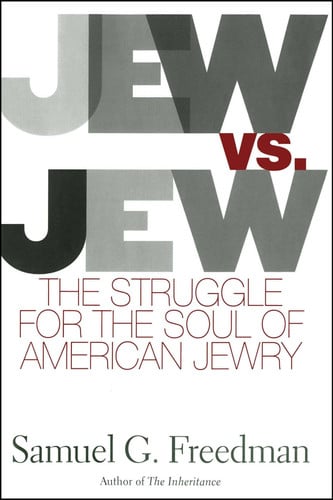
Jew Vs Jew The Struggle For The Soul Of American Jewry

Samuel G. Freedman
At a time when American Jews should feel more secure and cohesive than ever, civil war is tearing apart their community. Congregations, neighborhoods, even families are taking sides in battles about Jewish identity and Jewish authenticity. The conflict pits fundamentalist against secularist, denomination against denomination, even liberal against conservative within each branch of Jewry. Jew vs. Jew tells the story of how American Jewry has increasingly -- and perhaps terminally -- broken apart in the last forty years. Jew vs. Jew stretches in time from 1960 to 2000. It travels the country from Florida to New England, from Los Angeles to the Catskills in New York, from Cleveland to Denver, and it also crosses the ocean to Israel to show how tensions within the Jewish state inflame those among American Jews. The flash-points range from conversion standards to the role of women, from the peace process in Israel to the sexual climate on an Ivy League campus. But behind them all, as Samuel Freedman writes, lie common causes. First, far from unifying American Jews, Israel now divides them on both political and religious grounds. Second, neither America nor the larger world presents Jews with a single enemy against whom to coalesce. Third, and most important, nothing in the Jewish history of persecution, oppression, and exile prepared the Chosen People for the challenge posed by America, the challenge of being absorbed into a tolerant and diverse nation, being accepted so thoroughly that the intermarriage rate tops 50 percent. Jew vs. Jew introduces readers to memorable places and characters. Freedman describes one of the final summers at a Labor Zionist camp in the Catskills whose brand of secular Jewishness is becoming obsolete because Zionism succeeded in creating Israel. He tells the story of Orthodox and Reform Jews in a Cleveland suburb who are fighting about the construction of several synagogues -- and, on a deeper level, about whether unity or pluralism ought to be the goal of Jewish life. He portrays a Florida Jew so violently opposed to the Oslo peace accords that he planted a bomb in a synagogue where Shimon Peres was speaking. He tells about a Los Angeles congregation that spent three years debating whether or not to honor the Biblical matriarchs in its liturgy.We come to know the Long Island neighbors who cannot tolerate sharing even a property line because their versions of Jewish identity are so irreconcilably different. Jew vs. Jew is a work of vigorous reporting, lucid writing, and intellectual curiosity. And even as it chronicles an embittered and polarized community, it refuses to take sides or pass judgment. Instead, with compassion and acuity, Jew vs. Jew bears witness.
Simon & Schuster 2007-09-21 400 pages

Jewish emancipation: a history across five centuries

Sorkin, David Jan
The first comprehensive history of how Jews became citizens in the modern world For all their unquestionable importance, the Holocaust and the founding of the State of Israel now loom so large in modern Jewish history that we have mostly lost sight of the fact that they are only part of—and indeed reactions to—the central event of that history: emancipation. In this book, David Sorkin seeks to reorient Jewish history by offering the first comprehensive account in any language of the process by which Jews became citizens with civil and political rights in the modern world. Ranging from the mid-sixteenth century to the beginning of the twenty-first, Jewish Emancipation tells the ongoing story of how Jews have gained, kept, lost, and recovered rights in Europe, North Africa, the Middle East, the United States, and Israel. Emancipation, Sorkin shows, was not a one-time or linear event that began with the Enlightenment or French Revolution and culminated with Jews' acquisition of rights in Central Europe in 1867–71 or Russia in 1917. Rather, emancipation was and is a complex, multidirectional, and ambiguous process characterized by deflections and reversals, defeats and successes, triumphs and tragedies. For example, American Jews mobilized twice for emancipation: in the nineteenth century for political rights, and in the twentieth for lost civil rights. Similarly, Israel itself has struggled from the start to institute equality among its heterogeneous citizens. By telling the story of this foundational but neglected event, Jewish Emancipation reveals the lost contours of Jewish history over the past half millennium.
Princeton University Press 2021-09-14 511 pages

The Jewish past revisited: reflections on modern Jewish historians

David G. Myers,David N. Myers,Sady and Ludwig Kahn Professor of Jewish History David N Myers,David B. Ruderman,Rabbi David B Ruderman, PhD
In this new collection of essays, contemporary historians examine the ways earlier historians have framed, written, and "made" the Jewish past. Probing the ideology and methodology of their professional predecessors, American and Israeli historians offer new perspectives on some of the central figures of twentieth-century Jewish historiography, including Gershom Scholem, S. D. Goitein, Yitzhak Baer, Elias Bickerman, and Cecil Roth, as well as the Israeli "New Historians." Through their critical examinations of the construction of the Jewish past, the contributors to this volume develop important insights into current attitudes toward the dominant canons and ideals of historical scholarship and the future of historiography. They shine new light on the formation of a historical worldview and the "making" of history.
Yale University Press 1998 244 pages

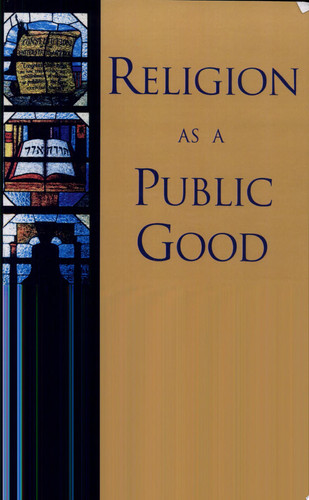
Religion as a public good: Jews and other Americans on religion in the public square

Alan Mittleman
Religion as a Public Good: Jews and Other Americans on Religion in the Public Square explores the often controversial topic of how religion ought to relate to American public life. The sixteen distinguished contributors, both Jewish and Christian, reflect on the topic out of their own disciplines-social ethics, political theory, philosophy, law, history, theology, and sociology. and take a stand based on their religious convictions and political beliefs. The volume is at once scholarly and committed, polemic and civil, reflective and activist. Written in the shadow of 9/11, it invites a new consideration of how religion enhances democratic public life with full awareness of the dangers that religion can sometimes pose. The volume is polemical, as befits the topic, but also civil, as befits a dialogue about an issue of profound significance for democratic citizenship.
Rowman & Littlefield 2003-12-09 336 pages

Jewish Theology Systematically and Historically Considered

Kaufmann Kohler
"The most important book on Jewish learning of this season, and one of the leading works published within the past few years....The work is a pioneer of its kind, in English as well as in other languages, in so far as it is a 'systematic' study of the subject....All other attempts made hitherto by German and other Jewish scholars at a presentation of Jewish theology have been of a limited scope....Kohler, on the other hand, through writing from the standpoint of the Reformer, does not refrain from giving the viewpoint of Orthodox or Conservative Judaism, which he endeavors to present fairly, howsoever much he disagrees with it....And never does Dr. Kohler better sustain his reputation as a scholar, nor use his vast learning to greater advantage, than in this splendid compendium of Jewish theology....Kohler's work covers the entire range of Jewish theological development, thus justifying its claim that it is a 'systematic' exposition of the subject where other works of a like nature dealt only with a partial survey. A mere glance at the table of contents reveals the immensity of the task performed, while a careful study of the book itself shows that the work is not only all-inclusive and exhaustive, but that it was executed with a charm and grace seldom to be met with in a work of so 'dry' a nature....The book is a truly valuable contribution to the treasure-house of Jewish learning for which its eminent author deserves the gratitude of the Jewish community. It is a book which will be read with pleasure and profit by student and layman alike." -The American Jewish Chronicle "In truth, Dr. Kohler's extended work of Jewish theology, the first of its kind, is an epoch-making contribution not only in the field of Jewish theological study, but also in the larger field of the study of comparative religion. Judging by the many favorable and even enthusiastic criticisms with which the book was received by scholars in the non-Jewish world, we are justified in believing that this work was, and will be instrumental in no small degree in correcting the utterly vicious and false view of Jewish theology, broadcasted in Christian circles.... Father Time often rectifies the encomiastic estimates made of living men so that men who were exalted in their day sink into insignificance and sometimes into oblivion with the passing of those who knew them. In the case of Dr. Kohler, I believe, that we may say, even now, that in the light of his signal and path-finding contributions in the field of Jewish scholarship, his eminence as a scholar in Israel will not be fugitive." -Hebrew Union College Monthly "Of all branches of Jewish study theology was hitherto the most neglected one. While here and there articles were written dealing with certain theological problems, no comprehensive book covering the entire field of Jewish theology and presenting a systematic treatment of the fundamental beliefs and doctrines of Judaism has heretofore appeared. Dr. Kohler's book is the first attempt in this direction....The method of Dr. Kohler in treating the subject of Jewish theology is a very excellent one and should be take as a starting point by future writers on the subject. He divides the subject into three parts God, where all questions relating to God, his nature and relation to the world are discussed; Man, dealing with man's relation to God and the world; and Israel and the Kingdom of God, describing the Jewish Mission and the destiny of Israel in history...The great scholarship displayed in it, the warmth and enthusiasm, the beautiful and simple style...and the zeal and earnestness, as well as the store of knowledge on traditional theology contained in it, will always serve as a source of inspiration to all those who respect earnestness and scholarship no matter how much their opinions may differ from the author's." -The Jewish Forum
CreateSpace Independent Publishing Platform 2017-12-19 588 pages

Modern Orthodox Judaism: a documentary history

Eleff, Zev
Modern Orthodox Judaism offers an extensive selection of primary texts documenting the Orthodox encounter with American Judaism that led to the emergence of the Modern Orthodox movement. Many texts in this volume are drawn from episodes of conflict that helped form Modern Orthodox Judaism. These include the traditionalists’ response to the early expressions of Reform Judaism, as well as incidents that helped define the widening differences between Orthodox and Conservative Judaism in the early twentieth century. Other texts explore the internal struggles to maintain order and balance once Orthodox Judaism had separated itself from other religious movements. Zev Eleff combines published documents with seldom-seen archival sources in tracing Modern Orthodoxy as it developed into a structured movement, established its own institutions, and encountered critical events and issues—some that helped shape the movement and others that caused tension within it. A general introduction explains the rise of the movement and puts the texts in historical context. Brief introductions to each section guide readers through the documents of this new, dynamic Jewish expression.
Jewish Publication Society 2016-07-01 520 pages