

41 results for "American History"

Fatal Embrace Christians, Jews, and the Search for Peace in the Holy Land
Author Mark Braverman shows how the Jewish quest for safety and empowerment and the Christian endeavor to atone for centuries of anti-Semitism have combined to suppress the conversations needed to bring about a just and lasting peace in the Holy Land. Fatal Embrace charts Braverman's journey as an American Jew struggling with the difficult realities of modern Israel. The book vividly describes the spiritual and psychological forces driving the discourse and is a call to action to Americans of all faiths.

Faith or Fear How Jews Can Survive in a Christian America
From Simon & Schuster, Faith or Fear is Elliott Abrams' guide to how Jews can survive in a Christian America. "In an erudite and fascinating way, Elliott Abrams explores the immense but amazingly under-appreciated changes in Christian attitudes towards Jews as well as the failure of communication between orthodox and more secular Jews, arguing that American Jewry can only survive as a 'religious' community." —Edward Koch, former mayor of New York City

A nation dedicated to religious liberty: the constitutional heritage of the religion clauses
Here is a concise overview of the historical development and judicial interpretation of the First Amendment religion clauses. It begins with a survey of the history of American religious liberty, goes on to present the views of the Founding Fathers, and then considers the core value of religious liberty and the constitutional purposes that implement that value. the book ends on a practical note by applying these principles to questions of equal access, religious symbolism in public life, and the task of defining religion for constitutional purposes. As the authors note in their introduction, "the historical principles that animate the religion clauses are more than an abstract intellectual exercise. . . . They provide an essential context for guiding the resolution of modern religious liberty issues."

Jacob's Voices Reflections of a Wandering American Jew
An American professor of history finds his roots in a personal journey through Israel -- and through assimilated America, academia, baseball, and family -- headlong into deep tensions and ambivalence about country, culture, identity and religion. Worried about the commitment of Jews to their heritage, Jerold Auerbach (renowned author of Unequal Justice) shares his story and musings with insight, irony, and intensity. A personal journey, literally and spiritually, to Israel by one of the most recognized legal historians in the United States.

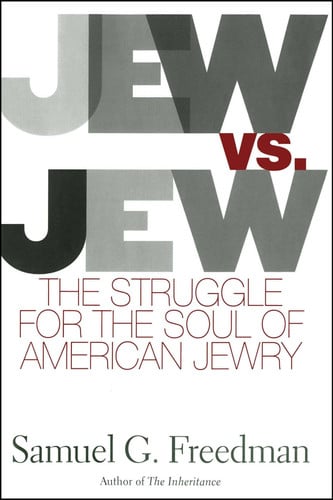
Jew Vs Jew The Struggle For The Soul Of American Jewry
At a time when American Jews should feel more secure and cohesive than ever, civil war is tearing apart their community. Congregations, neighborhoods, even families are taking sides in battles about Jewish identity and Jewish authenticity. The conflict pits fundamentalist against secularist, denomination against denomination, even liberal against conservative within each branch of Jewry. Jew vs. Jew tells the story of how American Jewry has increasingly -- and perhaps terminally -- broken apart in the last forty years. Jew vs. Jew stretches in time from 1960 to 2000. It travels the country from Florida to New England, from Los Angeles to the Catskills in New York, from Cleveland to Denver, and it also crosses the ocean to Israel to show how tensions within the Jewish state inflame those among American Jews. The flash-points range from conversion standards to the role of women, from the peace process in Israel to the sexual climate on an Ivy League campus. But behind them all, as Samuel Freedman writes, lie common causes. First, far from unifying American Jews, Israel now divides them on both political and religious grounds. Second, neither America nor the larger world presents Jews with a single enemy against whom to coalesce. Third, and most important, nothing in the Jewish history of persecution, oppression, and exile prepared the Chosen People for the challenge posed by America, the challenge of being absorbed into a tolerant and diverse nation, being accepted so thoroughly that the intermarriage rate tops 50 percent. Jew vs. Jew introduces readers to memorable places and characters. Freedman describes one of the final summers at a Labor Zionist camp in the Catskills whose brand of secular Jewishness is becoming obsolete because Zionism succeeded in creating Israel. He tells the story of Orthodox and Reform Jews in a Cleveland suburb who are fighting about the construction of several synagogues -- and, on a deeper level, about whether unity or pluralism ought to be the goal of Jewish life. He portrays a Florida Jew so violently opposed to the Oslo peace accords that he planted a bomb in a synagogue where Shimon Peres was speaking. He tells about a Los Angeles congregation that spent three years debating whether or not to honor the Biblical matriarchs in its liturgy.We come to know the Long Island neighbors who cannot tolerate sharing even a property line because their versions of Jewish identity are so irreconcilably different. Jew vs. Jew is a work of vigorous reporting, lucid writing, and intellectual curiosity. And even as it chronicles an embittered and polarized community, it refuses to take sides or pass judgment. Instead, with compassion and acuity, Jew vs. Jew bears witness.
From Suburb to Shtetl The Jews of Boro Park
"From Suburb to Shtetl" is an outstanding ethnography that moves beyond simple demographics. Mayer weaves an intricate tapestry of how family, school, and community leaders influence each other. Whether discussing the role of the rebbe or the matchmaker, those who know these communities will find what he says as relevant today as it was when first penned. This is hardly surprising, for the ultra-Orthodox community takes great pride in not changing, in maintaining itself as it was in Europe despite the allure of modern American society. His discussion of synagogue life is particularly informative and evocative. Those in charge of helping immigrants adopted the path of least resistance, allowing and even encouraging them to retain their identities except for those few aspects that might threaten the country's national interests. The American Orthodox community was tremendously augmented by the arrival from Europe, after World War Two, of thousands of Orthodox Jews who remained devoted to that way of life. Egon Mayer was himself part of a smaller, but significant group of Jews who came to the U.S. and settled mostly in Boro Park in the wake of the 1956 Hungarian Revolution. The interaction between the Hasidim and their less fervent Orthodox counterparts described and analyzed in this volume tells us a great deal about how people negotiate their beliefs, values, and norms when forced into close contact with each other in an urban setting within the larger American culture. By exploring these and many other related issues Mayer has given us the chance to assess and forecast the future of American Jewish life as a whole.

Explorers in Eden Pueblo Indians and the Promised Land
Beginning in the late nineteenth century, the pueblos of the Southwest frequently inspired Anglo-American visitors to express their sense of wonder and enchantment in biblical references. Frank Hamilton Cushing's first account of Zuni pueblo described a setting that looked like "The Pools of Palestine." Drawn to the Southwest, Mabel Dodge imagined "a garden of Eden, inhabited by an unfallen tribe of men and women." There she was attracted to Tony Luhan, a Taos Indian who looked "like a Biblical figure." When historian Jerold Auerbach first saw Edward S. Curtis's early twentieth-century photograph Taos Water Girls , he realized that "here, indeed, was the biblical Rebecca, relocated to New Mexico from ancient Haran, where Abraham's faithful servant had journeyed to find a suitable wife for Isaac. Rebecca with her water pitcher is as familiar a biblical icon as Noah and his ark or Moses with the stone tablets. Curtis had recast her as the archetypal Pueblo maiden." Explorers in Eden uncovers an intriguing array of diaries, letters, memoirs, photographs, paintings, postcards, advertisements, anthropological field studies, and scholarly monographs. They reveal how Anglo-Americans disenchanted with modern urban industrial society developed a deep and rich fascination with pueblo culture through their biblical associations.

Early American Jews
No detailed description available for "Early American Jews".
The Other 1492 Jewish Settlement in the New World
Mention 1492 and most people conjure up images of three stout ships making their way west. But 1492 was the year in which the vibrant Jewish community of Spain came to an abrupt and tragic end. This book details the expulsion of the Jews from Spain and Portugal and their early immigration to the New World. European anti-Semitism followed the Jews but the newcomers persevered and made a home for themselves in the New World. Starred Review and Editor’s Choice, Booklist, NCCS/CBC Notable Children’s Trade Book and American Bookseller Pick of the Lists, 1990.

The American Jew As Patriot, Soldier and Citizen
Published in 1895, this is the history of Jews who served in the military, including the American Revolution, Civil War, both Union and Confederate, Latin America and Europe. Includes lists of soldiers and what military organizations they served in.

On pagans, Jews, and Christians
'On Pagans, Jews, and Christians' is an important addition to his masterly work, bringing together nineteen essays written in the past five years from sources such as The New York Review of Books, The American Scholar, and the Annali della Scuola Normale Superiore di Pisa. It is written with literate clarity and elegance, humane wisdom, and breadth of intellect. The focus of this book is the secular cultures of pagan Greece and imperial Rome, and the religious cultures of Judaism and Christianity which, in turn, grew from and influenced them and the modern world. For Momigliano, religion, secular ideology, and politics live in and illuminate the present. Chapters include “The Jews of Italy” (history viewed in the autobiographical perspective of the Momigliano family), “The Disadvantages of Monotheism for a Universal State,” “How to Reconcile Greeks and Trojans,” and “The Theological Efforts of the Roman Upper Classes in the First Century B.C.

A History of the Jews in England
Albert M. Hyamson (1875-1954) was born in London. After attending Beaufort College, he started working for the post office in 1895. Once World War I broke out, Hyamson began writing a great deal in support of Zionism, much of it published by the British Palestine Committee and media outlets like the New Statesman. By 1917, Hyamson became the editor of The Zionist Review. Then Hyamson he became active in Department of Information's Jewish Bureau, and among other things, wrote for The American Hebrew and American Jewish Chronicle, to drum up interest in Zionism. Hyamson began working for the Administration of Palestine and was in charge of immigration applications. However, since he refused to let anyone else assist with the work, he single-handedly created a backlog of nearly a year, until he was replaced. Hyamson moved into making policy and working with the tenuous position that Jews, Arabs and others in Palestine found themselves in. He helped created the Hyamson-Newcome proposal in 1937 which proposed a independent Palestinian state which gave full autonomy to all citizens, recognized Arab ownership of the area, and allowed for Jewish immigration to rise to 50% of the total population. This was rejected by some Zionist leaders, but Hymanson went on to write and advocate against political Zionism and was one of the seven founders of The Jewish Fellowship. He continued to seek out Jewish-Arab co-operation for a unified Palestine, but his efforts were continually rebuffed. He wrote a great deal on other topics, including: A Dictionary of Artists and Art Terms (1906), The Humour of the Post Office (1909), Palestine Old and New (1928), and A Dictionary of International Affairs (1946). This new edition is dedicated to the memory of Seymour Martin Lipset, great scholar and teacher.

American Religion.

Dissenter in Zion From the Writings of Judah L. Magnes
For nearly half a century, until his death in October 1948, Judah Magnes occupied a singular place in Jewish public life. He won fame early as a preacher and communal leader, but abandoned these pursuits at the height of his influence for the roles of political dissenter and moral gadfly. During World War I he became an outspoken pacifist and supporter of radical causes. Settling permanently in Palestine in 1922, he was a founder and the first president of the Hebrew University. Increasingly, he viewed rapprochement with the Arabs as the practical and moral test of Zionism, and the formation of a bi-national state of Arabs and Jews became his chief political goal. His life interests thus focused on the core issues that confronted and still confront the Jewish people: group survival in democratic America, the direction and character of the return to Zion, and the reconciliation of universal ideals with Jewish aspirations and needs. Dissenter in Zion draws upon a rich corpus of private letters, personal journals, and diaries to offer a moving account of an eloquent and sensitive person grappling with the great questions of the day and of an activist striving to translate private moral feelings into public deeds through politics and diplomacy. We see Magnes disagreeing with Brandeis over the leadership and direction of American Zionism and with Weizmann and Ben-Gurion over ways to achieve peaceful relations with the Arabs; defending himself against charges by Einstein that he was mismanaging the affairs of the Hebrew University; and persistently negotiating with Arab leaders, trying to reach a compromise on the eve of the establishment of the State of Israel. Dissenter in Zion also contains a biographical essay on Magnes by Arthur Goren, assessing his ideas and motives and placing him in the context of his times. It shows Magnes's profundity without covering up his weaknesses, his lifelong tactic for courting repeated defeat in favor of long-term goals that could not come to pass in his lifetime.

Selected Writings of Isaac M. Wise
With our American Philosophy and Religion series, Applewood reissues many primary sources published throughout American history. Through these books, scholars, interpreters, students, and non-academics alike can see the thoughts and beliefs of Americans who came before us.

The Chosen People in America A Study in Jewish Religious Ideology
"This is a book of extraordinary quality and importance. In tracing the encounter of Jews (the chosen people) and America (the chosen nation) . . Eisen has given the American Jewish community a new understanding of itself." —American Jewish Archives ". . . one of the most significant books on American Jewish thought written in recent years." —Choice What does it mean to be a Jew in America? What opportunities and what threats does the great melting pot represent for a group that has traditionally defined itself as "a people that must dwell alone"? Although for centuries the notion of "The Chosen People" sustained Jewish identity, America, by offering Jewish immigrants an unprecedented degree of participation in the larger society, threatened to erode their Jewish identity and sense of separateness. Arnold M. Eisen charts the attempts of American Jewish thinkers to adapt the notion of chosenness to an American context. Through an examination of sermons, essays, debates, prayer-book revisions, and theological literature, Eisen traces the ways in which American rabbis and theologians—Reconstructionist, Conservative, and Orthodox thinkers—effected a compromise between exclusivity and participation that allowed Jews to adapt to American life while simultaneously enhancing Jewish tradition and identity.

My Life and Loves in Greenwich Village
My Life And Loves In Greenwich Village is a memoir written by Maxwell Bodenheim, an American poet and novelist who lived in the bohemian neighborhood of Greenwich Village in New York City during the early 20th century. The book is a candid account of Bodenheim's personal and professional life, detailing his struggles as a struggling writer, his relationships with women, and his experiences with drugs and alcohol. Bodenheim describes the colorful characters and events that defined the Greenwich Village scene during his time there, including the rise of modernist art and literature, the emergence of jazz music, and the social and political movements of the era. The book also provides insights into the author's own creative process, as he discusses his writing techniques and the inspiration behind his work.Overall, My Life And Loves In Greenwich Village is a fascinating glimpse into the bohemian lifestyle of early 20th century New York City, as seen through the eyes of one of its most talented and troubled writers.This scarce antiquarian book is a facsimile reprint of the old original and may contain some imperfections such as library marks and notations. Because we believe this work is culturally important, we have made it available as part of our commitment for protecting, preserving, and promoting the world's literature in affordable, high quality, modern editions, that are true to their original work.

Jews of the American West
In a series of nine original essays, the editors and other leading American historians bring dramatically new perspectives to bear on our understanding of the West, its Jews, and other Americans, both old and new. Whether comparing the history of the Jews of the West with the Jewish experience in the older regions of the country or bringing attention to the uniquely local aspects of the western experience, the contributors to this landmark volume perceive the West as an increasingly important and vital presence in the nation's history. The agrarians of Utah's Clarion and the cureseekers of Denver, no less than the boomers of Tucson, have been representative Americans, Jews, and westerners. Essays on the role of intermarriage, the shared encounter of immigrants and migrants, and the response to the founding of the State of Israel by western pioneer families, tell us much about the interaction of the West with our American world nation.

Israel at the Polls 2009
This book describes political and sociological developments in Israel before and after the February 2009 elections, alongside an analysis of electoral trends. It provides an effective analysis of contemporary political and sociological Israeli history. Rather than focusing narrowly on electoral politics alone, this book broadens its focus to make it relevant to undergraduate and graduate students in Middle Eastern, Israeli and Jewish studies and the liberal arts. Israel at the Polls has been updated and published annually for thirty years, providing readers with up-to-date analysis and continuity of scholarship; this book offers an expert long-term assessment of Israeli politics. This book was published as a special issue of Israel Affairs.
