42 results for "American History"

Baseball rebels: the players, people, and social movements that shook up the game and changed America

Dreier, Peter,Elias, Robert,Zirin, Dave
"Baseball Rebels tells stories of reformers and radicals who were influenced by, and in turn influenced, America's broader political and social protest movements, including battles against racism, corporate control, worker exploitation, sexism and homophobia, and American militarism"--
University of Nebraska Press 2022-04 370 pages

Death and the idea of Mexico

Lomnitz-Adler, Claudio
Death and the Idea of Mexico is the first social, cultural, and political history of death in a nation that has made death its tutelary sign. Examining the history of death and of the death sign from the sixteenth-century holocaust to contemporary Mexican American identity politics, anthropologist Claudio Lomnitz’s innovative study marks a turning point in understanding Mexico’s rich and unique use of death imagery. Unlike contemporary Europeans and Americans, whose denial of death permeates their cultures, the Mexican people display and cultivate a jovial familiarity with death. This intimacy with death has become the cornerstone of Mexico’s national identity. It is tempting to view this rich elaboration of death imagery as yet another example of an “invented tradition,” that is, a cult shaped by the modern state’s cultural policies or by the narrow interests of contemporary identity politics. Lomnitz takes a different approach. Rather than flattening out the tradition by insisting only on the ways it is willfully manipulated, this book focuses on the dialectical relationship between dying, killing, and the administration of death, and the very formation of the colonial state, of a rich and variegated popular culture, and of the Mexican nation itself. The elevation of Mexican intimacy with death to the center of national identity is but a moment within that history ― within a history in which the key institutions of society are built around the claims of the fallen. Based on a wide range of sources ― from missionary testimonies to newspaper cartoons, from masterpieces of artistic vanguards to accounts of public executions and political assassinations ― Death and the Idea of Mexico moves beyond the limited methodology of traditional historiographies of death to probe the depths of a people and a country whose fearless acquaintance with death shapes the very terms of their social compact. This work effects a novel turn in the classical historiography of death ― a turn that can be characterized by a move from social and cultural history to political history. The move toward the politics of death gives readers a unique insight into the peculiar story of death in the Americas.
Zone Books 2005-10-07 581 pages

From a cause to a style: modernist architecture's encounter with the American city

Glazer, Nathan
Modernism in architecture and urban design has failed the American city. This is the decisive conclusion that renowned public intellectual Nathan Glazer has drawn from two decades of writing and thinking about what this architectural movement will bequeath to future generations. In From a Cause to a Style , he proclaims his disappointment with modernism and its impact on the American city. Writing in the tradition of legendary American architectural critics Lewis Mumford and Jane Jacobs, Glazer contends that modernism, this new urban form that signaled not just a radical revolution in style but a social ambition to enhance the conditions under which ordinary people lived, has fallen short on all counts. The articles and essays collected here--some never published before, all updated--reflect his ideas on subjects ranging from the livable city and public housing to building design, public memorials, and the uses of public space. Glazer, an undisputed giant among public intellectuals, is perhaps best known for his writings on ethnicity and social policy, where the unflinching honesty and independence of thought that he brought to bear on tough social questions has earned him respect from both the Left and the Right. Here, he challenges us to face some difficult truths about the public places that, for better or worse, define who we are as a society. From a Cause to a Style is an exhilarating and thought-provoking book that raises important questions about modernist architecture and the larger social aims it was supposed to have addressed-and those it has abandoned.
Princeton University Press 2007-03-12 300 pages

Forces of production: a social history of industrial automation

Noble, David F.
Focusing on the design and implementation of computer-based automatic machine tools, David F. Noble challenges the idea that technology has a life of its own. Technology has been both a convenient scapegoat and a universal solution, serving to disarm critics, divert attention, depoliticize debate, and dismiss discussion of the fundamental antagonisms and inequalities that continue to beset America. This provocative study of the postwar automation of the American metal-working industry—the heart of a modern industrial economy—explains how dominant institutions like the great corporations, the universities, and the military, along with the ideology of modern engineering shape, the development of technology. Noble shows how the system of "numerical control," perfected at the Massachusetts Institute of Technology (MIT) and put into general industrial use, was chosen over competing systems for reasons other than the technical and economic superiority typically advanced by its promoters. Numerical control took shape at an MIT laboratory rather than in a manufacturing setting, and a market for the new technology was created, not by cost-minded producers, but instead by the U. S. Air Force. Competing methods, equally promising, were rejected because they left control of production in the hands of skilled workers, rather than in those of management or programmers. Noble demonstrates that engineering design is influenced by political, economic, managerial, and sociological considerations, while the deployment of equipment—illustrated by a detailed case history of a large General Electric plant in Massachusetts—can become entangled with such matters as labor classification, shop organization, managerial responsibility, and patterns of authority. In its examination of technology as a human, social process, Forces of Production is a path-breaking contribution to the understanding of this phenomenon in American society.
Transaction Publishers 2011 409 pages

Make me commissioner: I know what's wrong with baseball and how to fix it

Leavy, Jane
Jane Leavy has always loved baseball. Her grandmother lived one long, loud foul ball away from Yankee Stadium--the same grandmother who took young Jane to Saks Fifth Avenue and bought her her first baseball glove. It's no coincidence that Leavy was covering the game she loved for the Washington Post by the late 1970s. As a pioneering female sportswriter, she eventually turned her talent to books, penning three of the all-time best baseball biographies about three of the all-time best players: Sandy Koufax, Mickey Mantle, and Babe Ruth. But when she went searching for a fourth biographical subject, she realized that baseball had faltered. The Moneyball era of the last two decades obsessed over data and slowed the game down to a crawl, often at the expense of thrills, skills, and surprise. Major League Baseball has begun to address issues too long ignored, yet the questions linger: how much have these efforts helped to improve the game and reassert its place in American culture? Leavy takes a whirlwind tour of the country seeking answers to these questions, talking with luminaries like Joe Torre, Dave Roberts, Jim Palmer, Dusty Baker, and more. What Leavy uncovers is not only what's wrong with baseball--and how to fix it--but also what's right with baseball, and how it illuminates characters, tells stories, and fires up the imagination of those who love it and everyone who could discover it anew.
Grand Central Publishing 2025-09-09 369 pages

The knowledge deficit: closing the shocking education gap for American children

Hirsch, E. D. Jr.
Hirsch shows why American students perform less well than students in other industrialized countries. Drawing on classroom observation, the history of ideas, and current scientific understanding of the patterns of intellectual growth, he builds the case that our schools have indeed made progress in teaching the mechanics of reading, but do not convey the more complex and essential content needed for reading comprehension. Hirsch reasons that literacy depends less on formal reading 'skills' and more on exposure to rich knowledge. His argument gives parents specific tools for enhancing their child's ability to read with comprehension; shows how No-Child-Left-Behind tests and SATs are measuring a kind of knowledge that is not being taught in our schools; and maps out how American schools can become a strong antidote to poverty and to the race-based achievement gap, and thus fulfill our democratic ideal for our children.--From publisher description.
Houghton Mifflin 2006 169 pages

Bike lust: women, Harleys, and American society

Joans, Barbara
Bike Lust roars straight into the world of women bikers and offers us a ride. In this adventure story that is also an insider’s study of an American subculture, Barbara Joans enters as a passenger on the back of a bike, but soon learns to ride her own. As an anthropologist she untangles the rules, rituals, and rites of passage of the biker culture. As a new member of that culture, she struggles to overcome fear, physical weakness, and a tendency to shoot her mouth off—a tendency that very nearly gets her killed. Bike Lust travels a landscape of contradictions. Outlaws still chase freedom on the highway, but so do thousands of riders of all classes, races, and colors. Joans introduces us to the women who ride the rear—the biker chick, the calendar slut straddling the hot engine, the back-seat Betty at the latest rally, or the underage groupie at the local run. But she also gives us the first close look at women who ride in their own right, on their own bikes, as well as a new understanding of changing world of male bikers. These are ordinary women’s lives made extraordinary, adding a dimension of courage to the sport not experienced by males, risking life and limb for a glimpse of the very edge of existence. This community of riders exists as a primal tribute to humanity's lust for freedom.
University of Wisconsin Press 2001 271 pages

Mixing races: from scientific racism to modern evolutionary ideas

Farber, Paul Lawrence
This book explores changing American views of race mixing in the twentieth century, showing how new scientific ideas transformed accepted notions of race and how those ideas played out on college campuses in the 1960s. In the 1930s, it was not unusual for medical experts to caution against miscegenation, or race mixing, espousing the common opinion that it would produce biologically dysfunctional offspring. By the 1960s the scientific community roundly refuted this theory. The author traces this revolutionary shift in scientific thought, explaining how developments in modern population biology, genetics, and anthropology proved that opposition to race mixing was a social prejudice with no justification in scientific knowledge. In the 1960s, this new knowledge helped to change attitudes towards race and discrimination, especially among college students. Their embrace of social integration caused tension on campuses across the country. Students rebelled against administrative interference in their private lives, and university regulations against interracial dating became a flashpoint in the campus revolts that revolutionized American educational institutions. The author's provocative study is a personal one, featuring interviews with mixed-race couples and stories from the author's student years at the University of Pittsburgh. As such, this book offers a unique perspective on how contentious debates taking place on college campuses reflected shifts in race relations in the larger society. -- from Back Cover
Johns Hopkins University Press 2011-02-01 120 pages

The genius of the beast: a radical re-vision of capitalism

Bloom, Howard K.
Is global capitalism on its last legs? Is the era of American leadership over? Has the West begun a decline into a new Dark Age? Does American civilization deserve to survive? These are the unnerving questions raised by the Great Crash of 2009. This book presents a radically new answer, insisting that global society has only begun to realize its full potential. Author HowardBloom argues that there's a hidden mandate beneath the surface of capitalism: "It's struggling to whisper and rumble its message to you and me. That hidden imperative can lift us from economic crisis, can make us a leader in the next-generation economy, and can dramatically upgrade our ability to empower our fellow human beings." Bloom sees crisis as opportunity, opportunity for the whole human race.In more than eighty short, fast chapters, insights appear suddenly, like the quick bursts of flashbulbs, taking the reader on a sweeping tour of human history, from the Stone Age to the present. Every chapter conveys a radically new way to see the astonishing mechanism we call "Western Civilization." Bloom marvels at how humans have turned toxic waste into food and fuel, trash into treasure, and garbage into gold. He shows how we've produced material miracles based on immaterial things-passion, persistence, and fantasy. He shows that what many regard as the end is just the beginning. The beginning of something you've never before imagined. The author explains why the secret to capitalism's next great leap does not lie in new financial tricks, but in tapping things right under our noses in radically new ways-that is, tapping our imagination, our desire to feel useful, our desire to help others, and our desire to be recognized for contributing to the welfare of humanity. The key to next-generation capitalism lies in a big-picture view that's utterly unlike anything you've previously perceived. A big-picture view that will startle you. A big-picture view with which you can ignite the world, get a new handle on your life, and help transform society. This brilliant, inspirational work of daring ideas and breathtaking research offers more than hope. It offers unseen levels of understanding. Understanding that can literally redefine what it means to be a human being.
Prometheus Books 2010 607 pages

This man's pill: reflections on the 50th birthday of the pill

Djerassi, Carl
October 15, 1951 marks the birthday of one of the key episodes in 20th century social history: the first synthesis of a steroid oral contraceptive in a small laboratory in Mexico City - an event that triggered the development of the Pill. Carl Djerassi has been honoured worldwide for that accomplishment, which ultimately changed the life of women and the nature of human reproduction in ways that were not foreseeable. On the 50th anniversary of this pivotal event, Djerassi weaves a compelling personal narrative full of self-reflection and occasional humour on the impact this invention has had on the world at large and on him personally. He credits the Pill with radically altering his academic career at Stanford University to become one of the few American chemists writing novels and plays. This Man's Pill presents a forcefully revisionist account of the early history of the Pill, debunking many of the journalistic and romantic accounts of its scientific origin. Djerassi does not shrink from exploring why we have no Pill for men or why Japan only approved the Pill in 1999 (together with Viagra). Emphasizing that development of the Pill occurred during the post-War period of technological euphoria, he believes that it could not be repeated in today's climate. Would the sexual revolution of the 1960s or the impending separation of sex ("in bed") and fertilization ("under the microscope") still have happened? This Man's Pill answers such questions while providing a uniquely authoritative account of a discovery that changed the world.
Oxford University Press 2003 308 pages

The culture of the Cold War

Whitfield, Stephen J.
"Without the Cold War, what's the point of being an American?" As if in answer to this poignant question from John Updike's Rabbit at Rest , Stephen Whitfield examines the impact of the Cold War—and its dramatic ending—on American culture in an updated version of his highly acclaimed study. In a new epilogue to this second edition, he extends his analysis from the McCarthyism of the 1950s, including its effects on the American and European intelligensia, to the civil rights movement of the 1960s and beyond. Whitfield treats his subject matter with the eye of a historian, reminding the reader that the Cold War is now a thing of the past. His treatment underscores the importance of the Cold War to our national identity and forces the reader to ask, Where do we go from here? The question is especially crucial for the Cold War historian, Whitfield argues. His new epilogue is partly a guide for new historians to tackle the complexities of Cold War studies.
Johns Hopkins University Press 1996-05-19 275 pages

Slavery, resistance, freedom

G. S. Boritt,Scott Hancock
Americans have always defined themselves in terms of their freedoms--of speech, of religion, of political dissent. How we interpret our history of slavery--the ultimate denial of these freedoms--deeply affects how we understand the very fabric of our democracy. This extraordinary collection of essays by some of America's top historians focuses on how African Americans resisted slavery and how they responded when finally free. Ira Berlin sets the stage by stressing the relationship between how we understand slavery and how we discuss race today. The remaining essays offer a richly textured examination of all aspects of slavery in America. John Hope Franklin and Loren Schweninger recount actual cases of runaway slaves, their motivations for escape and the strains this widespread phenomenon put on white slave-owners. Scott Hancock explores how free black Northerners created a proud African American identity out of the oral history of slavery in the south. Edward L. Ayers, William G. Thomas III, and Anne Sarah Rubin draw upon their remarkable Valley of the Shadow website to describe the wartime experiences of African Americans living on both borders of the Mason-Dixon line. Noah Andre Trudeau turns our attention to the war itself, examining the military experience of the only all-black division in the Army of the Potomac. And Eric Foner gives us a new look at how black leaders performed during the Reconstruction, revealing that they were far more successful than is commonly acknowledged--indeed, they represented, for a time, the fulfillment of the American ideal that all people could aspire to political office. Wide-ranging, authoritative, and filled with invaluable historical insight, Slavery, Resistance, Freedom brings a host of powerful voices to America's evolving conversation about race.
Oxford University Press 2009 165 pages

Acting in the night: Macbeth and the places of the Civil War

Nemerov, Alexander
"Alexander Nemerov is one of the greatest readers of American visual culture. This book has the revelatory power that only wide-ranging curiosity and true independence of mind can achieve." Richard H. Brodhead President of Duke University and author of Cultures of Letters: Scenes of Reading and Writing in Nineteenth-Century America ; "A benchmark in the writing of art history and in studies of the Civil War, Acting in the Night occupies a category unto itself. It uniquely immerses the reader in a holistic experience of the Civil War and shows Nemerov as a cosummate stylist in the field of American art history."Kathleen Pyne author of Modernism and the Feminine Voice ; "This is a work of criticism that borders on poetry, a brilliant and extremely original book that invites us to rethink to the artistic world we study."Julia Reinhard Lupton author of Thinking with Shakespeare: Essays on Politics and Life ; What can the performance of a single play on one night tell us about the world this event inhabited so briefly? Alexander Nemerov takes a performance of Macbeth in Washington, D.C., on October 17, 1863--with Abraham Lincoln in attendance--to explore this question and illuminate American art, politics, technology, and life as it was being lived. Nemerov's inspiration is Wallace Stevens and his poem "Anecdote of the Jar,"in which a single object organizes the wilderness around it. For Nemerov, that evening's performance of Macbeth reached across the tragedy of civil war to acknowledge the horrors and emptiness of a world it tried and ultimately failed to change. --Book Jacket
University of California Press 2010-09-01 299 pages

Ballet class: an American history

Klapper, Melissa R.
Surveying the state of American ballet in a 1913 issue of Clure's Magazine, author Willa Cather reported that few girls expressed any interest in taking ballet class and that those who did were hard-pressed to find anything other than dingy studios and imperious teachers. One hundred years later, ballet is everywhere. Beginning with the arrival of Russian dancers like Anna Pavlova, who first toured the United States on the eve of World War I, 'Ballet Class: An American History' explores the growth of ballet from an ancillary part of nineteenth-century musical theater, opera, and vaudeville to the quintessential extracurricular activity it is today, pursued by countless children nationwide and an integral part of twentieth-century American childhood across borders of gender, class, race, and sexuality. 0A social history, 'Ballet Class' takes a new approach to the very popular subject of ballet and helps ground an art form often perceived to be elite in the experiences of regular, everyday people who spent time in barre-lined studios across the United States. Drawing on a wide variety of materials, including children's books, memoirs by professional dancers and choreographers, pedagogy manuals, and dance periodicals, in addition to archival collections and oral histories, this pathbreaking study provides a deeply-researched national perspective on the history and significance of recreational ballet class in the United States and its influence on many facets of children's lives, including gender norms, consumerism, body image, children's literature, extracurricular activities, and popular culture
Oxford University Press 2020 403 pages

Why baseball matters

Jacoby, Susan
Baseball, first dubbed the "national pastime" in print in 1856, is the country's most tradition-bound sport. Despite remaining popular and profitable into the twenty-first century, the game is losing young fans, among African Americans and women as well as white men. Furthermore, baseball's greatest charm--a clockless suspension of time--is also its greatest liability in a culture of digital distraction. These paradoxes are explored by the historian and passionate baseball fan Susan Jacoby in a book that is both a love letter to the game and a tough-minded analysis of the current challenges to its special position--in reality and myth--in American culture. The concise but wide-ranging analysis moves from the Civil War--when many soldiers played ball in northern and southern prisoner-of-war camps--to interviews with top baseball officials and young men who prefer playing online "fantasy baseball" to attending real games. Revisiting her youthful days of watching televised baseball in her grandfather's bar, the author links her love of the game with the informal education she received in everything from baseball's history of racial segregation to pitch location. Jacoby argues forcefully that the major challenge to baseball today is a shortened attention span at odds with a long game in which great hitters fail two out of three times. Without sanitizing this basic problem, Why Baseball Matters remind us that the game has retained its grip on our hearts precisely because it has repeatedly demonstrated the ability to reinvent itself in times of immense social change.
Yale University Press 2018-01-01 200 pages

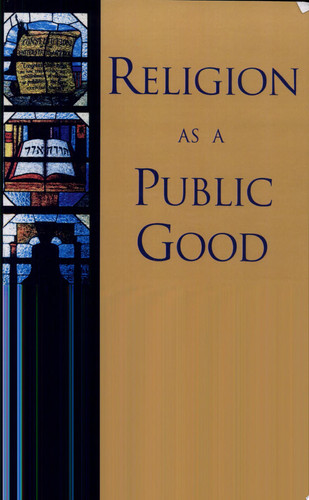
Religion as a public good: Jews and other Americans on religion in the public square

Alan Mittleman
Religion as a Public Good: Jews and Other Americans on Religion in the Public Square explores the often controversial topic of how religion ought to relate to American public life. The sixteen distinguished contributors, both Jewish and Christian, reflect on the topic out of their own disciplines-social ethics, political theory, philosophy, law, history, theology, and sociology. and take a stand based on their religious convictions and political beliefs. The volume is at once scholarly and committed, polemic and civil, reflective and activist. Written in the shadow of 9/11, it invites a new consideration of how religion enhances democratic public life with full awareness of the dangers that religion can sometimes pose. The volume is polemical, as befits the topic, but also civil, as befits a dialogue about an issue of profound significance for democratic citizenship.
Rowman & Littlefield 2003-12-09 336 pages