80 results for "Ancient Civilizations"

The earth chronicles expeditions: journeys to the mythical past

Sitchin, Zecharia
Zecharia Sitchin’s autobiographical recounting of a half century of investigative expeditions to unravel the enigmas of ancient civilizations and their gods • Includes vivid accounts of explorations in Greece, Thera, Crete, Egypt, the Sinai, Israel, Jordan, and Mesoamerica • Reveals behind-the-scenes findings in museums and archaeological sites • Contains 60 color and 159 black-and-white images from the author’s personal archive, including previously unpublished photographic evidence of UFOs in biblical times For the first time, Zecharia Sitchin, author of the bestselling The Earth Chronicles series, reveals the foundational research and adventurous expeditions that resulted in the concrete evidence for his conclusions that ancient myths were recollections of factual events, that the gods of ancient peoples were visitors to Earth from another planet, and that we are not alone in our own solar system. In the course of his investigations Sitchin also became convinced of the veracity of the Bible. Sitchin’s expeditions take readers from the Yucatan peninsula to the isle of Crete to ancient Egypt and the lands of the Bible as he explores the links between the Old World and the New World. His adventurous exploits reveal archaeological cover-ups concerning Olmec origins in Mexico and ancient UFO artifacts in Turkey. Other quests send him through the holy sites of Jerusalem, Jordan, Syria, and Lebanon in search of evidence of extraterrestrial gods in the artifacts and murals of these ancient civilizations. The Earth Chronicles Expeditions is a masterful historical and archaeological adventure into the origins of mankind and a “must” guidebook for all who wish to visit the numerous sites and museums covered in this book.
Bear & Co 2004-03-25 243 pages

Stories of the Babylonian Talmud

Rubenstein, Jeffrey L.
Jeffrey L. Rubenstein continues his grand exploration of the ancient rabbinic tradition of the Talmudic sages, offering deep and complex analysis of eight stories from the Babylonian Talmud to reconstruct the cultural and religious world of the Babylonian rabbinic academy. Rubenstein combines a close textual and literary examination of each story with a careful comparison to earlier versions from other rabbinic compilations. This unique approach provides insight not only into the meaning and content of the current forms of the stories but also into how redactors reworked those earlier versions to address contemporary moral and religious issues. Rubenstein's analysis uncovers the literary methods used to compose the Talmud and sheds light on the cultural and theological perspectives of the Stammaim — the anonymous editor-redactors of the Babylonian Talmud. Rubenstein also uses these stories as a window into understanding more broadly the culture of the late Babylonian rabbinic academy, a hierarchically organized and competitive institution where sages studied the Torah. Several of the stories Rubenstein studies here describe the dynamics of life in the academy: master-disciple relationships, collegiality and rivalry, and the struggle for leadership positions. Others elucidate the worldview of the Stammaim, including their perspectives on astrology, theodicy, and revelation.
Johns Hopkins University Press 2010-07-12 316 pages

Evolution and Culture

Marshall David Sahlins,Thomas G. Harding
About the Book Books about Civilization are concerned with the development of structured societies that grow to require urban planning, develop social and cultural elites, and forms of writing for record keeping, complex organization and transfer of ideas. Almost invariably, the process of civilization results in the growth of empires, and subjugation of less civilized peoples. Titles include: Ancient Man: The Beginning of Civilizations, Syllabus: Introduction to the History of European Civilization, Evolution and Culture, The Pivot of Civilization, The Western Hemisphere Idea: Its Rise and Decline, The decay of capitalist civilisation, and The fate of empires; being an inquiry into the stability of civilisation. About us Trieste Publishing's aim is to provide readers with the highest quality reproductions of fiction and non-fiction literature that has stood the test of time. Our titles are produced from scans of the original books and as a result may sometimes have imperfections. To ensure a high-quality product we have: thoroughly reviewed every page of all the books in the catalog repaired some of the text in some cases, and rejected titles that are not of the highest quality. You can look up "Trieste Publishing" in categories that interest you to find other titles in our large collection. Come home to the books that made a difference
Trieste Publishing Pty Limited 2017-09-26 156 pages

Sumerian Mythology

Samuel Noah Kramer
Samuel Noah Kramer (1897-1990) was an American Assyriologist and one of the foremost scholars in the field of Sumerian studies. He made significant contributions to the decipherment and understanding of ancient Mesopotamian texts and culture. In "Sumerian Mythology," Kramer provides a detailed exploration of the mythology and religious beliefs of the Sumerians. He examines the pantheon of Sumerian gods and goddesses, their attributes, roles, and relationships. The book also covers the creation myths, epic tales, and other mythological narratives from Sumerian literature. Kramer's work draws from a wide range of ancient Sumerian texts, including hymns, prayers, incantations, and mythological narratives. He provides translations and analysis of these texts, shedding light on the religious cosmology, rituals, and beliefs of the Sumerians. "Sumerian Mythology" has become a classic in the field of ancient Mesopotamian studies, offering valuable insights into the mythological worldview of one of the earliest civilizations in human history. It remains an essential reference for scholars and enthusiasts interested in Sumerian religion and mythology.
Zinc Read 2023-07-31 146 pages

Ancient Egyptian literature: a book of readings

Lichtheim, Miriam
First published in 1973 – and followed by Volume II in 1976 and Volume III in 1980 – this anthology has assumed classic status in the field of Egyptology and portrays the remarkable evolution of the literary forms of one of the world’s earliest civilizations. Volume I outlines the early and gradual evolution of Egyptian literary genres, including biographical and historical inscriptions carved on stone, the various classes of literary works written with pen on papyrus, and the mortuary literature that focuses on life after death. Introduced with a new foreword by Antonio Loprieno. Volume II shows the culmination of these literary genres within the single period known as the New Kingdom (1550-1080 B.C.). With a new foreword by Hans-W. Fischer-Elfert. Volume III spans the last millennium of Pharaonic civilization, from the tenth century B.C. to the beginning of the Christian era. With a new foreword by Joseph G. Manning.
University of California Press 2006-04-03 264 pages

Ancient Mesopotamia: portrait of a dead civilisation

Oppenheim, A. Leo
"Ancient Mesopotamia - the area now called Iraq - has received less attention than Ancient Egypt and other long-extinct and more spectacular civilizations. But numerous small clay tablets buried in the desert soil for thousands of years make it possible for us to know more about the people of ancient Mesopotamia than any other land in the early Near East. Professor Oppenheim, who has studied these tablets for more than thirty years, has used his intimate knowledge of long-dead languages to put together a distinctively personal picture of the Mesopotamians of some three thousand years ago. He outlines Babylonian and Assyrian history; discusses the social structure and psychology of the Mesopotamian people; describes their daily life, religion, literature, technology, and scientific tradition. This precise and unbiased presentation focuses on those unique cultural features of the ancient land that enabled the Mesopotamian civilization to last for more than three millennia. The result is a deft "portrait," a candid appraisal of the very essence of ancient Mesopotamia." --
The University of Chicago press 1964-04 433 pages

The Blue Hippopotamus

Phoebe Gilman,Joan Marshall Grant
Now in paperback - Phoebe Gilman and Joanne Fitzgerald's beautiful story about the transformative power of love. When a little hippo falls in love with an Egyptian princess, he hopes that a great magician can turn him into a human boy. Alas, even the magician can't perform such a feat! Instead, the magician turns him into a toy that the princess can playwith - a beautiful blue hippo on wheels. The princess adores her toy and takes him everywhere with her. But little girls don't play with toys forever. The princess grows up and yearns for a true love. Can the hippo make her wish come true? Based on a story by Joan Grant, The Blue Hippopotamus was Phoebe Gilman's final book. The illustrations by Joanne Fitzgerald were inspired by sketches Phoebe drew before her death in 2002. *A Governor General's Award nominee!
Scholastic Canada 2013-04 32 pages

The Mesopotamian riddle: an archaeologist, a soldier, a clergyman, and the race to decipher the world's oldest writing

Hammer, Joshua
"It was one of history's great vanishing acts. As early as 3500 BCE, scribes in the mud-walled city-state of Sumer used a reed stylus to press tiny wedge-shaped symbols into clay. For three thousand years, the script chronicled the military conquests, scientific discoveries, and epic literature of the grand kingdoms of Mesopotamia - Assyria, Babylon, the mighty Achaemenid Empire - along with precious minutia about everyday life so long ago. But as the palaces of these once great kingdoms sank beneath the desert sands, the meaning of these characters was lost. London, 1857. Colossal sculptures of winged bulls and alabaster bas-reliefs depicting cities under siege and vassals bearing tributes to Biblical kings lined the halls of the British Museum. In the Victorian era's obsession with the triumph of human progress, the mysterious kingdoms of ancient Mesopotamia - the very cradle of civilization - had captured the public imagination. Yet Europe's best philologists struggled to decipher the strange characters. Cuneiform seemed to have thousands of symbols - with some scholars claiming each could be pronounced in up to eight, nine, even ten different ways. Others insisted they'd cracked the code and deciphered inscriptions that corresponded precisely to the Old Testament - proving the veracity of the Word of God. Was it all a hoax? A delusion? A rollicking adventure through the golden age of archaeology, The Writing on the Wall tracks the decades-long race to decipher the oldest script in the world. It's the story of a swashbuckling young archeologist, a suave British military officer, and a curmudgeonly Irish rector, all vying for glory - from the ruins of Persepolis to the opulence of Ottoman-era Baghdad - in a quest to unearth the relics of lost civilizations and unlock the secrets of humanity's past"--
Simon & Schuster 2025 380 pages

The new science of the enchanted universe: an anthropology of most of humanity

Sahlins, Marshall
From the perspective of Western modernity, humanity inhabits a disenchanted cosmos. Gods, spirits, and ancestors have left us for a transcendent beyond, no longer living in our midst and being involved in all matters of everyday life from the trivial to the dire. Yet the vast majority of cultures throughout human history treat spirits as very real persons, members of a cosmic society who interact with humans and control their fate. In most cultures, even today, people are but a small part of an enchanted universe misconstrued by the transcendent categories of “religion” and the “supernatural.” The New Science of the Enchanted Universe shows how anthropologists and other social scientists must rethink these cultures of immanence and study them by their own lights. In this, his last, revelatory book, Marshall Sahlins announces a new method and sets an exciting agenda for the field. He takes readers around the world, from Inuit of the Arctic Circle to pastoral Dinka of East Africa, from Araweté swidden gardeners of Amazonia to Trobriand Island horticulturalists. In the process, Sahlins sheds new light on classical and contemporary ethnographies that describe these cultures of immanence and reveals how even the apparently mundane, all-too-human spheres of “economics” and “politics” emerge as people negotiate with, and ultimately usurp, the powers of the gods.
Princeton University Press 2023-12-05 208 pages

Peoples of an almighty god: competing religions in the ancient world

Goldstein, Jonathan A.
Some ancient civilizations, notably the Babylonians and the Israelites, held fast to the belief that their particular god (or gods) were stronger than all other heavenly powers and gods combined, supremely able to protect their well-being and success as a nation. This belief (which resounds in the modern-day rallying cry "God is on our side") led to some foolhardy and rash decisions, particularly when it came to war. For a nation defeated or conquered by a foreign power inevitably faced the profound, perplexing question: "Why did our God, who has sworn to protect us, allow this to happen?" Jonathan A. Goldstein turns to the religious literature of these ancient peoples to discover how they reconciled their beliefs with the realities of history. In a magnificent blend of several academic disciples (literary criticism, political theory, biblical and classical history), he compares and contrasts the responses of different eras and nations–from the Israelites, Babylonians, and Egyptians to the Zoroastrians, Iranians, and Persians under Alexander the Great. Goldstein’s close readings of literature written following such devastating events as the fall of the Israelites to the Assyrians and the Babylonians demonstrate that theology, far from being a static and unchanging set of beliefs, evolves with the course of history. Revealing how each defeat helped to shape and define the religious beliefs of the conquered, Peoples of an Almighty God clearly demonstrates that no belief can remain unchanged or untouched by the beliefs of other people.
Yale University Press 2009 575 pages

Before The Bible The Common Background Of Greek And Hebrew Civilizations

Cyrus Herzl Gordon
Before The The Common Background Of Greek And Hebrew Civilizations is a book written by Cyrus Herzl Gordon that explores the similarities and differences between the ancient Greek and Hebrew civilizations. The author argues that both civilizations shared a common cultural background that influenced their development, and that this common background can be traced back to the ancient Near East. The book covers a wide range of topics, including the origins of writing, the development of religion, the emergence of law and government, and the evolution of art and literature. Through a detailed analysis of archaeological evidence and historical documents, Gordon provides a comprehensive overview of the cultural and intellectual achievements of these two ancient civilizations. The book is aimed at scholars and students of ancient history, as well as anyone interested in the roots of Western civilization.This scarce antiquarian book is a facsimile reprint of the old original and may contain some imperfections such as library marks and notations. Because we believe this work is culturally important, we have made it available as part of our commitment for protecting, preserving, and promoting the world's literature in affordable, high quality, modern editions, that are true to their original work.
Literary Licensing, LLC 2013-07 334 pages

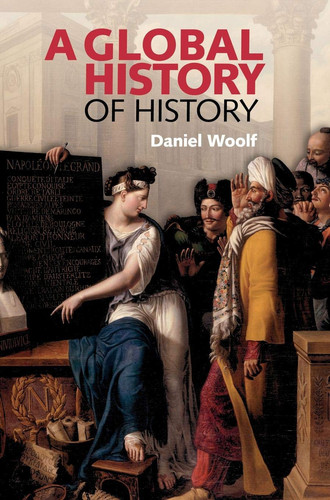
A global history of history

Woolf, D. R.
A global history of historical writing, thought and the development of the historical discipline from the ancient world to the present. This is a definitive guide to human efforts to recover, understand and represent the past, bringing together different historical traditions and their social, economic, political and cultural contexts. Daniel Woolf offers clear definitions of different genres and forms of history and addresses key themes such as the interactions between West and East, the conflict of oral, pictographic, and written accounts of the past and the place of history in society and in politics. Numerous textual extracts and illustrations in every chapter capture the historical cultures of past civilizations and demonstrate the different forms that historical consciousness has taken around the world. The book offers unique insights into the interconnections between different historical cultures over 3000 years and relates the rise of history to key themes in world history. --
Cambridge University Press 2011-02-17 568 pages

How modern science came into the world: four civilizations, one 17th-century breakthrough

Cohen, H. F.
Once upon a time 'The Scientific Revolution of the 17th century' was an innovative concept that inspired a stimulating narrative of how modern science came into the world. Half a century later, what we now know as 'the master narrative' serves rather as a strait-jacket - so often events and contexts just fail to fit in. No attempt has been made so far to replace the master narrative. H. Floris Cohen now comes up with precisely such a replacement. Key to his path-breaking analysis-cum-narrative is a vision of the Scientific Revolution as made up of six distinct yet narrowly interconnected, revolutionary transformations, each of some twenty-five to thirty years' duration. This vision enables him to explain how modern science could come about in Europe rather than in Greece, China, or the Islamic world. It also enables him to explain how half-way into the 17th century a vast crisis of legitimacy could arise and, in the end, be overcome --
Amsterdam University Press 2010-11-01 784 pages