144 results for "Astronomy"

Galileo and the Science Deniers

Mario Livio
Although Galileo Galilei lived and died centuries ago, his story is more relevant to our lives than we might realize. Today we face enormous challenges such as climate change that are disregarded or questioned by those who fear that their implications will damage business profitability. Others posit a false dichotomy between religion and science in order to reject scientific evidence whose implications they fear. Galileo confronted this problem 400 years ago. His discoveries were based on observation and experiment. His telescopes revealed previously unknown planets, moons orbiting other planets, and other discoveries that essentially confirmed the Copernican universe that the Church had rejected as heretical because Church theologians insisted on a literal reading of the Bible. Even St. Augustine in the fifth century maintained that the Bible pertained to the realm of faith, not reason. But when Galileo argued essentially the same position before an ecclesiastical court in Rome, he was forbidden from publishing any more books. Livio's life of Galileo shows us how the great thinker made his discoveries about the heavens and also formulated fundamental laws of physics. As an astrophysicist, Livio brings insight into how Galileo reasoned his way to his conclusions, which we know today were accurate. Along with Newton, Galileo remains one of the two great figures at the dawn of the scientific revolution. He insisted on reaching the widest audience possible, publishing his work in Italian rather than Latin as had been the case until his time, when vernacular languages were rapidly replacing Latin throughout Europe. Galileo believed that every educated person should know science as well as literature. Did Galileo actually say at the end of his trial when he was forced to recant his discoveries, as legend has it, And still it moves, referring to the motion of the earth around the sun? Not likely, says Livio, but Galileo nonetheless remains an inspiration to scientists and those who value open-minded inquiry, which as Livio reminds us, remains threatened even today.
Simon & Schuster Paperbacks 2020 304 pages

The black hole war: my battle with Stephen Hawking to make the world safe for quantum mechanics

Susskind, Leonard
A mind-bending book about modern physics, quantum mechanics, the fate of stars and the deep mysteries of black holes. What happens when something is sucked into a black hole? Does it disappear? Three decades ago, a young physicist named Stephen Hawking claimed it did--and in doing so put at risk everything we know about physics and the fundamental laws of the universe. Most scientists didn't recognize the import of Hawking's claims, but Leonard Susskind and Gerard t'Hooft realized the threat, and responded with a counterattack that changed the course of physics. This is the story of their united effort to reconcile Hawking's revolutionary theories with their own sense of reality--effort that would eventually result in Hawking admitting he was wrong, paying up, and Susskind and t'Hooft realizing that our world is a hologram projected from the outer boundaries of space.--From publisher description.
Little, Brown 2008-07-07 470 pages

Our mathematical universe: my quest for the ultimate nature of reality

Tegmark, Max
"Max Tegmark leads us on an astonishing journey through past, present, and future, and through the physics, astronomy and mathematics that are the foundation of his work, most particularly his hypothesis that our physical reality is a mathematical structure and his theory of the ultimate multiverse. In a dazzling combination of both popular and ground-breaking science, he not only helps us grasp his often mind-boggling theories (his website gives a flavor of how they might boggle the mind), but he also shares with us some of the often surprising triumphs and disappointments that have shaped his life as a scientist. Fascinating from first to last--here is a book for the full science-reading spectrum"--
Alfred A. Knopf 2014 421 pages

Frontiers II More Recent Discoveries about Life, Earth, Space, and the Universe

Isaac Asimov,Janet Asimov
More of Isaac Asimov's weekly science columns for the Los Angeles Times and those his wife, Janet, wrote during his illness and after his death in April 1992. The Asimovs discuss how close we are to producing life in a lab, the latest revelations about dinosaur extinction, recent startling sightings of planets and stars, if we can establish colonies on Mars, if computer intelligence can ever surpass human intelligence, and the gravest dangers to our environment. Annotation copyright by Book News, Inc., Portland, OR
Truman Talley Books/Plume 1994 384 pages

Special Relativity and Classical Field Theory The Theoretical Minimum

Leonard Susskind,Art Friedman
A funny, insightful, and self-contained guide to Einstein's relativity theory and classical field theories--including electromagnetism Physicist Leonard Susskind and data engineer Art Friedman are back. This time, they introduce readers to Einstein's special relativity and Maxwell's classical field theory. Using their typical brand of real math, enlightening drawings, and humor, Susskind and Friedman walk us through the complexities of waves, forces, and particles by exploring special relativity and electromagnetism. It's a must-read for both devotees of the series and any armchair physicist who wants to improve their knowledge of physics' deepest truths.
Basic Books 2019-05-07 448 pages

Exoplanet atmospheres: physical processes

Seager, Sara
Over the past twenty years, astronomers have identified hundreds of extrasolar planets--planets orbiting stars other than the sun. Recent research in this burgeoning field has made it possible to observe and measure the atmospheres of these exoplanets. This is the first textbook to describe the basic physical processes--including radiative transfer, molecular absorption, and chemical processes--common to all planetary atmospheres, as well as the transit, eclipse, and thermal phase variation observations that are unique to exoplanets. In each chapter, Sara Seager offers a conceptual introduction, examples that combine the relevant physics equations with real data, and exercises. Topics range from foundational knowledge, such as the origin of atmospheric composition and planetary spectra, to more advanced concepts, such as solutions to the radiative transfer equation, polarization, and molecular and condensate opacities. Since planets vary widely in their atmospheric properties, Seager emphasizes the major physical processes that govern all planetary atmospheres. Moving from first principles to cutting-edge research, Exoplanet Atmospheres is an ideal resource for students and researchers in astronomy and earth sciences, one that will help prepare them for the next generation of planetary science. The first textbook to describe exoplanet atmospheres Illustrates concepts using examples grounded in real data Provides a step-by-step guide to understanding the structure and emergent spectrum of a planetary atmosphere Includes exercises for students
Princeton University Press 2010-08-22 243 pages

Confessions of an Alien Hunter

Seth Shostak
Aliens are big in America. Whether they've arrived via rocket, flying saucer, or plain old teleportation, they've been invading, infiltrating, or inspiring us for decades, and they've fascinated moviegoers and television watchers for more than fifty years. About half of us believe that aliens really exist, and millions are convinced they've visited Earth. For twenty-five years, SETI has been looking for the proof, and as the program's senior astronomer, Seth Shostak explains in this engrossing book, it's entirely possible that before long conclusive evidence will be found. His informative, entertaining report offers an insider's view of what we might realistically expect to discover light-years away among the stars. Neither humanoids nor monsters, says Shostak; in fact, biological intelligence is probably just a precursor to machine beings, enormously advanced artificial sentients whose capabilities and accomplishments may have developed over billions of years and far exceed our own. As he explores what, if anything, they would tell us and what their existence would portend for humankind and the cosmos, he introduces a colorful cast of characters and provides a vivid, state-of-the-art account of the past, present, and future of our search for extraterrestrial intelligence.
National Geographic Society 2009-03 320 pages

The Cosmic Landscape String Theory and the Illusion of Intelligent Design

Leonard Susskind
The beginning of the 21st century is a watershed in modern science, a time that will forever change our understanding of the universe, Susskind contends. Several decades ago, he introduced the revolutionary concept of string theory to the world of physical science. In doing so, he inspired a generation of physicists who believed that the theory would uniquely predict the properties of our universe. Now, in his first book, Susskind argues that the very idea of such an "elegant theory" no longer suits our understanding of the universe, and that our narrow 20th-century view of a unique universe will have to give way to the much broader concept of a gigantic cosmic landscape--a megaverse, pregnant with new possibilities.--[Résumé de l'éditeur].
Little, Brown 2006-12-01 403 pages

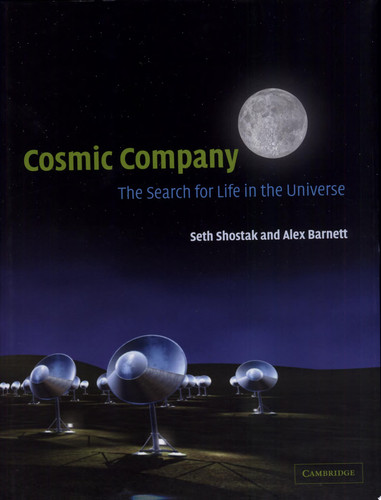
Cosmic company: the search for life in the universe

Shostak, G. Seth
In Cosmic Company, Seth Shostak and Alex Barnett ponder the possibility of aliens visiting the Earth, as well as the consequences of receiving a signal from the cosmos proving we're neither alone, nor the most intelligent life forms. They explain why scientists think life might exist on other worlds, and how we might contact it. Shostak and Barnett, experienced writers of popular astronomy, provide an accessible overveiw of the science and technology behind the search for life in the universe. Seth Shostak is a Senior Astronomer at the SETI Institute where he is involved in many of the outreach activities of the Institute, including editing the newsletter, overseeing the Web site, giving talks and writing magazine articles about SETI. He also teaches several informal education classes on astronomy and other topics in the Bay Area. Before coming to SETI, Seth did research work on galaxies using radio telescopes at observatories and universities in America and Europe. Alex Barnett is Programme Director at the National Space Centre. She is well-known in the science centre, planetarium and media worlds, particularly for public and educational programmes involving space and astronomy. She presents BBC's Final Frontier a space and astronomy programme.
Cambridge University Press 2003-10-30 161 pages