128 results for "Biography"

Wallace Stegner and the American West

Fradkin, Philip L.
Wallace Stegner was the premier chronicler of the twentieth-century western American experience, and his novels, the Pulitzer Prize–winning Angle of Repose and the National Book Award–winning The Spectator Bird, brought the life and landscapes of the West to national and international attention. Now, in this illuminating biography, Philip L. Fradkin goes beyond Stegner’s iconic literary status to give us, as well, the influential teacher and visionary conservationist, the man for whom the preservation and integrity of place was as important as his ability to render its qualities and character in his brilliantly crafted fiction and nonfiction. From his birth in 1909 until his death in 1993, Stegner witnessed nearly a century of change in the land that he loved and fought so hard to preserve. We learn of his hardscrabble youth on the Canadian frontier and in Utah, and of his painful relationship with his father, a bootlegger and gambler. We follow his intellectual awakening as a young man and his years as a Depression-era graduate student at the University of Iowa, during its earliest days as a literary center. We watch as he finds his home, with his wife, Mary, in the foothills above Palo Alto, which provided him with a long-awaited sense of belonging and a refuge in which he would write his most treasured works. And here are his years as the legendary founder of the Stanford Creative Writing Program, where his students included Ken Kesey, Edward Abbey, Robert Stone, and Wendell Berry. But the changes wrought by developers and industrialists were too much for Stegner, and he tirelessly fought the transformation of his Garden of Eden into Silicon Valley. His writings on the importance of establishing national parks and wilderness areas—not only for the preservation of untouched landscape but also for the enrichment of the human spirit—played a key role in the passage of historic legislation and comprise some of the most beautiful words ever written about the natural world. Here, too, is the story—told in full for the first time—of the accusations of plagiarism that followed the publication of Angle of Repose, and of the shadow they have cast on his greatest work. Rich in personal and literary detail, and in the sensual description of the country that shaped his work and his life—this is the definitive account of one of the most acclaimed and admired writers, teachers, and conservationists of our time.
Alfred A. Knopf 2008-02-12 369 pages

P.S.: further thoughts from a lifetime of listening

Terkel, Studs
Millions of Studs Terkel fans have come to know the prizewinning oral historian through his landmark books—“The Good War”, Hard Times, Working, Will the Circle Be Unbroken?, and many others. Few people realize, however, that much of Studs’s best work was not collected into these thematic volumes and has, in fact, never been published. P.S. brings together these significant and deeply enjoyable writings for the first time. The pieces in P.S. reflect Studs’s wide-ranging interests and travels, as well as his abiding connection to his hometown, Chicago. Here we have a fascinating conversation with James Baldwin, possibly Studs’s finest interview with an author; pieces on the colorful history and culture of Chicago; vivid portraits of Studs’s heroes and cohorts (including an insightful and still timely interview with songwriter Yip Harburg, known for his “Brother, Can You Spare a Dime”); and the transcript of Studs’s famous broadcast on the Depression, the very moving essence of what was to become Hard Times. A fitting postscript to a lifetime of listening, P.S. is a truly Terkelesque display of Studs’s extraordinary range of talent and the amazing people he found to talk to.
New Press 2008-11-11 230 pages

The best of us: a memoir

Maynard, Joyce
In 2011, when she was in her late fifties, beloved author and journalist Joyce Maynard met the first true partner she had ever known. Then, just after their one-year wedding anniversary, her new husband was diagnosed with pancreatic cancer. During the nineteen months that followed, as they battled his illness together, she discovered for the first time what it really meant to be a couple - to be a true partner and to have one. This is their story. Charting the course through their whirlwind romance, a marriage cut short by tragedy, and Joyce's return to singleness on new terms, 'The Best of Us' is a heart-wrenching, ultimately life-affirming reflection on coming to understand true love
Bloomsbury 2017 437 pages

Burning the days: recollection

Salter, James
In this brilliant book of recollection, one of America's finest writers re-creates people, places, and events spanning some fifty years, bringing to life an entire era through one man's sensibility. Scenes of love and desire, friendship, ambition, life in foreign cities and New York, are unforgettably rendered here in the unique style for which James Salter is widely admired. Burning the Days captures a singular life, beginning with a Manhattan boyhood and then, satisfying his father's wishes, graduation from West Point, followed by service in the Air Force as a pilot. In some of the most evocative pages ever written about flying, Salter describes the exhilaration and terror of combat as a fighter pilot in the Korean War, scenes that are balanced by haunting pages of love and a young man's passion for women. After resigning from the Air Force, Salter begins a second life, becoming a writer in the New York of the 1960s. Soon films beckon. There are vivid portraits of actors, directors, and producers--Polanski, Robert Redford, and others. Here also, more important, are writers who were influential, some by their character, like Irwin Shaw, others because of their taste and knowledge. Ultimately Burning the Days is an illumination of what it is to be a man, and what it means to become a writer. Only once in a long while--Vladimir Nabokov's Speak, Memory or Isak Dinesen's Out of Africa--does a memoir of such extraordinary clarity and power appear. Unconventional in form, Burning the Days is a stunning achievement by the writer The Washington Post Book World said "inhabits the same rarefied heights as Flannery O'Connor, Paul Bowles, Tennessee Williams and John Cheever" --a rare and unforgettable book.
Random House 1997-08-19 365 pages

Sailor and fiddler: reflections of a 100-year-old author

Wouk, Herman
"In an unprecedented literary accomplishment, Herman Wouk, one of America's most beloved and enduring authors, reflects on his life and times from the remarkable vantage point of 100 years old. Many years ago, the great British philosopher Sir Isaiah Berlin urged Herman Wouk to write his autobiography. Wouk responded, "Why me? I'm nobody." Berlin answered, "No, no. You've traveled. You've known many people. You have interesting ideas. It would do a lot of good." Now, in the same year he has celebrated his hundredth birthday, Herman Wouk finally reflects on the life experiences that inspired his most beloved novels. Among those experiences are his days writing for comedian Fred Allen's radio show, one of the most popular shows in the history of the medium; enlisting in the US Navy during World War II; falling in love with Betty Sarah Brown, the woman who would become his wife (and literary agent) for sixty-six years; writing his Pulitzer Prize-winning novel, The Caine Mutiny; as well as a big hit Broadway play The Caine Mutiny Court Martial; and the surprising inspirations and people behind such masterpieces as The Winds of War, War and Remembrance, Marjorie Morningstar, and Youngblood Hawke. Written with the wisdom of a man who has lived through two centuries and the wit of someone who began his career as professional comedy writer, the first part of Wouk's memoir ("Sailor") refers to his Navy experience and writing career, the second ("Fiddler") to what he's learned from living a life of faith. Ultimately, Sailor and Fiddler is an unprecedented reflection from a vantage point few people have lived to experience"-- Provided by publisher.
Simon & Schuster 2016-10-18 137 pages

Bad mother: a chronicle of maternal crimes, minor calamities, and occasional moments of grace

Waldman, Ayelet
Covering topics as diverse as the hysteria of competitive parenting (Whose toddler can recite the planets in order from the sun?), the relentless pursuits of the Bad Mother police, balancing the work-family dynamic, and the bane of every mother's existence (homework, that is), Bad Mother illuminates the anxieties that riddle motherhood today, while providing women with the encouragement they need to give themselves a break.
Doubleday 2009 213 pages

Groundwork: autobiographical writings, 1979-2012

Auster, Paul
"Paul Auster has spent his fifty-year writing career examining what it means to be truly alive. And now, for the first time ever, in this newly self-curated collection, Auster stitches together various autobiographical writings to lay bare the trajectory of both his personal life and sense of self. From his breakout memoir, The Invention of Solitude, which solidified Auster's reputation as a canonical voice in American letters, to excerpts from his later memoirs, Winter Journal and Report from the Interior, readers are ushered into the inner workings of Auster's self-development. His sweeping recollection winds through the halls of Columbia University during the turbulent 1960s and into life as a young poet-turned-novelist, then dives headfirst into the realities that accompany aging today. Along the way, Auster continually challenges the notion of what autobiography can be, inverting the form through fragmentation and, ultimately, illustrating firsthand the brilliance behind "one of the great writers of our time" (San Francisco Chronicle)"--
Picador 2020-05-05 639 pages

Hemingway and me: letters, anecdotes, and memories of a life-changing friendship

Lyons, Jeffrey
"When Ernest Hemingway died on July 2, 1961, Mary Hemingway asked the Hemingway's good friend, journalist Leonard Lyons, to announce the death of the Nobel Prize-winner to stunned readers and admirer everywhere. Both Hemingways admired Lyons for his fidelity to the truth, that "he would get the story right." (As it turns out the "truth" was not quite what it seemed, since Mary initially denied that her husband's death was suicide.) This memoir recounts the quarter-century long friendship between Hemingway and Leonard Lyons, which eventually came to include Lyons's wife and three sons. In this short book Jeffrey Lyons recounts visits to Hemingway in Cuba (where "Papa" first taught him how to shoot a gun) as well as nights out with the great writer at such popular New York watering holes as the Stork Club and Toots Shor's. Throughout the book Hemingway comes across as a hard-working, generous, and thoughtful man of letters, and not the gruff, hard drinking beast perpetually looking for a fight that he was often perceived as. This is a book about friendship, loyalty, and trust between a famed novelist and a working journalist and his family"--
Lyons Press 2021-05-01 140 pages

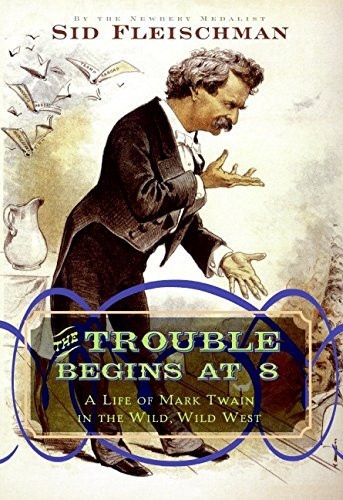
The trouble begins at 8: a life of Mark Twain in the wild, wild West

Fleischman, Sid
"Mark Twain was born fully grown, with a cheap cigar clamped between his teeth." So begins Sid Fleischman's ramble-scramble biography of the great American author and wit, who started life in a Missouri village as a barefoot boy named Samuel Clemens. Abandoning a career as a young steamboat pilot on the Mississippi River, Sam took a bumpy stagecoach to the Far West. In the gold and silver fields, he expected to get rich quick. Instead, he got poor fast, digging in the wrong places. His stint as a sagebrush newspaperman led to a duel with pistols. Had he not survived, the world would never have heard of Tom Sawyer or Huckleberry Finn—or red-headed Mark Twain. Samuel Clemens adopted his pen name in a hotel room in San Francisco and promptly made a jumping frog (and himself) famous. His celebrated novels followed at a leisurely pace; his quips at jet speed. "Don't let schooling interfere with your education," he wrote. Here, in high style, is the story of a wisecracking adventurer who came of age in the untamed West; an ink-stained rebel who surprised himself by becoming the most famous American of his time. Bountifully illustrated.
Greenwillow Books 2008 224 pages

As consciousness is harnessed to flesh: diaries 1964-1980

Sontag, Susan
As Consciousness is Harnessed to Flesh reveals the inner life of Susan Sontag.Providing a unique insight into the mind of one of the leading intellectuals of the modern age, Susan Sontag's As Conscious is Harnessed to Flesh chronicles the cultural, moral, and political journeys of this renowned critic and artist at the height of her powers.As Consciousness Is Harnessed to Flesh follows Sontag through the turbulent years of the late 1960s - from her trip to Hanoi at the peak of the Vietnam War to her time making films in Sweden - up to 1980, just before the beginning of the Reagan era. This is an invaluable record of the inner workings of one of the most inquisitive and analytical thinkers of the twentieth century at the height of her power. It is also a remarkable document of on individual's political and moral awakening.'More true to life, both intellectual and emotional, than the most artful novel or careful biography' Sunday Telegraph'Gold dust' Sunday Times'A powerful self-portrait emerges. In its fragmentation . . . and passion, its combination of the erudite and the everyday, it is more true to life, both intellectual and emotional, than the most artful novel or careful biography. It may well be that Sontag's diaries will come to be seen as just as brilliant and important as anything she wrote' Sunday Telegraph'Mesmerising, fascinating' Guardian'Express the fullness and diversity of her intellectual curiosity. Revelatory in the most profound sense: they are existential fragments, self-selected thoughts, emotions, reactions . . . arising in one of the most remarkable minds of the twentieth century' The TimesOne of America's best-known and most admired writers, Susan Sontag was also a leading commentator on contemporary culture until her death in December 2004. Her books include four novels and numerous works of non-fiction, among them Regarding the Pain of Others, On Photography, Illness as Metaphor, At the Same Time, Against Interpretation and Other Essays and Reborn: Early Diaries 1947-1963, all of which are published by Penguin. A further eight books, including the collections of essays Under the Sign of Saturn and Where the Stress Falls, and the novels The Volcano Lover and The Benefactor, are available from Penguin Modern Classics.
Hamish Hamilton 2012 523 pages

Ex-friends

Podhoretz, Norman
Allen Ginsberg, Lionel and Diana Trilling, Lillian Hellman, Hannah Arendt, and Norman Mailer -- all are ex-friends of Norman Podhoretz, the renowned editor and critic and leading member of the group of New York intellectuals who came to be known as "the Family." As only a family member could, Podhoretz tells the story of these friendships, once central to his life, and shows how the political and cultural struggles of the past fifty years made them impossible to sustain. With wit, piercing insight, and startling honesty, we are introduced as never before to a type of person for whom ideas were often matters of life and death, and whose passing from the scene has left so large a gap in American culture. Podhoretz was the trailblazer of the now-famous journey of a number of his fellow intellectuals from radicalism to conservatism -- a journey through which they came to exercise both cultural and political influence far beyond their number. With this fascinating account of his once happy and finally troubled relations with these cultural icons, Podhoretz helps us understand why that journey was undertaken and just how consequential it became. In the process we get a brilliantly illuminating picture of the writers and intellectuals who have done so much to shape our world. Combining a personal memoir with literary, social, and political history, this unique gallery of stern and affectionate portraits is as entertaining as a novel and at the same time more instructive about postwar American culture than a formal scholarly study. Interwoven with these tales of some of the most quixotic and scintillating of contemporary American thinkers are themes that are introduced, developed, and redeveloped in a variety of contexts, with each appearance enriching the others, like a fugue in music. It is all here: the perversity of brilliance; the misuse of the mind; the benightedness of people usually considered especially enlightened; their human foibles and olympian detachment; the rigors to be endured and the prizes to be won and the prices to be paid for the reflective life. Most people live their lives in a very different way, and at one point, in a defiantly provocative defense of the indifference shown to the things by which intellectuals are obsessed, Norman Podhoretz says that Socrates' assertion that the unexamined life was not worth living was one of the biggest lies ever propagated by a philosopher. And yet, one comes away from Ex-Friends feeling wistful for a day when ideas really mattered and when there were people around who cared more deeply about them than about anything else. Reading of a time when the finest minds of a generation regularly gathered in New York living rooms to debate one another with an articulateness, a passion, and a level of erudition almost extinct, we come to realize how enviable it can be to live a life as poignantly and purposefully examined as Norman Podhoretz's is in Ex-Friends.
Free Press 1999-02-21 244 pages

Tiny ladies in shiny pants: based on a true story

Soloway, Jill
From the creator and director of Transparent and Emmy-nominated writer for Six Feet Under comes a hilarious and unforgettable memoir. When Jill Soloway was just thirteen, she and her best friend donned the tightest satin pants they could find, poufed up their hair and squeezed into Candies heels, then headed to downtown Chicago in search of their one-and-only true loves forever: the members of whichever rock band was touring through town. Never mind that both girls still had braces, coke-bottle-thick glasses and had only just bought their first bras—they were fabulous, they felt beautiful, they were tiny ladies in shiny pants . Now that Jill is all grown up and a successful writer and producer, she can look back on her tiny self and share her shiny tales with fondness, absurdity, and obsessive-compulsive attention to even the most embarrassing details. From the highly personal (conflating her own loss of virginity and the Kobe Bryant accusations), to the political (what she has in common with Monica and Chandra), to the outrageously Los Angelean (why women wear huge diamonds and what they must do to get them), Tiny Ladies in Shiny Pants is a genre-defying combination of personal essay and memoir, or a hilarious, unruly and unapologetic evaluation of society, religion, sex, love, and—best of all—Jill.
Free Press 2006-10-17 258 pages