99 results for "Biography"

Icon of evil: Hitler's Mufti and the rise of radical Islam

Dalin, David G.
A political biography of Haj Amin al-Husaini (1895-1974), the Palestinian Arab nationalist leader and one-time Mufti of Jerusalem. Husaini adopted aggressive antisemitism in his youth, while studying in Cairo. He bears responsibility for the bloody anti-Jewish riots in the Land of Israel in 1920, 1921, and 1929, and was an instigator of the Arab revolt of 1936-39 in the country. In the 1930s he was close with Nazi leaders, with whom he shared extreme antisemitism and the goal of annihilation of the Jews. In the 1940s Husaini was instrumental in the establishment of pro-Nazi Muslim military formations in Europe, among them the Bosnian SS division "Handschar", which killed 12,600 Bosnian Jews. Argues that Husaini's legacy is alive in the modern Muslim world. He was the link between World War II antisemitism and the modern Islamic one, as well as a founding father of radical Islamic antisemitism. Dwells on the latter, which adopted from the West belief in the "Protocols of the Elders of Zion", blood libels, Holocaust denial, etc.
Transaction Publishers 2009 227 pages

If this is man: and, The truce

Levi, Primo
Primo Levi's account of life as a concentration camp prisoner falls into two parts. IF THIS IS A MAN describes his deportation to Poland and the twenty months he spend working in Auschwitz. THE TRUCE covers his long journey to Italy at the end of the war through Russia and Central Europe. Levi never raises his voice, complains or attributes blame. By telling his story quietly, objectively and in plain language he renders both the horror and the hope of the situation with absolute clarity. Probing the themes which preoccupy all his writing - work love, power, the nature of things, what it is to be human - he leaves the reader drained, elated, apprehensive.
Everyman's Library 1999 480 pages

33 days: [a memoir]

Werth, Léon,Johnston, Austin Denis
"A rare eyewitness account by an important author of fleeing the Nazis' march on Paris in 1940, featuring a never-before-published introduction by Antoine de Saint-Exupery. In June of 1940, Leon Werth and his wife fled Paris before the advancing Nazis Army. 33 Days is his eyewitness account of that experience, one of the largest civilian dispacements in history. Encouraged to write 33 Days by his dear friend, Antoine de Saint-Exupery, author of The Little Prince, Werth finished the manuscript while in hiding in the Jura mountains. Saint-Exupery smuggled the manuscript out of Nazi-occupied France, wrote an introduction to the work and arranged for its publication in the United States by Brentanos. But the publication never came to pass, and Werth's manuscript would disappear for more than fifty years until the first French edition, in 1992. It has since become required reading in French schools. This, the first-ever English language translation of 33 Days, includes Saint-Exupery's original introduction for the book, long thought to be lost. It is presented it here for the first time in any language. After more than seventy years, 33 Days appears--complete and as it was fully intended"--
Melville House Publishing 2015-05-12 116 pages

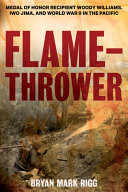
Flamethrower: Medal of Honor recipient Woody Williams, Iwo Jima, and World War II in the Pacific

Rigg, Bryan Mark
"Imagine strapping on a highly flammable 70-pound pack and entering combat as a surefire walking target-and you'd only begin to understand the job, and the horror, of Marine Corps flamethrower man. That's precisely what Hershel "Woody" Williams did in World War II, most importantly in February 1945 on Iwo Jima, one of the Pacific War's toughest battles. A few days into the battle, Marines were fighting hard for an airfield, and his captain asked Woody if he could do anything. He responded, "I'll try"-and for the next four hours, he virtually singlehandedly took on and ultimately destroyed seven enemy pillboxes and helped secure the airfield. Accomplished military historian Bryan Mark Rigg reconstructs Williams' remarkable story, from his youth in West Virginia to his experiences on Guadalcanal, Saipan, Guam, and most significantly Iwo Jima. In Rigg's telling, Williams's Medal of Honor action is not "just" a brave deed, but one of only a few strategically significant brave deeds-one that secured a strategic objective during a major campaign. Rigg tells Williams' story vividly, and objectively, and places it in the context of the broader Pacific theater of World War II."--
Stackpole Books 2020 544 pages

Simon Wiesenthal: a biography

Pick, Hella
A biography of Wiesenthal, based partly on interviews with him and with other persons. Wiesenthal was born in Buczacz in 1908. Ch. 4 (pp. 51-72) deals with the war years. Wiesenthal was interned in prison in Lvov, taken for forced labor, interned in the Lvov ghetto, and then in the Janowska camp. In 1943 he escaped, but he was caught in June 1944 and went through a number of camps, from Płaszów to Mauthausen, where he was liberated. The rest of the book deals with his postwar activities hunting down Nazi criminals. In 1947, Wiesenthal established the Historical Documentation Centre, first in Linz and then in Vienna. Wiesenthal ascribes to himself a key role in hunting down Eichmann, Stangl, and other Nazi criminals, which has led to quarrels with other Nazi hunters. However, it was Wiesenthal who persisted in the search for Eichmann in the late 1940s-50s. He also fought against the statute of limitation in Germany and Austria. During the Waldheim affair, Wiesenthal rejected the accusation that Waldheim was a war criminal, which aroused the ire of the World Jewish Congress. Despite many oddities in Wiesenthal's character, he always has been a man of conscience and a hero of our epoch.
Weidenfeld & Nicolson 1996 349 pages

In the lion's den: the life of Oswald Rufeisen

Tec, Nechama
Few lives shed more light on the complex relationship between Jews and Christians during and after the Holocaust--or provide a more moving portrait of courage--than Oswald Rufeisen's. A Jew passing as a Christian in occupied Poland, Rufeisen worked as translator for the German police--the very people who rounded up and murdered the Jews--and repeatedly risked his life to save hundreds from the Nazis. In this gripping biography, Nechama Tec, a widely acclaimed writer on the Holocaust, recounts Rufeisen's remarkable story. A youth of seventeen when World War II began, Rufeisen joined the exodus of Poles who fled the approaching German army. Tec vividly describes how Rufeisen used his ability to speak fluent German to pass as half German and half Polish in Mir, where he came to serve as translator and personal secretary to the German in charge of the gendarmerie. As he carried out his duties--reading death sentences to prisoners, swearing in new police officers before a portrait of Hitler--he earned the trust and affection of the German commander, yet lived in constant fear of discovery. He used his position to pass secret information to Jews and Christians about impending "aktions" and to sabatoge Nazi plans. Most notably, he thwarted the annihilation of the Mir ghetto by arming hundreds of doomed Jews and organizing their escape, and saved an entire Belorussian village from destruction. Denounced, Rufeisen escaped and found shelter in a convent, where he converted to Catholicism. Though a pacifist, he spent the rest of the war fighting in a Russian partisan unit. After the war, Father Daniel (as he is now known) became a priest and a Carmelite monk. Identifying himself as a Christian Jew and an ardent Zionist, he moved to Israel, where he challenged the Law of Return in a case that reached the High Court and attracted international attention. Today he continues to devote himself to bridging the gap between Christians and Jews. In the Lion's Den offers a stirring portrait of a Jewish rescuer during the Holocaust and its aftermath, illuminating the intricate connections between good and evil, cruelty and compassion, and Judaism and Christianity.
Oxford University Press 2008 279 pages

Beyond Glory

Lang, Stephen
"In Stephen Lang's theatrical adaptation of Larry Smith's book Beyond Glory: Medal of Honor Heroes in Their Own Words, Lang presents the stories of eight veterans from World War II, Korea, and Vietnam, rendering firsthand accounts of the actions which resulted in each of them receiving the nation's highest military award, the Medal of Honor. Beyond glory gathers these men together in the present to look back on the defining moments of their lives and to examine the meaning of courage, duty, and, ultimately, humility"--Page 4 of cover.
Dramatists Play Service, Inc 2017 37 pages

Moments of reprieve

Levi, Primo
“He is our Dante . . . writing a modern masterpiece about his journey into Hell . . . [that is] unique in the literature of the Holocaust.” — USA Today A Penguin Classic Primo Levi was one of the most astonishing voices to emerge from the twentieth century: a man who survived one of the ugliest times in history, yet who was able to describe his own Auschwitz experience with an unaffected tenderness. Levi was a master storyteller but he did not write fairytales. These stories are an elegy to the human figures who stood out against the tragic background of Auschwitz, “the ones in whom I had recognized the will and capacity to react, and hence a rudiment of virtue.” Each centers on an individual who—whether it be through a juggling trick, a slice of apple or a letter—discovers one of the “bizarre, marginal moments of reprieve.” For more than seventy years, Penguin has been the leading publisher of classic literature in the English-speaking world. With more than 1,800 titles, Penguin Classics represents a global bookshelf of the best works throughout history and across genres and disciplines. Readers trust the series to provide authoritative texts enhanced by introductions and notes by distinguished scholars and contemporary authors, as well as up-to-date translations by award-winning translators.
Joseph 1986 172 pages

Christine : SOE agent and Churchill's favourite spy

Masson, Madeleine
Christine Granville, G.M., O.B.E. and Croix de Guerre, one of the most successful women agents of the Second World War and said to have been Churchill's 'favourite spy', was murdered, aged 37, in a London Hotel in 1952. Her actions as a British secret agent in Poland, Hungary and France were legendary even in her lifetime and she repeatedly risked her life to undertake dangerous missions. Her exploits began after the fall of Poland when she became a British agent; organising the escape of British prisoners-of-war, Polish pilots and refugees and returning to Poland, her homeland, to set up escape routes and report on German troop movements. Her capture by the Gestapo led to a dramatic escape from Budapest in the boot of a car followed by travels through Turkey and Syria to Cairo. Christine is an inspiring and unforgettable true story.
Virago 2005-10-06 320 pages

Children of the flames: Dr. Josef Mengele and the untold story of the twins of Auschwitz

Matalon Lagnado, Lucette
Relates the life story of Josef Mengele and quotes from the testimonies of twin children who were the victims of his sadistic pseudo-medical experiments in Auschwitz. They speak about the complicated psychological problems which they confronted after the war, and which caused their silence in the 1950s-70s. In 1984 the organization of surviving twins, CANDLES, was established, which organized a trip to Auschwitz in 1985 and publicized their reminiscences.
Morrow 1991 320 pages

The art of resistance: my four years in the French underground : a memoir

Rosenberg, Justus
"In 1937, as the Nazis gained control and anti-Semitism spread in the Free City of Danzig, a majority German city on the Baltic Sea, sixteen-year-old Justus Rosenberg was sent to Paris to finish his education in safety. Three years later, France fell to the Germans. Alone and in danger, penniless, and cut off from contact with his family in Poland, Justus fled south. A chance meeting led him to Varian Fry, an American journalist in Marseille helping thousands of men and women, including many artists and intellectuals--among them Hannah Arendt, Marc Chagall, Andre Breton, and Max Ernst--escape the Nazis. With his German background, understanding of French culture, and fluency in several languages, including English, Justus became an invaluable member of Fry's refugee network as a spy and scout. The spry blond who looked even younger than his age flourished in the underground, handling counterfeit documents, secret passwords, black market currency, surveying escape routes, and dealing with avaricious gangsters. But when Fry was eventually forced to leave France, Gussie, as he was affectionately known, could not get out. For the next four years, Justus relied on his wits and skills to escape captivity, survive several close calls with death, and continue his fight against the Nazis, working with the French Resistance and later, becoming attached with the United States Army. At the war's end, Justus emigrated to America, and built a new life. Justus' story is a powerful saga of bravery, daring, adventure, and survival with the soul of a spy thriller. Reflecting on his past, Justus sees his life as a confluence of circumstances. As he writes, 'I survived the war through a rare combination of good fortune, resourcefulness, optimism, and, most important, the kindness of many good people.'" -- Publisher's description.
William Collins 2020 288 pages

Operation Last Chance: one man's quest to bring Nazi criminals to justice

Zuroff, Efraim
An autobiography by Zuroff (born in 1948 in New York), focusing on his relentless search for Holocaust perpetrators, both Nazis and their local collaborators, mainly in Eastern Europe, who after World War II found refuge in the USA and other Western countries. In 1978 Zuroff began to work at the newly established Wiesenthal Center in Los Angeles, and from 1979 he worked with the U.S. Office of Special Investigations, created to take legal action against Nazi war criminals and collaborators living in the USA. In the late 1980s he launched a campaign on behalf of the Wiesenthal Center to prosecute Nazi criminals and collaborators who had entered Australia, Canada, Britain, and other Western countries posing as refugees. In the course of his activities, Zuroff was confronted with the reluctance of authorities in Western countries to punish citizens who had been Holocaust perpetrators; many of those who Zuroff was able to trace died unpunished. After the fall of communism in Eastern Europe, he launched a similar campaign in formerly communist countries; his attempts to convince Latvian and Estonian governments to de-heroize mass murderers such as Herberts Cukurs and Evald Mikson, and to bring to trial numerous others, were in vain. In 1998-99, however, he was successful in achieving the extradition to Croatia from Argentina and then the trial and punishment of Dinko Šakić. Buoyed by the success, Zuroff began Operation Last Chance, aiming to trace and bring to trial former mass murderers from the Baltics, Ukraine, Croatia, Austria, Romania, etc. Relates some achievements of this operation. Zuroff's activities have occasionally evoked antisemitic and neo-Nazi backlash in the Baltics, Croatia, and elsewhere.
Palgrave Macmillan 2009-11-10 238 pages

The man who stopped the trains to Auschwitz: George Mantello, El Salvador, and Switzerland's finest hour

Kranzler, David
A biography of Mantello, born in 1901 to the Orthodox Jewish family of Mandl in Transylvania. As a businessman, he became honorary consul of El Salvador for several East European countries; in 1942-45 he served as first secretary of the El Salvador consulate in Geneva. With the approval of the consul general, Mantello provided thousands of Jews in Hungary and Transylvania with protective papers. In addition, during 1941-44 he gathered information on the Nazi Final Solution, including operations at Auschwitz. In 1944, using this data, he initiated two press campaigns in Switzerland which alerted that country and the entire world to the Nazi genocide of Jews. The first press campaign forced Horthy to stop the deportations. Dwells, also, on the activities of Florin Manoliu, a Romanian businessman who helped Mantello. During the war, Mantello was arrested several times by Swiss authorities on superficial pretexts. After an inquiry into his wartime activities in the 1950s, Mantello was forgotten and recalled only shortly before his death in 1992.
Syracuse University Press 2000 341 pages