85 results for "Business"

Vice Dick Cheney and the Hijacking of the American Presidency

Lou DuBose,Jake Bernstein
Dick Cheney is the most powerful yet most unpopular vice president in American history. He has thrived alongside a president who, from day one, had little interest in policy and limited experience in the ways of Washington. Yet Cheney's relentless rise to prominence over three decades has happened almost by stealth. Now veteran reporters Lou Dubose and Jake Bernstein reveal the disturbing truth about the man who has successfully co-opted executive control over the U.S. government, serving as the de facto 'shadow president' of the most dominant White House in a generation. Cheney has always been an astute politician. He survived the collapse of the Nixon presidency, finding a position of power in the administration of Gerald Ford. He was then elected to the House of Representatives and later served in the cabinet of the first Bush presidency. But when he became George W. Bush's running mate, Cheney reached a new level of influence. From the engineering of his own selection as vice president to his support of policies allowing torture as a permissible weapon in the 'war on terror', Cheney has consistently steered America to the right. With unique access to numerous first-hand sources, Vice provides an unprecedented expose of Cheney's career. Its startling revelations concern the war in Iraq, his relationship with the CIA and with big business, his involvement with Enron, his attitude towards Iran and his ruthless manoeuvering which today effectively puts him in charge of American policy at home and abroad. In the tradition of Carl Bernstein and Bob Woodward's All the President's Men , this powerful work of investigative journalism takes us behind the scenes in Washington, into hitherto secret meetings and deep into the heart of political decision-making. Utterly gripping, Vice chronicles and exposes the hijacking of the American presidency and illustrates the arrogance of power as never before.
Penguin Random House 2006 261 pages

The age of Clinton: America in the 1990s

Troy, Gil
"The 1990s was a decade of extreme change. Shifts in culture, politics, and technology radically altered the way Americans did business, expressed themselves, and thought about their role in the world. At the center of it all was Bill Clinton, the charismatic and flawed baby boomer president, along with his polarizing but increasingly popular wife, Hillary. Although it was in many ways a Democratic Gilded Age, the 1990s was also a time of great anxiety. The Cold War was over. America was stable and prosperous. Yet Americans felt more unmoored and isolated. This was the era of glitz and grunge, when we relished living in the Republic of Everything even as we feared it might degenerate into the Republic of Nothing. Bill Clinton dominated this era, but his complex legacy has yet to be clearly defined. Historian Gil Troy examines Clinton's presidency alongside the decade's cultural changes. Taking the '90s year by year, Troy shows how the culture of the day shaped the Clintons even as the Clintons shaped it, offering answers to two enduring questions about Bill Clinton's legacy: How did such a talented politician leave Americans thinking he accomplished so little when he actually accomplished so much? And to what extent was Clinton responsible for the catastrophes of the following decade, specifically 9/11 and the collapse of the housing market? Even more relevant as we head toward the 2016 election, The Age of Clinton will appeal to readers on both sides of the aisle as it chronicles the wild, transformative decade and the president at its center"--
Thomas Dunne Books/St. Martin's Press 2015-10-06 368 pages

The Sixties

Richard Avedon,Doon Arbus
The photographer Richard Avedon and the writer Doon Arbus began collaborating on this book thirty years ago. The photographs and interviews they did then remain faithful to what was, like the contents of a time capsule. Meeting somebody and balling them means something, but it doesn't mean near as much as it used to. --Janis Joplin, September 1969 In a society where there is institutionalized oppression, the thing is to catch government and business in the grass--actually humping. --Florynce Kennedy, August 1969 I was so afraid of being bad and being caught at it. --Dr. Benjamin Spock, September 1969 The connection between all the rhetoric and all the poetry, between the words of a Black Panther and those of a rock star or a pacifist, between the scars of a pop artist and those of a napalm victim, have haunted and informed the structuring of this book, with its own peculiar version of a beginning, a middle, and an end.
Random House, Incorporated 1999-10

A Plague on Both Your Houses A Novel in the Shadow of the Russian Mafia

Robert Littell
A brand-new novel from New York Times bestselling author Robert Littell, A Plague on Both Your Houses is a thrilling tale of love and war. On Christmas Day, 1991, Mikhail Gorbachev delivered a ten-minute televised speech announcing his resignation as Soviet president. Moments later, with little pomp and less circumstance, the red flag was lowered from its floodlit perch atop the Kremlin, and the Soviet Union ceased to exist. Into the vacuum--before a new democracy had time to put down roots--surged the Russian mafia, supplying what the new state could not: krysha, or "roof"--protection for the privately owned businesses sprouting across the country. Rivalries turned bloody as Moscow's Jewish mafia battled the Ossete vory v zakone (literally "thieves-in-law") for control of the city. Caught up in the mayhem, Yulia, only daughter of the Jewish mafia godfather, and Roman, only son of the Ossete mafia godfather, are obliged to navigate the minefield of a star-crossed love affair as they attempt to escape a destiny that appears preordained. A Plague on Both Your Houses is the fictional story of one bloody episode in Moscow's Great Turf War, when clans fought brutally in the streets and the future of the Russian nation was anything but assured.
Blackstone Publishing 2024-02-06 218 pages

Imperfect justice: looted assets, slave labor, and the unfinished business of World War II

Eizenstat, Stuart
A personal memoir by Eizenstat, who served under President Carter in several capacities, including secretary of state on Holocaust issues, relating his experiences in negotiations with governments of and/or business representatives from Switzerland, Austria, France, and Germany to pay compensation to Holocaust victims or their heirs for looted property and for suffering (slave labor) under the Nazis. Swiss gold, stolen art, and other stolen property of individuals and communities were finally repaid through agreements reached or encouraged by U.S. class-action suits. In addition to the "imperfect justice" of financial recompense, notes the moral success of furthering the truth and inspiring international efforts at Holocaust education. also discusses the author's role in helping establish the U.S. Holocaust Memorial Museum.
Public Affairs 2003 401 pages

A Theory of the Consumption Function

Milton Friedman
What is the exact nature of the consumption function? Can this term be defined so that it will be consistent with empirical evidence and a valid instrument in the hands of future economic researchers and policy makers? In this volume a distinguished American economist presents a new theory of the consumption function, tests it against extensive statistical J material and suggests some of its significant implications. Central to the new theory is its sharp distinction between two concepts of income, measured income, or that which is recorded for a particular period, and permanent income, a longer-period concept in terms of which consumers decide how much to spend and how much to save. Milton Friedman suggests that the total amount spent on consumption is on the average the same fraction of permanent income, regardless of the size of permanent income. The magnitude of the fraction depends on variables such as interest rate, degree of uncertainty relating to occupation, ratio of wealth to income, family size, and so on. The hypothesis is shown to be consistent with budget studies and time series data, and some of its far-reaching implications are explored in the final chapter.
Must Have Books 2022-03-15 254 pages

Inside the economist's mind: conversations with eminent economists

Paul A. Samuelson,William A. Barnett
By focusing on the human side as well as the intellectual dimensions of how economists work and think, this collection of interviews with top economists of the 20th century becomes a startling and lively introduction to the modern world of macroeconomics. A fun read! For more information, frequent updates, and to comment on the forthcoming book, visit William A. Barnett's weblog at http://economistmind.blogspot.com/. Acclaim for Inside the Economist's Mind "In candid interviews, these great economists prove to be fabulous story tellers of their lives and times. Unendingly gripping for insiders, this book should also help non-specialists understand how economists think." Professor Julio Rotemberg, Harvard University Business School, and Editor, Review of Economics and Statistics. "Economics used to be called the 'dismal science'. It will be impossible for anybody to hold that view anymore ... This is science with flesh and blood, and a lot of fascinating stories that you will find nowhere else." Dr. Jean-Pascal Bénassy, Paris-Jourdan Sciences Économiques, Paris, France "This book provides a rare and intriguing view of the personal and professional lives of leading economists ... It is like A Beautiful Mind , scaled by a factor of 16 [the number of interviews in the book]." Professor Lee Ohanian, University of California at Los Angeles " ... if you want an insider view of how economics has been developing in the last decades, this is the (only) book for you." Professor Giancarlo Gandolfo, University of Rome ‘La Sapienza,’ Rome "Here we see the HUMAN side of path-breaking research, the personalities and pitfalls, the DRAMA behind the science." Professor Francis X. Diebold, University of Pennsylvania, Philadelphia
Blackwell Pub 2007 419 pages

The fall of the house of Roosevelt: brokers of ideas and power from FDR to LBJ

Janeway, Michael
In the 1930s a band of smart and able young men, some still in their twenties, helped Franklin D. Roosevelt transform an American nation in crisis. They were the junior officers of the New Deal. Thomas G. Corcoran, Benjamin V. Cohen, William O. Douglas, Abe Fortas, and James Rowe helped FDR build the modern Democratic Party into a progressive coalition whose command over power and ideas during the next three decades seemed politically invincible. This is the first book about this group of Rooseveltians and their linkage to Lyndon Johnson's Great Society and the Vietnam War debacle. Michael Janeway grew up inside this world. His father, Eliot Janeway, business editor of Time and a star writer for Fortune and Life magazines, was part of this circle, strategizing and practicing politics as well as reporting on these men. Drawing on his intimate knowledge of events and previously unavailable private letters and other documents, Janeway crafts a riveting account of the exercise of power during the New Deal and its aftermath. He shows how these men were at the nexus of reform impulses at the electoral level with reform thinking in the social sciences and the law and explains how this potent fusion helped build the contemporary American state. Since that time efforts to reinvent government by "brains trust" have largely failed in the U.S. In the last quarter of the twentieth century American politics ceased to function as a blend of broad coalition building and reform agenda setting, rooted in a consensus of belief in the efficacy of modern government. Can a progressive coalition of ideas and power come together again? The Fall of the House of Roosevelt makes such a prospect both alluring and daunting.
Columbia University Press 2004 284 pages

Goodbye, Janette

Harold Robbins
From the author of The New York Times #1 bestselling novel The Carpetbaggers comes an unstoppable, mesmeric tale of fame, power, sexuality, and betrayal in the cutthroat world of haute couture... A dynasty of women triumphs in the fiercely male-dominated world of high fashion amid the ruins of war. A daughter honors her mother's ultimate sacrifice-by becoming a ruthless businesswoman who will stop at nothing to raise high her family's name. Another daughter seeks to flee the toxic legacy of her family and live in peace. And both daughters have a date with destiny in a vault filled with Nazi gold... treasure that will alter the course of both their lives.... Epic and intimate, moving from the icy nighttime streets of the Nazi occupation to the decadent beaches of St. Tropez, from the showrooms of Manhattan to the runways of Paris, Goodbye, Janette is a hypnotically gripping, mythic family saga of the power of blood to bind, to oppress, and finally to set free. Full of the shocking U-turns and unexpected revelations that make Harold Robbins a master storyteller, Goodbye, Janette transports the reader to a chic, dreamlike world where everyone wants an all-access pass... but the penalties for staying may be severe. Goodbye, Janette is a late masterpiece by Harold Robbins, America's most commercially successful and era-defining author of pulp fiction. The creator of erotic and ferocious turbocharged narratives of the soul-stricken rich and famous, Harold Robbins was, in his day, a close runner-up to Shakespeare and the Bible in numbers of books sold.
Oghma Communications 2023-06-27 328 pages

Canned: the rise and fall of consumer confidence in the American food industry

Zeide, Anna
"This book explores the earliest roots of the modern food industry, focusing on the development of the canning industry in the United States. Canning leaders leveraged the power of scientific expertise to create a market for canned food. Before the mid-twentieth century, in order to win consumer trust, canners adopted new technologies, cooperated with federal food regulation, sponsored agricultural and bacteriological research, and standardized food production. All of these moves helped to make canned food a staple of American pantries by the 1940s. As other industries entered the processed food landscape, and environmental and consumer critiques emerged, canners widened their scientific research base to more centrally incorporate marketing, advertising, and political strategy. In their increasing power, industry leaders were less willing to defer to governmental authority and more eager to directly control production and consumption. This study takes up the stories of six particular canned foods--condensed milk, peas, olives, tomatoes, tuna, and Campbell's soup--to understand the tools used by the food industry to build consumer confidence in a new way of eating. This modified diet not only changed the relationship between business and consumers, but also the relationships among Americans, farmers, universities, advertisers, and the natural environment."--Provided by publisher.
University of California Press 2018 269 pages

Legacy: one family, a cup of tea and the company that took on the world

Harding, Thomas
A panoramic new history of modern Britain, as told through the story of one extraordinary family, and one groundbreaking company. In the early 1800s, Lehmann Gluckstein and his family escaped the pogroms of Eastern Europe and made their way to Whitechapel in London's East End. There, starting with nothing, they worked tirelessly to pull themselves out of poverty, creating a small tobacco factory that grew to become the largest catering company in the world: J. Lyons. For over a century, Lyons was on every high street, in every home, in every coffee and teacup. It was an ascent from rags to riches in the face of many obstacles: poverty, hatred and anti-Semitism stood between this poor immigrant family and the British Dream. Legacy charts the rise and fall of one of the most influential dynasties in British history through the lives of five astonishing generations. Both sweeping and intimate, it is a story of sacrifice and selflessness, betrayal and personal tragedy, and Empire and its cost. It is also an illuminating new exploration of Britain and its place in the world, from the bestselling author of Hanns and Rudolf and The House by the Lake.
William Heinemann 2019 561 pages

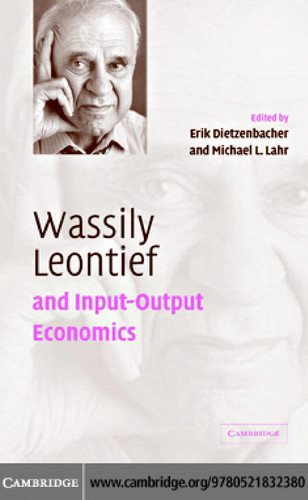
Wassily Leontief and input-output economics

Wassily Leontief,Erik Dietzenbacher,Michael L. Lahr
Wassily Leontief (1905–1999) was the founding father of input-output economics, for which he received the Nobel Prize in 1973. This book offers a collection of papers in memory of Leontief by his students and close colleagues. The first part, 'Reflections on Input-Output Economics', focuses upon Leontief as a person and scholar as well as his personal contributions to economics. It includes contributions by Nobel Laureate Paul A. Samuelson who shares his memories of a young Professor Leontief at Harvard and ends with the last joint interview with Wassily and his wife, to date previously unpublished. The second part, 'Perspectives of Input-Output Economics', includes theoretical and empirical research inspired by Leontief's work and offers a wide-ranging sample of the state of interindustry economics, a field Leontief founded. This is a strong collection likely to appeal to a wide range of professionals in universities, government, industry and international organizations.
Cambridge University Press 2004-03-25 396 pages

A Living Wage American Workers and the Making of Consumer Society

Lawrence B. Glickman
The fight for a "living wage" has a long and revealing history as documented here by Lawrence B. Glickman. The labor movement's response to wages shows how American workers negotiated the transition from artisan to consumer, opening up new political possibilities for organized workers and creating contradictions that continue to haunt the labor movement today. Nineteenth-century workers hoped to become self-employed artisans, rather than permanent "wage slaves." After the Civil War, however, unions redefined working-class identity in consumerist terms, and demanded a wage that would reward workers commensurate with their needs as consumers. This consumerist turn in labor ideology also led workers to struggle for shorter hours and union labels. First articulated in the 1870s, the demand for a living wage was voiced increasingly by labor leaders and reformers at the turn of the century. Glickman explores the racial, ethnic, and gender implications, as white male workers defined themselves in contrast to African Americans, women, Asians, and recent European immigrants. He shows how a historical perspective on the concept of a living wage can inform our understanding of current controversies.
Cornell University Press 1999-03-11 240 pages

Trapped The 1909 Cherry Mine Disaster

Karen Tintori
A gripping account of the worst coal mine fire in US history—the 1909 Cherry Mine Disaster that claimed the lives of 259 men. "Drawing on diaries, letters, written accounts of survivors and testimony from the coroner's inquest...Tintori's engaging prose keeps readers on the edge" ( Publishers Weekly ). Inspired by a refrain of her girlhood—"Your grandfather survived the Cherry Mine disaster"—Karen Tintori began a search for her family's role in the harrowing tragedy of 1909. She uncovered the stories of victims, survivors, widows, orphans, townspeople, firefighters, reporters, and mine owners, and wove them together to pen Trapped, a riveting account of the tragic day that would inspire America's first worker's compensation laws and hasten much-needed child labor reform. On a Saturday morning in November of 1909, four hundred and eighty men went down into the mines as they had countless times before. But a fire erupted in the mineshaft that day and soon burned out of control. By nightfall, more than half the men would either be dead or trapped as officials sealed the mine in an attempt to contain the blaze. Miraculously, twenty men would emerge one week later, but not before the Cherry Mine disaster went down in history as the worst ever coal mine fire in the US—and not before all the treachery and heroism of mankind were revealed.
Simon and Schuster 2003-09-17 288 pages

King Zeno

Rich, Nathaniel
A New York Times Book Review Editors' Choice and a Paris Review Staff Pick A January Pick by Salon , Town and Country, Southern Living, and LA Magazine New Orleans, 1918. The birth of jazz, the Spanish flu, an ax murderer on the loose. The lives of a traumatized cop, a conflicted Mafia matriarch, and a brilliant trumpeter converge—and the Crescent City gets the rich, dark, sweeping novel it so deserves. From one of the most inventive writers of his generation, King Zeno is a historical crime novel and a searching inquiry into man’s dreams of immortality. New Orleans, a century ago: a city determined to reshape its destiny and, with it, the nation’s. Downtown, a new American music is born. In Storyville, prostitution is outlawed and the police retake the streets with maximum violence. In the Ninth Ward, laborers break ground on a gigantic canal that will split the city, a work of staggering human ingenuity intended to restore New Orleans’s faded mercantile glory. The war is ending and a prosperous new age dawns. But everything is thrown into chaos by a series of murders committed by an ax-wielding maniac with a peculiar taste in music. The ax murders scramble the fates of three people from different corners of town. Detective William Bastrop is an army veteran haunted by an act of wartime cowardice, recklessly bent on redemption. Isadore Zeno is a jazz cornetist with a dangerous side hustle. Beatrice Vizzini is the widow of a crime boss who yearns to take the family business straight. Each nurtures private dreams of worldly glory and eternal life, their ambitions carrying them into dark territories of obsession, paranoia, and madness. In New Orleans, a city built on swamp, nothing stays buried long.
MCD 2018-01-09 386 pages

Political Awakenings Conversations with History

Harry Kreisler
Twenty sensational erotic stories that are sinfully good from Xcite Books, winners of the ETO Best Erotic Book Brand 2010, 2011, 2012 and 2013. Featuring stories by some of the best writers in the erotic field including Kay Jaybee, Angela Meadows, Elizabeth Cage and Penelope Friday. Indulge yourself in this sensational collection and discover the pleasure of Ultimate Sins. French Connection by Cathy King Escaping to France in the wake of a failed marriage, Mandy attempts to put the past behind her and indulge in a change of scenery. Bad memories fade as the delights of her holiday destination reveal themselves. With British men off of the menu, she is determined to sample the local fare. A chance encounter following an early evening trip to the beach allows Mandy to experience some of the local delicacies. But, with her appetite whetted all she can crave for is more. Eat Me by Elizabeth Cage Tired after a hard day at work all Joanne wants is to go home, relax and indulge her sweet tooth. A chance encounter at the bus station results in a journey home by quite a different route. Her unforeseen diversion is not without its delights. As the evening unfolds she discovers an appetite that needs to be satiated, and is soon treated to a gourmet feast from a menu of the very risqué kind. Vichysoisse by Astrid L. Gathering ingredients to make a soup at the local supermarket, Sophia encounters the highly charged and seductive Samantha, and is immediately enchanted. Intoxicated by her presence she invites Samantha for a culinary lesson in the preparation of Vichysoisse. As the cooking begins, intimacy, passion and anticipation quickly swirl into a heady infusion that consumes the both of them. Unlike the cold soup that brings them together, their relationship soon progresses from a light simmer to boiling desire. Bamboobzled by Landon Dixon When gorgeous celluloid dame, Brinn Stones saunters'' into his office, hard-nosed PI Jim Brubaker is offered a case he simply cannot refuse. Charged with the task of unearthing a seedy blackmailing scam, Brubaker is forced to trawl the seedy underbelly of the City of Angels. As the case reveals itself, he soon discovers that Tinsel Town is not quite as it seems. It''s a dog-eat-dog world, where just about anything goes. Pretty Young Things by Cathryn Cooper It''s the Roaring Twenties, a decade of decadence, prosperity and wild-abandon. In need of fresh excitement, Carew accepts the challenge of a car race to the nearby abbey ruins. With the brazen Suzanne at his side, he leads the rowdy crowd out into the dark night. Once at the ruins, Suzanne embarks upon a ribald display that soon drives those in attendance into a wanton frenzy. Unmoved, Carew leaves the gathering to wander the ruins, chancing upon a mysterious woman and an erotic encounter of his own. Purposeful Liaison by Shermaine Williams When work calls her husband back from their romantic island holiday, Charlotte is left to enjoy what''s left on her own, rather that reigniting the lost passion of her marriage. Her sudden abandonment soon registers on the radar of Matthew, a well-toned holiday-maker looking for company during his stay. His persistent attention soon wears down Charlotte''s resolve, and a late-night invitation for a drink releases more passion than she can possibly control. Alice and the Red Queen by Jean Roberta When a young student takes on the job of gardener for an erstwhile tennis star, gardening is not the only activity to leave her hot and breathless. The Red Queen soon sets her sights on the nubile employee and enters into a game where domination is the ultimate prize. As the game begins, the temperature starts to rise as the former tennis queen samples the many new delights that await her in the intimacy of her well-maintained grounds. Serial Satisfaction by Cathryn Cooper Michael can''t wait to indulge in his affair with his best friend''s wife. In the seclusion of a lay-by Crystal waits for her lover, but has demands of her own in mind. As Michael revels in her sensuous affection, Crystal takes him to the brink only to stop. A girl needs commitment and that''s exactly what she wants. Crystal wants Michael for herself, not to be shared with his wife. As Michael ponders his next move, he soon learns an important lesson, that Hell hath no fury as a woman scorned. Shared Experience by Lynn Lake The saying goes two''s company and three''s a crowd, but is that always the case? David is desperate for Amy to join him in realising his yearning for a threesome. Reluctant at first, Amy eventually succumbs to his wish and arranges for the arrival of the additional party: the voluptuous Cassandra. With her appetite whetted, Amy soon becomes a willing participant in David''s lustful scenario. However, her involvement is always going to be on her own terms, whatever they may be. Sweet Dreams by Jade Taylor Horny, frustrated and eager to get her toy boy home to the bedroom, Ellie must first lure Greg away from the nightclub. However, the easy distractions of youth interfere with her intentions, despite her most determined and seductive efforts. However, fate works in mysterious ways, and an after hours invitation to Greg''s friend Adam''s home provides her with a golden opportunity. Employing the power of her sensual allure, she teases them both only to enjoy a return that doubles her delight. The Florist by Eva Hore Melissa is determined to have her way with John the hunky Florist. With a plan in mind, she arrives late one evening to pursue her intention. As Melissa embarks on her seductive task, events take a very sudden and unexpected twist. Melissa soon finds herself at the centre of a wanton scenario that takes her on a wild, new experience of pleasure and pain. Behind closed doors at the florists will never be the same again. A Lesson For Victoria by Angela Meadows Dispatched by her Father, Victoria arrives at a school for young ladies nestled high the Tyrol. It soon becomes clear, that she has been sent to be educated as a lady. Under the expert guidance of Madams Thackeray and Hulot Victoria is to be prepared for presentation as a desirable Wife for high society gentleman. As the first evening session in the curriculum unfolds, it''s soon apparent to Victoria that her two-year attendance will be extremely hands on. Story Telling by Jim Baker Reality and imagination become entwined in a series of carnal encounters. A lecturer stumbles upon some raunchy extra-curricular activity in the University lecture hall, whilst a Librarian offers a personal and energetic critique of an author''s work. Yet it''s the mind behind these tales that feeds eagerly from its muse. As the plots are energetically worked out, the Authors fantasies are the only limitation. Beautiful Sin by Penelope Friday Two friends met again after a period of prolonged absence and cordially acknowledge each other. The reality is that both Catherine and Elizabeth share a passion that the world must never know. Against a backdrop of strict moral codes, their true feelings would see them incarcerated and separated forever; their lust for each other deemed a sin. Yet when the lights go out and others settle for the night, both women can meet secretly once more to share in their beautiful sin. The Spying Game by Roz MacLeod It''s the height of the Cold War and the nation is on its guard against the spectre of foreign espionage. When Sandi, a top agent in the Secret Service is called before Control, she is presented with a mission to uncover a possible double agent. Determined to safeguard the Nation''s secrets and using the cover of an erotic dancer, Sandi embarks on her wild and raunchy assignment, using every vice at her disposal to catch her target. The Librarian by Eva Hore A young woman returns early to her shared apartment, to find her scantily clad room mate preparing for a mysterious night-out. Where does a Librarian go after a day in the stacks? Imagination runs riot as an increasingly lecherous scenario unfolds in the young woman''s mind. Her room mate''s daytime mousy demeanour, tight bun and glasses are soon discarded, to reveal a wanton dominatrix hell bent on tasting the delights of her desires. Wreck-Her by Lynn Lake A business woman is unexpectedly delayed as her company car breaks-down, deep in the sun-parched Manitoba prairie. With no cell phone signal and the soaring heat of the surroundings rising, desperation rapidly begins to set in. Help soon arrives in the form of a tow truck that stops to offer assistance. After thoroughly appraising the situation, the truck driver is soon ready to dispense a unique form of roadside assistance that ultimately proves much to the woman''s delight. Mixed Blessings by Phoebe Grafton Two friends are in need of temporary relief from their respective husbands. With one husband too demanding and the other too languid, both wives decide that a weekend exchange is the best tonic. A plan is hatched, and after a night out together is put into effect, as door keys are exchanged for each others home and husband. The weekend that follows indulges each in the marital secrets of the other and in doing so sheds light over the question: is the grass always greener on the other side? Blindspot by Elspeth Potter Becca is both excited and intrigued when Dante brings a new toy to their swingers'' event. But what fascinates her more is how he wants to use it. Very soon, she is joined by Marcus who assists both Dante and herself in experiencing a new, exciting and heightened pleasure. As they plunge into their shared lascivious adventure, all inhibitions fall away leading t
UWA Publishing 2011 286 pages

The JFK ASSASSINATION DIARY My Search For Answers to the Mystery of the Century

Edward Jay Epstein
One of the most important original documents about the assassination of President John F. Kennedy to be published on the 50th anniversary of the event. The never before published diary of Edward Jay Epstein's investigation into the assassination reveals startling new details. Epstein, one of America's most acclaimed investigative journalists and widely acknowledged as the premier expert on the assassination, while still an undergraduate at Cornell, interviewed the members of the Warren Commission and its staff of investigators, and obtained their key files. He was the only journalist, ever, to have gained this access. His full findings are disclosed here for the first time. In his investigation, Epstein also interviewed the top officials of the CIA, including at length the legendary chief of counter-intelligence James Jesus Angleton. He was the only journalist to interview Yuri Nosenko, the KGB officer who claimed to be Oswald's KGB case officer. Jim Garrison, the New Orleans district attorney, who attempted to reopen the case, confided his methods and sources in Epstein. Epstein was, moreover, the last person to see George De Mohrenschildt, Oswald's mysterious White Russian friend, who he interviewed for hours until the moment when he took his secrets with him in death. The JFK Assassination Diary is the true story at last of the incredible answers Epstein unearthed in pursuit of the greatest crime of the 20th century. Praise for Edward Jay Epstein "A grand figure of modern journalism...Show Epstein a juicy crime and he will show you how it has been subverted by unseen powers for their own agenda, by the inevitable incompetence of investigative authorities and by the media because it likes a simple story line." -Michael Wolff, USA Today "Epstein believes that conspiracies are more common than most journalists credit; for much of his career, he has reveled in the kind of tantalizing clues that could lead somewhere, or nowhere." -Joe Nocera, The New York Times "Epstein is a bulldog researcher." -Jonathan Yardley, The Washington Post "A brilliant investigator." - Lou Dobbs Praise For Agency of Fear "Epstein tells all." -John Leonard, New York Times " Part detective story, part farce, part exposé, and part textbook on investigative reporting. It is ingenious, perverse, hilarious, and shocking." -Victor Navasky "Exciting research, impressive thesis." -Norman Mailer Praise For Legend: The Secret World of Lee Harvey Oswald A fascinating, alarming, and enormously significant book on the mystery of Lee Harvey Oswald-- The New York Times Book Review ABOUT THE AUTHOR Edward Jay Epstein is the author of fifteen books. He studied government at Cornell and Harvard and received a Ph.D from Harvard in 1973. His thesis on the search for political truth became a best-selling book, Inquest: The Warren Commission and the Establishment of Truth. His doctoral dissertation on television news was published as News From Nowhere. He is the recipient of numerous foundation grants and awards, including the prestigious Financial Times/Booz Allen & Hamilton Global Business Book Award for both best biography and best business book for Dossier: The Secret History of Armand Hammer. He has written for Vanity Fair, The New Yorker, The Atlantic, The New York Times Magazine, and the Wall Street Journal. He lives in New York City.
CreateSpace Independent Publishing Platform 2013-09-26 110 pages

The trials of Radclyffe Hall

Souhami, Diana
Radclyffe Hall was born in 1884 in Bournemouth in a house of horrors called 'Sunny Lawn'. It was an unhappy childhood, until her father's death when Radclyffe inherited £200,000. She was 18. She leased a London house, dressed in chappish clothes, called herself Peter then John & wrote her first collection of verse. She was a political reactionary, a reformed Catholic, obsessive about work, hunted with 3 packs, got her pipes from Dunhill's, wore brocade smoking jackets & had her hair cropped. She thought real women were born to be wives & disliked doing any business with them. Her 1st love was Mabel Batten, known as Ladye, who reputedly had an affair with Edward VII. Radclyffe Hall is now most famous for THE WELL OF LONELINESS, written in 1928. A novel about 'congenital inverts' - lesbian love - the book was suppressed both here & the US & caused Radclyffe to be put on trial under the Obscene Publications Act. Brilliantly written, this biography is a fresh and irreverent insight into the lives of one of the most alluring and eccentric women of this century.
Virago 1999 16 pages

The telephone booth Indian

Liebling, A. J.
A classic work on Broadway sharpers, grifters, and con men by the late, great New Yorker journalist A. J. Liebling. Often referred to as “Liebling lowlife pieces,” the essays in The Telephone Booth Indian boisterously celebrate raffishness. A. J. Liebling appreciated a good scam and knew how to cultivate the scammers. Telephone Booth Indians (entrepreneurs so impecunious that they conduct business from telephone booths in the lobbies of New York City office buildings) and a host of other petty nomads of Broadway—with names like Marty the Clutch and Count de Pennies—are the protagonists in this incomparable Liebling work. In The Telephone Booth Indian , Liebling proves just why he was the go-to man on New York lowlife and con culture; this is the master at the top of his form, uncovering scam after scam and writing about them with the wit and charisma that established him as one of the greatest journalists of his generation and one of New York’s finest cultural chroniclers.
Broadway Books 2004-07-13 241 pages