150 results for "Business"

How to succeed in business without really crying

Leifer, Carol
"For many years, television comedy was an exclusive all boys' club--until a brilliant comedian named Carol Leifer came along, blazing a trail for funny women everywhere. From Late Night with David Letterman and Saturday Night Live to Seinfeld, The Ellen Show, and Modern Family, Carol has written for and/or performed on some of the best TV comedies of all time. This hilarious collection of essays charts her extraordinary three-decade journey through show business, illuminating her many triumphs and some missteps along the way--and offering valuable lessons for women and men in any profession. Part memoir, part guide to life, and all incredibly funny,How to Succeed in Business without Really Crying offers tips and tricks for getting ahead, finding your way, and opening locked doors--even if you have to use a sledgehammer" --
Quirk Books 2014-04-08 239 pages

Bloomberg by Bloomberg

Bloomberg, Michael,Winkler, Matthew
"The original Bloomberg by Bloomberg was published in 1997 and focused primarily on the genesis of the financial software, data, and media company, Bloomberg L.P. Bloomberg began his career at the securities brokerage Salomon Brothers, before forming Bloomberg L.P. in 1981 and spending the next twenty years as its Chairman and CEO. Bloomberg by Bloomberg featured insights and anecdotes from Bloomberg's illustrious career and advice for aspiring entrepreneurs. In 2001, Bloomberg became the 108th Mayor of New York City, and he was reelected for two more terms. Thus, Bloomberg by Bloomberg, Second Edition will feature additional content highlighting Bloomberg's time as mayor of NYC and how it affected his principles"--
Wiley 2019-01-07 244 pages

The kid stays in the picture

Evans, Robert
Robert Evans's The Kid Stays in the Picture is universally recognized as the greatest, most outrageous, most unforgettable show business memoir ever written. The basis of a groundbreaking, award-winning documentary film, it remains the gold standard of Hollywood storytelling. The only actor ever to run a Hollywood studio, Evans emerged from near-obscurity in the mid-1960s to rescue Paramount, one of the great studios of the Golden Age, from near-bankruptcy. A self-confessed "half-assed actor," Evans proved a genius producer and studio chief, drawing on his irresistible combination of instinct, smarts, showmanship, and bravado to take Paramount from the basement to the penthouse with such films as The Odd Couple, Rosemary's Baby, Love Story, The Godfather, and Chinatown. He lived a swashbuckling life, partying with lifetime friends like Jack Nicholson, Warren Beatty, and Dustin Hoffman, consulting with power players like Henry Kissinger, and squiring a host of dazzling women including his wives Ali McGraw, Catherine Oxenberg, and Phyllis George. After a decade of triumph, he lost everything in a spectacular flameout of cocaine and bad business decisions, yet survived it all--and lived to tell the tale. An extraordinary raconteur, Evans spares no one, least of all himself. Filled with starring roles for everyone from Ava Gardner to Marlon Brando to Sharon Stone, The Kid Stays in the Picture is sharp, witty, and self-aggrandizing and self-lacerating in equal measure-- Provided by publisher.
IT Books 2013-06-04 499 pages

Hollywood ending: Harvey Weinstein and the culture of silence

Auletta, Ken
"A shocking account of how Harvey Weinstein rose to become one of the most iconic figures in the world of movies, how he used that position to feed his monstrous sexual appetites, and how it all came crashing down, from the author who has covered the Hollywood power game for the New Yorker for three decades. Twenty years ago, Ken Auletta wrote one of the iconic New Yorker profiles for which he is famous, of the Hollywood mogul Harvey Weinstein, then at the height of his powers. The profile created waves for exposing how volatile, even violent, Weinstein was to his employees and collaborators. But there was a much darker story that was just out of reach: rumors had long swirled that Weinstein was a sexual predator, but no one was willing to go on the record, and in the end he and the magazine concluded they couldn't close the case. But the story always nagged at him, and many years later, he was able to share his reporting notes and all that he knew with Ronan Farrow, and to cheer him along with Jodi Kantor and Megan Twohey as they broke their pioneering stories and wrote their bestselling books. But the story continued to nag at him. Farrow, Twohey, and Kantor did a brilliant job exposing the trail of assaults and their cover-up, but the larger questions remained: what explained Weinstein's monstrousness? Even more importantly, how and why was it never checked? How does a man run the day to day operations of a company with hundreds of employees and revenues in the hundreds of millions of dollars and at the same time live a shadow life of sexual predation without ever being caught, for years and years? How much is this a story about Harvey Weinstein, and how much is this a story about Hollywood and power? To answer that question fully, Ken Auletta has spent the past three years constructing a full reckoning with a career in film that has no parallel in Hollywood's history in its combination of extraordinary business and creative success and a personal brutality and viciousness that left a trail of ruined lives in its wake. How did one thing relate to the other? Hollywood Ending is an unflinching examination of Weinstein's life and career in full. Not simply a prosecutor's litany of crimes, it embeds them in the context of his overall business, his failures but also his outsized successes. To understand how he could behave as he did, we have to understand the power he wielded. Iconic film stars, Miramax employees and board members, old friends and family, even the person who knew him best, Harvey's brother Bob, all talked to Auletta at length. The result is not simply the portrait of a predator, it is a portrait of the power that allowed Weinstein to operate with such impunity for so many years, the spider web in which his victims found themselves trapped. To understand Weinstein's web is to understand how many other spider webs no doubt still remain."--
Penguin Press 2022-07-12 466 pages

The third act: reinventing your next chapter

Sapan, Joshua
"There's an entirely new way to think about what you do later in life. The third act profiles sixty people who are doing it differently. From names you'll know to those you'll discover for the first time, these life stories and beautiful photographic portraits encourage you to bring your passion and capabilities to redefine and reframe the conventional idea of retirement. Read how well-known celebrities like Alan Alda, Rita Moreno, Gloria Steinem, Jane Fonda, James E. Clyburn, Robert Redford, and Norman Lear took on new challenges at an age when some people choose to slow down. Be inspired by the stories of lesser-known figures like Donzella Washington, who became the oldest graduate of Alabama A&M University at eighty; Andrea Peterson, who fulfilled a lifelong dream of becoming a firefighter at fifty; Paul Dillon, who started an incubator for marine veterans after his business career; Hope Harley, who founded the Bronx Children's Museum after a career at telecommunications company; and many more"--Back cover.
Princeton Architectural Press 2022 159 pages

Retail gangster: the insane, real-life story of Crazy Eddie

Weiss, Gary
"A biography of the spectacular rise and fall of Eddie Antar, better known as "Crazy Eddie," whose home electronics empire changed the world even as it turned out to be one of the biggest business scams of all time Back in the fall of 2016 we heard the news about the passing of Eddie Antar, "Crazy Eddie" as he was known to millions of people, the man behind the successful chain of electronic stores and one of the most iconic ad campaigns in history. Few things evoke the New York of a particular era the way "Crazy Eddie! His prices are insaaaaane!" does. The journalist Herb Greenberg called his death the "end of an era" and that couldn't be more true. What's insane is that his story has never been told. Before Enron, before Madoff, before The Wolf of Wall Street, Eddie Antar's corruption was second to none. The difference was that it was a street franchise, a local place that was in the blood stream of everyone's daily life in the 1970s and early '80s. And Eddie pulled it off with a certain style, an in your face blue collar chutzpah. Despite the fact that then U.S. Attorney Michael Chertoff called him "the Darth Vader of capitalism" after the extent of the fraud was revealed, one of the largest SEC frauds in American history after Crazy Eddie's stores went public in 1984, Eddie was talked about fondly by the people who worked for him. They still do--there are myriads of ex-Crazy Eddie employee web pages that still attract fans, and the Crazy Eddie fraud scheme is now taught in every business school across the United States. Many years have passed since the franchise went down in spectacular fashion but Crazy Eddie's moment has endured the way that iconic brands and characters do--one only need Google the media outpouring that accompanied his death. Maybe it's because it crystallized everything about 1970s New York almost perfectly, the merchandise and rise of consumer electronics (stereos!), the ads (cheesy!), the money (cash!). In Retail Gangster, investigative journalist Gary Weiss takes readers behind the scenes of one of the most unbelievable business scam stories of all time, a story spanning continents and generations, reaffirming the old adage that the truth is often stranger than fiction"--
Hachette Books 2022 316 pages

My anecdotal life : a memoir

Reiner, Carl
More than once, Carl Reiner has had friends say, “Hey, Reiner, you ought to write those things down.” And at eighty, he finally has. In this funny and engaging memoir, one of the best raconteurs on the planet recalls his life in show business in short comic takes. Reiner tells of how, after answering an ad for free acting classes on his brother Charlie’s advice, he forsakes a budding career as a machinist for an acting career. In “Sidney Bechet and His Jazz Band Meet Franz Kafka,” he captivates the legendary jazz man and his band with an unusual reading of The Metamorphosis , during a thunderstorm at a Catskills resort in 1942. Reiner also recalls the highlights of the succeeding decades: his first sweaty audition, impersonating a dog impersonating movie stars; his forays into the theater; his work on Your Show of Shows and The Dick Van Dyke Show during TV’s golden days; and his long friendship and collaboration with Mel Brooks which gave birth to the Two Thousand Year Old Man. In “A Recipe to Remember,” he recites a recipe for cream cheese cookies to a star-studded audience that includes Paul Newman, Leonard Bernstein, and Barbra Streisand. In “The Gourmet Eating Club,” he gives an insider’s take on the now-legendary group that included Mario Puzo, Joseph Heller, Zero Mostel, and other luminaries. Mary Tyler Moore, Sid Caesar, Mickey Rooney, Johnny Carson, Cary Grant, Dinah Shore, Ann Bancroft, Jean Renoir – the list goes on and on – also appear in what Reiner calls the “literary variety show” that captures the highs and lows of his extraordinary life. Through it all, Reiner displays the wit and warmth that have made him one of the most beloved figures in the entertainment business. This charming memoir will delight anyone who wants a behind-the-scenes look at five decades of Hollywood and television history.
St. Martin's Press 2003-05-16 236 pages

Even this I get to experience

Lear, Norman
“Flat out, one of the best Hollywood memoirs ever written . . . an absolute treasure.” — Booklist (starred review) In my ninety-plus years I’ve lived a multitude of lives. In the course of all these lives, I had a front-row seat at the birth of television; wrote, produced, created, or developed more than a hundred shows; had nine on the air at the same time; founded the 300,000-member liberal advocacy group People For the American Way; was labeled the “no. 1 enemy of the American family” by Jerry Falwell; made it onto Richard Nixon’s “Enemies List”; was presented with the National Medal of Arts by President Clinton; purchased an original copy of the Declaration of Independence and toured it for ten years in all fifty states; blew a fortune in a series of bad investments in failing businesses; and reached a point where I was informed we might even have to sell our home. Having heard that we’d fallen into such dire straits, my son-in-law phoned me and asked how I was feeling. My answer was, “Terrible, of course,” but then I added, “But I must be crazy, because despite all that’s happened, I keep hearing this inner voice saying, ‘Even this I get to experience.’” Norman Lear’s work is legendary. The renowned creator of such iconic television programs as All in the Family ; Maude ; Good Times ; The Jeffersons ; and Mary Hartman, Mary Hartman , Lear remade our television culture from the ground up. At their peak, his programs were viewed by 120 million people a week, with stories that dealt with the most serious issues of the day—racism, poverty, abortion—yet still left audiences howling with laughter. In Even This I Get to Experience , Lear opens up with all the candor, humor, and wisdom to be expected from one of America’s greatest living storytellers. But TV and politics are only a fraction of the tale. Lear’s early years were grounded in the harshness of the Great Depression and further complicated by his parents’ vivid personalities. The imprisonment of Lear’s father, a believer in the get-rich-quick scheme, colored his son’s childhood. During this absence, Lear’s mother left her son to live with relatives. Lear’s comic gifts were put to good use during this hard time, as they would be decades later during World War II, when Lear produced and staged a variety show for his fellow airmen in addition to flying fifty bombing missions. After the war, Lear tried his hand at publicity in New York before setting out for Los Angeles in 1949. A lucky break had a powerful agent in the audience the night Danny Thomas performed a nightclub routine written by Lear, and within days his career in television began. Before long, his work with Dean Martin and Jerry Lewis (and later Martha Raye and George Gobel) made him the highest-paid comedy writer in the country, and he was spending his summers with the likes of Carl Reiner and Mel Brooks. Movies followed, and soon he was making films starring Frank Sinatra, Dick Van Dyke, and Jason Robards. Then came the ’70s and Lear’s unprecedented string of TV hits. Married three times and the father of six children ranging in age from nineteen to sixty-eight, Lear’s penetrating look at family life, parenthood, and marriage is a volume in itself. A memoir as touching, funny, and remarkable as any of Lear’s countless artistic creations, Even This I Get to Experience is nothing less than a profound gift, endlessly readable and characteristically unforgettable.
Penguin Books 2015-10-27 480 pages

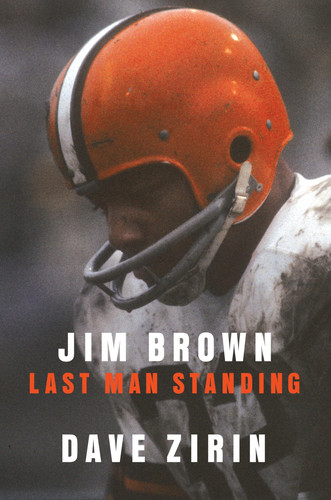
Jim Brown: last man standing

Zirin, Dave
A unique biography of Jim Brown—football legend, Hollywood star, and controversial activist—written by acclaimed sports journalist Dave Zirin. Jim Brown is recognized as perhaps the greatest football player to ever live. But his phenomenal nine-year career with the Cleveland Browns is only part of his remarkable story, the opening salvo to a much more sprawling epic. Brown parlayed his athletic fame into stardom in Hollywood, where it was thought that he could become “the black John Wayne.” He was an outspoken Black Power icon in the 1960s, and he formed Black Economic Unions to challenge racism in the business world. For this and for his decades of work as a truce negotiator with street gangs, Brown—along with such figures as Muhammad Ali, Bill Russell, and Billie Jean King—is revered as a socially conscious athlete. On the most hypermasculine cultural canvases of the United States—NFL football, the Black Power movement, Hollywood's blaxploitation films, gang intervention both inside and outside prison walls—Jim Brown has made his mark. Yet in the landscape of the most toxic expression of “what makes a man”—numerous accusations of violence against women—he has left a jagged mark as well. Dave Zirin's book redefines an American icon, and not always in a flattering light. At eighty-one years old, Brown continues to speak out and look for fights. His recent public support of Donald Trump and criticism of Colin Kaepernick are just the latest examples of someone who seems restless if he is not in conflict. Jim Brown is a raw and thrilling account of Brown's remarkable life and a must-read for sports fans and students of the black freedom struggle.
Blue Rider Press 2018-05-15 320 pages

One tough mother: taking charge in life, business, and apple pies

Boyle, Gert
When a heart attack claimed Gert Boyle's husband in 1970, the forty-six-year-old housewife and mother of three found herself at the helm of Columbia Sportswear, a small outerwear manufacturer in Portland, Oregon, that was struggling financially. With no business experience whatsoever, Boyle was faced with the challenge of running Columbia, which had been founded in 1937 by her father — a Jewish immigrant who had fled Hitler's Germany. Boyle and her son Tim persevered, turning a company that in 1970 had forty employees and less than 800,000 in annual sales into the leading seller of skiwear in the United States, with more than 2000 employees and over a billion in annual sales. Along the way, thanks in part to a creative marketing campaign that billed her as "one tough mother," Boyle established herself as an industry icon, and the first woman ever inducted into the International Sporting Goods Hall of Fame. One Tough Mother presents an honest and often irreverent account of Boyle's journey from a childhood in Nazi Germany to incredible success in America. She offers insights into succeeding in business and in life, and shares many of the advertisements and strategies that have made her so recognizable.
Carroll & Graf 2007 198 pages

Siren song: my life in music

Stein, Seymour
Seymour Stein is America's greatest living record man. Not only has he signed and nurtured more important artists than anyone alive, now sixty years in the game, he's still the hippest label head, travelling the globe in search of the next big thing. Since the late fifties, he's been wherever it's happening: Billboard, Tin Pan Alley, The British Invasion, CBGB, Studio 54, Danceteria, the Rock n Roll Hall of Fame, the CD crash. Along that winding path, he discovered and broke out a skyline full of stars: Madonna, The Ramones, Talking Heads, Depeche Mode, The Smiths, The Cure, Ice-T, Lou Reed, Seal, and many others. Brimming with hilarious scenes and character portraits, Siren Song's wider narrative is about modernity in motion, and the slow acceptance of diversity in America - thanks largely to daring pop music. Including both the high and low points in his life, Siren Song touches on everything from his discovery of Madonna to his wife Linda Stein's violent death. Ask anyone in the music business, Seymour Stein is a legend. Sung from the heart, Siren Song will etch his story in stone
St. Martin's Press 2018-06-12 342 pages

From the ground up: a journey to reimagine the promise of America

Schultz, Howard,Gordon, Joanne
"From the longtime CEO and chairman of Starbucks, a bold, dramatic work about the new responsibilities that leaders, businesses, and citizens share in American society today--as viewed through the intimate lens of one man's life and work. What do we owe one another? How do we channel our drive, ingenuity, even our pain, into something more meaningful than individual success? And what is our duty in the places where we live, work, and play? These questions are at the heart of the American journey. They are also ones that Howard Schultz has grappled with personally since growing up in the Brooklyn housing projects and while building Starbucks from eleven stores into one of the world's most iconic brands. In From the Ground Up, Schultz looks for answers in two interwoven narratives. One story shows how his conflicted boyhood--including experiences he has never before revealed--motivated Schultz to become the first in his family to graduate from college, then to build the kind of company his father, a working-class laborer, never had a chance to work for: a business that tries to balance profit and human dignity. A parallel story offers a behind-the-scenes look at Schultz's unconventional efforts to challenge old notions about the role of business in society. From health insurance and free college tuition for part-time baristas to controversial initiatives about race and refugees, Schultz and his team tackled societal issues with the same creativity and rigor they applied to changing how the world consumes coffee. Throughout the book, Schultz introduces a cross-section of Americans transforming common struggles into shared successes. In these pages, lost youth find first jobs, aspiring college students overcome the yoke of debt, post-9/11 warriors replace lost limbs with indomitable spirit, former coal miners and opioid addicts pave fresh paths, entrepreneurs jump-start dreams, and better angels emerge from all corners of the country. From the Ground Up is part candid memoir, part uplifting blueprint of mutual responsibility, and part proof that ordinary people can do extraordinary things. At its heart, it's an optimistic, inspiring account of what happens when we stand up, speak out, and come together for purposes bigger than ourselves. Here is a new vision of what can be when we try our best to lead lives through the lens of humanity."--Dust jacket.
Random House 2019 352 pages

Harvey Milk: His Lives and Death

Faderman, Lillian
"Harvey Milk--eloquent, charismatic, and a smart-aleck--was elected to the San Francisco Board of Supervisors in 1977, but he had not even served a full year in office when he was shot by a homophobic fellow supervisor. Milk's assassination at the age of forty-eight made him the most famous gay man in modern history; twenty years later Time magazine included him on its list of the hundred most influential individuals of the twentieth century. Before finding his calling as a politician, however, Harvey variously tried being a schoolteacher, a securities analyst on Wall Street, a supporter of Barry Goldwater, a Broadway theater assistant, a bead-wearing hippie, the operator of a camera store and organizer of the local business community in San Francisco. He rejected Judaism as a religion, but he was deeply influenced by the cultural values of his Jewish upbringing and his understanding of anti-Semitism and the Holocaust. His early influences and his many personal and professional experiences finally came together when he decided to run for elective office as the forceful champion of gays, racial minorities, women, working people, the disabled, and senior citizens. In his last five years, he focused all of his tremendous energy on becoming a successful public figure with a distinct political voice."--Dust jacket.
Yale University Press 2018-01-01 283 pages

Birdseye: the adventures of a curious man

Kurlansky, Mark
While working as a fur trapper in Labrador, Canada, Clarence Birdseye encountered an age-old problem: bad food and an unappealing, unhealthy diet. However, he observed that fresh vegetables wetted and left outside in the Arctic winds froze in a way that maintained their integrity after thawing. As a result, he developed his patented Birdseye freezing process and started the company that still bears his name. Birdseye forever changed the way we preserve, store, and distribute food, and the way we eat. Mark Kurlansky’s vibrant and affectionate narrative reveals Clarence Birdseye as a quintessential “can-do” American inventor—his other patents include an electric sunlamp, a harpoon gun to tag finback whales, and an improved incandescent lightbulb—and shows how the greatest of changes can come from the simplest of ideas and the unlikeliest of places.
Anchor 2013-02-12 288 pages

My journey

Karan, Donna
NAMED ONE OF THE BEST BOOKS OF THE YEAR BY HARPER’S BAZAAR • In this candid memoir, featuring a foreword by Barbra Streisand, renowned designer Donna Karan shares intimate details about her lonely childhood, her four-plus decades in the fashion industry, her two marriages, motherhood, and her ongoing quest for self-acceptance and spiritual peace. Donna Karan was born into the fashion business—her father was a tailor, and her mother was a showroom model and Seventh Avenue saleswoman—yet Karan dreamed of becoming a dancer like Martha Graham or a singer like Barbra Streisand. Fashion was her destiny, though. My Journey traces Karan’s early days as an intern at Anne Klein, the creation of her Seven Easy Pieces (which forever changed the way working women dressed), and the meteoric rise of her company. Along with juicy industry stories, Karan candidly discusses her difficult mother and traumatic childhood, her turbulent romantic life, all the loved ones she has lost over the years, and the personal awakening that occurred just as she reached the height of professional and financial success. That awakening set Karan down a path of spiritual discovery and self-improvement. From est to Kabbalah, from silent retreats to leech therapy, Karan tried everything to find, as she writes, “calm in the chaos.” But she also reveals how a chaotic life, fueled by endless curiosity and childlike impulses, helped her design seminal collections season after season for global powerhouse brands Donna Karan New York and DKNY. She also details how she has channeled her creativity (and her urge to solve problems and nurture others) into philanthropic work, particularly her early outspoken advocacy for AIDS awareness and research, and the creation of her Urban Zen Foundation, focusing on integrated healthcare and education as well as preservation of culture, which led to her current efforts in Haiti. Karan’s life has been crowded with glamorous characters and adventures around the world. But she sometimes still feels like that awkward teen from Long Island who never fit in—which makes her all the more endearing. Brimming with Karan’s infectious energy, My Journey is about much more than the fashion world: It is the story of a young woman whose vision and hard work made her a role model for women everywhere—a woman who dreamed big, fought to have it all, broke the rules, and loved passionately along the way. Praise for My Journey “By turns moving, insightful, and hilarious, yet always, always heartfelt . . . When you’re a true force of fashion, nothing holds you back.” — Vogue “When Donna Karan stepped down . . . it was the end of an era, so consider this autobiography her parting gift. . . . Expect a holistic view of the woman behind one of the most influential American labels.” — StyleCaster “Donna’s creativity and passion as a committed philanthropist are matched only by her gift for friendship. Whether she’s making the world more beautiful or giving a Haitian artisan the tools to create a sustainable business, Donna has always led with great heart and wonderful humor.” —President Bill Clinton “What we take for granted often comes from the most revolutionary of sources. In New York in the 1980s, no one was more radical than Donna Karan. She created a way of dressing that was womanly, practical, and empowering.” —Anna Wintour “An extraordinary personal, professional, and spiritual life . . . defined by Donna’s incredible resilience, her inward search for calm in the midst of success, and her insistence on always following her heart.” —Arianna Huffington
Ballantine Books 2015-10-13 363 pages

Good for the money: my fight to pay back America

Benmosche, Bob
"In 2009, at the peak of the financial crisis, AIG - the American insurance behemoth - was sinking fast. It was the peg upon which the nation hung its ire and resentment during the financial crisis: the pinnacle of Wall Street arrogance and greed. When Bob Benmosche climbed aboard as CEO, it was widely assumed that he would go down with his ship. In mere months, he turned things around, pulling AIG from the brink of financial collapse and restoring its profitability. Before three years were up, AIG had fully repaid its staggering debt to the U.S. government - with interest.Good for the Money is an unyielding leader's memoir of a career spent fixing companies through thoughtful, unconventional strategy. With his brash, no-holds-barred approach to the job, Benmosche restored AIG's employee morale and good name. His is a story of perseverance, told with refreshing irreverence in unpretentious terms.Called "an American hero" by Andrew Ross Sorkin, author of Too Big to Fail, Benmosche was a self-made man who never forgot what life is like for the nation's 99-percent; again and again, he pushed back against obstinate colleagues to salvage American jobs and industry. Good for the Money affords you a front-row seat for Benmosche's heated battles with major players from Geithner to Obama to Cuomo, and offers incomparable lessons in leadership from the legendary CEO who changed the way Wall Street does business"--
St. Martin's Press 2016-04-12 271 pages

I'm not really a waitress: how one woman revamped the beauty industry one color at a time

Weiss-Fischmann, Suzi
Inspiring women to pursue their own colorful dreams, I'm Not Really a Waitress tells the story of how Suzi Weiss-Fischmann transformed a small dental supply company into a #1 beauty brand around the world Today, OPI is known as a global beauty brand, famous for its trend-setting colors, unforgettable shade names, and celebrity collaborations with the biggest stars from film, television, music, and sports. But behind all the glamour is the little-known tale of OPI's unlikely origins-an intimate and inspiring story of a timid schoolgirl who arrives in this country with little money and no English and becomes the business leader and industry game-changer known worldwide as "Suzi, the First Lady of Nails." In I'm Not Really a Waitress --titled after OPI's top-selling nail color--Suzi reveals the events that led her family to flee Communist Hungary and eventually come to New York City in pursuit of the American dream. She shares how those early experiences gave rise to OPI's revolutionary vision of freedom and empowerment, and how Suzi transformed an industry by celebrating the power of color-and of women themselves.
Seal Press 2019-03-12 225 pages