326 results for "Business"

The New Society: The Anatomy of Industrial Order

Drucker, Péter
In The New Society, Peter Drucker extended his previous works The Future of Industrial Man and The Concept of the Corporation into a systematic, organized analysis of the industrial society that emerged out of World War II. He analyzes large business enterprises, governments, labor unions, and the place of the individual within the social context of these institutions. Although written when the industrial society he describes was at its peak of productivity, Drucker's basic conceptual frame has well stood the test of time. Following publication of the first printing of The New Society, George G. Higgins wrote in Commonweal that "Drucker has analyzed, as brilliantly as any modem writer, the problems of industrial relations in the individual company or 'enterprise.' He is thoroughly at home in economics, political science, industrial psychology, and industrial sociology, and has succeeded admirably in harmonizing the findings of all four disciplines and applying them meaningfully to the practical problems of the 'enterprise.'" This well expresses contemporary critical opinion. Peter Drucker's new introduction places The New Society in a contemporary perspective and affirms its continual relevance to industry in the mid-1990s. Economists, political scientists, psychologists, and professionals in management and industry will find this seminal work a useful tool for understanding industry and society at large.
[distributor] Taylor & Francis, c/o Bookpoint 2017 362 pages

Understanding Marxism

Richard D. Wolff
Why should we pay attention to the great social critics like Marx? If you want to understand capitalism in order to make society better, then understanding Marx’s analysis is fundamental in drawing your attention to capitalist production’s core conflict: class struggle. It is everywhere, and it influences everything and everyone in our society. Marx is the theoretician who first explained it systematically. He was a social critic for whom capitalism signified not the end of human history, but the latest phase that badly needed a transition to something better. Marxism displays a central, crucial focus on the class struggle that both haunts and drives capitalism. Nothing could be more relevant and useful here and now to help us understand and cope with the threatening global capitalism of our times. Indeed, Americans today confront serious questions and evidence that our capitalist system is in trouble and that it clearly serves the 1% far better than the vast mass of the people. We offer this introductory book now because of the power and usefulness today of Marx’s criticism of the capitalist economic system. This 2021 hardcover edition features a new introduction by author Richard D. Wolff, which strengthens the case for why Marxism is worth understanding. It explains and shares our excitement about the ways in which Marxism helps us to critically rethink capitalism today, and offers new directions for social development beyond and better than the capitalism we have.
Democracy at Work 2021 110 pages

Understanding socialism

Wolff, Richard D.
"Understanding Socialism is a plainspoken text that disarms false narratives, confronts past failures, and offers a path to a fresh and modern understanding of socialism, by outlining what democracy in the workplace could look like. Wolff not only explains what socialism is and has meant to its various proponents, he also looks at the transition from feudalism to capitalism as a model to help us visualize an evolution from our current socioeconomic state. Understanding Socialism explores how socialist theory was used and applied to help shape the histories of countries such as Russia and China, and beyond. Wolff also analyzes the successes and defeats of those countries, the world's reactions to them, and how they offer important lessons for the building of a democratic, worker-controlled 21st-century socialism."--Publisher description.
Haymarket Books 2025-12-09 156 pages

Building the New American Economy Smart, Fair, and Sustainable

Jeffrey D. Sachs
In this passionate and powerful book--part manifesto, part plan of action--the renowned economist Jeffrey D. Sachs offers a practical strategy to move America, seemingly more divided than ever, toward a new consensus: sustainable development. Sustainable development is a holistic approach that emphasizes economic, social, and environmental objectives in shaping policy. In focusing too much on economic growth, the United States has neglected rising economic inequality and dire environmental threats. Now, even growth is imperiled. Sachs explores issues that have captivated the nation and political debate, including infrastructure, trade deals, energy policy, the proper size and role of government, the national debt, and income inequality. Not only does he provide illuminating and accessible explanations of the forces at work in each case, but he also presents specific policy solutions. His argument rises above the pessimism born of political paralysis, economic stagnation, and partisanship to devise a brighter way forward, achievable both individually and collectively. In Building the New American Economy , Sachs shows how the United States can find a path to renewed economic progress that is fair and environmentally sustainable.
Columbia University Press 2018-03-20 130 pages

Socialism: An Economic And Sociological Analysis (1951)

Mises, Ludwig Von
""Socialism: An Economic and Sociological Analysis"" is a seminal work by the Austrian economist and philosopher Ludwig von Mises. Originally published in 1922, this revised edition from 1951 offers a comprehensive critique of socialism, examining its economic and sociological implications. Mises argues that socialism, which seeks to eliminate private ownership of the means of production and replace it with collective ownership, is fundamentally flawed and cannot work in practice. He explores the reasons why socialist economies inevitably lead to inefficiency, misallocation of resources, and ultimately, economic collapse. Mises also examines the social and political implications of socialism, arguing that it leads to the destruction of individual freedom and the growth of authoritarianism. The book remains a classic in the field of economics and political philosophy, and is essential reading for anyone interested in understanding the strengths and weaknesses of socialist ideology.This scarce antiquarian book is a facsimile reprint of the old original and may contain some imperfections such as library marks and notations. Because we believe this work is culturally important, we have made it available as part of our commitment for protecting, preserving, and promoting the world's literature in affordable, high quality, modern editions, that are true to their original work.
Kessinger Publishing, LLC 2010-09-10 598 pages

A functioning society

Peter F. Drucker
Peter F. Drucker may be best known as a writer on business and management, but these subjects were not his foremost intellectual concern. Drucker's primary concerns were community, in which the individual has status, and society, in which the individual has function. Here he has assembled selections from his vast writings on these subjects. This collection presents the full range of Drucker's thought on community, society, and political structure and constitutes an ideal introduction to his ideas. The volume is divided into seven parts. The selections in parts 1 and 2 were mostly written during World War Two and in the wake of the Great Depression. Part 3 deals with the limits of governmental competence in the social and economic realm. It contains some of Drucker's most influential writings concerned with the difference between big government and effective government. The chapters in part 4 explore autonomous centers of power outside government and within society. Part 5 contains chapters from Drucker's path-breaking work on the corporation as a social organization rather than merely an economic one. The rise of the so-called "knowledge industries" forms the background for part 6. The concluding part 7 is devoted entirely to Drucker's long essay "The Next Society." Drucker examines the emergence of new institutions and new theories arising from the information revolution and the social changes they are helping to bring about. In organizing these representative writings, Drucker chose to be topical rather than chronological, with each excerpt presenting a basic theme of his life's work. As is characteristic of his efforts, A Functioning Society appeals both the general reader as well as a cross-disciplinary scholarly readership.
Transaction Publishers 2011-02 242 pages

Public Finance, 9th Edition by Harvey S. Rosen, Ted Gayer (2009) Hardcover

Harvey S. Rosen
Public Finance benefits from the combined efforts of Harvey Rosen s market-leading book and co-author Ted Gayer s research and government agency experience. This combination of experience is able to explain as clearly as possible how the tools of economics can be used to analyze government expenditure and tax policies. This new edition incorporates recent developments and along the way takes students to the frontiers of current research and policy. While the information presented is cutting edge and reflects the work of economists currently active in the field, the approach makes the text accessible to undergraduates whose only prior exposure to economics is at the introductory level. All of the changes in the Tenth edition were made to further the authors goal of providing students with a clear and coherent view of the role of government spending and taxation. The authors years of policy experience have convinced themselves that modern public finance provides a practical and invaluable framework for thinking about policy issues. The goal is to emphasize the links between sound economics and the analysis of real-world policy problems.Connect is the only integrated learning system that empowers students by continuously adapting to deliver precisely what they need, when they need it, and how they need it, so that your class time is more engaging and effective."
McGraw-Hill/Irwin

The coming of post-industrial society: a venture in social forecasting

Bell, Daniel
In 1976, Daniel Bell€™s historical work predicted a vastly different society developing—one that will rely on the “economics of information€ rather than the “economics of goods.€ Bell argued that the new society would not displace the older one but rather overlie some of the previous layers just as the industrial society did not completely eradicate the agrarian sectors of our society. The post-industrial society€™s dimensions would include the spread of a knowledge class, the change from goods to services and the role of women. All of these would be dependent on the expansion of services in the economic sector and an increasing dependence on science as the means of innovating and organizing technological change.Bell prophetically stated in The Coming of the Post-Industrial Society that we should expect “ new premises and new powers, new constraints and new questions—with the difference that these are now on a scale that had
Basic Books 1973-07-12 507 pages

The spirit of green: the economics of collisions and contagions in a crowded world

Nordhaus, William D.
"From a Nobel Prize-winning pioneer in environmental economics, an innovative account of how and why "green thinking" could cure many of the world's most serious problems-from global warming to pandemics Solving the world's biggest problems-from climate catastrophe and pandemics to wildfires and corporate malfeasance-requires, more than anything else, coming up with new ways to manage the powerful interactions that surround us. For carbon emissions and other environmental damage, this means ensuring that those responsible pay their full costs rather than continuing to pass them along to others, including future generations. In The Spirit of Green, Nobel Prize-winning economist William Nordhaus describes a new way of green thinking that would help us overcome our biggest challenges without sacrificing economic prosperity, in large part by accounting for the spillover costs of economic collisions. In a discussion that ranges from the history of the environmental movement to the Green New Deal, Nordhaus explains how the spirit of green thinking provides a compelling and hopeful new perspective on modern life. At the heart of green thinking is a recognition that the globalized world is shaped not by isolated individuals but rather by innumerable interactions inside and outside the economy. He shows how rethinking economic efficiency, sustainability, politics, profits, taxes, individual ethics, corporate social responsibility, finance, and more would improve the effectiveness and equity of our society. And he offers specific solutions-on how to price carbon, how to pursue low-carbon technologies, how to design an efficient tax system, and how to foster international cooperation through climate clubs. The result is a groundbreaking new vision of how we can have our environment and our economy too"--
Princeton University Press 2021-05-18 355 pages

Rich Bitch A Simple 12-Step Plan for Getting Your Financial Life Together... Finally

Nicole Lapin
NEW YORK TIMES BESTSELLER In this New York Times bestseller, journalist and financial expert Nicole Lapin shows women how to take charge of their lives by taking charge of their money "You might not know this but stressing over money can harm your overall health. Let Nicole be the doctor for your financial health and you will feel better in more ways than you'd think." --Dr. Oz, host of the "Dr. Oz Show", and Lisa Oz, host of the "Lisa Oz Show" Do your eyes glaze over just thinking about the mumbo-jumbo language of finance? Do you break out into hives when faced with getting your financial life together? Well, sister, you are not alone. In Rich Bitch, money expert and financial journalist Nicole Lapin lays out a 12-Step Plan in which she shares her experiences--mistakes and all--of getting her own finances in order. She talks to you not like a lecturer but as your friend. And even though money is typically an "off-limits" conversation, nothing is off-limits here. Lapin rethinks every piece of financial "wisdom" you've ever heard and puts her own fresh, modern, sassy spin on it. Sure, there are some hard-and-fast rules about finance, but when it comes to your money, the only person who can tell you how to spend it is you. Should you invest in a 401(k)? Maybe not. Should you splurge on that morning latte? Likely yes. Instead of focusing on nickel-and-diming yourself, Nicole's advice focuses on investing in yourself so you don't have to stress over the little things. Rich Bitch rehabs whatever bad money habits you might have and provides a plan you can not only sustain, but also thrive on. You won't feel deprived but rather inspired to go after the rich life you deserve, and confident enough to call yourself a rich bitch.
HarperCollins Publishers 2019-11-05 400 pages

Stone age economics

Sahlins, Marshall David
Stone Age Economics is a classic study of anthropological economics, first published in 1974. As Marshall Sahlins stated in the first edition, "It has been inspired by the possibility of 'anthropological economics,' a perspective indebted rather to the nature of the primitive economies than to the categories of a bourgeois science." Ambitiously tackling the nature of economic life and how to study it comparatively, the book includes six studies which reflect the author's ideas on revising traditional views of the hunter-gatherer and so-called primitive societies, revealing them to be the original affluent society. The book examines notions of production, distribution and exchange in early communities and examines the link between economics and cultural and social factors. It consists of a set of detailed and closely related studies of tribal economies, of domestic production for livelihood, and of the submission of domestic production to the material and political demands of society at large. Marshall Sahlins is one of the most prominent American anthropologists of our time. He holds the title of Charles F. Grey Distinguished Service Professor of Anthropology at the University of Chicago. His most recent book is How Natives Think: About Captain Cook, for Example.
Transaction Publishers 2011 348 pages

The three trillion dollar war: the true cost of the Iraq conflict

Stiglitz, Joseph E.
The true cost of the Iraq War is $3 trillion rather than the $50 billion projected by the White House. Apart from its tragic human toll, the Iraq War will be staggeringly expensive in financial terms. This sobering study by Nobel Prize winner Joseph E. Stiglitz and Harvard professor Linda J. Bilmes casts a spotlight on expense items that have been hidden from the U.S. taxpayer, including not only big-ticket items like replacing military equipment (being used up at six times the peacetime rate) but also the cost of caring for thousands of wounded veterans for the rest of their lives. Shifting to a global focus, the authors investigate the cost in lives and economic damage within Iraq and the region. Finally, with the chilling precision of an actuary, the authors measure what the U.S. taxpayer's money would have produced if instead it had been invested in the further growth of the U.S. economy. Written in language as simple as the details are disturbing, this book will forever change the way we think about the war.
W.W. Norton 2008-02-17 311 pages

Inadequate Equilibria Where and How Civilizations Get Stuck

Eliezer Yudkowsky
When should you think that you may be able to do something unusually well?If you're trying to advance a scientific field - or start the next Facebook - or just get a really good deal buying cheap electronics from Hong Kong - then it's important that you have a sober understanding of your competencies, and the competencies of others. The story only ends there, however, if you're fortunate enough to live in an adequate civilization.Inadequate Equilibria is a sharp and lively guidebook for anyone questioning when and how they can know better, and do better, than the status quo. Freely mixing debates on the foundations of rational decision-making with tips for everyday life, Eliezer Yudkowsky explores the central question of when we can (and can't) expect to spot systemic inefficiencies and opportunities to "beat the market."
Machine Intelligence Research Institute 2017-11-16 167 pages

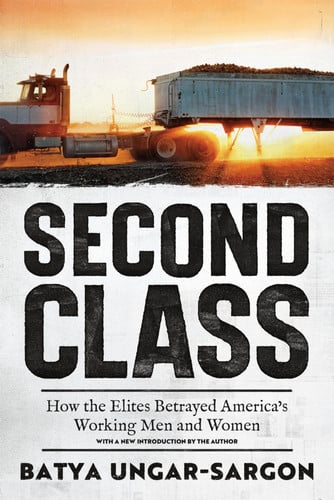
Second class: how the elite betrayed America's working men and women

Ungar-Sargon, Batya
A personal, journalistic ethnography of the modern American working class, based on the travels and interactions of the author through the American heartland. " Second Class is the most important book you will read all year. A political realignment is coming, and it's my hope that the end result will work in favor of our all-too-neglected American working class. When that realignment comes, Batya and her book will help lead the way." --Greg Lukianoff, CEO of the Foundation for Individual Rights in Education, and co-author of The Coddling of the American Mind Who is the American working class? Do they still have a fair shot at the American Dream? What do they think about their chances to secure the hallmarks of a middle-class life? While writing this book, Batya Ungar-Sargon visited states across the nation to speak with members of the American working class who are fighting tooth and nail to survive. In Second Class , working-class Americans of all races, political orientations, and occupations share their stories--cleaning ladies, health care aides, cops, truck drivers, fast food workers, electricians, and more. In their own words, these working-class Americans explain the struggles and triumphs of their increasingly precarious lives--as well as what policies they think would improve them. Second Class combines deep reporting with a look at the data and expert opinions on America's emergent class divide, in which the most basic elements of a secure and stable life are increasingly out of reach for those without a college education. America has broken its contract with its laboring class. So, how do we get back to the American Dream? How do we once again become the land of opportunity, the promised land, where hard work and commitment to family are enough to protect you from poverty? It's not that hard actually. All it would take, as this book illustrates, is for those in power to once again respect the dignity of work--and the American worker.
Encounter Books 2025 248 pages

Supercapitalism The Transformation of Business, Democracy, and Everyday Life

Robert B. Reich
Mid-twentieth-century capitalism has turned into global capitalism, and global capitalism - turbocharged, Web-based, and able to find and make almost anything just about anywhere - has turned into supercapitalism. But as Robert B. Reich makes clear in this eye-opening book, while supercapitalism is working wonderfully well to enlarge the economic pie, democracy - charged with caring for all citizens - is becoming less and less effective under its influence. Reich explains how widening inequalities of income and wealth, heightened job insecurity, and the spreading effects of global warming are the logical outcomes of supercapitalism. He shows us why companies, fighting harder than ever to maintain their competitive positions, have become even more deeply involved in politics; and how average citizens, seeking great deals and invested in the stock market to an unprecedented degree, are increasingly loath to stand by their values if it means biting the hands that feed them. As one of America's most influential voices, Reich sets out a clear course to a vibrant capitalism and a concurrent, equally vibrant democracy.
Scribe Publications 2008 272 pages

Macroeconomics

Landsburg, Steven E.
The Fourth Edition represents the most comprehensive revision to date, systematically covering modern economic theory. Aided by examples, illustrations and step-by-step explanations, it provides a clear connection between theory and policy. Highlighting aggregate supply and aggregate demand, the Fourth Edition features new sections on current issues in unemployment, inflation, growth, productivity, and fiscal and monetary policy. More so than in other texts, it provides a complete selection of applied micro topics, including chapters on agriculture, natural resources, government regulation, politics and economics. The many special features that enhance the text include: ``key concepts,'' ``key terms'' and ``key-point summaries;'' running glossaries; many charts, graphs and tables; and end-of-chapter problems.
McGraw-Hill College 1996-12 266 pages

The Tyranny of the Status Quo

Milton Friedman,Rose D. Friedman
In Tyranny of the Status Quo, Milton and Rose Friedman describe a remarkable political phenomenon: the uniform tendency in government to reverse the declared policies of leaders whether left or right. In the first six to nine months following their election, Reagan, Thatcher, and Mitterand, too, initiated big changes. Soon, each was frustrated by the "Iron Triangle" which preserves the status quo. In the triangle's corners are the direct beneficiaries of laws, the bureaucrats who thrive on them, the politicians who seek votes. Book jacket.
HarperCollins Publishers 1985-03 192 pages

The Road to Freedom Economics and the Good Society

Joseph E. Stiglitz
We are a nation born from the conviction that people must be free. But since the middle of the last century, that idea has been co-opted. Forces on the political Right have justified exploitation by cloaking it in the rhetoric of freedom, leading to pharmaceutical companies freely overcharging for medication, a Big Tech free from oversight, politicians free to incite rebellion, corporations free to pollute, and more. How did we get here? Whose freedom are we--and should we--be thinking about? In The Road to Freedom, Nobel prize winner Joseph E. Stiglitz dissects America's current economic system and the political ideology that created it, laying bare their twinned failure. "Free" and unfettered markets have only succeeded in delivering a series of crises: the financial crisis, the opioid crisis, and the crisis of inequality. While a small portion of the population has amassed considerable wealth, wages for most people have stagnated. Free and unfettered markets have exploited consumers, workers, and the environment alike. Such failures have fed populist movements that believe being free means abandoning any obligations citizens have to one another. As they grow in strength, these movements now pose a real threat to true economic and political freedom. As an economic advisor to presidents and as chief economist at the World Bank, Stiglitz has witnessed these profound changes firsthand. As he argues, the failures follow from the elites' unshakeable dedication to "the neoliberal experiment." Explicitly taking on giants such as Friedrich Hayek and Milton Friedman, Stiglitz exposes accepted ideas about our political and economic life for what they are: twisted visions that tear at the social fabric while they enrich the very few. The Road to Freedom breaks new ground, showing how economics--including recent advances in which Stiglitz has played such an important role--reframes how to think about freedom and the role of the state in a twenty-first century society. Drawing on the work of contemporary philosophers, Stiglitz explains a deeper, more humane way to assess freedoms--one that considers with care what to do when one person's freedom conflicts with another's. We must reimagine our existing economic and legal systems and embrace forms of collective action, including regulation and investment, if we are to create an innovative society in which everyone can flourish. The task could not be more urgent, and Stiglitz's latest book is essential reading for those committed to the American ideal of an economic and political system that delivers well-being, opportunity, and meaningful freedoms for all.
W. W. Norton, Incorporated 2026-02-24 384 pages