
76 results for "Business"

Second class: how the elite betrayed America's working men and women

Ungar-Sargon, Batya
A personal, journalistic ethnography of the modern American working class, based on the travels and interactions of the author through the American heartland. " Second Class is the most important book you will read all year. A political realignment is coming, and it's my hope that the end result will work in favor of our all-too-neglected American working class. When that realignment comes, Batya and her book will help lead the way." --Greg Lukianoff, CEO of the Foundation for Individual Rights in Education, and co-author of The Coddling of the American Mind Who is the American working class? Do they still have a fair shot at the American Dream? What do they think about their chances to secure the hallmarks of a middle-class life? While writing this book, Batya Ungar-Sargon visited states across the nation to speak with members of the American working class who are fighting tooth and nail to survive. In Second Class , working-class Americans of all races, political orientations, and occupations share their stories--cleaning ladies, health care aides, cops, truck drivers, fast food workers, electricians, and more. In their own words, these working-class Americans explain the struggles and triumphs of their increasingly precarious lives--as well as what policies they think would improve them. Second Class combines deep reporting with a look at the data and expert opinions on America's emergent class divide, in which the most basic elements of a secure and stable life are increasingly out of reach for those without a college education. America has broken its contract with its laboring class. So, how do we get back to the American Dream? How do we once again become the land of opportunity, the promised land, where hard work and commitment to family are enough to protect you from poverty? It's not that hard actually. All it would take, as this book illustrates, is for those in power to once again respect the dignity of work--and the American worker.
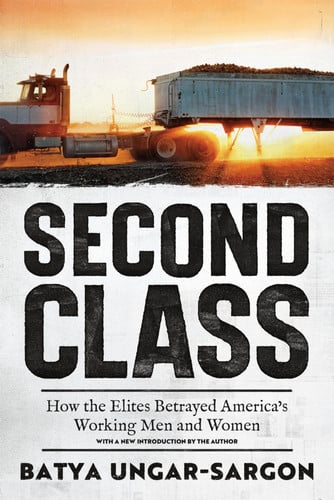
Encounter Books 2025 248 pages

The Road to Freedom Economics and the Good Society

Joseph E. Stiglitz
We are a nation born from the conviction that people must be free. But since the middle of the last century, that idea has been co-opted. Forces on the political Right have justified exploitation by cloaking it in the rhetoric of freedom, leading to pharmaceutical companies freely overcharging for medication, a Big Tech free from oversight, politicians free to incite rebellion, corporations free to pollute, and more. How did we get here? Whose freedom are we--and should we--be thinking about? In The Road to Freedom, Nobel prize winner Joseph E. Stiglitz dissects America's current economic system and the political ideology that created it, laying bare their twinned failure. "Free" and unfettered markets have only succeeded in delivering a series of crises: the financial crisis, the opioid crisis, and the crisis of inequality. While a small portion of the population has amassed considerable wealth, wages for most people have stagnated. Free and unfettered markets have exploited consumers, workers, and the environment alike. Such failures have fed populist movements that believe being free means abandoning any obligations citizens have to one another. As they grow in strength, these movements now pose a real threat to true economic and political freedom. As an economic advisor to presidents and as chief economist at the World Bank, Stiglitz has witnessed these profound changes firsthand. As he argues, the failures follow from the elites' unshakeable dedication to "the neoliberal experiment." Explicitly taking on giants such as Friedrich Hayek and Milton Friedman, Stiglitz exposes accepted ideas about our political and economic life for what they are: twisted visions that tear at the social fabric while they enrich the very few. The Road to Freedom breaks new ground, showing how economics--including recent advances in which Stiglitz has played such an important role--reframes how to think about freedom and the role of the state in a twenty-first century society. Drawing on the work of contemporary philosophers, Stiglitz explains a deeper, more humane way to assess freedoms--one that considers with care what to do when one person's freedom conflicts with another's. We must reimagine our existing economic and legal systems and embrace forms of collective action, including regulation and investment, if we are to create an innovative society in which everyone can flourish. The task could not be more urgent, and Stiglitz's latest book is essential reading for those committed to the American ideal of an economic and political system that delivers well-being, opportunity, and meaningful freedoms for all.
W. W. Norton, Incorporated 2026-02-24 384 pages

The Idealist Jeffrey Sachs and the Quest to End Poverty

Nina Munk
A powerful portrayal of Jeffrey Sachs's ambitious quest to end extreme global poverty, now a Signal paperback. "The poor you will always have with you," according to Matthew 26:11. But Jeffrey Sachs, economics superstar, special advisor to the Secretary General of the UN and the author of The End of Poverty , vehemently disagrees. In his view, poverty -- especially the extreme deprivation of sub-Saharan Africa -- can easily be eradicated. The vast sums spent in foreign aid over the decades has not come close to alleviating the dire subsistence problems of Africans. Sachs believed he knew the reason: the developed world simply hadn't spent enough. In 2006, Sachs, backed by tens of millions of donor dollars, launched the five-year Millennium Villages Project. Sachs would test his theories in villages in different African countries, then, with each success, scale up until until the program was continent-wide. His first village "make-over" was a small community in Sauri, Kenya, and the immediate effect was encouraging. With that first inkling of success achieved, Sachs rolled out a dozen model Millennium villages in ten countries. For the past six years, Nina Munk has reported deeply on the Project, following Sachs on official trips and listening in on conversations with heads of states, rival organisations and potential donors. And she has immersed herself in the lives of people in two of the remote villages: Ruhiira, in southwest Uganda, and Dertu, in the arid borderland between Kenya and Somalia. Accepting hospitality from these camel herders and smallhold farmers, and sharing in their struggles, Munk came to understand the on-the-ground issues challenging Sachs' one-size-fits-all approach to global poverty. The Idealist is the profound and moving story of what happened when the abstract theories of a brilliant, driven man met messy human reality.
McClelland & Stewart 2014-10-07 288 pages

Drone Warfare: Killing by Remote Control

Medea Benjamin
The CIA chief, Leon Panetta, calls drones the ‘only game in town’. The figures bear him out. Between 2004 and 2012, the US reportedly conducted over 350 drone strikes in Pakistan, killing between 2,600 and 3,400 people. Drone strikes have killed more than 200 children alone in Pakistan and Yemen. In 2000, the Americans had fewer than fifty aerial drones; ten years later, it had a fleet of nearly 7,500, and the US Air Force now trains more drone ‘pilots’ than bomber and fighter pilots combined. Drones are already a $ 5 billion business in the US alone. American activist Medea Benjamin, a co-founder of the peace group CODEPINK and the international human rights organization Global Exchange, provides the first extensive analysis of who is producing the drones, where they are being used, who controls these unmanned places, and what are the legal and moral implications of their use. Benjamin also looks at what activists, lawyers, and scientists across the globe are doing to ground these weapons.
Daily Star Books 2013 241 pages

In an uncertain world: tough choices from Wall Street to Washington

Rubin, Robert Edward
Publisher's description: Robert Rubin was sworn in as the seventieth U.S. Secretary of the Treasury in January 1995 in a brisk ceremony attended only by his wife and a few colleagues. As soon as the ceremony was over, he began an emergency meeting with President Bill Clinton on the financial crisis in Mexico. This was not only a harbinger of things to come during what would prove to be a rocky period in the global economy; it also captured the essence of Rubin himself--short on formality, quick to get into the nitty-gritty. From his early years in the storied arbitrage department at Goldman Sachs to his current position as chairman of the executive committee of Citigroup, Robert Rubin has been a major figure at the center of the American financial system. He was a key player in the longest economic expansion in U.S. history.
Random House 2003 427 pages

Manipulation: what it is, why it's bad, what to do about it

Sunstein, Cass R.
"New technologies are offering companies, politicians, and others unprecedented opportunity to manipulate us. Sometimes we are given the illusion of power - of freedom - through choice, yet the game is rigged, pushing us in specific directions that lead to less wealth, worse health, and weaker democracy. In, Manipulation, nudge theory pioneer and New York Times bestselling author, Cass Sunstein, offers a new definition of manipulation for the digital age, explains why it is wrong; and shows what we can do about it. He reveals how manipulation compromises freedom and personal agency, while threatening to reduce our well-being; he explains the difference between manipulation and unobjectionable forms of influence, including 'nudges'; and he lifts the lid on online manipulation and manipulation by artificial intelligence, algorithms, and generative AI, as well as threats posed by deepfakes, social media, and 'dark patterns,' which can trick people into giving up time and money. Drawing on decades of groundbreaking research in behavioral science, this landmark book outlines steps we can take to counteract manipulation in our daily lives and offers guidance to protect consumers, investors, and workers." --
Cambridge University Press 2025-08-28 219 pages

Climate justice: what rich nations owe the world - and the future

Sunstein, Cass R.
The social cost of carbon: The most important number you've never heard of—and what it means. If you’re injuring someone, you should stop—and pay for the damage you’ve caused. Why does this simple proposition, generally accepted, not apply to climate change? In Climate Justice , a bracing challenge to status quo thinking on the ethics of climate change, renowned author and legal scholar Cass Sunstein clearly frames what’s at stake and lays out the moral imperative: When it comes to climate change, everyone must be counted equally, regardless of when they live or where they live—which means that wealthy nations, which have disproportionately benefited from greenhouse gas emissions, are obliged to help future generations and people in poor nations that are particularly vulnerable.
The MIT Press 2025 195 pages

The politics of genocide

Herman, Edward S.
In this impressive book, Edward S. Herman and David Peterson examine the uses and abuses of the word “genocide.” They argue persuasively that the label is highly politicized and that in the United States it is used by the government, journalists, and academics to brand as evil those nations and political movements that in one way or another interfere with the imperial interests of U.S. capitalism. Thus the word “genocide” is seldom applied when the perpetrators are U.S. allies (or even the United States itself), while it is used almost indiscriminately when murders are committed or are alleged to have been committed by enemies of the United States and U.S. business interests. One set of rules applies to cases such as U.S. aggression in Vietnam, Israeli oppression of Palestinians, Indonesian slaughter of so-called communists and the people of East Timor, U.S. bombings in Serbia and Kosovo, the U.S. war of “liberation” in Iraq, and mass murders committed by U.S. allies in Rwanda and the Republic of Congo. Another set applies to cases such as Serbian aggression in Kosovo and Bosnia, killings carried out by U.S. enemies in Rwanda and Darfur, Saddam Hussein, any and all actions by Iran, and a host of others. With its careful and voluminous documentation, close reading of the U.S. media and political and scholarly writing on the subject, and clear and incisive charts, The Politics of Genocide is both a damning condemnation and stunning exposé of a deeply rooted and effective system of propaganda aimed at deceiving the population while promoting the expansion of a cruel and heartless imperial system.
Monthly Review Press 2010-04-01 159 pages

Keynes for Our Times

Skidelsky, Robert
"John Maynard Keynes (1883-1946) was arguably the most important economist of the twentieth century; his ideas have fundamentally altered the way governments approach economic policy. Exploring the enduring relevance of his ideas, Robert Skidelsky emphasizes Keynes's conception of economics as a moral science. Keynes was deeply invested in the broader societal implications of economic policies, and this book highlights his belief in economics as a tool for achieving the good life. Skidelsky sheds new light on Keynes's views on capitalism, discusses his advocacy of low interest rates, and delves into his thoughts on economic instability. He also offers fresh insight into Keynes's ideas about money, his philosophical foundations, and his unique approach to uncertainty and probability. Ultimately, Skidelsky shows how Keynes's vision of an economic policy that prioritizes the common good can be adapted to help solve our current economic and political challenges"--
Yale University Press 2026-06-23 186 pages

Shared prosperity in a fractured world: a new economics for the middle class, the global poor, and our climate

Rodrik, Dani
"Fighting climate change, saving democracy, and eradicating poverty are urgent global challenges, yet the world's leaders continue to pursue outdated policies that focus on one while worsening the tradeoffs between each of them. Shared Prosperity in a Fractured World shows how the nations of the world can achieve all three objectives. Dani Rodrik provides a bold new vision of globalization, one in which we accelerate the green transition to achieve a sustainable planet, shore up the middle class to restore democracy's foundations, and hasten economic revitalization in the developing world to put an end to poverty. The rising tide of authoritarianism has demonstrated our inability to alleviate economic anxieties. Economic nationalism has raised the specter of increased protectionism and deteriorating prospects for economic growth. And automation and other new technologies have undercut the advantages of low-cost, unskilled labor in manufacturing and export-oriented industrialization. Rodrik reveals how we can restore prosperity through new forms of collaborative public-private action-to promote renewables and green industries, middle-class jobs, and enhanced productivity in labor-absorbing services-even in the absence of global cooperation. He explains why this new kind of globalization must also recognize the legitimate desire of governments to pursue their economic, social, and security interests autonomously. Turning conventional economic wisdom on its head, Shared Prosperity in a Fractured World builds on practices that work while radically transforming those that don't, presenting a grounded, clear-eyed approach to tackling the problems that affect us all, at home and around the world"--
Princeton University Press 2025-11-04 269 pages

National Power and the Structure of Foreign Trade

Albert Hirschman
This study begins with a brief survey of economic thought on the relationship between foreign trade and national power, from the Mercantilists on. Chapter II attempts a systematic theoretical approach to the subject. It first makes clear the fundamental basis of the possible use of foreign trade as an instrument of national power policy. Using well-known concepts of economic analysis, it proceeds to show under what conditions and by means of what policies this instrument is likely to attain its highest efficiency. The principles of power policy thus deduced theoretically are then compared with the actual practices followed by German trading methods in recent years. Toward the end of this chapter the reader will be carried into a detailed discussion of certain problems of the theory of international trade, which are touched upon earlier in the chapter. Chapter III is applied to the historical background of our problem. It gives a survey of the literature on "economic aggression" before and during World War I and brings out the importance of the Paris Economic Conference of the Allies in 1916 for the Versailles Treaty and postwar economic policies. In Chapter IV we review in the light of our theoretical and historical analyses certain safeguards or remedies which could be or have been proposed to prevent the use of foreign trade as an instrument of national power policies. Certain questions raised in Part 1 can be answered in quantitative terms. Part 2 consists, therefore, of an exposition of various trends of international trade in recent years disclosed by statistical analysis. In Chapter V we calculate an index number expressing the extent to which the trade of the large trading nations is or has been directed by preference toward the smaller trading countries. Chapter VI gives index numbers for the degree of concentration of their foreign trade on one or a few big markets or sources of supply. Finally, in Chapter VII we measure the extent to which world trade has been based primarily on an exchange of manufactures against raw materials and foodstuffs. This title is part of UC Press's Voices Revived program, which commemorates University of California Press’s mission to seek out and cultivate the brightest minds and give them voice, reach, and impact. Drawing on a backlist dating to 1893, Voices Revived makes high-quality, peer-reviewed scholarship accessible once again using print-on-demand technology. This title was originally published in 1945, with an expanded edition published in 1980.
Univ of California Press 2024-06-14 194 pages

The Art of Diplomacy How American Negotiators Reached Historic Agreements that Changed the World

Stuart E. Eizenstat
A riveting retelling of diplomatic history with praise from Bill Clinton, Hillary Clinton, Bertie Ahern (Ireland), Tony Blair (UK), Ehud Olmert (Israel), and more. “A magisterial tome on the international negotiations that shaped modern American history.... Grand in scope and grounded in decades of experience, The Art of Diplomacy is a compelling work of political history aimed at the diplomatic negotiators of tomorrow.” -Foreword Reviews Commended by Kirkus Reviews , which says Eizenstat writes with "authority and clarity of experience." Inside the greatest diplomatic negotiations of the past 50 years In one readable volume, diplomat and negotiator Stuart E. Eizenstat covers every major contemporary international agreement, from the treaty to end the Vietnam War to the Kyoto Protocols and the Iranian Nuclear Accord. Written from the perspective that only a participant in top level negotiations can bring, Eizenstat recounts the events that led up to the negotiation, the drama that took place around the table, and draws lessons from successful and unsuccessful strategies and tactics. Based on interviews with over 60 key figures in American diplomacy, including former presidents and secretaries of state, and major political figures abroad, Eizenstat provides an intimate view of diplomacy as today's history. The Art of Diplomacy will be an indispensable volume to understand American foreign policy and provide invaluable insights on the art of negotiation for anyone involved in government or business negotiations. The paperback edition adds a substantive afterword that presents the challenges and opportunities for the second Trump administration.
Bloomsbury Academic 2026-01-22 544 pages

The Making of Global Capitalism The Political Economy of American Empire

Sam Gindin,Leo Panitch
The all-encompassing embrace of world capitalism at the beginning of the twenty-first century was generally attributed to the superiority of competitive markets. Globalization had appeared to be the natural outcome of this unstoppable process. But today, with global markets roiling and increasingly reliant on state intervention to stay afloat, it has become clear that markets and states aren’t straightforwardly opposing forces. In this groundbreaking work, Leo Panitch and Sam Gindin demonstrate the intimate relationship between modern capitalism and the American state, including its role as an “informal empire” promoting free trade and capital movements. Through a powerful historical survey, they show how the US has superintended the restructuring of other states in favor of competitive markets and coordinated the management of increasingly frequent financial crises. The Making of Global Capitalism , through its highly original analysis of the first great economic crisis of the twenty-first century, identifies the centrality of the social conflicts that occur within states rather than between them. These emerging fault lines hold out the possibility of new political movements transforming nation states and transcending global markets.
Verso Books 2025-08-05 480 pages

Famine crimes: politics & the disaster relief industry in Africa

De Waal, Alexander
Famine Crimes is a factually rich, powerfully intelligent, morally important analysis of the persistence of famine in Africa. Using comparative studies from other parts of the world and a detailed knowledge of specific cases in Africa, de Waal lays the blame for Africa's problems with starvation on the political failings of African governments, western donors, and international relief agencies. The message of this important book is that no one need starve in Africa.
African Rights & the International African Institute in association with James Currey, Oxford & Indiana University Press, Bloomington 1997-10-01 238 pages

An Economic Theorist's Book of Tales China Edition

Akerlof, George A.
These essays explore what happens when a skilful economist makes unconventional assumptions. Economic theory has traditionally relied upon a tacit and 'classical' set of assumptions that have gradually acquired a life of their own in defining how economists write and how they justify economic models. Similarly, these assumptions have acquired an autonomous character: they guide the way economists think about the world. In consequence, consideration of alternative assumptions has become taboo. These essays are substantively and stylistically novel because they break these taboos and bring new assumptions into economic theory. The papers apply this adventurous approach to a wide range of issues - from insurance markets and trade in underdeveloped countries to unemployment and discrimination. Some of the essays derive the implications for economic markets of costly asymmetric information. Others explore the findings of other social sciences such as anthropology, psychology and sociology.
Cambridge University Press 2015-01-29 240 pages

Agriculture and food in crisis: conflict, resistance, and renewal

Fred Magdoff,Brian Tokar
The failures of “free-market” capitalism are perhaps nowhere more evident than in the production and distribution of food. Although modern human societies have attained unprecedented levels of wealth, a significant amount of the world’s population continues to suffer from hunger or food insecurity on a daily basis. In Agriculture and Food in Crisis , Fred Magdoff and Brian Tokar have assembled an exceptional collection of scholars from around the world to explore this frightening long-term trend in food production. While approaching the issue from many angles, the contributors to this volume share a focus on investigating how agricultural production is shaped by a system that is oriented around the creation of profit above all else, with food as nothing but an afterthought. As the authors make clear, it is technically possible to feed to world’s people, but it is not possible to do so as long as capitalism exists. Toward that end, they examine what can be, and is being, done to create a human-centered and ecologically sound system of food production, from sustainable agriculture and organic farming on a large scale to movements for radical land reform and national food sovereignty. This book will serve as an indispensible guide to the years ahead, in which world politics will no doubt come to be increasingly understood as food politics.
Monthly Review Press 2010-11-01 348 pages