105 results for "Business"

Stone age economics

Sahlins, Marshall David
Stone Age Economics is a classic study of anthropological economics, first published in 1974. As Marshall Sahlins stated in the first edition, "It has been inspired by the possibility of 'anthropological economics,' a perspective indebted rather to the nature of the primitive economies than to the categories of a bourgeois science." Ambitiously tackling the nature of economic life and how to study it comparatively, the book includes six studies which reflect the author's ideas on revising traditional views of the hunter-gatherer and so-called primitive societies, revealing them to be the original affluent society. The book examines notions of production, distribution and exchange in early communities and examines the link between economics and cultural and social factors. It consists of a set of detailed and closely related studies of tribal economies, of domestic production for livelihood, and of the submission of domestic production to the material and political demands of society at large. Marshall Sahlins is one of the most prominent American anthropologists of our time. He holds the title of Charles F. Grey Distinguished Service Professor of Anthropology at the University of Chicago. His most recent book is How Natives Think: About Captain Cook, for Example.
Transaction Publishers 2011 348 pages

The three trillion dollar war: the true cost of the Iraq conflict

Stiglitz, Joseph E.
The true cost of the Iraq War is $3 trillion rather than the $50 billion projected by the White House. Apart from its tragic human toll, the Iraq War will be staggeringly expensive in financial terms. This sobering study by Nobel Prize winner Joseph E. Stiglitz and Harvard professor Linda J. Bilmes casts a spotlight on expense items that have been hidden from the U.S. taxpayer, including not only big-ticket items like replacing military equipment (being used up at six times the peacetime rate) but also the cost of caring for thousands of wounded veterans for the rest of their lives. Shifting to a global focus, the authors investigate the cost in lives and economic damage within Iraq and the region. Finally, with the chilling precision of an actuary, the authors measure what the U.S. taxpayer's money would have produced if instead it had been invested in the further growth of the U.S. economy. Written in language as simple as the details are disturbing, this book will forever change the way we think about the war.
W.W. Norton 2008-02-17 311 pages

The wires of war: technology and the global struggle for power

Helberg, Jacob
From the former news policy lead at Google, an urgent and groundbreaking account of the high-stakes global cyberwar brewing between Western democracies and the autocracies of China and Russia that could potentially crush democracy. From 2016 to 2020, Jacob Helberg led Google's global internal product policy efforts to combat disinformation and foreign interference. During this time, he found himself in the midst of what can only be described as a quickly escalating two-front technology cold war between democracy and autocracy. On the front-end, we're fighting to control the software--applications, news information, social media platforms, and more--of what we see on the screens of our computers, tablets, and phones, a clash which started out primarily with Russia but now increasingly includes China and Iran. Even more ominously, we're also engaged in a hidden back-end battle--largely with China--to control the Internet's hardware, which includes devices like cellular phones, satellites, fiber-optic cables, and 5G networks. This tech-fueled war will shape the world's balance of power for the coming century as autocracies exploit twenty-first-century methods to re-divide the world into twentieth century-style spheres of influence. Helberg cautions that the spoils of this fight are power over every meaningful aspect of our lives, including our economy, our infrastructure, our national security, and ultimately, our national sovereignty. Without a firm partnership with the government, Silicon Valley is unable to protect democracy from the autocrats looking to sabotage it from Beijing to Moscow and Tehran. The stakes of the ongoing cyberwar are no less than our nation's capacity to chart its own future, the freedom of our democratic allies, and even the ability of each of us to control our own fates, Helberg says. And time is quickly running out.
Avid Reader Press 2022 360 pages

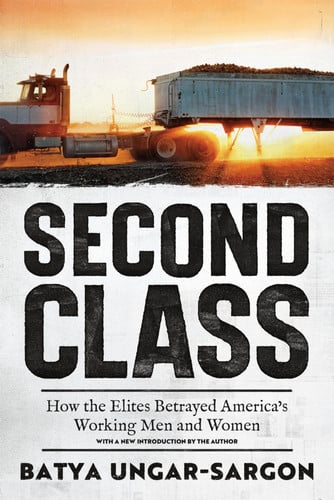
Second class: how the elite betrayed America's working men and women

Ungar-Sargon, Batya
A personal, journalistic ethnography of the modern American working class, based on the travels and interactions of the author through the American heartland. " Second Class is the most important book you will read all year. A political realignment is coming, and it's my hope that the end result will work in favor of our all-too-neglected American working class. When that realignment comes, Batya and her book will help lead the way." --Greg Lukianoff, CEO of the Foundation for Individual Rights in Education, and co-author of The Coddling of the American Mind Who is the American working class? Do they still have a fair shot at the American Dream? What do they think about their chances to secure the hallmarks of a middle-class life? While writing this book, Batya Ungar-Sargon visited states across the nation to speak with members of the American working class who are fighting tooth and nail to survive. In Second Class , working-class Americans of all races, political orientations, and occupations share their stories--cleaning ladies, health care aides, cops, truck drivers, fast food workers, electricians, and more. In their own words, these working-class Americans explain the struggles and triumphs of their increasingly precarious lives--as well as what policies they think would improve them. Second Class combines deep reporting with a look at the data and expert opinions on America's emergent class divide, in which the most basic elements of a secure and stable life are increasingly out of reach for those without a college education. America has broken its contract with its laboring class. So, how do we get back to the American Dream? How do we once again become the land of opportunity, the promised land, where hard work and commitment to family are enough to protect you from poverty? It's not that hard actually. All it would take, as this book illustrates, is for those in power to once again respect the dignity of work--and the American worker.
Encounter Books 2025 248 pages

The Road to Freedom Economics and the Good Society

Joseph E. Stiglitz
We are a nation born from the conviction that people must be free. But since the middle of the last century, that idea has been co-opted. Forces on the political Right have justified exploitation by cloaking it in the rhetoric of freedom, leading to pharmaceutical companies freely overcharging for medication, a Big Tech free from oversight, politicians free to incite rebellion, corporations free to pollute, and more. How did we get here? Whose freedom are we--and should we--be thinking about? In The Road to Freedom, Nobel prize winner Joseph E. Stiglitz dissects America's current economic system and the political ideology that created it, laying bare their twinned failure. "Free" and unfettered markets have only succeeded in delivering a series of crises: the financial crisis, the opioid crisis, and the crisis of inequality. While a small portion of the population has amassed considerable wealth, wages for most people have stagnated. Free and unfettered markets have exploited consumers, workers, and the environment alike. Such failures have fed populist movements that believe being free means abandoning any obligations citizens have to one another. As they grow in strength, these movements now pose a real threat to true economic and political freedom. As an economic advisor to presidents and as chief economist at the World Bank, Stiglitz has witnessed these profound changes firsthand. As he argues, the failures follow from the elites' unshakeable dedication to "the neoliberal experiment." Explicitly taking on giants such as Friedrich Hayek and Milton Friedman, Stiglitz exposes accepted ideas about our political and economic life for what they are: twisted visions that tear at the social fabric while they enrich the very few. The Road to Freedom breaks new ground, showing how economics--including recent advances in which Stiglitz has played such an important role--reframes how to think about freedom and the role of the state in a twenty-first century society. Drawing on the work of contemporary philosophers, Stiglitz explains a deeper, more humane way to assess freedoms--one that considers with care what to do when one person's freedom conflicts with another's. We must reimagine our existing economic and legal systems and embrace forms of collective action, including regulation and investment, if we are to create an innovative society in which everyone can flourish. The task could not be more urgent, and Stiglitz's latest book is essential reading for those committed to the American ideal of an economic and political system that delivers well-being, opportunity, and meaningful freedoms for all.
W. W. Norton, Incorporated 2026-02-24 384 pages

The Idealist Jeffrey Sachs and the Quest to End Poverty

Nina Munk
A powerful portrayal of Jeffrey Sachs's ambitious quest to end extreme global poverty, now a Signal paperback. "The poor you will always have with you," according to Matthew 26:11. But Jeffrey Sachs, economics superstar, special advisor to the Secretary General of the UN and the author of The End of Poverty , vehemently disagrees. In his view, poverty -- especially the extreme deprivation of sub-Saharan Africa -- can easily be eradicated. The vast sums spent in foreign aid over the decades has not come close to alleviating the dire subsistence problems of Africans. Sachs believed he knew the reason: the developed world simply hadn't spent enough. In 2006, Sachs, backed by tens of millions of donor dollars, launched the five-year Millennium Villages Project. Sachs would test his theories in villages in different African countries, then, with each success, scale up until until the program was continent-wide. His first village "make-over" was a small community in Sauri, Kenya, and the immediate effect was encouraging. With that first inkling of success achieved, Sachs rolled out a dozen model Millennium villages in ten countries. For the past six years, Nina Munk has reported deeply on the Project, following Sachs on official trips and listening in on conversations with heads of states, rival organisations and potential donors. And she has immersed herself in the lives of people in two of the remote villages: Ruhiira, in southwest Uganda, and Dertu, in the arid borderland between Kenya and Somalia. Accepting hospitality from these camel herders and smallhold farmers, and sharing in their struggles, Munk came to understand the on-the-ground issues challenging Sachs' one-size-fits-all approach to global poverty. The Idealist is the profound and moving story of what happened when the abstract theories of a brilliant, driven man met messy human reality.
McClelland & Stewart 2014-10-07 288 pages

Drone Warfare: Killing by Remote Control

Medea Benjamin
The CIA chief, Leon Panetta, calls drones the ‘only game in town’. The figures bear him out. Between 2004 and 2012, the US reportedly conducted over 350 drone strikes in Pakistan, killing between 2,600 and 3,400 people. Drone strikes have killed more than 200 children alone in Pakistan and Yemen. In 2000, the Americans had fewer than fifty aerial drones; ten years later, it had a fleet of nearly 7,500, and the US Air Force now trains more drone ‘pilots’ than bomber and fighter pilots combined. Drones are already a $ 5 billion business in the US alone. American activist Medea Benjamin, a co-founder of the peace group CODEPINK and the international human rights organization Global Exchange, provides the first extensive analysis of who is producing the drones, where they are being used, who controls these unmanned places, and what are the legal and moral implications of their use. Benjamin also looks at what activists, lawyers, and scientists across the globe are doing to ground these weapons.
Daily Star Books 2013 241 pages

In an uncertain world: tough choices from Wall Street to Washington

Rubin, Robert Edward
Publisher's description: Robert Rubin was sworn in as the seventieth U.S. Secretary of the Treasury in January 1995 in a brisk ceremony attended only by his wife and a few colleagues. As soon as the ceremony was over, he began an emergency meeting with President Bill Clinton on the financial crisis in Mexico. This was not only a harbinger of things to come during what would prove to be a rocky period in the global economy; it also captured the essence of Rubin himself--short on formality, quick to get into the nitty-gritty. From his early years in the storied arbitrage department at Goldman Sachs to his current position as chairman of the executive committee of Citigroup, Robert Rubin has been a major figure at the center of the American financial system. He was a key player in the longest economic expansion in U.S. history.
Random House 2003 427 pages

Madoff The Final Word

Richard Behar
Renowned investigative journalist Richard Behar delivers the definitive account of history’s largest—and longest-running—financial fraud, “the scale of the deception…beggars belief” ( New York Post ). Some $68 billion evaporated during Bernie Madoff’s epic confidence game. Two people were driven to suicide in the wake of the Ponzi Scheme’s exposure. Others went to prison. But there has never been a satisfying accounting for how Bernie got away with so much, for so long. Until now. Richard Behar’s relationship with Madoff began in 2011 with a simple email request from the conman. By the time Madoff died in 2021, he had sent Behar more than 300 emails and dozens of handwritten letters, participated in some fifty phone conversations, and sat for three in-person jailhouse interviews—a level of access provided to no other reporter. Behar also established relationships with hundreds of regulators, prosecutors, FBI agents, investors, Wall Street experts, ex-employees of Madoff’s, family members, school classmates, and others. The result is the final word on the criminal behind history’s most enduring fraud—and on those who believed him, covered for him, or locked him up. Behar illuminates not only the fraud’s origins—decades earlier than Madoff claimed in his confession—but also the complicity of investors, Wall Street insiders, family members, and some of the largest banks in the US and Europe. Shocking, infuriating, riveting (and at times absurdly funny), Madoff shows us how Bernie ensnared thousands of investors. As Behar’s dogged reporting over the last fifteen years makes clear, however, there aren’t many innocents left standing by the end of this tale. Just about everyone involved is guilty, at a minimum, of humanity’s most consistent weakness: greed.
Avid Reader Press / Simon & Schuster 2025-07 384 pages

Manipulation: what it is, why it's bad, what to do about it

Sunstein, Cass R.
"New technologies are offering companies, politicians, and others unprecedented opportunity to manipulate us. Sometimes we are given the illusion of power - of freedom - through choice, yet the game is rigged, pushing us in specific directions that lead to less wealth, worse health, and weaker democracy. In, Manipulation, nudge theory pioneer and New York Times bestselling author, Cass Sunstein, offers a new definition of manipulation for the digital age, explains why it is wrong; and shows what we can do about it. He reveals how manipulation compromises freedom and personal agency, while threatening to reduce our well-being; he explains the difference between manipulation and unobjectionable forms of influence, including 'nudges'; and he lifts the lid on online manipulation and manipulation by artificial intelligence, algorithms, and generative AI, as well as threats posed by deepfakes, social media, and 'dark patterns,' which can trick people into giving up time and money. Drawing on decades of groundbreaking research in behavioral science, this landmark book outlines steps we can take to counteract manipulation in our daily lives and offers guidance to protect consumers, investors, and workers." --
Cambridge University Press 2025-08-28 219 pages

Climate justice: what rich nations owe the world - and the future

Sunstein, Cass R.
The social cost of carbon: The most important number you've never heard of—and what it means. If you’re injuring someone, you should stop—and pay for the damage you’ve caused. Why does this simple proposition, generally accepted, not apply to climate change? In Climate Justice , a bracing challenge to status quo thinking on the ethics of climate change, renowned author and legal scholar Cass Sunstein clearly frames what’s at stake and lays out the moral imperative: When it comes to climate change, everyone must be counted equally, regardless of when they live or where they live—which means that wealthy nations, which have disproportionately benefited from greenhouse gas emissions, are obliged to help future generations and people in poor nations that are particularly vulnerable.
The MIT Press 2025 195 pages

Minds wide shut: how the new fundamentalisms divide us

Morson, Gary Saul,Schapiro, Morton Owen
A timely exploration of intellectual dogmatism in politics, economics, religion, and literature—and what can be done to fight it Polarization may be pushing democracy to the breaking point. But few have explored the larger, interconnected forces that have set the stage for this crisis: namely, a rise in styles of thought, across a range of fields, that literary scholar Gary Saul Morson and economist Morton Schapiro call “fundamentalist.” In Minds Wide Shut , Morson and Schapiro examine how rigid adherence to ideological thinking has altered politics, economics, religion, and literature in ways that are mutually reinforcing and antithetical to the open-mindedness and readiness to compromise that animate democracy. In response, they propose alternatives that would again make serious dialogue possible. Fundamentalist thinking, Morson and Schapiro argue, is not limited to any one camp. It flourishes across the political spectrum, giving rise to dueling monologues of shouting and abuse between those who are certain that they can’t be wrong, that truth and justice are all on their side, and that there is nothing to learn from their opponents, who must be evil or deluded. But things don’t have to be this way. Drawing on thinkers and writers from across the humanities and social sciences, Morson and Schapiro show how we might begin to return to meaningful dialogue through case-based reasoning, objective analyses, lessons drawn from literature, and more. The result is a powerful invitation to leave behind simplification, rigidity, and extremism—and to move toward a future of greater open-mindedness, moderation, and, perhaps, even wisdom.
Princeton University Press 2023-01-31 307 pages

Social mobility in industrial society

Lipset, Seymour Martin,Bendix, Reinhard
"Where else but in America," captains of industry are fond of saying, "could a penniless immigrant like Andrew Carnegie achieve so much?" "Any place else that has reached the same stage of industrial development," is the answer implicit in Social Mobility. The authors conclude, somewhat surprisingly, that is not noticeably easier to pull oneself up by the bootstraps in the "Land of Opportunity" than it is in a number of other countries. The very process of industrialization, with its growing demands for skilled management, prevents an elite in any nation form permanently establishing itself in a position of exclusive superiority. Even in states where neither political institutions nor official ideologies favor upward mobility, increasing industrialization requires a growing--and, consequently, a changing--elite class. The authors are concerned primarily with mobility in the total population, with movements into and out of the working class, though they report extensively on the social origins of business leaders in various countries. They deal, too, with the different values of different societies and with the motivation of the socially mobile. Solidly based on examination of studies in more than ten languages and of raw data from unpublished works, this is the first attempt in thirty years to bring together in one volume what is known of social mobility around the world. Here is the first systematic comparison of mobility patterns in such diverse countries as Sweden and Italy, Great Britain and Japan--a comparison backed by statistics and given added meaning by discussions of the causes and consequences of mobility. The authors analyze in detail the political implications of mobility and they explore the relationship between education and mobility. Their discussions of factors making for success or failure in school, of the role of intelligence in mobility, of the effects on children of growing up in various environments, and of the varying personalities of the mobile and non-mobile bring together the work of both psychologists and sociologists. This title is part of UC Press's Voices Revived program, which commemorates University of California Press’s mission to seek out and cultivate the brightest minds and give them voice, reach, and impact. Drawing on a backlist dating to 1893, Voices Revived makes high-quality, peer-reviewed scholarship accessible once again using print-on-demand technology. This title was originally published in 1959.
Univ of California Press 2018-10-23 332 pages

The human test: how predictability, creativity, and the quantum mind will redefine life in the age of AI

Folman, Ron
"As data harvesting continues its exponential growth and computing power increases beyond what we can even imagine, AI and Big Data will be able to predict what we want for breakfast, what shoes we will buy, which political party we will vote for, and who we will fancy in a bar. Indeed, these deep-learning machines will know us better than we know ourselves. The day awaits when academia and big business will be able to quantify just how predictable each of us are. If indeed we are predictable like machines, to what extent are we alive, and under what definition? In The Human Test, quantum physicist Ron Folman unites findings from cognitive science, quantum physics, philosophy, and technology to offer a prescient look into this startling new era of human existence. If we are indeed found to be predictable, it will change everything we thought we knew about human nature. The Human Test strives for a new paradigm, and this new paradigm is found in human predictability. Existing monitors of general brain activity measure only very rudimentary aspects of the human experience, or what may be called human life; could the advent of a disruptive new technology bring about a much more insightful measure of who we are? While The Human Test describes a new and profound near-future impact of AI, it is rooted in a topic of paramount importance to humans: the enigma of consciousness and how it defines human life-or, what differentiates humans from all other life forms. Ultimately, The Human Test addresses some of the most fundamental questions about our species, starting with the most crucial: do we have free will, or are we merely machines? Fortunately, there is an antidote to predictability: creativity, that wondrous state of being original and inherently not predictable. Ultimately, Folman argues that if we can understand predictability, we can learn how to distance ourselves from it, and transcend to a purer idea of what human life should look like"-- Provided by publisher.
Prometheus 2025-03-25 267 pages

The politics of genocide

Herman, Edward S.
In this impressive book, Edward S. Herman and David Peterson examine the uses and abuses of the word “genocide.” They argue persuasively that the label is highly politicized and that in the United States it is used by the government, journalists, and academics to brand as evil those nations and political movements that in one way or another interfere with the imperial interests of U.S. capitalism. Thus the word “genocide” is seldom applied when the perpetrators are U.S. allies (or even the United States itself), while it is used almost indiscriminately when murders are committed or are alleged to have been committed by enemies of the United States and U.S. business interests. One set of rules applies to cases such as U.S. aggression in Vietnam, Israeli oppression of Palestinians, Indonesian slaughter of so-called communists and the people of East Timor, U.S. bombings in Serbia and Kosovo, the U.S. war of “liberation” in Iraq, and mass murders committed by U.S. allies in Rwanda and the Republic of Congo. Another set applies to cases such as Serbian aggression in Kosovo and Bosnia, killings carried out by U.S. enemies in Rwanda and Darfur, Saddam Hussein, any and all actions by Iran, and a host of others. With its careful and voluminous documentation, close reading of the U.S. media and political and scholarly writing on the subject, and clear and incisive charts, The Politics of Genocide is both a damning condemnation and stunning exposé of a deeply rooted and effective system of propaganda aimed at deceiving the population while promoting the expansion of a cruel and heartless imperial system.
Monthly Review Press 2010-04-01 159 pages

Keynes for Our Times

Skidelsky, Robert
"John Maynard Keynes (1883-1946) was arguably the most important economist of the twentieth century; his ideas have fundamentally altered the way governments approach economic policy. Exploring the enduring relevance of his ideas, Robert Skidelsky emphasizes Keynes's conception of economics as a moral science. Keynes was deeply invested in the broader societal implications of economic policies, and this book highlights his belief in economics as a tool for achieving the good life. Skidelsky sheds new light on Keynes's views on capitalism, discusses his advocacy of low interest rates, and delves into his thoughts on economic instability. He also offers fresh insight into Keynes's ideas about money, his philosophical foundations, and his unique approach to uncertainty and probability. Ultimately, Skidelsky shows how Keynes's vision of an economic policy that prioritizes the common good can be adapted to help solve our current economic and political challenges"--
Yale University Press 2026-06-23 186 pages