44 results for "Business History"

The age of Clinton: America in the 1990s

Troy, Gil
"The 1990s was a decade of extreme change. Shifts in culture, politics, and technology radically altered the way Americans did business, expressed themselves, and thought about their role in the world. At the center of it all was Bill Clinton, the charismatic and flawed baby boomer president, along with his polarizing but increasingly popular wife, Hillary. Although it was in many ways a Democratic Gilded Age, the 1990s was also a time of great anxiety. The Cold War was over. America was stable and prosperous. Yet Americans felt more unmoored and isolated. This was the era of glitz and grunge, when we relished living in the Republic of Everything even as we feared it might degenerate into the Republic of Nothing. Bill Clinton dominated this era, but his complex legacy has yet to be clearly defined. Historian Gil Troy examines Clinton's presidency alongside the decade's cultural changes. Taking the '90s year by year, Troy shows how the culture of the day shaped the Clintons even as the Clintons shaped it, offering answers to two enduring questions about Bill Clinton's legacy: How did such a talented politician leave Americans thinking he accomplished so little when he actually accomplished so much? And to what extent was Clinton responsible for the catastrophes of the following decade, specifically 9/11 and the collapse of the housing market? Even more relevant as we head toward the 2016 election, The Age of Clinton will appeal to readers on both sides of the aisle as it chronicles the wild, transformative decade and the president at its center"--
Thomas Dunne Books/St. Martin's Press 2015-10-06 368 pages

Adventures of a bystander

Drucker, Peter F.
"It is [a] belief in diversity and pluralism and the uniqueness of each person that underlies all my writings . . . " -from the Preface. Regarded as the most influential and widely read thinker on modern organizations and their management, Peter Drucker has also established himself as an unorthodox and independent analyst of politics, the economy, and society. A man of impressive scope and expertise, he has paved significant inroads in a number of key areas, sharing his knowledge and keen insight on everything from the plight of the employee and the effects of technology to the vicissitudes of the markets and the future of the new world order. Adventures of a Bystander is Drucker's rich collection of autobiographical stories and vignettes, in which this legendary figure paints a portrait of his remarkable life, and of the larger historical realities of his time. In a style that is both unique and engaging, Drucker conveys his life story -from his early teen years in Vienna through the interwar years in Europe, the New Deal era, World War II, and the postwar period in America-through intimate profiles of a host of fascinating people he's known through the years. Their personal histories are, as Drucker tells us, the beads for which his own life serves as the string. A colorful group, these diverse, often unpredictable, always multidimensional individuals were chosen "because each of them, in his or her own highly personal way, reflects and refracts the thirty crucial years from the end of World War I to the first post-World War II decade-the thirty years that largely formed the world in which we now live." An amazing pageant of characters, both famous and otherwise, springs from these pages, illuminating and defining one of the most tumultuous periods in world history. Along with bankers and courtesans, artists, aristocrats, prophets, and empire-builders, we meet members of Drucker's own family and close circle of friends, among them such prominent figures as Sigmund Freud, Henry Luce, Alfred Sloan, John Lewis, and Buckminster Fuller. Playing to perfection their roles as those who "reflect and refract" the customs, beliefs, and attitudes of the times, these singular personalities lend Adventures of a Bystander a striking "you-are-there" feel. A brief encounter with Freud becomes the catalyst for an absorbing, multidimensional description of the economics, politics, and social psychology of pre-World War II Europe. Drucker introduces us to Fritz Kraemer, a brilliant, monocle-wearing eccentric who became an influential mentor to the young Henry Kissinger. His personal memoir of Henry Luce documents the development of modern journalism, while in "The Indian Summer of Innocence," he rescues and preserves the very heart of the American experience during the last New Deal years before World War II. Shedding light on a turbulent and important era, Adventures of a Bystander also reflects Peter Drucker himself as a man of imaginative sympathy and enormous interest in people, ideas, and history. These enthralling stories complement and complete the groundbreaking analytical writing for which he is so revered. Luminous autobiographical stories by one of the greatest thinkers of our time "The cast of characters among whom Drucker moves is superbly rich, and the informed glimpse he provides of a vanished social and political universe is an education in itself. Adventures of a Bystander is better than a novel, more lively than an essay, and as thoughtful as both at their best." -The Harvard Business Review. "Adventures of a Bystander is a virtuoso performance in which Drucker displays a dazzling diversity of personal interests and knowledge, an awesome power of recall, and a crisp, highly readable writing style." -BusinessWeek. "Adventures of a Bystander appears in a stroke to have restored the art of the memoir and of the essay. It will doubtless be a while before its like comes round again." -The Washington Post.
Wiley 1997 344 pages

The prince of the city: Guiliani, New York, and the genius of American life

Siegel, Frederick F.
In this first post-9/11 account of the career of the man who established himself as America's Mayor in the dark days after America was attacked, Fred Siegel shows how Rudy Giuliani's successes in New York--restoring law and order, cutting taxes and radically reducing the welfare rolls--demonstrated that Gotham was indeed governable (a matter of doubt until his election) and that our major cities might again become vibrant and dynamic places to live after thirty years of middle-class flight. Someone who has worked with Giuliani as well as studied him, Siegel describes this colorful figure as an immoderate centrist, who, like the city he came to embody, evokes contradictory emotions. For some, he was a ruthless autocrat during his years at city hall; for others, he was a heroic figure who took on the vested interests that had dragged the city down. Siegel regards Guiliani as a shrewd tactician and artist of the possible who could have stepped out of the pages of Machiavelli's THE PRINCE. A self-promoting, self-absorbed man, the mayor made his own enormous ego serve the city's well-being. He promoted the virtues of duty and sacrifice, but was sometimes unable to honor these values in his personal life. He was suspicious of those outside his immediate circle, but he also placed this tribal ethos in the service of ideals that transcended New York's ethnic politics and business as usual. THE PRINCE OF THE CITY is at once a fascinating character study, a history of New York over the last forty years, and a classic inquiry into the issue of how cities thrive or die. Siegel's story culminates with a dramatic account of September 11, 2001, revealing how Giuliani's s eight years in office had prepared him and the city to rise to this tragic occasion. Siegel concludes with a look at how Guiliani's successor, Mayor Michael Bloomberg, has handled his legacy and at what the future might hold for America's Mayor.
Encounter 2007 392 pages

Inside the economist's mind: conversations with eminent economists

Paul A. Samuelson,William A. Barnett
By focusing on the human side as well as the intellectual dimensions of how economists work and think, this collection of interviews with top economists of the 20th century becomes a startling and lively introduction to the modern world of macroeconomics. A fun read! For more information, frequent updates, and to comment on the forthcoming book, visit William A. Barnett's weblog at http://economistmind.blogspot.com/. Acclaim for Inside the Economist's Mind "In candid interviews, these great economists prove to be fabulous story tellers of their lives and times. Unendingly gripping for insiders, this book should also help non-specialists understand how economists think." Professor Julio Rotemberg, Harvard University Business School, and Editor, Review of Economics and Statistics. "Economics used to be called the 'dismal science'. It will be impossible for anybody to hold that view anymore ... This is science with flesh and blood, and a lot of fascinating stories that you will find nowhere else." Dr. Jean-Pascal Bénassy, Paris-Jourdan Sciences Économiques, Paris, France "This book provides a rare and intriguing view of the personal and professional lives of leading economists ... It is like A Beautiful Mind , scaled by a factor of 16 [the number of interviews in the book]." Professor Lee Ohanian, University of California at Los Angeles " ... if you want an insider view of how economics has been developing in the last decades, this is the (only) book for you." Professor Giancarlo Gandolfo, University of Rome ‘La Sapienza,’ Rome "Here we see the HUMAN side of path-breaking research, the personalities and pitfalls, the DRAMA behind the science." Professor Francis X. Diebold, University of Pennsylvania, Philadelphia
Blackwell Pub 2007 419 pages

The pill, pygmy chimps, and Degas' horse: the autobiography of Carl Djerassi

Djerassi, Carl
Father of the birth control pill, developer of antihistamines, founder of biomedical companies, teacher of world-class chemists, best-selling novelist.... As The Scientist notes, "Few can match Carl Djerassi's juggling act for success and longevity". Here is Djerassi's remarkable autobiography. Blending vivid descriptions of the lucrative world of drug development with controversial chapters on the politics of contraception and poignant disclosures about his personal life, this book tells the story of one of the most productive and socially conscious chemists working today. The Pill, Pygmy Chimps, and Degas' Horse tells how Djerassi, while still in his twenties and leading a small team in an obscure laboratory in Mexico City, used a locally grown yam first to synthesize cortisone and then, within twelve months, to create the first steroid effective as a birth control pill. Dubbed for this latter work "the father of the pill", a title he often shares with Gregory Pincus and John Rock, who performed the biological and clinical studies to confirm the pill's efficacy in humans, Djerassi has spent a lifetime thinking and rethinking, discussing and debating, the social, economic, and biological consequences of the changed attitudes toward contraception engendered by the pill. In two riveting chapters entitled "The Pill at Twenty" and "The Pill at Forty: What Now?" Djerassi recounts the fascinating history of the pill's journey from its first days in the laboratory to widespread public use--from being hailed as an agent of the sexual revolution to condemnation as an agent of the new promiscuity, to being accused of being an expression of the scientific community's sexism (Why was there no malebirth control pill?). And then, in a powerful consideration of where the politics of contraception have taken us, he discusses why so few innovations in contraception are being investigated today, and why even fewer are making their way to the public. The Pill, Pygmy Chimps, and Degas' Horse chronicles Djerassi's many successful careers in science, business, the academy, and the arts (he is a published poet and novelist, as well as the founder of an artists' colony). His growing appreciation for the soft side of science--its human and humane aspects--have long been reflected in the courses he teaches at Stanford, in the plot of his novel, Cantor's Dilemma, and in his decision to found one of the first environmentally aware pesticide companies. In this intellectually challenging book, the reader is let into the fertile mind and psyche of one of the few Renaissance men of twentieth-century science.
Basic Books 1992-04-26 319 pages

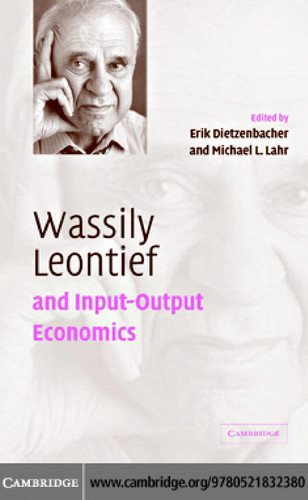
Wassily Leontief and input-output economics

Wassily Leontief,Erik Dietzenbacher,Michael L. Lahr
Wassily Leontief (1905–1999) was the founding father of input-output economics, for which he received the Nobel Prize in 1973. This book offers a collection of papers in memory of Leontief by his students and close colleagues. The first part, 'Reflections on Input-Output Economics', focuses upon Leontief as a person and scholar as well as his personal contributions to economics. It includes contributions by Nobel Laureate Paul A. Samuelson who shares his memories of a young Professor Leontief at Harvard and ends with the last joint interview with Wassily and his wife, to date previously unpublished. The second part, 'Perspectives of Input-Output Economics', includes theoretical and empirical research inspired by Leontief's work and offers a wide-ranging sample of the state of interindustry economics, a field Leontief founded. This is a strong collection likely to appeal to a wide range of professionals in universities, government, industry and international organizations.
Cambridge University Press 2004-03-25 396 pages

The trials of Radclyffe Hall

Souhami, Diana
Radclyffe Hall was born in 1884 in Bournemouth in a house of horrors called 'Sunny Lawn'. It was an unhappy childhood, until her father's death when Radclyffe inherited £200,000. She was 18. She leased a London house, dressed in chappish clothes, called herself Peter then John & wrote her first collection of verse. She was a political reactionary, a reformed Catholic, obsessive about work, hunted with 3 packs, got her pipes from Dunhill's, wore brocade smoking jackets & had her hair cropped. She thought real women were born to be wives & disliked doing any business with them. Her 1st love was Mabel Batten, known as Ladye, who reputedly had an affair with Edward VII. Radclyffe Hall is now most famous for THE WELL OF LONELINESS, written in 1928. A novel about 'congenital inverts' - lesbian love - the book was suppressed both here & the US & caused Radclyffe to be put on trial under the Obscene Publications Act. Brilliantly written, this biography is a fresh and irreverent insight into the lives of one of the most alluring and eccentric women of this century.
Virago 1999 16 pages

Missing man: the American spy who vanished in Iran

Meier, Barry
A real-life thriller about a CIA contractor who vanished in Iran and the international manhunt to find him In late 2013, Americans were shocked to learn that a former FBI agent turned private investigator who disappeared in Iran in 2007 was there on a mission for the CIA. The missing man, Robert Levinson, appeared in pictures dressed like a Guantánamo prisoner and pleaded in a video for help from the United States. Barry Meier, an award-winning investigative reporter for The New York Times , draws on years of interviews and never-before-disclosed CIA files to weave together a riveting narrative of the ex-agent’s journey to Iran and the hunt to rescue him. The result is an extraordinary tale about the shadowlands between crime, business, espionage, and the law, where secrets are currency and betrayal is commonplace. Its colorful cast includes CIA operatives, Russian oligarchs, arms dealers, White House officials, gangsters, private eyes, FBI agents, journalists, and a fugitive American terrorist and assassin. Missing Man is a fast-paced story that moves through exotic locales and is set against the backdrop of the twilight war between the United States and Iran, one in which hostages are used as political pawns. Filled with stunning revelations, it chronicles a family’s ongoing search for answers and one man’s desperate struggle to keep his hand in the game.
Farrar, Straus and Giroux 2018-02-20 279 pages

One from the Hart

Powers, Stefanie
The career of Stefanie Powers is one of so many stage, screen, and television credits that her name alone recalls memories as varied as her roles. Groomed for show business at an early age, she began her career at the tail end of the Studio System, a dynamic education in star quality and Hollywood history she happily admits was "one hell of a ride." She tells of the time she broke down in tears at a party over her divorce from actor Gary Lockwood, only to be comforted with hard-won, been-there advice from two guests she had never met: Elizabeth Taylor and Ava Gardner. She is also an award-winning stage actress, fitness advocate, and an internationally recognized animal conservationist. But in a lifetime of dear friends, no other had such a significant effect on Stefanie as Oscar-winning actor William Holden. Here, she reveals for the first time the extraordinary nine-year relationship they shared.--From publisher description.
Gallery Books 2010-11-02 260 pages

Emma Goldman: revolution as a way of life

Gornick, Vivian
A vibrant, deeply human portrait of a woman dedicated to fierce protest against the tyranny of institutions over individuals, by the celebrated author Emma Goldman is the story of a modern radical who took seriously the idea that inner liberation is the first business of social revolution. Her politics, from beginning to end, was based on resistance to that which thwarted the free development of the inner self. The right to stay alive in one's senses, to enjoy freedom of thought and speech, to reject the arbitrary use of power--these were key demands in the many public protest movements she helped mount. Anarchist par excellence, Goldman is one of the memorable political figures of our time, not because of her gift for theory or analysis or even strategy, but because some extraordinary force of life in her burned, without rest or respite, on behalf of human integrity--and she was able to make the thousands of people who, for decades on end, flocked to her lectures, feel intimately connected to the pain inherent in the abuse of that integrity. To hear Emma describe, in language as magnetic as it was illuminating, what the boot felt like on the neck, was to experience the mythic quality of organized oppression. As the women and men in her audience listened to her, the homeliness of their own small lives became invested with a sense of drama that acted as a catalyst for the wild, vagrant hope that things need not always be as they were. All you had to do, she promised, was resist. In time, she herself would become a world-famous symbol for the spirit of resistance to the power of institutional authority over the lone individual. In Emma Goldman, Vivian Gornick draws a surpassingly intimate and insightful portrait of a woman of heroic proportions whose performance on the stage of history did what Tolstoy said a work of art should do: it made people love life more.
Yale University Press 2013 151 pages

Bookends: two women, one enduring friendship

Rostenberg, Leona
The rare book dealers who delighted readers with the history of their bookselling days in "Old Books, Rare Friends" now offer the other side of their story -- an intimate look at the joys of a relationship that has lasted more than half a century. When their friendship and business partnership began in the 1940s, Leona Rostenberg and Madeleine Stern were pioneers in a man's world. Now approaching their nineties, the duo, who -- among their many discoveries -- unearthed Louisa May Alcott's pseudonymous blood-and-thunder stories, remains a vibrant institution in the rare book trade, even as the Internet changes their field -- and their community -- forever. After publishing "Old Books, Rare Friends," Rostenberg and Stern received a flood of fan mail asking about their personal lives, and they have responded with poignant honesty and the warmth for which they are famous, as they reflect on their lives and their remarkable partnership. "Bookends" recounts their fascinating histories: family backgrounds, business adventures, the men they did not marry, and their approach to the bittersweet trials of aging. More than just a dual memoir, "Bookends" is also a chronicle of the cultural changes of twentieth-century American life and a loving farewell to the golden age of book collecting. Filled with wisdom and humor, this volume is a tribute to Rostenberg and Stern's passion for the written word -- and for life itself. Catching us off guard with their candor, they offer their insights regarding their business, their way of life, and their worldview. Above all, they present the story of a special relationship. At a time when people find it increasingly difficult to connect, here wehave the seamless story of a shared life. It is the unique product of an earlier time, yet it is a timeless reflection on the very nature of friendship. Though their fantastic partnership is un-reproducible, the ideal they have established, for the integration of one life so completely with another, contains lessons for all of us. Without husband or children they created a loving home when this was uncharted territory for women. They nurtured a business and life partnership that has lasted more than half a century and has only gotten stronger with time. When the passing years began to claim one's hearing and the other's sight, they became each other's eyes and ears. A meditation on aging and togetherness, this book is also the narrative of two pioneering single, Jewish women making their way in tandem through a world largely organized to keep them in their place. It is a gentle, wise story, told in their inimitable style, sparse, unadorned, and honest. Their affirmations supersede their uncertainties. As they write, "Bookends support books and come in pairs...If the word encapsulates our past, it looks also to the future, and to the books -- lived together, written together -- that will follow." They confront the challenges of aging in a no-nonsense tone, and, in facing them, give us an ideal of enduring human friendship that can't help but touch the heart.
Free Press 2001 246 pages

My life is in your hands ; &, Take my life: the autobiographies of Eddie Cantor

Cantor, Eddie
A giant in the history of American entertainment, Eddie Cantor (1892-1964) won over the American public time and time again, first on stage, bowling audiences over in the Ziegfeld Follies, then in films, on the radio, and on television. His career ran from Vaudeville to video making all stops in between. A tireless person even when not on the stage, Cantor helped found the March of Dimes, and was the first national president of the Screen Actor's Guild (SAG), the American Federation of Radio Artists (later AFTRA), and the Jewish Theatrical Guild. Yet another medium in which Cantor succeeded was print. He authored and co-authored several books that upheld his standing as one of America's leading comedians. My Life Is In Your Hands & Take My Life combines for the first time in a single volume two memoirs written in 1928 and 1957, in which Eddie remembers his beginnings as an orphan on the Lower East Side and his hard-won climb from poverty to the bright lights of Broadway. The book also contains a lost chapter in which Eddie recalls his reactions to the stock market crash of 1929, along with a new complete index, discography, and filmography. In My Life Is In Your Hands & Take My Life, Cantor's humor is as sharp as ever and his sentiment is 100% genuine. While not at all modest about his decades of public adoration, Cantor shows a willingness to laugh at his blunders (such as his second film, "Special Delivery"), and to praise the many talented people with whom he collaborated. Along with telling the story of show business in the first half of the 20th century, Cantor also lets readers in on fond stories of his friends, from Jimmy Durante (who worked as a pianist in the Coney Island restaurant where Cantor was a singing waiter), to Ziegfeld alumni Will Rogers and W. C. Fields, to fellow entertainers Clara Bow and Fanny Brice.
Cooper Square Press 2000-06 319 pages

Impromptu man: J.L. Moreno and the origins of psychodrama, encounter culture, and the social network

Moreno, Jonathan D.
""Impromptu Man captures the remarkable impact of a singular genius, J.L. Moreno, whose creations-the best-known being psychodrama-have shaped our culture in myriad ways, many unrecognized. The record will be set straight for all time by this can't-put-down biography, a tribute by Jonathan D. Moreno to his father's masterly legacy." -DANIEL GOLEMAN, author of Emotional Intelligence: Why It Can Matter More Than IQ J.L. Moreno (1889-1974), the father of psychodrama, was an early critic of Sigmund Freud, wrote landmark works of Viennese expressionism, founded an experimental theater where he discovered Peter Lorre, influenced Martin Buber, and became one of the most important psychiatrists and social scientists of his time. ?? A mystic, theater impresario and inventor in his youth, Moreno immigrated to America in 1926, where he trained famous actors, introduced group therapy, and was a forerunner of humanistic psychology. As a social reformer, he reorganized schools and prisons, and designed New Deal planned communities for workers and farmers. Moreno's methods have been adopted by improvisational theater groups, military organizations, educators, business leaders, and trial lawyers. His studies of social networks laid the groundwork for social media like Twitter and Facebook. ?? Featuring interviews with Clay Shirky, Gloria Steinem, and Werner Erhard, among others, original documentary research, and the author's own perspective growing up as the son of an innovative genius, Impromptu Man is both the study of a great and largely unsung figure of the last century and an epic history, taking readers from the creative chaos of early twentieth-century Vienna to the wired world of Silicon Valley. Jonathan D. Moreno, called the "most interesting bioethicist of our time" by the American Journal of Bioethics, is a professor at the University of Pennsylvania and a Senior Fellow at the Center for American Progress. "--
Bellevue Literary Press 2014 319 pages

Back lot: growing up with the movies

Rapf, Maurice
Son of pioneer movie producer Harry Rapf, Maurice Rapf grew up in Hollywood in that city's golden age. After moving from independent filmmaking to Warner Bros., in 1924 the senior Rapf joined Louis Mayer and became one of the founding members of MGM. Hence, movies were a huge influence in Maurice Rapf's early life. After graduating from college, Rapf worked as a screenwriter for major Hollywood studios, but, in 1947, he left Hollywood, never to work for a major studio again. On numerous occasions, he was called before the House Un-American Activities Committee as an alleged communist, although he never made a public confession or denial. As a result he was blacklisted from the industry and forced to begin a new career in the East. He eventually became a movie critic and film studies professor. Maurice Rapf knows movies and the movie business as an insider, from first-hand experience, not from books. His autobiography is the story of one person's interaction with an evolving Hollywood. Rapf witnessed the historical progression of movie production: from silents to sound, from a fun-loving frontier community to a huge and fiercely competitive industry, from an apolitical never-never land to a community very much aware of-and nervous about-its social responsibility in a period of economic depression and in a period of world peace seriously threatened by the aggression of fascism. Of interest to students and teachers of film studies, of American history, and of American popular culture, as well as anyone who loves movies.
Scarecrow Press 1999-01-28 211 pages

So much to do: a full life of business, politics, and confronting fiscal crises

Ravitch, Richard
Every city and every state needs a Richard Ravitch. In sixty years on the job, whether working in business or government, he was the man willing to tackle some of the most complex challenges facing New York. Trained as a lawyer, he worked briefly for the House of Representatives, then began his career in his family's construction business. He built high-profile projects like the Whitney Museum and Citicorp Center but his primary energy was devoted to building over 40,000 units of affordable housing including the first racially integrated apartment complex in Washington, D.C. He dealt with architects, engineers, lawyers, bureaucrats, politicians, union leaders, construction workers, bankers, and tenants—virtually all of the people who make cities and states work. It was no surprise that those endeavors ultimately led to a life of public service. In 1975, Ravitch was asked by then New York Governor Hugh Carey to arrange a rescue of the New York State Urban Development Corporation, a public entity that had issued bonds to finance over 30,000 affordable housing units but was on the verge of bankruptcy. That same year, Ravitch was at Carey's side when New York City's biggest banks said they would no longer underwrite its debt and he became instrumental to averting the city's bankruptcy. Throughout his career, Ravitch divided his time between public service and private enterprise. He was chairman of the Metropolitan Transportation Authority from 1979 to 1983 and is generally credited with rebuilding the system. He turned around the Bowery Savings Bank, chaired a commission that rewrote the Charter of the City of New York, served on two Presidential Commissions, and became chief labor negotiator for Major League Baseball. Then, in 2008, after Governor Eliot Spitzer resigned in a prostitution scandal and New York State was in a post-financial-crisis meltdown, Spitzer's successor, David Paterson, appointed Ravitch Lieutenant Governor and asked him to make recommendations regarding the state's budgeting plan. What Ravitch found was the result of not just the economic downturn but years of fiscal denial. And the closer he looked, the clearer it became that the same thing was happening in most states. Budgetary pressures from Medicaid, pension promises to public employees, and deceptive budgeting and borrowing practices are crippling our states' ability to do what only they can do—invest in the physical and human infrastructure the country needs to thrive. Making this case is Ravitch's current public endeavor and it deserves immediate attention from both public officials and private citizens.
PublicAffairs 2014-04-29 254 pages

Maxwell, the outsider

Bower, Tom
Robert Maxwell was driven by an obsession to be remembered by posterity, to create and re-create his own life in order to become part of the Establishment. Tom Bower's compelling portrait, the subject of numerous libel suits brought by Maxwell in Britain before his death, is now published for the first time--in a thoroughly updated edition--in the United States. It provides a fascinating look at the man who was relentless in his attempts to obtain media power and respectability, attempts that would eventually destroy him. Born into a life of poverty, an outsider forever trying to get in, Robert Maxwell was plagued by a deep sense of alienation. His career as publisher, printer, politician, financier, industrialist, and tycoon extraordinary was charged with both magnificent coups and controversial setbacks. He built his fortune on a mixture of engineered leaks and secrecy at the expense of long-term stability. Accused of everything from creative bookkeeping to outright fraud, Maxwell withstood each debacle until the end, surviving troubles that would have felled a less determined personality. Bower describes the many suspect strategies of Maxwell's business dealings while he was alive and the disintegration of his empire after his death, focusing along the way on Maxwell's often nebulous business dealings and his immense skills at bullying and deception. Beginning with Maxwell's early years, Bower describes in depth the period after World War II during which Maxwell made a fortune out of barter deals and the export of scientific journals from Germany, which became the basis for his Pergamon Press flagship; the Pergamon-Leasco affair in the late 1960s (involving two millionaires, Maxwelland Saul Steinberg), an ill-fated takeover deal that fell apart with Maxwell declared unfit to hold office in a public company; and his revival of the loss-making British Printing Corporation. The author explains Maxwell's numerous acquisitions and his competitive obsession with Rupert Murdoch. We learn of the mysteries surrounding Maxwell's private banking in Liechtenstein, his strange links with the Soviet Union and Eastern Europe, the notorious "Mirrorgate" affair and Maxwell's close relationship with Israel. Going beyond recent media coverage, the author provides up-to-the-minute facts on missing corporate assets and pension funds as well as the nefarious share-support schemes. In this powerful biography, Tom Bower comes as close as anyone ever will to understanding Robert Maxwell and his demons.
Viking 1992 539 pages

The assassination of Hole in the Day

Treuer, Anton
On June 27, 1868, Hole in the Day (Bagonegiizhig) the Younger left Crow Wing, Minnesota, for Washington, DC, to fight the planned removal of the Mississippi Ojibwe to a reservation at White Earth. Several miles from his home, the self-styled leader of all the Ojibwe was stopped by at least twelve Ojibwe men and fatally shot. Hole in the Day's death was national news, and rumors of its cause were many: personal jealousy, retribution for his claiming to be head chief of the Ojibwe, retaliation for the attacks he fomented in 1862, or retribution for his attempts to keep mixed-blood Ojibwe off the White Earth Reservation. Still later, investigators found evidence of a more disturbing plot involving some of his closest colleagues: the business elite at Crow Wing. While most historians concentrate on the Ojibwe relationship with whites to explain this story, Anton Treuer focuses on interactions with other tribes, the role of Ojibwe culture and tradition, and interviews with more than fifty elders to further explain the events leading up to the death of Hole in the Day. The Assassination of Hole in the Day is not only the biography of a powerful leader but an extraordinarily insightful analysis of a pivotal time in the history of the Ojibwe people. " An essential study of nineteenth-century Ojibwe leadership and an important contribution to the field of American Indian Studies by an author of extraordinary knowledge and talent. Treuer's work is infused with a powerful command over Ojibwe culture and linguistics." --Ned Blackhawk, author of Violence Over the Land: Indians and Empires in the Early American West "The Assassination of Hole in the Day is a masterful history, and more. Anton Treuer illuminates the character of a controversial and charismatic Ojibwe leader from within Ojibwe culture, and tells a powerful story of loss that reverberates in the present." --Louise Erdrich "This is more than a murder mystery. It provides insights into the evolution of clan structure, tribal governance and relations with the Dakota and other tribes since the time a century and a half ago when white pressure, the declining fur trade and other factors led to the cession of great tracts of land and the people's removal to reservations." --Star Tribune "This highly recommended work provides insights into the challenges faced by native peoples during an era when they were under intense pressure by the federal government to move to reservations." --Library Journal "Treuer explores the life and death of this brash young leader, and delves into tribal history and the intricate machinations of Ojibwa politics." --Booklist Anton Treuer, professor of Ojibwe at Bemidji State University, is the author of Ojibwe in Minnesota and several books on the Ojibwe language. He is also the editor of Oshkaabewis Native Journal, the only academic journal of the Ojibwe language.
Borealis Books 2011 295 pages

Leo Melamed: escape to the futures

Melamed, Leo
Acclaim for Leo Melamed Escape to the Futures "A well-written, fascinating memoir of a remarkable man of many parts, who arrived in the United States at age 9, fleeing the Holocaust. Almost single-handedly, he transformed a minor commodity exchange into the leading futures market in the world. His influence was and remains worldwide." —Milton Friedman Senior Research Fellow Hoover Institution, Stanford University "There are only a few people who have revolutionized big portions of the business world. Warren Buffett did it in investing, Bill Gates in software. Leo Melamed, author of this book, is in that same league. He truly revolutionized futures trading in the United States, and in the world. This book tells how." —Ambassador Clayton Yeutter Past President of the Chicago Mercantile Exchange Former U.S. Trade Representative "A grizzled old Merc trader once assured me that nobody ever lost by being long on Leo. Why that's so, this endlessly fascinating personal history makes clear. It shows how an immigrant boy, after surviving unimaginable horrors, drew on the 'elan, combativeness, and sophisticated conviction' learned from his equally remarkable father to build the CME and to lay the foundations of the modern, Chicago-based, financial services industry." — Merton H. Miller 1990 Nobel Laureate Emeritus Professor University of Chicago Graduate School of Business "Leo tells it all. To say there would not have been a financial futures industry without Leo is probably only a slight exaggeration!!!" — John Damgard President Futures Industry Association "Escape to the Futures tells the remarkable story of a young boy's escape from the Nazis and the impact of his life on the financial markets of the world. It also serves as yet another poignant reminder of the immeasurable losses —in the arts, sciences, professions, and everyday life—humanity suffered because of the Holocaust." — Benjamin Meed President American Gathering of Jewish Holocaust Survivors He is one of the most powerful figures in the world of finance—a visionary who pioneered the modern futures industry and launched the International Monetary Market (IMM). Yet, Leo Melamed was not born to wealth and influence. His is an extraordinary rags-to-riches tale of intelligence, drive, savvy, timing, and the overpowering force of a uniquely charismatic personality. Now the inside story of the remarkable life and career of Leo Melamed is revealed in this long-awaited autobiography. A Holocaust survivor, Leo Melamed had barely begun the first grade in 1939 when he and his parents fled their native Poland one step ahead of the oncoming Nazi juggernaut. Crossing Siberia en route to a brief stay in Japan—just months before Pearl Harbor—the family arrived in the United States to begin life anew. They settled in Chicago, where young Leo became a product of the inner city and embraced his new country and its culture. Seeking part-time employment while attending law school, Leo Melamed answered a classified ad that would change his life. Hired by what he presumed was a law firm named Merrill, Lynch, Pierce, Fenner & Bean, he found himself on the floor of the Chicago Mercantile Exchange. "I was Alice stepping through the Looking Glass into a world of not just one Mad Hatter, but hundreds. The shouting among the traders, the movement of their bodies and hands, captivated me like nothing before . . . there was a life force on that floor that was magical and exciting, and though I didn't understand what was going on, I wanted to be a part of it." Leo Melamed became much more than just a part of it. From modest beginnings as a pork belly trader, he led the Chicago Merc for the next quarter of a century, introducing finance to an industry that was the exclusive domain of agriculture. As his reputation as a financial genius grew, so did the tales of his larger-than-life personality. In Leo Melamed: Escape to the Futures, you'll meet the man behind the legend. Written with the assistance of award-winning journalist Bob Tamarkin, this enthralling memoir deftly weaves intimate personal details with behind-the-scenes accounts of some of the most momentous financial events of our century—including Leo's role as advisor to the White House after the Hillary Rodham Clinton cattle futures trading episode. You'll read fascinating accounts of his dealings with political powerhouses like Bob Dole, Tip O'Neill, Dan Rostenkowski, and others. Offering penetrating insights into the workings of a multibillion dollar industry, this is a story that has as much to say about human nature as it does about the nature of today's markets. Hailed as both hero and tyrant, Leo Melamed is undeniably one of the most colorful and intriguing personalities of our time. This intimate, revealing personal account is not to be missed.
John Wiley & Sons 1996-05-02 463 pages