34 results for "Children"

Stories for Children

Isaac Bashevis Singer
Isaac Bashevis Singer is known for his mastery of storytelling - but it was not until 1966, at the age of sixty-two, that he published his first children's book, Zlateh the Goat, a Newbery Honor Book and instant classic. Singer went on to write many stories for children, most of which are included in this volume, along with a brief introduction and a special epilogue, "Are Children the Ultimate Literary Critics?" The collection presents exuberant and timeless tales for children rich in fantasy and deeply rooted in the lost cultural tradition of his native Poland. A number of the stories appear in book form for the first time - and all have been translated from the Yiddish with the author's personal supervision.
Goodreads Press 2021-04-04 328 pages

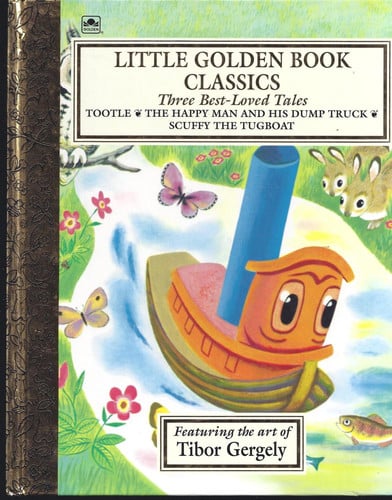
Three Best-Loved Tales Tootle; The Happy Man and His Dump Truck; Scuffy the Tugboat

Gergely, Tibor
Tootle, the baby locomotive, goes to the village of Lower Trainswitch to learn how to become a working locomotive. A man with a dump truck takes all of his friends for a ride and lets them use his dumper for a slide. Tuffy sails down a stream, into the river, and finally into the ocean, where he is rescued by the man with polka-dot tie.
Random House Children's Books 1992-07 80 pages

The Happy Egg

Ruth Krauss
Perfect as a baby shower or Easter basket gift, The Happy Egg celebrates the promise and confidence of little birds (and young children) everywhere. A simple and delightful story for parents and children to enjoy together, now with a refreshed cover design. From the husband-and-wife team who created the timeless classic The Carrot Seed. The Happy Egg is just right for the youngest of readers, and the storyline lends itself to interactive reading—parents can encourage their children to walk, sing, and fly as the little bird does.
HarperCollins 2016-01-05 40 pages

The Same Phrase Describes My Marriage and My Breasts: Before the Kids, They Used to Be Such a Cute Couple : Notes While They Nap

Amy Krouse Rosenthal
Humorist Amy Krouse Rosenthal's hilarious and nail-on-the-head writing has struck again. Her latest book, The Same Phrase Describes My Marriage and My Breasts, spotlights the lighter side of parenting with a sharp wit reminiscent of the late Erma Bombeck, but with a modern twist. Rosenthal reassures parents that the insanity that comes with raising a child is perfectly normal. It is a delightful book for any parent who has realized that stain-free baby clothes and perfectly behaved children only exist on commercials for Kodak and Downy. Rosenthal's endearing collection of humorous anecdotes and reflections is drawn from her illuminating first years as a mother of three. Being a pregnant working mom means occasionally having a urine specimen hidden in your briefcase for your mid-day checkup. No matter how anal you get, no matter how methodically you put away the toys, the Candyland cards end up in the Lego bin, and Lion King puzzle pieces turn up in your shoes. Daylight savings means that on one Sunday, when it's 7:30 A.M., you still have something like 80 more hours until they go to bed. Forget the instructions of Dr. Spock and open your heart to a woman who proudly survives life with three kids-granted not a single glass from her bridal registry remains intact-and relishes being a mom. At times touching, at other times hysterical, The Same Phrase Describes My Marriage and My Breasts is a must for parents who long ago realized that parenting is just like The Brady Bunch if you eliminate the neatly-wrapped solutions and toss in complete unpredictability and random vomiting.
Andrews Mcmeel Pub 1999-06-01

Beauties, Beasts and Enchantment Classic French Fairy Tales

Jack Zipes
BEAUTIES, BEASTS AND ENCHANTMENT CLASSIC FRENCH FAIRY TALES Edited and translated by Jack Zipes A wonderful new collection of 36 French fairy tales translated into English by renowned writer and authority on fairy tales, Jack Zipes. Cinderella, Beauty and the Beast, Sleepy Beauty, Puss In Boots, Bluebeard, and Little Red Riding Hood are some of the classic fairy tales in this amazing book. There are many stories here by Charles Perrault, the most famous author of French conte de fées. Features a new introduction by editor Jack Zipes. Includes a generous number of exquisite illustrations from fairy tale collections. This is a clothbound edition, with gold letters embossed on a blue cloth cover, and a colour flyleaf. 'Terrific... a succulent array of 17th and 18th century 'salon' fairy tales' - The New York Times Book Review 'These tales are adventurous, thrilling in a way fairy tales are meant to be... The translation from the French is modern, happily free of archaic and hyperbolic language... a fine and sophisticated collection' - New York Tribune 'Enjoyable to read... a unique collection of French regional folklore' - Library Journal 'Charming stories accompanied by attractive pen-and-ink drawings' - Chattanooga Times 'An excellent collection' - Booklist. JACK ZIPES is professor emeritus of German and comparative literature at the University of Minnesota. In addition to his scholarly work, he is an active storyteller in public schools and has worked with children's theaters in Europe and the United States. Some of Jack Zipes' major publications include Breaking the Magic Spell: Radical Theories of Folk and Fairy Tales (1979), Fairy Tales and the Art of Subversion (1983, rev. ed. 2006), Don't Bet On the Prince: Contemporary Feminist Fairy Tales in North America and England (1986), The Brothers Grimm: From Enchanted Forests to the Modern World (1988), Sticks and Stones: The Troublesome Success of Children's Literature from Slovenly Peter to Harry Potter (2000), Speaking Out: Storytelling and Creative Drama For Children (2004), Hans Christian Andersen: The Misunderstood Storyteller (2005), and Why Fairy Tales Stick: The Evolution and Relevance of a Genre (2006). Jack Zipes has also translated The Complete Fairy Tales of the Brothers Grimm (1987) and edited The Oxford Companion to Fairy Tales (2000), and The Great Fairy Tale Tradition (2001). Most recently he has translated and edited The Folk and Fairy Tales of Giuseppe Pitre (2008) and Lucky Hans and Other Merz Fairy Tales (2008) by Kurt Schwitters. Includes illustrations and a new introduction. ISBN 9781861717474. 612 pages. www.crmoon.com
Crescent Moon Publishing 2018-11-12 612 pages

For the Temple; a Tale of the Fall of Jerusalem, By G.A. Henty ( Illustrated ) By Solomon Joseph Solomon(16 September 1860 - 27 July 1927) was a British Painter.

G. A. Henty,Solomon J. Solomon
This tale follows the adventures of John of Gamala during the years of Roman occupation, political infighting, and lawlessness that resulted in the destruction of the Temple in AD 70. It puts the reader at the heart of the conflict between Rome and the greedy political groups and robber bands of Palestine. Although fighting a losing struggle, John keeps his integrity and honor intact, even overcoming slavery and eventually becoming a procurator after the struggle. Solomon Joseph Solomon RA (16 September 1860 - 27 July 1927) was a British painter, a founding member of the New English Art Club and member of the Royal Academy.Solomon's family was Jewish, and his sister, Lily Delissa Joseph (née Solomon), was also a painter.He made an important contribution to the development of camouflage in the First World War, working in particular on tree observation posts and arguing tirelessly for camouflage netting.... George Alfred Henty (8 December 1832 - 16 November 1902) was a prolific English novelist and war correspondent.He is best known for his historical adventure stories that were popular in the late 19th century. His works include The Dragon & The Raven (1886), For The Temple (1888), Under Drake's Flag (1883) and In Freedom's Cause (1885).G. A. Henty was born in Trumpington, near Cambridge. He was a sickly child who had to spend long periods in bed. During his frequent illnesses he became an avid reader and developed a wide range of interests which he carried into adulthood. He attended Westminster School, London, and later Gonville and Caius College, Cambridge, where he was a keen sportsman. He left the university early without completing his degree to volunteer for the Army Hospital Commissariat when the Crimean War began. He was sent to the Crimea and while there he witnessed the appalling conditions under which the British soldier had to fight. His letters home were filled with vivid descriptions of what he saw. His father was impressed by his letters and sent them to The Morning Advertiser newspaper which printed them. This initial writing success was a factor in Henty's later decision to accept the offer to become a special correspondent, the early name for journalists now better known as war correspondents.Shortly before resigning from the army as a captain in 1859 he married Elizabeth Finucane. The couple had four children. Elizabeth died in 1865 after a long illness and shortly after her death Henty began writing articles for the Standard newspaper. In 1866 the newspaper sent him as their special correspondent to report on the Austro-Italian War where he met Giuseppe Garibaldi. He went on to cover the 1868 British punitive expedition to Abyssinia, the Franco-Prussian War, the Ashanti War, the Carlist Rebellion in Spain and the Turco-Serbian War. ........
CreateSpace Independent Publishing Platform 2016-08-02 190 pages

Israel Zangwill - Merely Mary Ann 'It Takes Two Men to Make One Brother''

Israel Zangwill
Israel Zangwill was born in London on 21st January 1864, to a family of Jewish immigrants from the Russian Empire. Zangwill was initially educated in Plymouth and Bristol. At age 9 he was enrolled in the Jews' Free School in Spitalfields in east London. Zangwill excelled here. He began to teach part-time at the school and eventually full time. Whilst teaching he also studied with the University of London and by 1884 had earned his BA with triple honours in philosophy, history, and the sciences. His writing earned him the sobriquet "the Dickens of the Ghetto" primarily based on his much lauded novel 'Children of the Ghetto: A Study of a Peculiar People' in 1892 and its glimpse of the poverty-stricken life in London's Jewish quarter. As a writer he was keen to reflect on his political and social outlooks. His simulation of Yiddish sentence structure in English aroused great interest. His mystery work, 'The Big Bow Mystery' (1892) was the first locked room mystery novel. Zangwill was also involved with narrowly focused Jewish issues as an assimilationist, an early Zionist, and later a territorialist. In the early 1890s he had joined the Lovers of Zion movement in England. In 1897 he joined Theodor Herzl (considered the father of modern political Zionism) in founding the World Zionist Organization. Zangwill quit the established philosophy of Zionism when his plan for a homeland in Uganda was rejected and founded his own organisation; the Jewish Territorialist Organization. Its stated goal was to create a Jewish homeland in whatever territory in the world could be found for them. Amongst the challenges in his life he found time to write poetry. He had translated a medieval Jewish poet in 1903 and his volume 'Blind Children' in 1908 shows his promise in this new endeavour. 'The Melting Pot' in 1909 made Zangwill's name as an admired playwright. When the play opened in Washington D.C., former President Theodore Roosevelt leaned over the edge of his box and shouted, "That's a great play, Mr. Zangwill, that's a great play." Israel Zangwill died on 1st August 1926 in Midhurst, West Sussex.
Copyright Group Limited 2018-11-07 70 pages

Citizens and soldiers

Döblin, Alfred
Towards the end of 1937, having just completed his South American Amazonas trilogy (The Land without Death), Doblin embarked on a new project much closer to home. As a military doctor in Alsace he had experienced firsthand the chaotic scenes in Haguenau and Strasbourg that followed the Kaiser's abdication and the Armistice. His skill at depicting historical events in vivid epic prose would now be applied to seminal events still within living memory, and still highly controversial. He and his family (now with three small children) left Alsace on 14 November 1918 with the hospital staff and patients, reaching Berlin several days later. In March 1919 he witnessed the savage repression of the uprising in Lichtenberg, the eastern Berlin district where he had settled; his sister Meta was killed by grenade shrapnel as she fetched milk for her children. His essay On Cannibalism reveals his anger at both the ineptitude of the insurgents and the callousness of the Social Democrat Minister of War, Noske. Citizens and Soldiers, the self-contained first volume of November 1918: A German Revolution, presents a vivid panorama of fictional and real individuals, scenes and events over a chaotic two weeks. It was published in Amsterdam and Stockholm in October 1939, shortly after Britain and France declared war on Germany. Unsurprisingly it had little chance to circulate. During his exile years in California (1940-45), Doblin completed the remaining parts of what became the longest of his nine epic novels. When in 1947 the question arose of publishing the entire work in Germany, the French Occupation Authority (in which Doblin was serving as Public Education Officer) vetoed Citizens & Soldiers because of sensitivities about the status of Alsace-Lorraine, main location of the novel's action. (This border region had been French territory since the 17th century; was annexed by Germany in 1871 after the Franco-Prussian War, and reverted to France at the end of the First World War. Apart from the war years 1940-45 it has since remained French.) November 1918 A German Revolution therefore appeared as three volumes successively in autumn 1948, spring 1949 and spring 1950. This truncated edition was the basis for an incomplete English translation in the 1980s. In Germany, a complete edition appeared only in 1978, two decades after Doblin's death, enabling for the first time a proper evaluation of what is now seen as one of Doblin's most impressive achievements. It is high time that English readers too should have access to the missing first volume: Citizens & Soldiers.
Galileo 2024-09-19 288 pages