
121 results for "Children"

My friend Anne Frank: the inspiring and heartbreaking true story of best friends torn apart and reunited against all odds

Pick-Goslar, Hannah,Kraft, Dina
"In 1933, Hannah Pick-Goslar and her family fled Nazi Germany to live in Amsterdam, where she struck up a close friendship with her next-door neighbor, an outspoken and fun-loving young girl named Anne Frank. For several years, the inseparable pair enjoyed a carefree childhood of games, sleepovers, and treats with the other children in their neighborhood of Rivierenbuurt. But in 1942, Hannah and Anne's lives abruptly changed forever. As the Nazi occupation of Amsterdam progressed, Anne and the Frank family seemingly vanished, leaving behind unmade beds and dishes in the sink--but no trace of Anne's precious diary. Torn from her dear friend without warning, Hannah spent the next two years tormented by questions about Anne's fate, wondering if she had, by some miracle, managed to escape danger. In this long-awaited memoir, Hannah shares the story of her childhood during the Holocaust, from the introduction of anti-Jewish laws in Amsterdam to the gradual disappearance of classmates and, eventually, the Frank family, to Hannah and her family's imprisonment in the Bergen-Belsen concentration camp. As Hannah chronicles the experiences of her own life during and after the war, she provides a searing look at what countless children endured at the hands of the Nazi regime, as well as an intimate, never-before-seen portrait of the most recognizable victim of the Holocaust. Culminating in an astonishing fateful reunion, My Friend Anne Frank is the profoundly moving story of childhood and friendship during one of the darkest periods in the world's history"--Dust jacket flap.
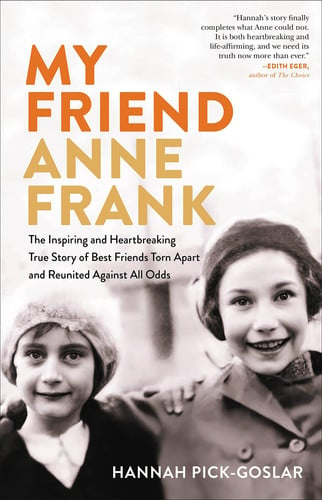
Little, Brown Spark 2023 313 pages

The diary of Dawid Sierakowiak: five notebooks from the Łódź ghetto

Sierakowiak, Dawid
"In the evening I had to prepare food and cook supper, which exhausted me totally. In politics there's absolutely nothing new. Again, out of impatience I feel myself beginning to fall into melancholy. There is really no way out of this for us." This is Dawid Sierakowiak's final diary entry. Soon after writing it, the young author died of tuberculosis, exhaustion, and starvation--the Holocaust syndrome known as "ghetto disease." After the liberation of the Lodz Ghetto, his notebooks were found stacked on a cookstove, ready to be burned for heat. Young Sierakowiak was one of more than 60,000 Jews who perished in that notorious urban slave camp, a man-made hell which was the longest surviving concentration of Jews in Nazi Europe.The diary comprises a remarkable legacy left to humanity by its teenage author. It is one of the most fastidiously detailed accounts ever rendered of modern life in human bondage. Off mountain climbing and studying in southern Poland during the summer of 1939, Dawid begins his diary with a heady enthusiasm to experience life, learn languages, and read great literature. He returns home under the quickly gathering clouds of war. Abruptly Lodz is occupied by the Nazis, and the Sierakowiak family is among the city's 200,000 Jews who are soon forced into a sealed ghetto, completely cut off from the outside world. With intimate, undefended prose, the diary's young author begins to describe the relentless horror of their predicament: his daily struggle to obtain food to survive; trying to make reason out of a world gone mad; coping with the plagues of death and deportation. Repeatedly he rallies himself against fear and pessimism, fighting the cold, disease, and exhaustion which finally consume him. Physical pain and emotional woe hold him constantly at the edge of endurance. Hunger tears Dawid's family apart, turning his father into a thief who steals bread from his wife and children.The wonder of the diary is that every bit of hardship yields wisdom from Dawid's remarkable intellect. Reading it, you become a prisoner with him in the ghetto, and with discomfiting intimacy you begin to experience the incredible process by which the vast majority of the Jews of Europe were annihilated in World War II. Significantly, the youth has no doubt about the consequence of deportation out of the ghetto: "Deportation into lard," he calls it. A committed communist and the unit leader of an underground organization, he crusades for more food for the ghetto's school children. But when invited to pledge his life to a suicide resistance squad, he writes that he cannot become a "professional revolutionary." He owes his strength and life to the care of his family.
Oxford University Press 1996-11-07 271 pages

The last million: Europe's displaced persons from World War to Cold War

Nasaw, David
"In May of 1945, German forces surrendered to the Allied powers, effectively putting an end to World War II in Europe. But the aftershocks of this global military conflict did not cease with the signing of truces and peace treaties. Millions of lost and homeless POWs, slave laborers, political prisoners, and concentration camp survivors overwhelmed Germany, a country in complete disarray. British and American soldiers gathered the malnourished and desperate foreigners, and attempted to repatriate them to Poland, Estonia, Latvia, Lithuania, Ukraine, and the USSR. But after exhaustive efforts, there remained over a million displaced persons who either refused to go home or, in the case of many, had no home to which to return. They would spend the next three to five years in displaced persons camps, divided by nationalities, temporary homelands in exile, with their own police forces, churches, schools, newspapers, and medical facilities. The international community couldn't agree on the fate of the Last Million, and after a year of fruitless debate and inaction, an International Refugee Organization was created to resettle them in lands suffering from labor shortages. But no nations were willing to accept the 200,000 to 250,000 Jewish men, women, and children who remained trapped in Germany. In 1948, the United States, among the last countries to accept anyone for resettlement, finally passed a Displaced Persons Bill - but as Cold War fears supplanted memories of WWII atrocities, the bill only granted visas to those who were reliably anti-communist, including thousands of former Nazi collaborators, Waffen-SS members, and war criminals, while barring the Jews who were suspected of being Communist sympathizers or agents because they had been recent residents of Soviet-dominated Poland. Only after the passage of the controversial UN resolution for the partition of Palestine and Israel's declaration of independence were the remaining Jewish survivors finally able to leave their displaced persons camps in Germany."--
Penguin Press 2020-09-15 654 pages

The last million: Europe's displaced persons from World War to Cold War

Nasaw, David
"In May of 1945, German forces surrendered to the Allied powers, effectively putting an end to World War II in Europe. But the aftershocks of this global military conflict did not cease with the signing of truces and peace treaties. Millions of lost and homeless POWs, slave laborers, political prisoners, and concentration camp survivors overwhelmed Germany, a country in complete disarray. British and American soldiers gathered the malnourished and desperate foreigners, and attempted to repatriate them to Poland, Estonia, Latvia, Lithuania, Ukraine, and the USSR. But after exhaustive efforts, there remained over a million displaced persons who either refused to go home or, in the case of many, had no home to which to return. They would spend the next three to five years in displaced persons camps, divided by nationalities, temporary homelands in exile, with their own police forces, churches, schools, newspapers, and medical facilities. The international community couldn't agree on the fate of the Last Million, and after a year of fruitless debate and inaction, an International Refugee Organization was created to resettle them in lands suffering from labor shortages. But no nations were willing to accept the 200,000 to 250,000 Jewish men, women, and children who remained trapped in Germany. In 1948, the United States, among the last countries to accept anyone for resettlement, finally passed a Displaced Persons Bill - but as Cold War fears supplanted memories of WWII atrocities, the bill only granted visas to those who were reliably anti-communist, including thousands of former Nazi collaborators, Waffen-SS members, and war criminals, while barring the Jews who were suspected of being Communist sympathizers or agents because they had been recent residents of Soviet-dominated Poland. Only after the passage of the controversial UN resolution for the partition of Palestine and Israel's declaration of independence were the remaining Jewish survivors finally able to leave their displaced persons camps in Germany."--
Penguin Press 2020 654 pages

Abraham's children: race, identity, and the DNA of the chosen people

Entine, Jon
Could our sense of who we are really turn on a sliver of DNA? In our multiethnic world, questions of individual identity are becoming increasingly unclear. Now in ABRAHAM'S CHILDREN bestselling author Jon Entine vividly brings to life the profound human implications of the Age of Genetics while illuminating one of today's most controversial topics: the connection between genetics and who we are, and specifically the question "Who is a Jew?" Entine weaves a fascinating narrative, using breakthroughs in genetic genealogy to reconstruct the Jewish biblical tradition of the chosen people and the hereditary Israelite priestly caste of Cohanim. Synagogues in the mountains of India and China and Catholic churches with a Jewish identity in New Mexico and Colorado provide different patterns of connection within the tangled history of the Jewish diaspora. Legendary accounts of the Hebrew lineage of Ethiopian tribesmen, the building of Africa's Great Zimbabwe fortress, and even the so-called Lost Tribes are reexamined in light of advanced DNA technology. Entine also reveals the shared ancestry of Israelites and Christians. As people from across the world discover their Israelite roots, their riveting stories unveil exciting new approaches to defining one's identity. Not least, Entine addresses possible connections between DNA and Jewish intelligence and the controversial notion that Jews are a "race apart." ABRAHAM'S CHILDREN is a compelling reinterpretation of biblical history and a challenging and exciting illustration of the promise and power of genetic research.
Grand Central Pub 2007-10-24 420 pages

My name is Anne, she said, Anne Frank

Maarsen, Jacqueline van
A touching and intimate autobiography, this account recalls the author's remarkable childhood friendship with Anne Frank while attending a special school for Jewish children in Amsterdam during the late 1930s. With the story of her initial meeting and bonding with Anne Frank, Jacqueline van Maarsen's memoir recollects her family's near escape from the Netherlands only months after the Frank family went into hiding-or moved to Switzerland, as van Maarsen was lead to believe-and provides a revealing look into life under Nazi occupation. Written by a one-time friend who only discovered the truth about Anne's fate after the war ended, this memoir is a moving, firsthand recollection of a youthful friendship in the foreboding days of World War II.
Arcadia 2008-03-28 176 pages

Dearest children,--

Shain, Ruchoma
From the time she made aliyah, Ruchoma Shain, author of the best-selling "All for the Boss" , kept up a lively correspondence with her children in America. In these beautiful letters, filled with her hallmark warmth, sincerity, and irrepressible humor, she vividly describes her experiences in getting adjusted to life in Israel and in celebrating the festivals Eretz Yisrael-style. She shares with her children her excitement over starting a new career as an author at the age of 68, and poignantly mourns her beloved husband's passing. Inspiring, touching, informative, hilarious Mrs. Shain's letters and anectdotes are all these things and more.
Feldheim Publishers 1992 293 pages

Turbulent souls: a Catholic son's return to his Jewish family

Dubner, Stephen J.
Two years ago, Stephen J. Dubner wrote a cover story for the New York Times Magazine called "Choosing My Religion." It became one of the most widely discussed articles in the magazine's history. Turbulent Souls, the book that grew out of that article, is an intimate memoir of a man in search of a Jewish heritage he never knew he had. It is also a loving portrait of his parents. Stephen Dubner's family was as Catholic as they come. His devout parents attended mass at every opportunity and named their eight children after saints. Stephen, the youngest child, became an altar boy, studied the catechism, and learned the traditional rituals of the Church -- never suspecting that the religion he embraced was not his by blood. Turbulent Souls is Dubner's personal account of his family; tumultuous journey from Judaism to Catholicism -- and in his own case, back to Judaism -- and the effects, some tragic, some comic, of those spiritual transformations. His parents were Jews, born in Brooklyn to immigrant parents, but -- independent of each other and, indeed, before they met -- each converted to Christianity, only to be shunned by their families. After their marriage, they closed the door on Judaism so firmly that their children had no inkling that their background was far different from what it seemed: They didn't know, for instance, that their mother had a first cousin named Ethel Rosenberg, who was executed for treason in one of the most controversial cases of the cold war era. Stephen Dubner's is a story about discovery: of relatives he never knew existed, of family history he'd never learned, and of a faith he'd never thought of as his own and, in fact, knew nothing about. It's a fascinating, thoughtful, and thought-provoking exploration of a subject of intense interest to spiritually minded men and women everywhere.
W. Morrow 1998-10-17 320 pages

Lost in America: a journey with my father

Nuland, Sherwin B.
A writer renowned for his insight into the mysteries of the body now gives us a lambent and profoundly moving book about the mysteries of family. At its center lies Sherwin Nuland’s Rembrandtesque portrait of his father, Meyer Nudelman, a Jewish garment worker who came to America in the early years of the last century but remained an eternal outsider. Awkward in speech and movement, broken by the premature deaths of a wife and child, Meyer ruled his youngest son with a regime of rage, dependency, and helpless love that outlasted his death. In evoking their relationship, Nuland also summons up the warmth and claustrophobia of a vanished immigrant New York, a world that impelled its children toward success yet made them feel like traitors for leaving it behind. Full of feeling and unwavering observation, Lost in America deserves a place alongside such classics as Patrimony and Call It Sleep .
Knopf 2003 209 pages

The forgotten

Wiesel, Elie
Distinguished psychotherapist and survivor Elhanan Rosenbaum is losing his memory to an incurable disease. Never having spoken of the war years before, he resolves to tell his son about his past—the heroic parts as well as the parts that fill him with shame—before it is too late. Elhanan's story compels his son to go to the Romanian village where the crime that continues to haunt his father was committed. There he encounters the improbable wisdom of a gravedigger who leads him to the grave of his grandfather and to the truths that bind one generation to another.
Schocken Books 1995-01-31 316 pages

The Jews of silence

Wiesel, Elie
In the fall of 1965 the Israeli newspaper Haaretz sent a young journalist named Elie Wiesel to the Soviet Union to report on the lives of Jews trapped behind the Iron Curtain. “I would approach Jews who had never been placed in the Soviet show window by Soviet authorities,” wrote Wiesel. “They alone, in their anonymity, could describe the conditions under which they live; they alone could tell whether the reports I had heard were true or false—and whether their children and their grandchildren, despite everything, still wish to remain Jews. From them I would learn what we must do to help . . . or if they want our help at all.” What he discovered astonished him: Jewish men and women, young and old, in Moscow, Kiev, Leningrad, Vilna, Minsk, and Tbilisi, completely cut off from the outside world, overcoming their fear of the ever-present KGB to ask Wiesel about the lives of Jews in America, in Western Europe, and, most of all, in Israel. They have scant knowledge of Jewish history or current events; they celebrate Jewish holidays at considerable risk and with only the vaguest ideas of what these days commemorate. “Most of them come [to synagogue] not to pray,” Wiesel writes, “but out of a desire to identify with the Jewish people—about whom they know next to nothing.” Wiesel promises to bring the stories of these people to the outside world. And in the home of one dissident, he is given a gift—a Russian-language translation of Night, published illegally by the underground. “‘My God,’ I thought, ‘this man risked arrest and prison just to make my writing available to people here!’ I embraced him with tears in my eyes.”
Vallentine, Mitchell 1973 141 pages

Free as a Jew: a personal memoir of national self-liberation

Wisse, Ruth R.
"First came parents with the good sense to flee Europe in 1940 and the good fortune to reach the land of freedom. Their daughter, Ruth, grew up in the shadow of genocide--but in tandem with the birth of Israel, which remained her lodestar. She learned that although Jewishness is biologically transmitted, democracy is not, and both require intensive, intelligent transmission through education in each and every generation. They need adults with the confidence to teach their importance. Ruth tried to take on that challenge as dangers to freedom mounted and shifted sides on the political spectrum. At the high point of her teaching at Harvard University, she witnessed the unraveling of standards of honesty and truth until the academy she left was no longer the one she had entered."--Book flap.
Wicked Son 2021-09-21 359 pages

Inheriting Anne Frank

Maarsen, Jacqueline van
Jacqueline van Maarsen's first book My Name is Anne, She Said, Anne Frank ends in 1947, two years after the death of her close friend Anne Frank. But Anne's death did not spell the end of the friendship. Otto Frank clung desperately to his deceased daughter's dearest friend. Having remained silent about her friendship with Anne Frank for decades after the war, Jacqueline van Maarsen finally decided to tell her story, hoping to expose half-truths and fabrications surrounding her former friend and to respect Anne Frank's legacy for what it is. While her books have been written in close cooperation with the Anne Frank Foundation, there are times when she has felt obliged to disagree with the Foundation and she has not shied away from confrontation. In her second book, van Maarsen returns in detail to the most dominant person in her life, her French mother who died in 1992 at the age of 101. The aftermath of an inheritance question in France in which the author had an important role to play, takes on tragic proportions, although the hilarity of the sometimes grotesque situation surfaces now and then. Inheriting Anne Frank is the continuation of Jacqueline van Maarsen's My Name is Anne, She Said, Anne Frank, and is an important documentary contribution to our knowledge of Anne Frank and what happened to and on account of her renowned diary. It is also a stirring portrait of a woman's turbulent life in the twentieth century
Arcadia Books 2009 158 pages

Shanda: a memoir of shame and secrecy

Pogrebin, Letty Cottin
"In her deeply engaging, astonishingly candid memoir, author and activist Letty Cottin Pogrebin exposes the fiercely-guarded lies and intricate cover-ups woven by dozens of members of her extended family. Beginning with her own long-suppressed secret, the story spirals through the hidden lives of her parents and relatives--revealing the truth about their origins, personal traumas, marital misery, abandoned children, religious transgressions, sexual identity, radical politics, and supposedly embarrassing illnesses. While unmasking their charades and disguises, Pogrebin also showcases her family's remarkable talent for reinvention in a narrative that is, by turns, touching, searing, and surprisingly universal." --
Post Hill Press 2022 429 pages